
September 5, 2024 · Updated August 22, 2026
By Alexander Grabovetskiy — Master Woodcarver · Founder, School of Wood Carving · 19 min read
How many coats of lacquer should I apply for a durable finish on carving?
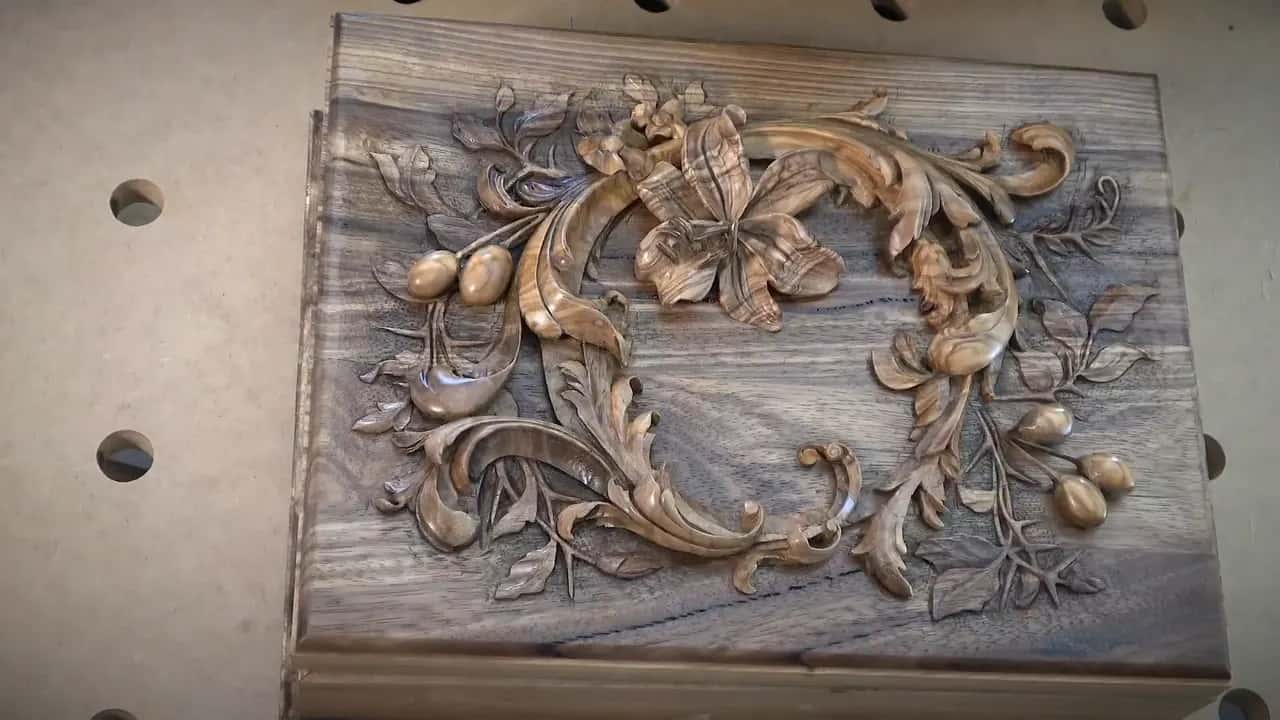
The count of coats of lacquer I sprayed on one carved box was four or five, thin, at a low sheen. That box was acacia and olive wood, and it had to sit in somebody's house and get picked up every week. Sheen did more for it than any extra coat.
You spray a coat, you hold the piece to the light, and the wood still reads dry. So you spray another. Then a third, then a fourth. Nobody tells you where the count is supposed to end.
The trap I can name from the bench is the grain: a first coat lifts it, and in a complicated area you can barely reach it afterwards. Chasing a count without a plan for the surface underneath is what costs you.

The can I reached for, held over the lid it went on.
Here is exactly what I did, part by part. Four coats, maybe five. A small aerosol can rather than my five-stage HVLP. Sheen at 10 to 15 percent instead of 25. Then a 4000 grit sponge, to put brightness back where I wanted it.
Below you get the count, then every qualification that belongs with it, then the one question where I have no number to hand you.
- Four thin sprayed coats, five if the surface still moves. One box, one wood, one sheen.
- The sheen number did more work than the count.
- A 4000 grit Mirka pad puts brightness back into chosen spots, which is the look of wax without any wax.
- On anything you eat from, leave the lacquer in the cupboard and open a bottle of oil.
- Grinling Gibbons finished nothing at all, so the honest range starts at zero.
How many coats did I put on that olive wood box?
Four, maybe five, and I said it while the box was in front of me. I used multiple coats, about probably four or five coats on this project. That claim belongs to one box and no other.
That piece was a lily box in olive wood and acacia, and the finishing lesson closes the olive wood lily box course. No glass case was waiting for it. Somebody would keep it out on a table, open the lid, and set a wet glass down beside it.
My material was a pre-catalyzed clear lacquer from Mohawk in a small aerosol can. I believe this can cost about maybe about $7 or $8. One can per project, usually.

Three cans, and the sheen number is printed on every label. Two got used, one stayed shut.
Which brings me to the part most finishing pages skip. That count came off one piece, in one species, at one sheen. I do not hand students a fixed number, because the piece and the room decide. A panel above a fireplace wants nothing like a box on a coffee table.
Why spray the clear coat rather than brush it on?
A small can lays down less material with more control, and it throws no cloud over the detail. I do have a HVLP system, five-stage, but I rarely pull it for small projects.
I really do not need to create all that mess. The little can is almost like using a spray gun and you can control volume, how much you are using. Because it is small I am not creating the cloud, and there is no over-spray.
One warning about where the can comes from. I tried to buy even lacquer in the Home Depot in United States, lacquer products, and it does not give me the same result whatsoever. First of all, the spray is not as nice. It is not really spraying, it is more like spitting, not spraying.

A loaded brush, and look what is on it. Stain, going onto bare wood. My clear coat came out of a can.
Want the chemistry instead of my bench habits? The page on nitrocellulose lacquer explains what evaporates out of an aerosol, the survey of wood finishing sets film finishes beside the oils, and I wrote up how a lacquer finish behaves on carved wood separately.
Does the sheen matter more than the coat count?
On that box the sheen number did more for the carving than any extra pass could. I really like to use a dead flat a lot of times, and I really love to use a 10 to 15 percent sheen. It gives me a really good result.
What happens when you are using different sheens, and I did not use a 25 percent, it would be a little too shiny. Shiny reads cheap on carved detail.

No top coat on it yet, and dead flat is what that looks like. No light comes back.
Then comes the trick that makes a flat film worth using. Later on, I would take a 4000 grit paper, or in this case, it is just a sponge, and I really like this Mirka brand. And I would just buff a little bit the areas which I want to make it a little more shinier. So initially, I am creating exactly the same effect I would get from wax or waxing.

That red disc, held over the lid it already worked. Olives carry a soft shine, and the dark walnut around them stays flat.
Read that slowly, because carvers get it backwards. The pad buffs a cured flat film in chosen places. Sanding between coats is a different operation, and this is simply not it.

The far end of the scale. Oil on a panel, still wet, every carved edge holding a bright line.
Why lacquer instead of shellac on a box people handle?
Two reasons, and neither one has anything to do with durability. You could use shellac. I'm okay with shellac, but I really did not want to make it shiny.
In this case, why I do not want to use shellac, because it is just almost too shiny. And also, if you spill some kind of spirit on it or wine, it will destroy the finish. Near a dinner table, that ends the argument.
Wax lost for a different reason entirely. The reason why I did not use wax, any type of wax, because the box lives in a house, and it does not matter how much you paid for the wax. Wax is wax. It's melting inside of the house.

My palm flat on the wood while the cloth comes in. A hand reads a surface better than an eye.
One carving still gets wax from me, and it has to be the liquid kind. Over in the Grinling Gibbons class in Maine I said you also could finish it, you could apply some lacquer or shellac or maybe even waxing, but it has to be liquid wax.
What have I actually said about each finish?
Six materials, six positions, and only two ever got a coat count out of me. The table carries what I said and where I said it.
| Finish | What I say about it | Where I used it |
|---|---|---|
| Spray lacquer | Four thin coats, five if it wants one, and keep the sheen low | The olive wood lily box |
| Shellac | Almost too shiny for me, and spilled wine or spirit destroys it | Named as an option, thinned, to bind loose fibers |
| Wax | Wax is wax, and it melts indoors | Liquid wax only, on a deep piece |
| Food-grade mineral oil | Three or four coats, fed in until the wood stops drinking | The carved bird panel from the beginner course |
| Boiled linseed oil | What the old builders used, and their wood still looks fresh | Named, never filmed |
| Nothing whatsoever | Gibbons left the wood white and that work survived | Never my choice on a box |
Two rows carry a number, four carry an opinion. A wider map of the same ground sits at wood carving finishes and sealants, plus a second pass at how to seal wood after carving.
What goes on a carving you will eat from?
Mineral oil, food grade, and no lacquer anywhere near it. On the carved board in the beginner course we apply butcher block finish, which is actually just mineral oil.
Just a pure mineral oil, food grade, so it is absolutely food safe. And probably about three, four coats and penetrate that deep, and that will be enough. I spent about $8, but it lasts me forever.

Cutting board oil. The label says food grade mineral oil, nothing more exciting.
I never save on oil. I know it will not penetrate and I have to feed it about three, four times until you really see nice sheen on it. Then I leave it for about a week until it dries before I can use it.

Straight from the bottle onto the carving. One wing went dark already.
Food safe covers wax as well, and wax fails elsewhere. Wax is safe, but it's not water-resistant, so if you apply wax you won't be able to put that board under water.

Pressing oil into the deep hollows. The bottom of a cut drinks more than the top.
Like I said, if you apply three, four coats of this, so you can easily wipe it with the water and you will have no problem.

A later pass. The panel is wet through and the pad is working one corner.
The board in those frames is really a carved bird panel from the Bird of Paradise beginner course. Why oil behaves that way inside a cut gets answered in should I oil wood before carving.

Holding the oiled panel up against the tool wall. Turning it in the light tells you when it has had enough.
Do more coats make a carving last longer?
Nobody has ever handed me a measurement for that, and I refuse to invent one. The label talks big. They are claiming this can last, the finish itself, all the way, 10, 15, and some people say it is all the way to 50 years.
I'm not sure, but it's what they're claiming. Printed on a can, that stays marketing until somebody measures it. Trust the Getty Conservation Institute and the American Institute for Conservation ahead of any label.
Here is a number I do trust, off a building. What they did, all the window jams and the sash and all the doors, they used just wood, and they applied boiled linseed oil, and wood looks really really fresh even today. Three hundred years later, nothing rotten and no wormholes. So that is how you preserve your work.

A big acanthus panel, and nothing at all on it yet. Half these cuts are invisible until something wet touches the wood.
And then there is Grinling Gibbons, the carver most of us measure ourselves against. Speaking about him in the Roman acanthus course, I put it plainly. He never stained his work, he never even waxed his work, and he left all the wood just stay natural, white, with no finish whatsoever on it. Some of it has held up in English houses for three centuries.
David Esterly, who restored Gibbons work and wrote The Lost Carving, points at the other end of this argument.
But there was that flood of Victorian varnish that still stains our sensibilities about the color of woodwork.

Same story on the bird panel. Pale and even, two dark knots by the tail, and zero coats on any of it.
Longevity is a question about the wood, not the film on top. It leans on how rot resistant your species is and on how far it moves as it dries, both ahead of the coat count. The long answer on how long carvings last goes further.
Can a thick film swallow the carved detail?
Paint is the only place I can prove that, so let me be straight with you. The film thickness argument gets repeated everywhere as a lacquer problem.
I will not tell you that lacquer pools in a hollow and softens a shadow line. That claim needs a measurement, and I do not have one. What I have shown on camera is paint.
On the floral and molding panel I said it will be chalk paint, which means a lot of those facets, what you see, will be completely covered with the paint. Obviously, I do first primer, maybe even two times, and I use a really thick primer. Even primer covers majority of those facets.
So a thick coating does precisely what carvers fear a thick coating does. Four thin sprayed passes are a different animal altogether.

First stroke on the bead border. The swatch board on the right is where that color got tested first.
For the clear-coat version, ask people whose job is film thickness. The Forest Service wood handbook is the free reference there, and its chapter on physical properties puts real numbers on wood and moisture.
How did I get four coats onto that box without losing the surface?
Six moves, in this order, and the sheen decision arrives before the spraying decision. This is the sequence that box got.
Step 1, get the bare wood right before any finish touches it
Whatever the finish does, it does to the surface you hand it. On bare wood I name grits. Talking about gilding I said I would not go lower than 120, and most of the case is gonna be no lower than 240 or 220 grit. In a different lesson, working under paint, I put the starting point at 180 and said you could go higher, 220, 320, 400.

Six or seven browns and grays tried out on a scrap board first. Color never gets settled on the carving.
Step 2, pick the sheen before you pick the count
Buy the dead flat can and the low flat one. Leave the shiny one on the shelf. This single choice changes how a piece reads across a room, and no number of passes will rescue a sheen you regret.
Step 3, mask the parts the spray must not reach
I'm going to use green tape. It's lacquer-safe, and also definitely doesn't look like it's lacquered. The blue tape I wouldn't use, even a 14-day release tape, even the mild one. That habit came off the dining table apron workshop.

Green tape along the inside edge of the tray, pressed hard where spray likes to creep under.
Step 4, lay on thin passes from a small can
Short passes, and keep the can moving. Follow the label for its recoat window, not me. I have never given a time between coats, and I am not going to start guessing.

A carved vase waiting. The jar and the brush hold stain, not the clear coat.
Step 5, buff the shine back into the spots you want bright
Now the 4000 grit sponge earns its keep. Buff the raised parts and leave the deep ground alone. Only where you want it brighter. Stop early rather than late, because a buffed high spot cannot be un-buffed.

Steadying the vase in one hand, wiping the neck with the other. Dust comes off before finish goes on.
Step 6, stop when the surface stops changing
On that box the count stopped at five, and I never split the difference. Watch the piece under a lamp, and when a pass changes nothing, stop. Better a real judgment than a fake number.

A folded napkin lifting color off. Raw umber comes out of the high spots well before any clear coat.
Should I sand a carving before the finish goes on?
On a complicated carving, mostly not, and raised grain is the reason. You know, what's the raising grain after you apply like a first coat of whatever the stain or shellac or anything the grain pops out?
Okay, and you have to sand it. In some cases it's okay. But when you have a really complicated area, it's almost impossible to take care of that raised grain. Your first coat creates a problem your tools cannot reach, which is the trap. I say the same thing on the modern acanthus course, and the grain itself is why.
Gilding is the exception. What you can do, what I like to do, I would, before I sand, I like to just get light coat of sanding sealer. I also use, if it's gonna be for the gold leaf, I'm using 4,000 grit Mirka, it's a final step, and it gives me beautiful, beautiful, shiny, shiny result.

Wood on wood, an offcut rubbed along the edge of a basswood leaf instead of paper.
Two more places to look if sanding is really your question. There is a long answer in how to prepare raw wood for carving, and the whole question set lives in the techniques and tips course.

A P240 mesh sheet on the bench and a disc on the grape onlay. Bare wood work, long before any coat.
What does the finish do to the tool marks?
It makes every cut visible, which turns finishing day into an exam. I know on the dark wood sometimes it's almost impossible to see. Especially if it's not finished.
I'm talking about you did not apply any type of finish like shellac or lacquer or wax. So it's hard to see, but once you apply the finish, you'll see every cut. And it makes huge difference how it will play.

One small tool lifting pale edges out of dark stain, along acanthus and lily petals.
There is a moment on the lily box where I point at a dark corner and say it out loud. Now there's no finish on it, that's why you really don't see too much difference. But once we apply finish on it, I'm talking about the final coat, it's going to be really noticeable. This is a really important spot. I need to make it like pop.

Halfway across the feathers. Dark on the left, bare wood on the right.
What happens to a carving with nothing on it at all?
Your own hands begin changing its color. Now, the body oils is not the biggest problem. Body oils, it's oxidation what happens with the wood when you're touching.
You can have absolutely clean hands. I clean my hands all the time. But when you're touching it, a reaction happens inside of the wood, and it becomes darker. Not damage. The piece keeps a record of every hand that picked it up.

The jar standing on its own swatch board, propped against a carving that is still pale.
Deep undercut work carries a second problem, and thinned shellac answers it. What you could do, you can dilute a shellac as much as possible by using spirit and penetrate multiple times. And that way, it will bind all those fibers on inside, and it will hold really long.
That was my only measure, so no ratio exists to write down. Worried about a thin piece? Read stabilizing thin wood carvings first, and treat any finish as the last step rather than the rescue.
Penetrating epoxy comes up for the same job in the Tray of Blessing class. But that will make it shiny, and it's gonna look plasticy unless you put on top like lacquer. So if you put the lacquer on top, like satin and so on, then it's gonna look like you would finish normally.
Is spray lacquer safe in a small shop?
Read two government pages before spraying indoors, then make your own call. Solvent thins lacquer, and solvent leaves the can with the spray.
The EPA keeps a page on what volatile organic compounds do to indoor air, and OSHA keeps one on wood dust, the other thing floating around a carving shop. The EPA also runs Safer Choice for comparing products.
Which finish should you actually use?
I am not going to tell you how to finish it, and I mean that kindly. Depends, where you're gonna place it, if it's gonna be a, let's say, on a mantle, and mantle itself is painted, so you're gonna paint that.
The plate with butterflies was a wall piece, and I said it out loud about the back. As far as the backside, well, of course, you can protect that. You can put the lacquer, you can apply the shellac, you can put wax on it. And I'm not doing that in all.
Ancient people used only two, well, it's what we know, only two different final coats. They would use a beeswax for the finishing, and also they used just the oil. Could be linseed oil, boiled linseed oil, and some other oils also. Two materials, and they were enough for every carver who left carved work behind.
Going outside? None of this page applies, and a separate page covers weatherproofing carved work. For an indoor wall piece, look at the carved vase with grape leaves, where my plan named a Danish or a tung oil first, then a shellac on top of it, then a high gloss finish.
All of this happens in one finishing lesson at the end of the lily box course. Come carve the box with me, or skip to the can and watch the count get used. Join School of Wood Carving.
Frequently asked questions
How many coats of lacquer are enough on a small carved box?
Four, plus a fifth if the surface still changes under a lamp. That was my count on the olive wood box, sprayed thin from an aerosol at a low sheen. A piece hung on a wall and never touched will happily take fewer.
Can I brush a clear coat onto a relief carving?
People do, and I have never once compared brushed against sprayed, so ranking them would be me guessing. My own box got sprayed, out of a can small enough to keep the material under tight control the whole way.
What sheen should I ask for at the counter?
Dead flat, or the can labelled flat 10-15 sheen. I passed on the flat 25 because it read too shiny for carved detail. Buy low and put brightness back afterwards with a 4000 grit pad, only in the few spots you want bright.
Is lacquer safe on a bowl or a board I eat from?
Put it away and reach for food-grade mineral oil, three or four coats, fed in until the wood stops drinking. Waxed wood counts as food safe as well, and it is not water resistant, so a waxed board stays out of the sink.
How long should a finished piece sit before I use it?
About a week for an oiled board, which is what the butcher block oil gets from me. For the sprayed box I never gave a cure time at all, so treat the label as the authority and allow longer than you expect.
Do I need any finish at all?
Gibbons left his carvings white and bare, and they survived three centuries. Bare wood does darken where hands touch it, from oxidation rather than dirt. If that record of handling suits the piece, then zero coats is a perfectly real answer.
Filed under
- Alternatives to lacquer for wood finishing
- Benefits of multiple lacquer coats
- Best practices for lacquer on carvings
- Best types of lacquer for carvings
- Can I use one coat of lacquer on carvings?
- Carving finish with different lacquer types
- Common mistakes with lacquer application
- Comparing lacquer and polyurethane for carvings
- How lacquer impacts wood carving durability
- How long to wait between lacquer coats
- How many layers of lacquer for wood carvings?
- How to apply lacquer on carved wood
- How to ensure durability in carved pieces
- Importance of multiple lacquer layers
- Lacquer application for intricate designs
- Maintenance for lacquered carvings
- Steps for applying lacquer on wood carvings
- Tips for achieving a glossy lacquer finish
- Types of wood and lacquer application
- Wood Carving finish
- Wood types and their lacquer needs