
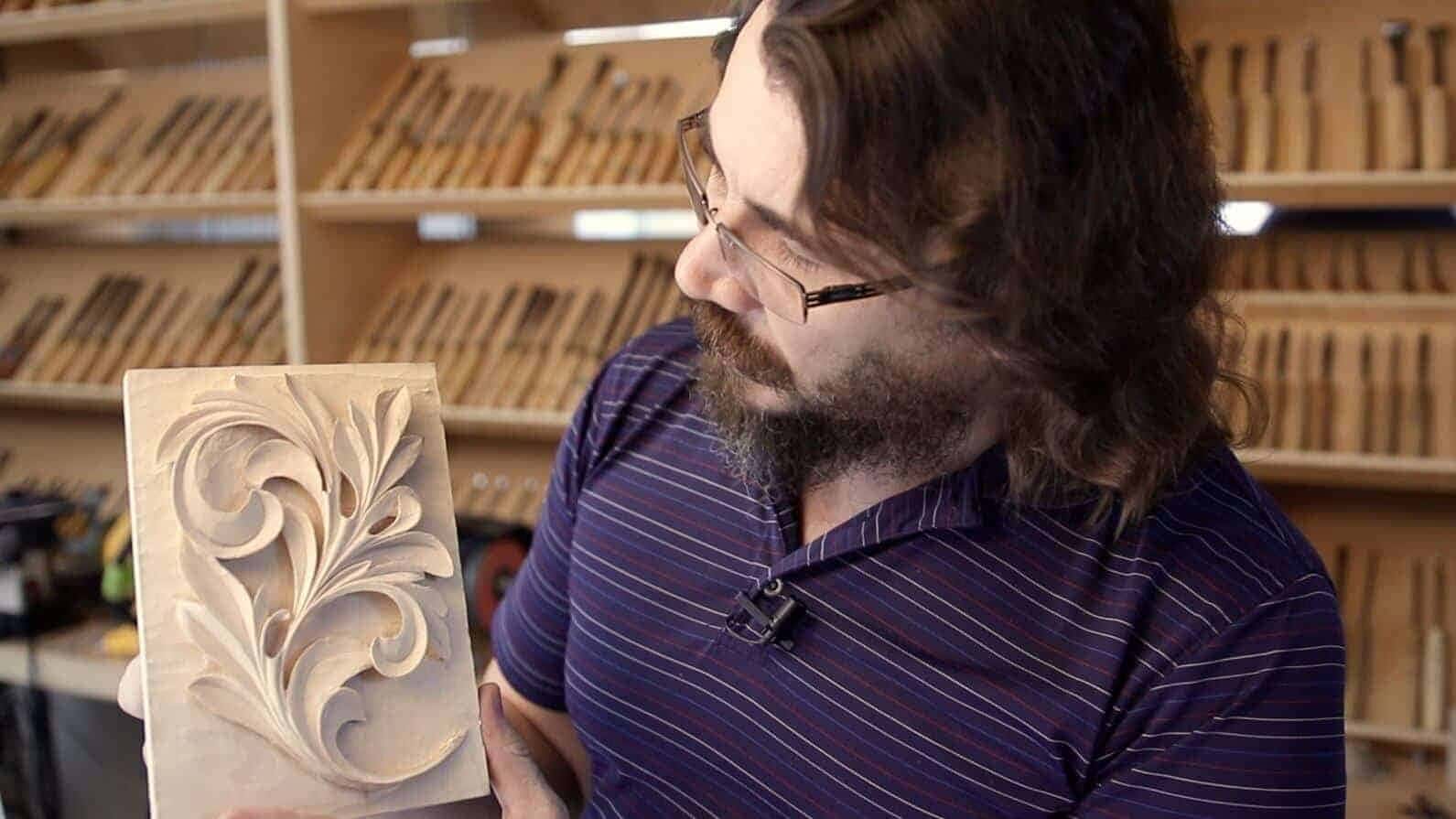
Looking for Wood carving mentorship online?
How to carve decorative borders with Ancient Greek Acanthus, taught online
How to carve decorative borders with Ancient Greek Acanthus is mostly drawing. You set the leaf out full size in pencil, cut around the edge, sink the background, then model the lobes from the highest one down. The Greek leaf sits shallow and it holds a stiff, formal shape, so the layout decides the carving long before the mallet does.
Many years of this leaf, and I still open the same way every time. A pencil and a board. The gouges wait.
A lot of you land here after typing Wood carving mentorship online into a search box. Reasonable. So before you judge anybody's course, here is the leaf and the order the cuts happen in.
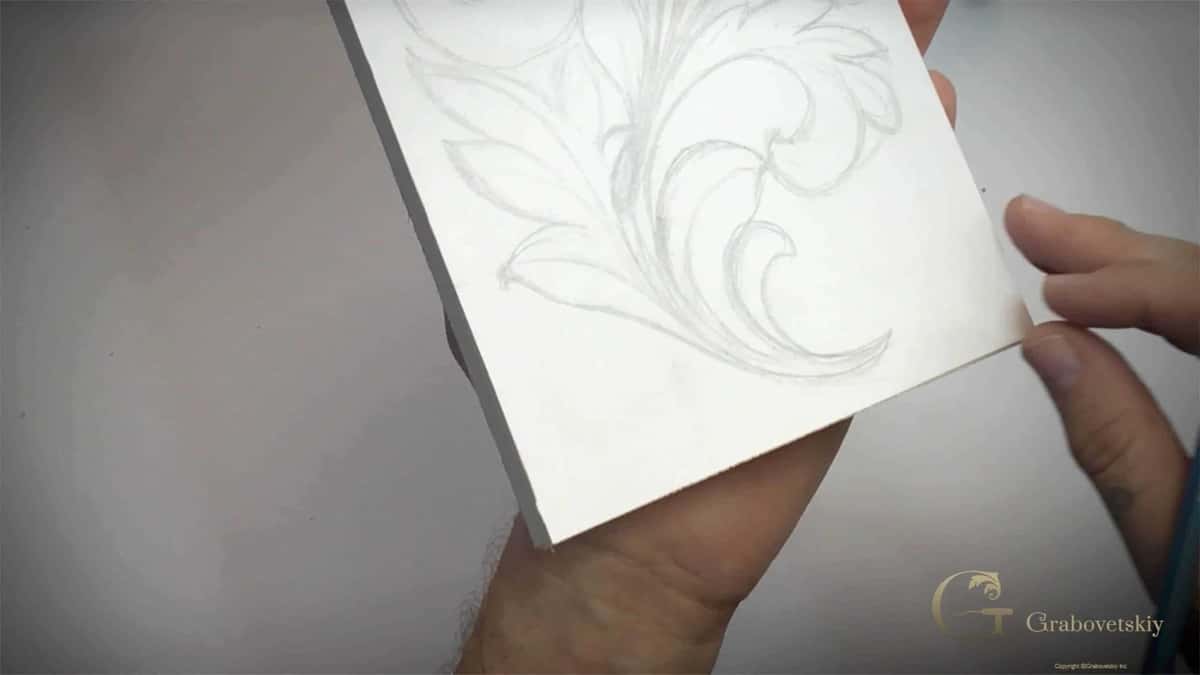
How to carve decorative borders with Ancient Greek Acanthus starts with a pencil
Full size, on the board. Not a taped sheet, and not a traced copy. Straight on the wood.
When you draw the leaf, your hand learns the curve ahead of the gouge. Trace it and nothing goes into your hand, so the first awkward lobe leaves you guessing.
First the rectangle. Then the line down the center. Then the arcs the leaf grows out of.

Why draw it full size when Wood carving mentorship online can hand you a pattern?
Take the pattern. It helps. Then draw the leaf yourself until you can do one from memory.
I was sixteen when I started my apprenticeship with a fine art master in Russia, and the thing he beat into me was not how to hold a chisel. Design is not a drawing. It is the law of space and rhythm and repeat, and knowing the limits of the steel in your hand. He taught me to think like a tool. Nothing else has ever been worth teaching first.
You get the shape from the pattern and the reasons from your own hand. Most people take one and leave the other. A printed sheet is usually the very first thing Wood carving mentorship online will hand you.
Is the Greek acanthus the same leaf as the Roman one?
Same family, different animal. Greek is tight and pointed. Roman is open, rolled over, and much deeper.
A student caught me at the end of a class at a woodworking school. He said he had never once thought about acanthus this way. For him, acanthus meant the thing he had seen a hundred times on Chippendale chairs, and that was the end of it.
The differences are small on paper and enormous under a gouge, so they get their own courses. Carving Greek Acanthus Leaf runs 16 lessons. Carving Roman Acanthus Leaf runs 17. There is a Corinthian one at 7 lessons, a Byzantine one, and one built from a design somebody drew in 1903.
Acanthus has a habit of turning up. I went down to St. Augustine in Florida, the oldest city in the country, and walked around the old fort, Castillo de San Marcos. Cannons. Cast iron, sitting outside for three hundred years. On a gun barrel, of all places.
A short answer to "How to carve decorative borders with Ancient Greek Acanthus"
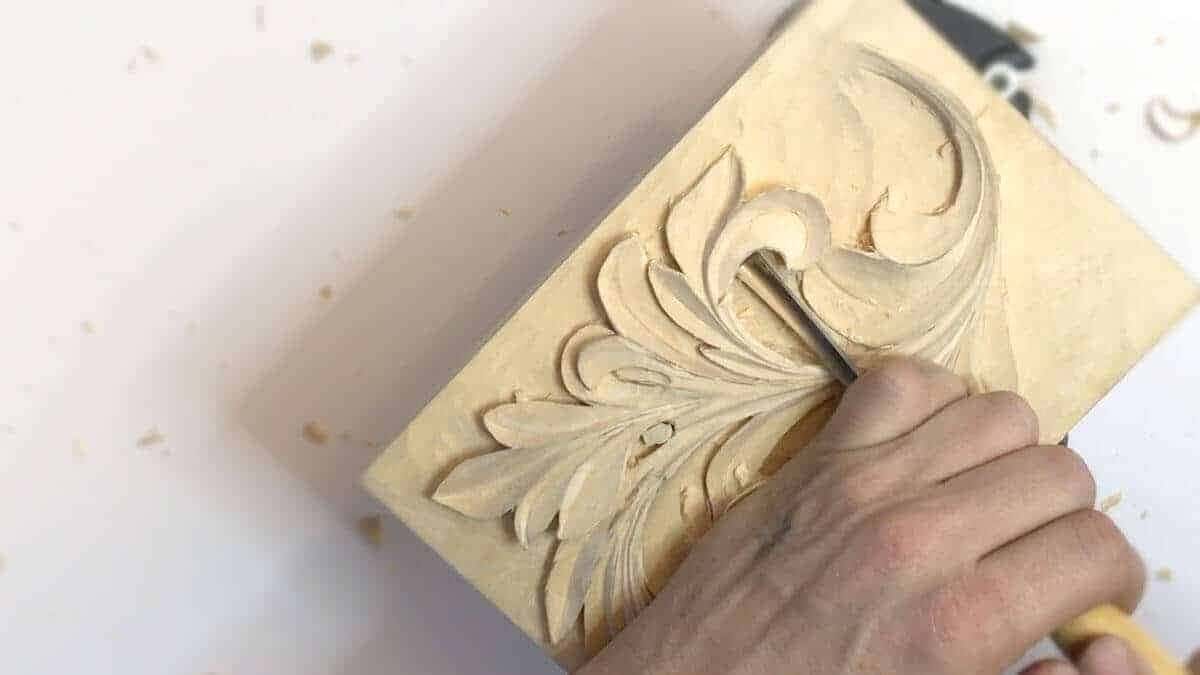
Six steps in all. Five are about depth, and the order is not optional.
- Draw the leaf full size, on the wood itself.
- Cut a stop line right on the outline with a V-tool. Do not cut the line away.
- Take the background down to one even depth. The entire background, level, before anything else.
- Rough the big masses. The high lobe sets the level for the rest.
- Model the pipes and the eyes. This is where the leaf stops looking like a pancake.
- Undercut the edges. Last. Do it early and you will break something.
Most of the failures happen at steps two and three. They shape before the ground is flat, and then the ground can never be flattened without eating the shape they just made.
The honest answer to "How to carve decorative borders with Ancient Greek Acanthus" is that list, repeated until your hand stops needing it.
How many gouges do you need before day one of Wood carving mentorship online?
Three, and one of them is a V-tool. A shallow gouge for the broad sweeps, something deeper for the pipes and the eyes, and the V-tool for your stop line. A mallet if your wrist is tired of arguing.
The sharp tool wins, whatever it cost. I have watched a man with one honed chisel outwork a room full of people holding four hundred dollar sets, and it was not close. Sharpening is the skill that takes years. That is unwelcome news, so I get it out of the way early, before you pay a cent to Wood carving mentorship online.
The wood deserves the budget. Basswood, lindenwood, limewood, whatever your part of the world calls it. A two by four from the hardware store kills tools and beginners. Real carving wood is pricey and I say so plainly. You have to be real.
If that sounds like your kind of trouble, shall we carve?
What the wood decides for you
Basswood forgives you. Oak does not. The acanthus is built out of long thin lobes running in every direction, so half of them will be cutting against the grain no matter how you set the board down.
The whole case for basswood sits in that one problem. The fibers are short and even, so a lobe that runs the wrong way still slices instead of tearing out. Do that in red oak and you get a splinter the size of your thumb.
Later, when your hand knows the leaf, move to walnut. Beautiful wood, and it punishes every lazy cut you make. By then you can afford the argument.
What should Wood carving mentorship online show you before you pay for it?
Ask for the boring footage. The drawing. Where a pencil meets the board and somebody says why.
Finished leaves look great and tell you nothing. Layout is where you find out whether somebody actually knows this. Put that test to Wood carving mentorship online, mine included.
Two more things worth checking. Does the course go all the way to the end, including the parts that go wrong? And can you see the tool in the cut, close, at the angle the carver sees it?
Ten minutes of anything you found under Wood carving mentorship online will tell you whether it can really answer "How to carve decorative borders with Ancient Greek Acanthus".
The School of Woodcarving is a 501(c)(3) non-profit. Tuition is $25 a month and it opens all 48 courses and 621 lessons, the whole library, not one corner of it. It renews automatically every month and you can stop it whenever you like. Some of what comes in goes to orphans and widows, and that is the part I care about.
Frequently asked questions
Can a beginner carve the Greek acanthus?
Yes, and it is a better first ornament than most. The leaf is shallow, the shapes are large, and there is very little undercutting. Start with a panel about 6 by 8 inches.
Do I need the pattern, or can I draw my own?
The course comes with the full size pattern as a download, so you have it either way. Use it for the first leaf. Draw the second one yourself.
What wood should I use for a Greek acanthus leaf?
American basswood, or lindenwood and limewood if that is what your country sells. Avoid construction pine, and leave oak alone until the leaf is familiar.
How long does one leaf take?
Two or three evenings is normal for a first leaf. The drawing is often the longest part of it.
Where is the school?
Online. You watch and carve at your own bench, at whatever hour suits you, so there is nothing to drive to. Alexander also teaches in person at woodworking schools through the year.
What is the short version of "How to carve decorative borders with Ancient Greek Acanthus"?
Draw it full size, cut a stop line on the outline, drop the background to one even depth, then shape the lobes tallest first and undercut them last.
Who teaches these lessons?
Alexander Grabovetskiy, a master carver and International Woodcarver of the Year, who has been carving for over forty years.