

Alexander Grabovetskiy, woodcarver, School of Woodcarving · Published 2023
What does a wood carver mean by "segment"?
Quick answer: In Venice Room workshop 1, part 11, I said "I did just the fast, whatever, the speedy segment, just because there's nothing to explain." I went on to say it was just roughing out. Other lessons of mine use the word for the video before, the video now, the video next, and how long one runs.
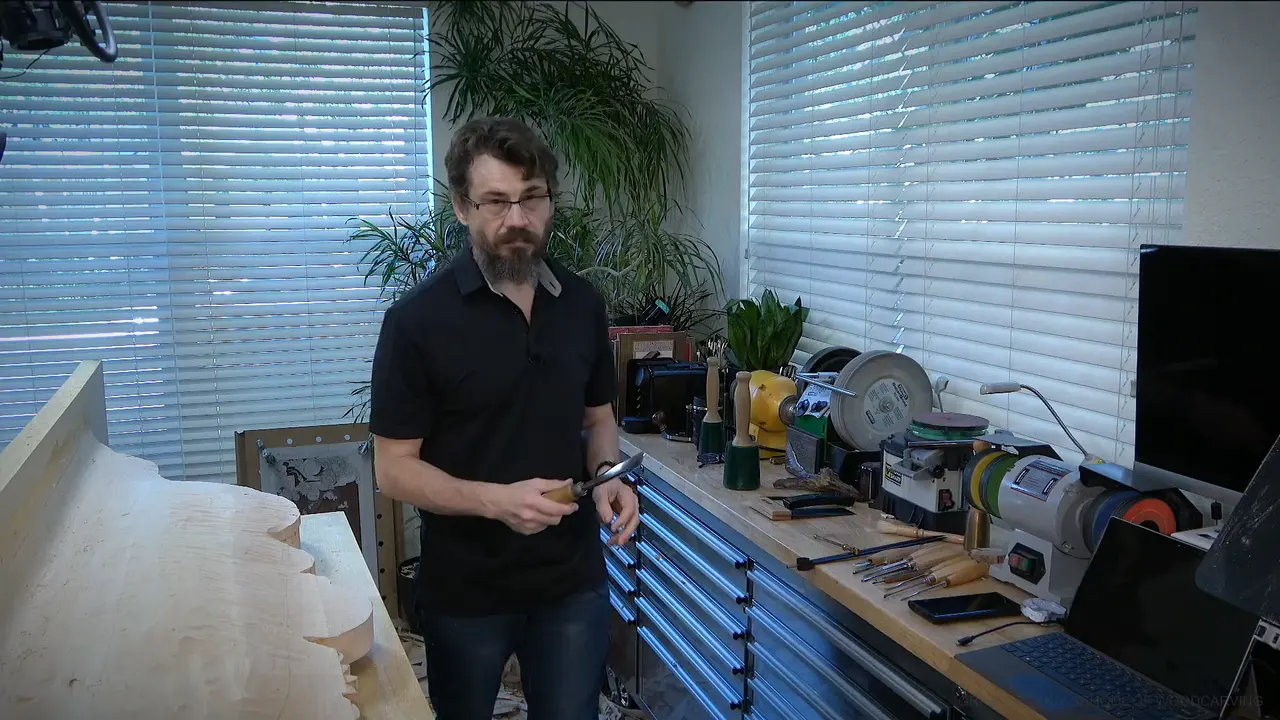

"I did just the fast, whatever, the speedy segment, just because there's nothing to explain." That is how I described the video before part 11 of Venice Room 1, and I went on to call it roughing out.
Other lessons of mine say segment too. Every lesson I name on this page is linked, so you can watch what I said in its own place.
Ever started a carving video and wondered what the one before it skipped? Ever lost your place in a long course? Ever wanted to know what a roughing out video leaves out? Read on.
What this page holds
- The speedy segment, the number seven gouge and my paper pattern, all from part 11.
- My call to watch the previous segments.
- Last segment, this segment and next segment, as I said them.
- The reason my segments stay short.
- One table of every video I quote, each beside my own words.
What did I say in the speedy segment?
The segment before it was the fast one. "It was just roughing out. But let me just go back and just tell you what I did," I said. The video itself opens on "Now, I am happy with the overall shape of what I've done" and then I am ready to work on details.
Mostly I used big, huge gouges, "which I used mostly this one, which is a 3 1/8 of an inch gouge, number seven." In metric that is about 79 mm. I called it "really a workhorse for me in this case" and I just roughed out.
A question came next. "Do I need to clean it? I don't, okay? Because right now it's just the overall shape, but we are ready to carve the details."
The video before it, part 10, has a plan. My plan was to shut up and continue to work, "establishing just the three-dimensional look of it," so "I really don't need to talk to you this stage." I planned to use just my headphones and work on the piece.
Which part of my paper did I keep, and why?
Only the middle. The first detail I wanted to start was "probably just right in the middle" and that is exactly what I planned to do.
My long paper had more on it than I needed, and "I can actually disconnect that because I really don't need that anymore on the same long paper. So all I need is just the middle part." Out it would come, with "Let me take it out."
Something else could wait. "I'm going to need it later, but not today, okay?"

"I know it looks a little complicated shell, but I promise it's not going to be complicated." Then came let me check, and "It is supposed to be just like that."
Did I measure the distance with calipers?
The calipers came up, though I did not think I would need them. Normally you would "just measure the distance just using calipers." The big caliper was missing, I said, "Got only 12 inches," which is about 305 mm. I told you I probably could be a little off.

Then "Pretty much it goes to the point I want to see it, which is just about right there. So which is good." Next came "let me figure out what's the best way to do that."
"I want to make sure I'm doing the right thing, okay?" Then "It looks like I am."
How did I describe the lines I printed?
"That is a big shell," I said, and my plan was to use my knife and "cut the details out." I also said let me line up a little nicer.
Then I lost track of where I was, and I put it plainly, "I kind of lost myself, where I'm at." Anyway, right there. "And I've got overlapping detail right here."

Then came the drawing. "Yes, I generated that on the computer in 3D, and there is a lot of lines, which is somewhat confusing for me, even for me." I made the 3D model myself, I said.
A wireframe view came up, and "it would be ideal for me because wireframe mode gives me perfect line. So that's why I did it the way I did." Then "So that would be acanthus."
What came with the carbon paper and the small details?
First a maybe. "I could use probably just carbon paper." Then another, "Maybe I should use carbon paper. I'm not sure." Then "But carbon paper gives me a lot of black dirt, which I'm not the biggest fan of."
Small details came up next, and I said I would not work on those. "I can always add them. All I need is just pretty much the main idea, the big idea, okay?" Next, part 12 opens with "Again, I'm not going to do the details."

Near the end, "You probably don't see what I'm doing."
When do I send you back to a previous segment?
Venice Room 65, part 7, gives one. My idea was a plug cut from this side and another from that side, and "It's going to give me a frame. If you watched previous segments, you should understand what I mean by frame." Each element should be "like a frame with the shadows."
In the lesson 70 page, part 5, I said "I've got almost all of the development actually, like I said, recorded and then lost it." What followed was "it is the same idea what I've done before" plus the line for anyone who watched the previous segments, who should be able to understand the development. Then "let me explain to you."

Another one sits in Venice Room 48, part 2. "And I said in another segment, in another lesson, that you cannot do rotation cuts like this or plug cuts with the number 11 because number 11 is a shape like U, letter U." With the plug cut in place, "all of my other cuts can go over that."
Furniture panel 31, part 1, has a plug cut as well. "If you watch other segments, you know that I really like that plug cut." Right away I planned another one.

Over in the furniture panel design lesson 8 the word points to a T-stop, "what I was talking about before in another segment." It is "not necessarily just a hard stop," I said, but "also like an invisible line."
A reason begins with a repeat in Venice Room 4, part 9. "I just said that in another segment why I'm actually going deep," because the shell itself will not be on the same level. "It's also going to have a variation in three-dimensional world." I said I need that depth.

Beads got the same treatment, in Venice Room 100, part 6. "There is multiple ways, and you saw if you watched the previous segments, you know what I'm talking about." I picked one way that day, and I named a small skew, a chisel, a number nine and a number seven.
Two more of the same kind. In Venice Room 24, part 7, I plan to take care of some bits a little later, "maybe even off-camera, because in the previous segments, I showed you how to do that." The Venice Room 107 video, part 2, calls it "pretty much repetition of what we've done in the previous segments, just outlining, outlining." Then "I did my first pass. Yeah, I know it looks messy."

The saw comes back in workshop 104, part 3. My pattern was transferred, I said, and I "cut all around by using just the jigsaw I mentioned in previous segment. And I really like that jigsaw." And in workshop 96, part 8, "If you followed me previously in another segment, so the height of it is going to give me also a 12 millimeters," which is about 0.47 in, and "That would be really good measuring device."

What comes up in the last segment and the next one?
Furniture panel 9, part 1, starts right in with "Let's continue to work on this piece. And the last segment I developed this area." Then comes advice I gave, to "step back and look at it and stare for a few moments and check if you like it, if you don't like it." My own verdict on that area was "not looking too good," so I planned a little different movement.

In part 5 of panel lesson 15 I say "let me clean a little bit whatever's left from the last segment." A flower in furniture panel 24, part 1, is another case, "this flower we worked in the last segment, but it's not done also."

Two Roman acanthus lessons say this segment. Roman acanthus 5, part 1, begins "In this segment, I will try to solve a common problem actually in every wood carving project." On the left-hand side "I can clearly see where my pipe is going to be," but "I completely lost this pipe on that side, and I need to recreate that."

Back to number seven. In Roman acanthus 2, part 2, "you can see in this segment, we're using mostly V tool." A moment later I was "using number seven" and I called it "one of my favorite ones" and "the first gouge my teacher gave me."

The Lily Box lesson looks ahead. In lesson 2, part 5, I said "we're going to undercut later on in the later segments" and "We're going to create just a little bit of a shadow."

Floral and molding closes the same way. At the end of lesson 5, part 3, my words were "I'm going to catch you up in the next segment."

Why do my segments run seven to 10 minutes?
Straight talk comes in Venice Room 57, part 1. People leave comments, and I said "I am doing my segments about seven, eight, nine, 10 minutes long for a reason, okay?"
The reason came right after. "Some of you like longer, some of you like shorter. But I see how much people actually watching." Most of the people watch seven or eight minutes, I said, and it is "a lot easier to find the segment you did not watch yet."

Then a story. Some people, I said, were "watching my segments while driving" and I added "I'm not suggesting you're supposed to do that." Waiting at a stoplight, they would "open one of the segments and they start watching" and by the green light they "already half a segment done, and they know where they're supposed to start next time."
Who sees which segment you watched?
I do. My words in lesson 1 were "I actually see who's watching, who's not watching" and "I still able to see how many people watch particular segment or workshop and who's finished, who's not finished and so on."
A request sits in Venice Room 13, part 10. "In every segment underneath, you can see a share option." I said it would be nice if you shared every segment, and my reason was "every time you share, it creates the link pointing to the site."
Why did I switch cameras on the fly?
In lesson 23, part 1, I put it this way. "I'm filming right now just live pretty much, and I'm switching the cameras on the fly. That way, I'm able to produce a lot more video lessons, video segments."

Roman acanthus 16, part 2, repeats it. "Like I said in previous segment, I am switching on the fly or live switching."
And Venice Room 6, part 9, has another use of the word. "I looked myself yesterday in one of the segments, when I was editing, and it's almost impossible to see the real shape right now because my camera position."
Which videos say segment, and what did I say?
Here is each one in a single table, beside my own words.
| Video | My words about the segment | Nearby words |
|---|---|---|
| Venice 1.11 | The fast video before this one | Just roughing |
| Room 57.1 | Seven to 10 minutes long, for a reason | Please comment |
| Lesson 1.1 | I see who finished a segment or workshop | Who watches |
| Venice 13.10 | A share option sits under every segment | Please share |
| Part 23.1 | Switching on the fly for more lessons | Live filming |
| Room 65.7 | Previous segments, and what frame means | Shadows around |
| Lesson 70.5 | Earlier segments show how I develop it | Same idea |
| Video 48.2 | Said in another segment, number 11 is U shaped | Plug cuts |
| Video 24.7 | Earlier videos showed how to do those bits | Maybe off-camera |
| Workshop 107.2 | Repetition of what we did, just outlining | Messy first pass |
| Part 100.6 | Multiple ways to do the same operation | Beads |
| Panel 9.1 | In the last segment I developed this area | Stare a few moments |
| Panel 15.5 | Cleaning up after the last segment | Closer to final |
| Roman 5.1 | In this segment I try to solve one problem | Lost pipe |
| Lily Box 2.5 | We undercut later on in the later segments | Little shadow |
| Floral 5.3 | Pointing ahead to the next segment | Hope you like |
The course page holds all twelve workshops. Every video named here is inside tuition to the school, paid monthly or yearly and renewed automatically until you stop it.
How it's done
- Say what the last segment was. Part 11 opens with me happy with the overall shape, then goes back over the speedy segment.
- Name the big gouge. A number seven did most of my roughing out. Workhorse was my word for it.
- Take only the paper you need. The middle part was the only piece I needed, and out it would come.
- Check the distance. Calipers are the usual way, I said, though I did not think I would need them just then.
- Start the details in the middle. The detail I wanted to start with in part 11 was probably right in the middle.
- Keep the main idea. Small details could wait, I said, and pretty much the main idea was enough.
Frequently asked questions
What was in the segment before part 11?
Roughing out, with big gouges and mostly one, a number seven that I measured at 3 1/8 inch (about 79 mm). Nothing in it needed explaining, I said. Part 11 goes back over it before the details begin.
Which gouge was my workhorse in part 11?
The number seven again, and Roman acanthus 2 calls the same number one of my favorite ones, and the first gouge my teacher gave me. Part 11 gave it most of the roughing out. I did not clean the surface after.
Why did I keep only the middle of my paper?
The rest of the long paper was something I really did not need anymore, I said. The middle part was enough, and I planned to take it out. Another sheet I would want later, but not that day.
What to carve next