

Alexander Grabovetskiy, woodcarver, School of Woodcarving · Published 2017
Why are acanthus leaves carved on furniture?
Quick answer: Acanthus leaves on furniture are the most common carved leaf there, especially for the furniture guys. People call the acanthus an architectural detail, yet antique furniture is full of it. I put it on panels, a dining table apron and moldings. On furniture it has to stay strong, because hands touch it all the time.
Acanthus leaves on furniture are the most common carved leaf you will meet there, especially for the furniture guys, as I said in the first video of my Corinthian acanthus course. I put the leaf into almost all of my carvings. Even the deep relief piece on my bench that day, still not finished, had one on its side. A furniture panel of mine has it too. Look closer and even the small details on that panel are acanthus.
Have you ever seen a leaf carved along the apron of an old dining table? Or running over a molding, or around a mirror? Then you already know the plant this page is about. By the end you will know where I put it on my own furniture work and what furniture changes about the way it gets carved.

Acanthus leaf furniture in six short lines
- Furniture makers use the acanthus more than any other carved leaf.
- People call it an architectural detail, and old furniture is full of it anyway.
- I have carved it on panels, on an apron for a dining table and along a molding, and I have drawn it into shelf designs.
- Furniture asks the leaf to keep its mass, because hands touch it.
- Hitting the edge of a shallow leaf makes it look deeper, the way I showed on a Roman acanthus.
- Styles can be mixed on one piece, though somebody may catch you.
How common is the acanthus on furniture?
More common than any other carved leaf, as I see it. In my first Corinthian video I called the acanthus the most common leaf in woodcarving and in architecture too. After that came the part that matters for this page. The furniture guys use it the most.
I named three kinds of carving that use it: architectural woodcarving, ornamental woodcarving and furniture woodcarving. Even sculptures carry it, especially ancient sculptures. Many people in my own school are involved in furniture making, men and women both.

Furniture people know it better than most. It is really hard to find people nowadays who honestly understand the structure and the anatomy of the acanthus, I said while carving in the Venice Room, workshop 28. A lot of people don't even know what an acanthus leaf is. But if you are a furniture maker and a wood carver, you usually know what acanthus leaf means.
I made the same point in my Grinling Gibbons class in Maine. If you like 18th century furniture, there is a lot of acanthus carving on it, and many people don't understand the whole logic behind the acanthus anatomy, which is the same.
Stone and wood both carry it. Wikipedia's page on the acanthus ornament describes it as a leaf carved into stone or wood, and says the motif carried on through medieval art, in sculpture and wood carving especially.

Where have I put the acanthus on my own furniture work?
On panels, first of all. The furniture panel I showed in that same video has acanthus on it, and I said I try to put the leaf everywhere, even in the furniture. The small details are acanthus too.
On paper. I love to draw acanthus, I really love to draw it, and some of my drawings are just for the fun of it. Others are for furniture. I worked the leaf into designs with different kinds of shelves, and you can still see the acanthus elements in them, with all the swirls. Next came a French acanthus drawing, more complicated, and some flowers.

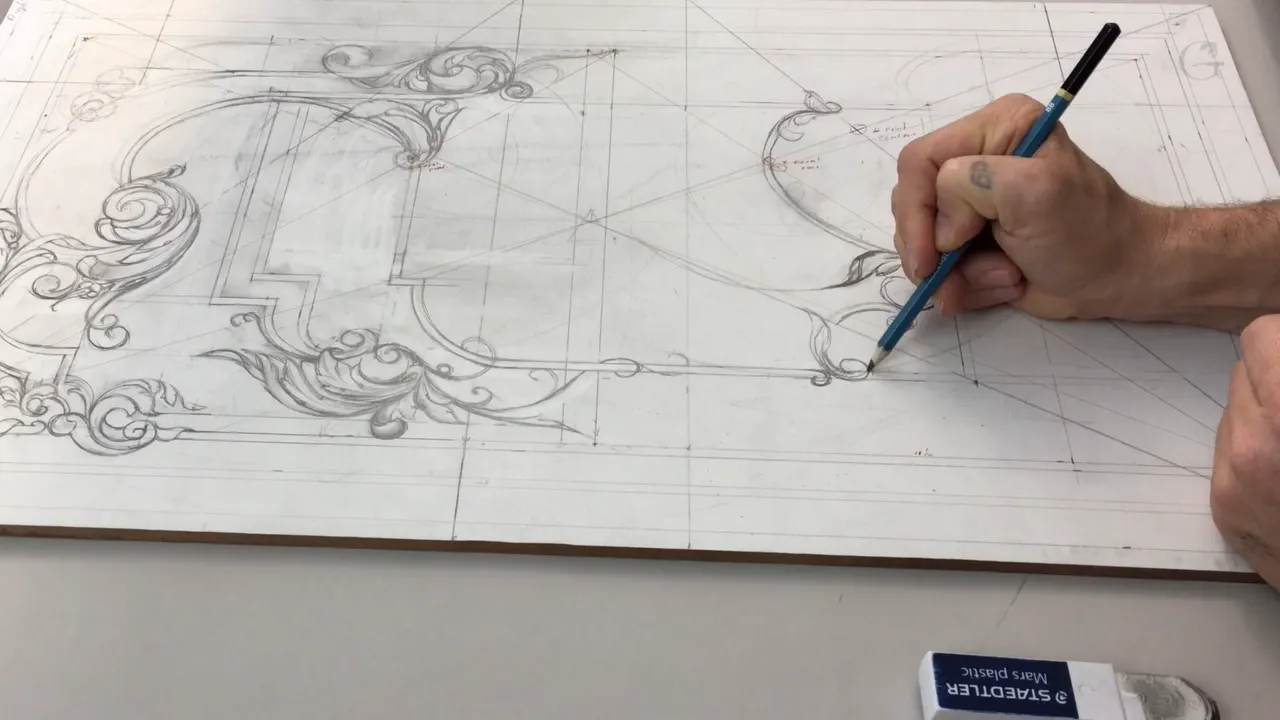
Then my design board. When I drew my furniture panel in design lesson 11, I reached one spot and added a small detail, and maybe another acanthus. I love acanthus design, I said right then, and it was really common to incorporate a lot of movements with acanthus. The next line I drew was my baroque line.

A dining table apron too. I loved the original design, and it has an acanthus leaf. That is the day I told the camera that, for some reason, acanthus leaf is just so in me.

Over a molding. In Floral and Molding, lesson 6 the goal of the project was to give you an idea of what you can do. Apply it to furniture, I said, or make a mirror or a picture frame, and there is an acanthus movement right on top of the molding.
That one was going under paint, so I skipped sandpaper. Furniture makers really like to sand that stuff, though, and I'm okay with that, sandpaper or small rasps or whatever you like, until it comes to perfection.

Is the acanthus an architectural detail or a furniture one?
Both. On my Greek acroterion I said the acanthus is considered more of an architectural detail, and in the same breath that you can see a lot of acanthus designs on old furniture, the antique pieces. Some architectural carving can be applied on furniture, and the acanthus was the example I gave. I added in the Roman course that the leaf used to decorate the temples and official buildings. The Roman leaf I carve there is symmetrical, the kind you find a lot of times on capitals, and also on furniture. It's really useful for furniture, I said.
Let me tell you a story about the old trade. In Venice Room workshop 55 I split carvers into levels. The third level were called home carvers, and that would be equal to architectural carving. They did a lot of egg-and-darts, a lot of moldings with some acanthus movements, frames for pictures and for art, corbels, and beautiful arches with carved details.

Their skill was real. They would carve one detail day after day after day, egg-and-dart, egg-and-dart, until they could carve it with closed eyes and not miss even one millimeter (0.04 in). But they were not able to design. Walk through the old palaces and look at the crown moldings, the base moldings and the chair rails, and they all use about the same details.
The fourth level was artistic, like Grinling Gibbons. Someone else carved the frame for a piece of fine art, and a carver like Gibbons would create something surrounding that existing frame, or a design over a mantel.
One trick on my Roman leaf comes from stone. In the last lesson of my Roman acanthus I shaved one ridge only a 16th of an inch (1.6 mm), and it gave me that classical Roman, or Greek, look. They used that technique, I said, and it is common in architectural stone carving. The next part of that lesson got to beads. For the Romans, and on the later Greek leaves, it was a big deal to do all the moldings and the architectural details, and beads are probably some of the oldest forms of architectural detail.

What changes when the leaf goes onto furniture?
Strength, mostly. On my Greek acanthus I did extreme undercutting, and I said that for furniture it would not be a good idea if people are going to touch it all the time. It would be too fragile. Frame it and place it on the wall, and it's absolutely fine.
Acanthus over Moldings 9 goes further. Hang it on a wall where nobody is going to hit it, and a deep undercut is absolutely fine. Furniture is different. You really can't do too deep an undercut there. Well, you could, with a smaller half millimeter (under 1/32 in) number 11, as long as you keep the mass of the detail somewhat thick. Earlier in that course I said that off furniture you could take it to the extreme and make it paper thin, and on that piece I couldn't.

The Corinthian leaf follows the same rule, and Corinthian lesson 5 is where I say it. On a piece of art I go to the extreme. If a piece will be heavily used, I would not suggest extreme undercutting.
The wood can change too. Basswood worked for my molding piece because it would get white paint. Apply that on furniture and you can use walnut, you can use cherry, you can use any other woods.
Repeats change as well. On the Greek leaf I made two mistakes in one day, and it was okay on that piece. If I had to work on furniture and make exactly the same pattern, I could not allow those errors.
What makes a shallow acanthus look deeper on furniture?
Hitting its edge is one way. During the Roman course I stopped to talk about people who like to use acanthus leaves in furniture. If it is a low relief carving, I said, this is one of the techniques to make it more three dimensional. Just hit the edge, like that, and do the next one.

Hollows help. A book I mentioned in the Modern acanthus course says the concave gives you the best shadow, and that is why, on furniture, they did a lot of concaves in those acanthus movements.
I have pushed that on purpose. On some of the styles of carving I've done, I put concave movements even on the flipping parts. It gives you an extra dimension, I said during the upper acanthus of the panel course, and you can use that concave cut in different designs.
Then trust your hand. People love to touch, I said in the Byzantine course, and the human hand can feel what the eye can't. With furniture you use that. You feel where the high spot is.

How do you move an acanthus from an old book onto a Queen Anne leg?
With plastic. On an April 2020 live stream I showed an old book, old but authentic, full of designs with beautiful movements and ideas. Find whatever detail you like, let's say an acanthus leaf, and if you want to use it on furniture, put the plastic over it. Take a fine marker and just trace it.
That plastic works on concave movements, or even convex ones. If you are a furniture maker doing a Queen Anne leg and you want to place an acanthus on it, you just use the plastic again and transfer it. I called plastic probably one of the most useful tools in wood carving.
That curved leg is the cabriole. Wikipedia's page on Queen Anne furniture calls the cabriole leg the most recognizable element of the style, and the cabriole page says that in England the design was characteristic of Chippendale furniture too.
Old furniture hides other puzzles. On that same stream I talked about moldings on ancient furniture that taper, where no molding plane can follow. Know how to handle wood carving tools, and you can do any type of molding and any type of movement.

Can you mix acanthus styles on one furniture piece?
You can. Start with the list I gave in the opening video of this course. There are two types of Greek acanthus, then Roman, Byzantine and Moroccan, and when the leaf traveled into European culture, Gothic, Renaissance, Belgian and French. All of them still show one plant. On the apron I talked about limitless different styles of acanthus from different places, Moroccan, Greek, Roman, and said you can actually incorporate different styles of acanthus leaf in just one design. "Nobody's going to know if it's Roman plus Greek." Then I took it back. I shouldn't say nobody, because there are plenty of people who do understand the big difference between a Roman acanthus and a Greek one. I added one more thing in the Venice Room. Most of the time, when I work with designers and big architects, famous ones, they have no idea what the difference is. And let's keep it that way.
The difference goes all the way inside. On an October 2020 live stream I was carving an Italian acanthus, a particular 15th and 16th century one. That leaf has a convex on the inside, I said, where a Roman acanthus has a concave.
A period has its own taste too. In the Venice Room I kept my acanthus simple, because I wanted to be authentic to the period. The acanthus that developed later in France and Belgium has a lot more twists and overlapping, lots of different movements. The panel in my furniture course follows its own style, North European, more French, late 18th century, and I wanted to stay authentic to what I designed. Thomas Chippendale, the London cabinet maker, published his own furniture designs in 1754, and his name became shorthand for a whole look.

Where the acanthus went in my lessons
| Piece | What I said there | Lesson | What a furniture maker can take |
|---|---|---|---|
| A furniture panel | Even its small details are acanthus leaves. | Corinthian introduction | The leaf still works very small. |
| Shelf furniture drawings | Still acanthus elements, with all the swirls. | Corinthian introduction | These were drawings for furniture designs. |
| A dining apron | The original design has an acanthus leaf. | Apron workshop | The design I followed had one. |
| A molded panel | An acanthus movement right over the molding. | Molding project | Same idea suits mirrors and frames. |
| Queen Anne legs | You just use plastic and transfer it. | April livestream | Plastic works on concave and convex. |

Where should a furniture maker start with the acanthus?
With the oldest leaf. In my school we don't carve just one acanthus, or two or three. We work in a historical progression, from the most ancient forms all the way to the Renaissance era, and believe me, it's a good idea to do that. The first Corinthian lesson starts the leaf on paper.
Is there a chair in your house? Does it have one flat spot that could hold a small leaf? Then begin with the plain leaf. The Tuition page tells you how to carve along with me.
How it's done
- Find a leaf you like. I look in an old book, old but authentic, and pick whatever acanthus detail I want on the piece.
- Trace it on plastic. Plastic goes over the page, and a fine marker traces the leaf.
- Transfer it to the curve. The same plastic carries the leaf onto a curved leg. It lays on concave movements, or even convex ones.
- Leave the detail thick. I don't undercut furniture too deep. With a half millimeter (0.02 in) number 11 I can go deeper, as long as the detail stays somewhat thick.
- Hit the edge. In low relief, hitting the edge is a technique that makes the leaf look more three dimensional.
Frequently asked questions
What does the acanthus leaf symbolize?
A bear's claw is what the name actually means, and the leaf looks like the claw of an animal. In Roman culture, I said on camera, people looked at the acanthus as a sign of endurance, resistance and triumph. The column story behind it may be a tale or a true history.
How do you carve acanthus leaves?
I start people on the oldest and simplest one. At my school we work in a historical progression, the Corinthian leaf first and then the more complicated types, moving toward the Renaissance era. The first Corinthian lesson draws the leaf on paper, and the carving goes on from there, lesson by lesson.
Which wood should I use for an acanthus on furniture?
For my molding piece basswood was fine, since paint would cover it. On furniture the wood can change. You can use walnut, you can use cherry, you can use any other woods, and that was my advice in the first lesson of the moldings course.
What to carve next