

Alexander Grabovetskiy, woodcarver, School of Woodcarving · Published 2021
Is the Fibonacci sequence the same as the golden ratio?
Quick answer: The Fibonacci sequence is a row of whole numbers, each one the sum of the two before it, while the golden ratio is a single split of a line, about 62 to 38. They are different things. Divide neighbors in the row, though, and the answer keeps creeping toward that split.
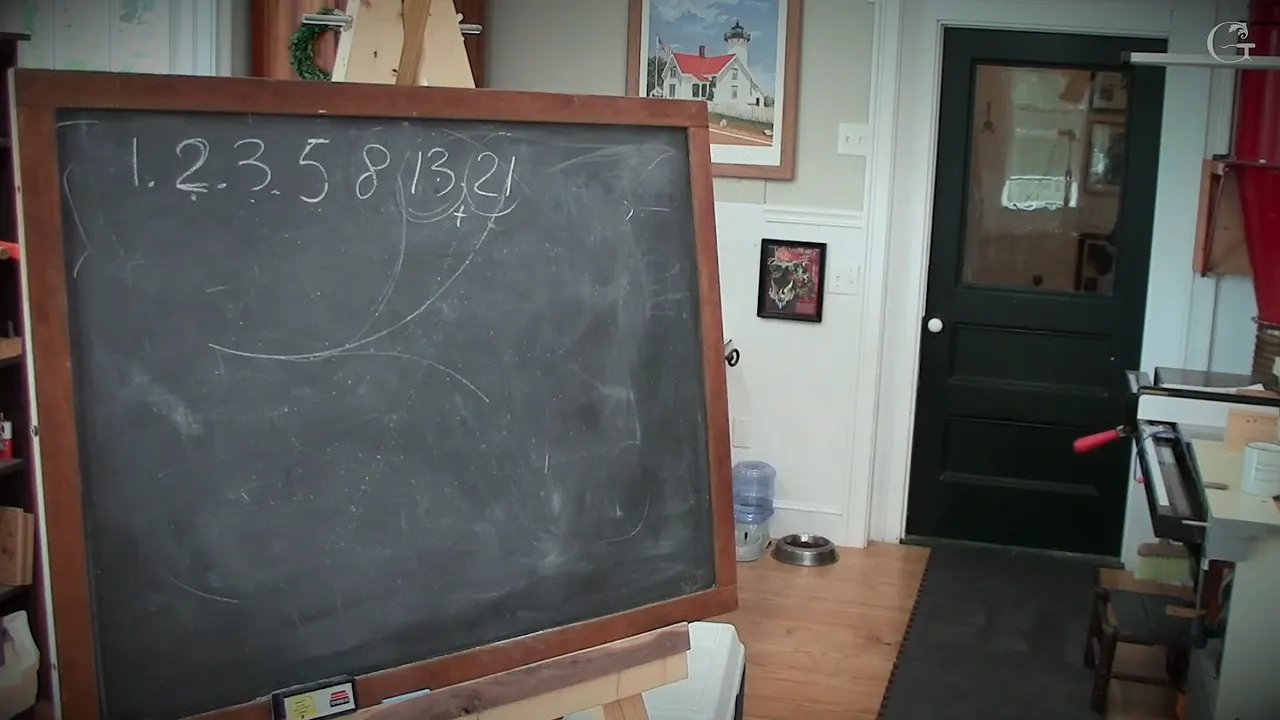
The Fibonacci sequence is a row of whole numbers, while the golden ratio marks one split of a line, so the two are not the same thing. Divide any number in that row by the one before it, though, and the answer keeps closing in on the split. That's why the Fibonacci sequence and golden ratio keep turning up together on my drawings.
Have you heard the two names used as if they meant one thing? Which one do you measure? Then you are asking the question this page answers. First I pull the two apart. After that they go back together where they meet on wood, using my design class in front of a chalkboard and a few other courses where I said the two names together.

The short version for your notebook
Think of the sequence as a count, where each number is the sum of the two before it.
A golden split marks a line near 62 of 100.
Divide neighbors in the row and the answer closes in on about 1.618, then swings around it.
Three against two is 60/40.
On real work I mark six tenths.
No pair of whole numbers ever lands on the ratio exactly, however far down the row you go.

How are the Fibonacci sequence and golden ratio related?
Two different things, tied by arithmetic. Start with the Fibonacci sequence, which is a list. Begin with 1 and 1, add the last two numbers to get the next one, and keep going, 2, 3, 5, 8, 13, 21, with no end. The golden ratio is a single number, about 1.618. It marks the split where the whole line is to the long piece as the long piece is to the short one.
One you can count on your fingers. The other you can only get close to.
In my classes I give that number as 1.62, the way the first lesson of the design course has it, and at the board in this video I gave 1.61. On a Venice Room leaf I called it 0.62, or 62 of every 100. All of those are the same split, rounded.

In the lesson on the law of arabesque I put both names in one sentence. Measure from a starting point to an ending point, as I told the class, and the distance still sits on the Fibonacci and still sits on the golden ratio, because Fibonacci is also based on the golden ratio. So it's still the 60 40 rule. To be exact, 62 38.
Mathematicians have a formula that backs that line up. Binet's formula, on the same Wikipedia page, writes every Fibonacci number in terms of the golden ratio.

On my grape leaf vase I came at it from the other side. If you know a little bit about Fibonacci, I said, you know its golden ratio, and the easiest way to understand it is the 60/40 rule, 60 percent out of 100.

Where did the two meet in this video?
On the board in this video I built the row with one instruction, take the last part plus the first part, and a few minutes later I found 1.61 between two lines of seeds inside a sunflower. That whole story is on the lesson 3 page, so I won't tell it twice here. In one class a row of counting numbers led to a ratio. That is the question on this page.

How do whole numbers turn into the golden ratio?
Divide each number by the one in front of it, and the table below does exactly that for the first few pairs. Its second column turns each pair into a split, the bigger number out of the two added together.
| Pair | Split | Quotient | Note |
|---|---|---|---|
| Two and three | Three of five parts is 60 percent | 1.5 even | The butterfly plate used this pair |
| Three and five | Five of eight parts makes 62.5 percent | about 1.67 | Overshoots the golden split a little |
| Five and eight | Eight of 13 parts gives 61.5 percent | 1.6 flat | Kepler's first pair in that remark |
| Eight and thirteen | Thirteen of 21 parts equals 61.9 percent | 1.625 exactly | A little over the mark again |
| Thirteen and 21 | Twenty-one of 34 parts makes 61.8 percent | roughly 1.615 | The difference now hides in decimals |
Read down the third column. The answers swing above and below 1.618, and every swing is smaller than the last one. Johannes Kepler noticed this in 1608. He wrote that 5 is to 8 roughly as 8 is to 13. A German mathematician named Simon Jacob, who died in 1564, saw it even earlier, according to the golden ratio page.
The swings never stop. Mathematicians call the golden ratio an irrational number, and Wolfram MathWorld works it out as half of one plus the square root of five. No fraction made of whole numbers ever equals it, so each pair only gets closer.
Look at the first row again. Three of five is already 60 percent, the same split I gave on the vase as the easy way in. The bigger pairs farther down sit closer to 1.618, and they are much harder to count off on a board.
Why do I call three against two a Fibonacci split?
Near the end of drawing the plate with butterflies I was filling the last empty spots. Inside I had drawn a triple movement, and the same detail went on another spot. I drew it again in the opposite direction, filling that part. But in this case, I said, just the two.

Those three versus two, again, 60/40. So it's going to be Fibonacci. Two, three.
Two and three sit right next to each other in the row, and three parts in five come to exactly 60 percent. Two neighbors give a split close to golden that you can count instead of measure. After that I stopped adding. I didn't want to make it too busy, and there's plenty of movement, I said, so I didn't think I wanted to change anything. I know it doesn't look perfect yet, I said, but it doesn't have to look perfect, and it's going to look really good.

Earlier in that video I had chosen to run the movement the opposite direction, and I told anyone who felt uncomfortable with that to do whatever they felt like. The same technique, I said near the end, could dress up a mirror frame. I have done that style on casings around windows and doors inside really high end homes, just the detail on the inside.

Where does six of 10 come from?
From the same split, made easy to find. In Venice Room workshop 49 I was drawing an acanthus over a ball shape, a dome, looking at it from above. I'm all about the golden ratio and Fibonacci numbers, I said, and stuff like that. My shortcut for the center line is to divide the line between two points in about 10.

I don't even draw the marks. As I put it there, the Fibonacci sequence or golden ratio comes to 0.62, or 62 parts out of 100, or six parts out of 10. Five of 10 would be the middle. So I move slightly to one side, just eyeballing, to about six, and that becomes the middle line of the design.

Every acanthus leaf is supposed to have divisions, I said next, and I call them subdivisions, but you can call them whatever you want. Each division has an eye, and a pipe runs from that eye.
A minute later I did the same thing smaller. The first division got split in three parts, and again I looked from above, took one point and another point, and moved by eye to about six of ten. I also warned that the camera sat a little away from me, so it didn't show exactly what I was looking at.

Notice what happened there. Two names went into one sentence and came out as one middle line.

What is wrong with the exact middle?
On a livestream in April 2020 I gave the answer in a few words, that's not going to be good. I had to match the size of one side of the design on the other side, and I asked the people watching to pay attention to where I placed the middle line, because it matters for all of those movements. Take this point and that point. The middle between them would be somewhere right there.
So you move it to the left or to the right, if you want to be accurate to the Fibonacci sequence or golden ratio, if you wish. Six of 10. It's an easy way to understand it, I said, and the same applies on the other side.

For the preliminary cut I kept the same tool, a number 11 veiner at 7 mm, a little bigger than a quarter inch. The pencil was an 8B, really soft. When I carve I usually use a marker instead, because those pencils leave a lot of dirt markings. Sometimes I just grab one anyway. A minute later I pointed out that the space between those two leaves was much smaller, so the only way to match them was to undercut underneath each side and lower that section of the division.

In workshop 53 of the Venice Room the same split moved a pipe. Two pipes were already done, and that was good. The new pipe goes between two middle lines of a separation, and I shifted it a little to be closer to the Fibonacci sequence, about six tenths.

I leaned the tool a little to the left-hand side and started my concave. That concave usually takes two gouges, a number 9 and then a flatter number 3 sweep, but a U shaped number 11 does it in pretty much one cut.

Where do the count and the split part ways?
At the question each one answers. The sequence answers how many, and the ratio answers where.
In the last video of the design class I repeated one idea on the board and asked the room whether it was Fibonacci or not. Then I caught myself. I had repeated it once, so that made two elements. It is Fibonacci, I said, because one is Fibonacci and two is Fibonacci. Three would work too, or five spots with the same idea, as long as each one plays with a different size.
A flower in Venice Room workshop 74 needed divisions on its main body. It could be five, it could be eight, if you follow the Fibonacci sequence, I said. I made it just five, the main divisions, and counted them out, one to five.
Once I skipped the count. In workshop 139 I was planning V cuts around a part and said I was not going to calculate Fibonacci that time, although it's a good idea. Then came the advice anyway, use the Fibonacci sequence for how many lines you've got.

Neither of those counts puts anything on a golden point. Five divisions on a flower are a count. Where the middle line of that flower sits is a split. A carving can need both answers, and they are still two different questions.
Is the golden spiral the same as a Fibonacci spiral?
Close, but drawn differently. A golden spiral grows wider by the golden ratio with every quarter turn. A Fibonacci spiral is built from quarter circles drawn inside squares whose sides are Fibonacci numbers, and the golden spiral page calls it an approximation, made slightly differently. That same page says even the quarter circle version is not a true logarithmic spiral.
Be careful with the pictures online, too. The golden ratio page keeps a list of disputed observations, and the nautilus shell is on it, often wrongly called golden proportioned.
Who wrote the sequence down first?
Indian mathematicians, long before Fibonacci. The Wikipedia page says the numbers were first described in Indian mathematics as early as 200 BC, in work by Pingala on patterns of Sanskrit poetry built from syllables of two lengths. Leonardo of Pisa, also known as Fibonacci, brought the row to Western European mathematics in his 1202 book, and the MacTutor biography calls him Leonardo Pisano.
The numbers turn up so often in mathematics that a whole journal, the Fibonacci Quarterly, studies them. The OEIS entry A000045 lists them far past anything a carver will ever count.
Where this video sits in the design class
This is the third video of lesson 3. The first one is about movement, which part of a design rules and whether it grows or falls. The second is the law of space. This one brings in the Fibonacci numbers, and lesson 4 goes on to dynamic symmetry, the arabesque, rhythm and the ten elements of classical design. The whole path starts on the Principles of Design in Wood Carving page.
Is there a line on your board waiting for a center? Can you count ten marks along it? Then move one mark past the middle, and you are on the same split I use on the Venice Room, the vase and the butterfly plate. Every one of those courses sits inside the school.
How it's done
- Add the last two numbers. I begin with 1 on the board and take the last part plus the first part. Two numbers added make the next one, as far as you want to go.
- Pick two neighbors. My butterfly plate got three on one spot and a pair opposite, which I called 60/40 and Fibonacci together.
- Mark the line in about 10. Between two points I divide the line in about 10, usually without drawing a single mark.
- Move off the middle. The exact middle would be five of 10, and the middle is not good. I slide over slightly, just eyeballing, to about six.
- Check it with the caliper. For my vase I spread a golden ratio caliper across the body, and the golden center fell where my largest circle was going to go.
Frequently asked questions
Why do you say Fibonacci when you mean a golden split?
In my head the two belong together. During the arabesque lesson I told the class Fibonacci is also based on the golden ratio, so one distance sits on both at once. I called that 60 40, or 62 38 to be exact.
Is 1.61 the golden ratio?
In this class I gave 1.61 for two lines inside a sunflower. Working on a Venice Room leaf I said 0.62, and for everyday marking I go six of ten.
Which two Fibonacci numbers give a 60/40 split?
Three and two. On the butterfly plate a triple movement sat on one spot and just the two on the opposite one, and I called it three versus two, 60/40 and Fibonacci in one breath. Then I stopped, because I did not want the design too busy.
What to carve next