

Alexander Grabovetskiy, woodcarver, School of Woodcarving · Published 2021
Should a carving design grow upward or fall downward?
Quick answer: Growing or falling is the way a movement travels in a carving design, uphill or downhill. On the flower panel from my class the main movement goes uphill, and a second one falls on the opposite diagonal from one shared point. On a vase layout one leaf climbs while another drops.
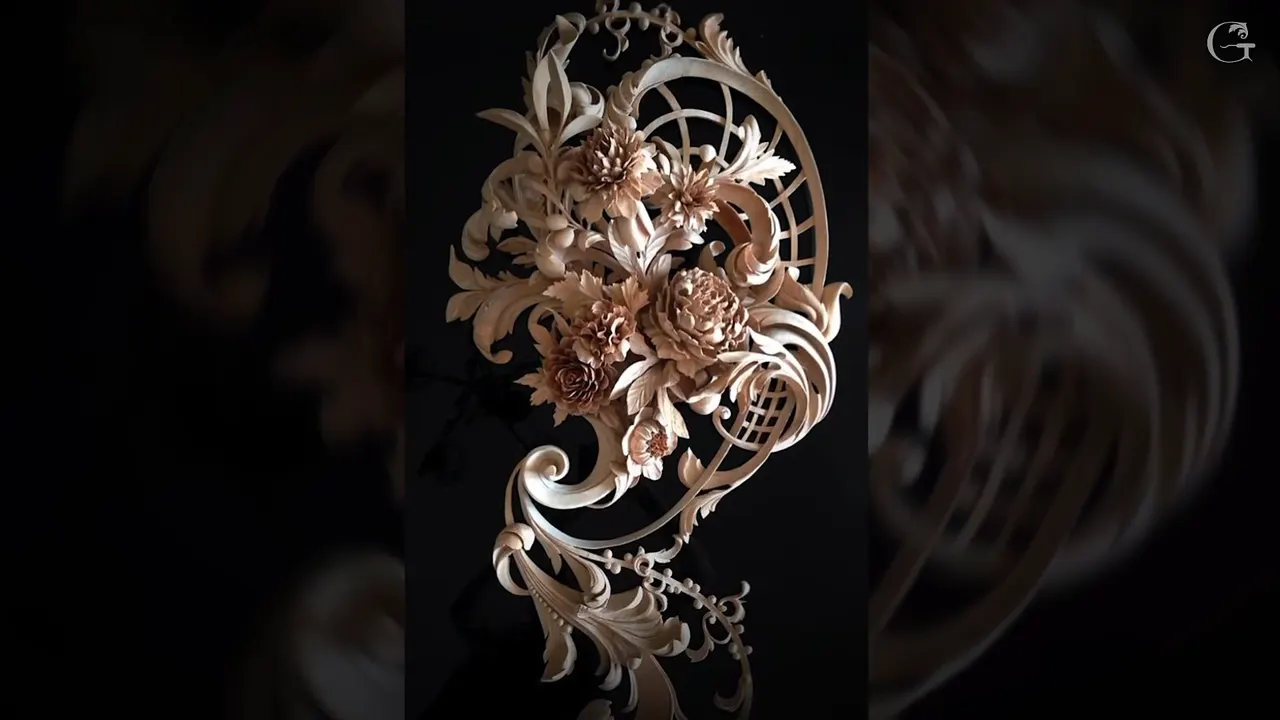
Growing or falling is the way a movement travels across a carving design, uphill or downhill, and I settle it inside each part of the design. Upward movement in design reads as growth. In the live class I filmed for my design course, I showed a carved flower panel whose main movement climbs from a spiral scroll near the bottom. A second movement drops away from that same spot, on the other diagonal, and it has a job of its own.
Have you ever watched a vine climb a fence post? Ever seen a heavy flower bend its own stem back toward the ground? A carving can say either one. So decide, inside every part of your design, whether it will grow or fall.
What follows is the short video from lesson three of my design course, filmed at the chalkboard with students in the room, and then that same choice on pieces from my other courses. A vase comes first, then petals on a furniture panel and on two flower carvings, then a molding, and a grape onlay with a branch that fades away inside.

Seven lines on climbing and falling
My class flower panel climbs from the bottom up.
The second one falls onto the opposite diagonal.
They start at one point, since the falling part supports the main one.
One vase leaf climbs and the one beside it drops, and a single vine ties the pair together.
Petals sitting side by side look natural when they head different ways.
A Hashemi flower got deep excavations underneath it.
A falling part can wrap around a molding, or fade out on the inside.
What does upward movement in design say?
It says the piece is growing. I opened that video by going back over the first rule, right to left or left to right, and in the picture we had looked at, the main movement ran left to right. After that came a new rule. Fall, or grow?
I like to talk in a simple language, because it's easier to understand. So I asked the room which part of those flowers was dominant. The upper part.

Inside those parts I had to decide again, grow or fall. On this panel I did both, in opposite directions. One part grows that way, I said, and the other goes on an absolutely different line.
The main idea of those flowers sits in the upper part, and the main movement goes uphill. It's growing, I said, and it's alive, and the lesson page on the law of space carries the rest of that talk. A label on the video names the start of the climb as a volute, which it calls a spiral scroll, near the bottom of the panel. Its main flower is a peony.

Plants grow this way too. The Wikipedia page on gravitropism says roots grow in the direction of gravity, downward, while stems grow the opposite way, upward. Lay a potted plant on its side and the growing parts of the stem turn up again, the page adds. And the page on design principles lists movement as an illusion of motion, made by repeating an object rhythmically or by bending its shape.
What does the falling part of a design do?
It carries the fight. I asked the class to look at the second movement, please, and tell me what it does. It falls. And it does more than fall, I told them, because the movement changes onto the opposite diagonal, the sinister.

So it's actually supporting the idea of war behind. It falls downhill, and it starts from the same point, because this part supports this guy. Its point of view is absolutely opposite from the main design.
Wikipedia's article on composition in the visual arts says oblique lines convey a sense of movement. My students got two of those lines on one panel, one climbing and one dropping, and both began at that one scroll.

Then I stopped to check on them. Is it interesting for you, or no? Either you know everything already or it's just too complicated, I said, but you see the logic behind it, right? The class had asked me for this, because I don't explain it in every class.
Do the two movements always have to go opposite ways?
Not always. They can move one direction and still fight each other, like the two parties in the United States, I told the room. The same idea, different ways, different approaches. But look deeper, and they have absolutely different ideas. A two-party system, as Wikipedia puts it, is one where two major parties consistently dominate, and one of them usually holds the majority.
I'm not about politics right now, I said, and I went to the Bible. Two brothers in the Bible fight each other. From the beginning, brother fights brother, until Moses meets Aaron and they hug, and that fight ends.

The meeting is in Exodus 4:27, where Aaron goes into the wilderness, meets Moses in the mount of God, and kisses him. Something needs to be fixed, I told my class. That's the big idea of Judaism, to fix what was broken and stop that fight. Jewish teaching has a name for repairing the world, tikkun olam.
But in design, while we live on the planet Earth, we still apply the same rules we see around us. The very last words in that video were about the two diagonals. Always remember them, I said.
How did one vase leaf climb while the next one fell?
My vase with grape leaves was still at the layout stage. I want to fill the space, I said, but I want it to look like it's part of the same branch or vine. So maybe I branch this one out of the same movement from this side, and it goes underneath that movement, and then it turns.

That leaf grows this way, uphill. That one grows downhill. And I still needed to make it look somewhat nice. Then I wanted to create the movement and tie it upward again.
Real grapevines climb, too. The grape genus, Vitis, has a Wikipedia page that says the tendrils support the climbing plant by twining around branches.
Golden ratio calipers were optional later in that lesson. Here's my center line, I said, and it's going to be dying underneath the big movement.

Can one petal grow uphill and fall in the same shape?
It can, and every petal of one flower did it, up on the top part of my furniture panel, lesson 21. I explained it as I carved. This flower is going to grow from underneath, I said, then caught myself and made it the petal. It grows from underneath, goes uphill, and then goes downhill, all the petals like that.
It has a little bump, like a mountain almost. I didn't know the best way to describe it, I said. A moment before, I was working against the grain, and it was okay, because my tools are sharp.

Back in the drawing stage of that panel, in lesson 13, I said the outer ring of a flower goes downhill most of the time, even when the rest of the flower goes uphill.
Why do petals side by side go different ways?
Every petal has to be different, I said. On my Venetian Flowers Rosette, lesson 2, the idea was not to make them the same, and I corrected myself right away, flowers and petals too. Before I started, I said I would like to mention what you don't have to do. They're all going to look a different direction.
This one goes downhill, I said, and this one most likely downhill too, and this one kind of downhill. But those two go uphill. So they're not going to be the same. The section closer to the center drops in on all of them, because that looks natural. It grows up and down, I said, and then the curves on the outside come.

The Hashemi flowers, lesson 43, had the same rule. I took the ridges out of one flower to make it more rounded on the inside, like a sphere. More natural, I said. So one petal grows downhill, and the next one goes uphill like this. Petals, says the Wikipedia entry for the petal, are modified leaves that surround the reproductive parts of a flower.
How do you carve a flower so it reads as growing?
Underneath, for the Hashemi flowers. In Hashemi flowers, lesson 36, I took a number 4 gouge at 10 mm (3/8 in) and went all the way downhill underneath one flower. Maybe even make it a smoother upward growth, I said. I mean movement, how the flower is going to grow.

A number 9 at 4 mm (5/32 in) went in next to excavate even deeper underneath the petal. You're not going to see those extreme excavations from underneath, I told the camera, but they create a shadow.
Upward movement can fight you. In workshop 17 of the Venice Room I wanted a flip upward right above one movement, and it gave me such a hard time. But I still got that little upward movement. It made me happy. During workshop 61 I left the inside of one part uncleaned, because I still had to develop the upward movement there, and started on an acanthus movement sticking from the flower. For workshop 39, I knocked one part down and brought it a little closer, and it still had that upward movement. I think it just looks much better, I said. On my chamomile and bow rosette, a small number 8 of about a millimeter and a half (1/16 in) went straight down again and again, really close to each other, going around. I really wanted the feel of a bunch of stuff growing up from the middle.

Where does a falling movement end?
Often underneath something. I worked the movement first on the floral and molding panel, lesson 10. It was going to follow the curves of the clover molding and fall down below. I checked the piece I had carved before, and yes, there it goes downhill, lying right on top and just wrapping. It doesn't raise too much above, and it goes almost underneath.
I could have wrapped it right under, but I didn't think that was really necessary. Wikipedia describes a molding as a strip of material with various profiles, used to cover transitions between surfaces or for decoration.

On the grape onlay in lesson 11, one branch was going to die on the inside somehow. It's dying somewhere right here, I said, and then I had to take care of the next guy, which goes right underneath from this side. I rotated the piece for a much better position and attacked with the same number 11 at 5 mm (3/16 in).
On those two pieces, dying meant a part fading away, under a bigger movement or on the inside. The main movement in the class video was the one that kept growing.
| Piece | Which way the movement went | What I said about it on camera |
|---|---|---|
| Class flower panel | The climb started at the scroll, and a second movement fell onto the other diagonal. | Supporting the idea of war behind. |
| Grape leaf vase | One leaf climbs in the layout while its partner drops, both out of one movement. | The same branch or vine. |
| Furniture panel petal | Each petal rose from underneath, climbed, and turned back down again. | Like a mountain almost. |
| Venetian rosette petals | I planned three petals going downhill and two going uphill. | So they are not the same. |
| Clover molding panel | The movement followed the molding, fell down below and wrapped almost underneath. | It does not raise too much. |
| Grape onlay branch | One branch faded away inside, and the next one went underneath. | Dying somewhere right here. |

What makes a growing leaf look alive?
The motion inside it. A number 11 at 7 mm (about 1/4 in) made a little wave on the grape onlay, lesson 8, and it didn't have to go all the way. I hope you can detect the overall motion, I said, and that's what makes those leaves alive. After it, a number 7 at 4 mm (5/32 in) excavated with its flute, to the left or to the right.
On Acanthus over Moldings, lesson 7, I kept the overall movement of one petal, the same one I had shown before, and created the movements inside it. That gave me life, I should say. It looks more alive. For the other side, which still needed cleaning, I reached for a number 5 at 1/8 of an inch.

Which way should your own board go?
Look at your drawing. Where is the main idea, and which way does it travel? Mine climbs. The second movement then has a place to fall from, the same spot where the climb begins.
This video is the first part of lesson three, with the law of space and the Fibonacci numbers after it. Lesson one sets left or right, and lesson four carries the curves and the rhythm. The whole path starts at principles of design in wood carving, and the videos sit behind Access.
How it's done
- Settle up or down. Inside every section I make the call, climb or drop. In class that came right after left or right.
- Give the main idea the climb. My panel has its big movement rising from the scroll at the bottom.
- Drop the second part from that spot. My secondary movement drops along the other diagonal and begins where the main one begins, because it supports that guy.
- Tie both to one vine. With the vase I branched a leaf out of the same movement, so the climbing leaf and the dropping one read as one branch.
- Carve the rise from below. Under a Hashemi flower a number 4, 10 mm, went downhill first, then a number 9, 4 mm, dug deeper beneath the petal for shadow.
Frequently asked questions
Should every petal on a carved flower point the same way?
Not on my Venetian rosette. The idea was not to make them the same, and every petal has to be different, I said. I planned three going downhill and two going uphill, and the part near the center would drop in on all of them to look natural.
Where does the falling part of a design begin?
Right at the point where the climbing one begins, on the panel I showed my class. My second movement drops away along the opposite diagonal, and I start it there because that part supports the main guy. Its point of view is opposite to the main design.
How do I carve a petal that rises and then drops?
Each petal of one flower on my furniture panel grew from underneath, climbed, then turned back down. A little bump, I called it, almost a mountain. Just before, I was going against the grain, which was okay because my tools were sharp.
What to carve next