
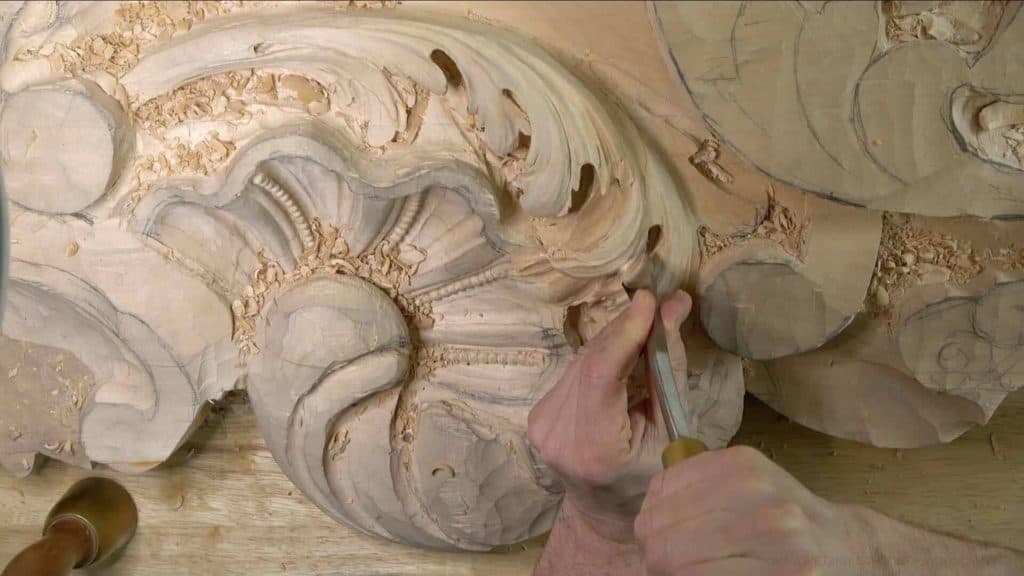
Alexander Grabovetskiy, woodcarver, School of Woodcarving · Published 2020
What does a wood carver mean by "nice and sharp"?
Quick answer: A clean edge from a small tool is what I mean by those words. In video 8 of workshop 12, I named a number 5 to clean an edge, then said the line after one light pass. Other lessons put them beside a mallet, a knife and a veiner.
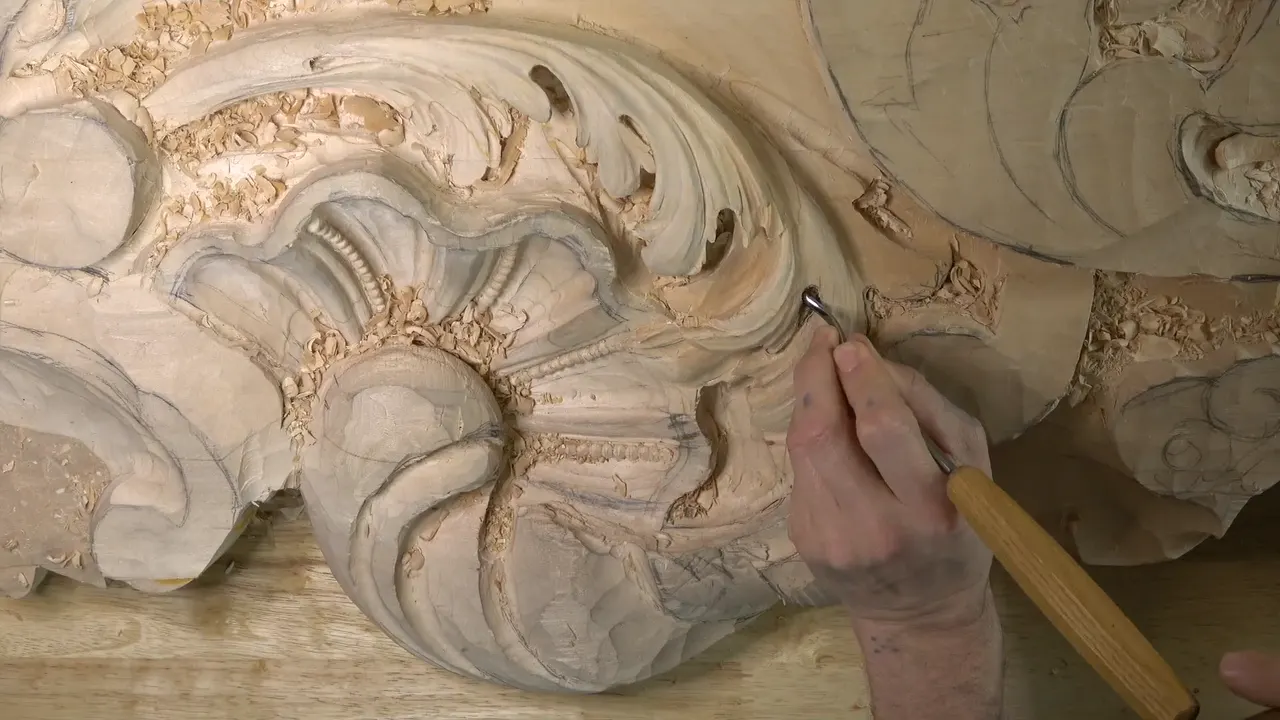

In Venice Room 12, video 8, I name a number 5 for an edge and say "Really nice and sharp." Each passage below names its lesson, so you can open that video and hear me say it.
Ever cleaned a small edge and wondered if the line would hold up when the light moved? Ever left waste in a hollow and forgotten it? Both worries sit in one short video, the eighth of workshop 12.
What happened in video 8 before the clean edge?
The video starts partway into the work with "So you also go slightly in." I could do that side "even with just a straight tool," I say, but a back bend "helps me not to damage this edge, because when I'm using back bend, it's staying above this edge, so it's safer." You do not need a tool like that, I add, though I think it's "just safer."
Next comes the waste. "Now I'm ready to get rid of this junk on inside," I say, and my pick is a number 11. My plan is to start with "the 2 millimeters" (0.08 in) "right away and excavate both directions like that." Seconds later I argue with myself: "I think I should use a bigger one." "Let me check."

Maybe even "5 millimeters" (0.2 in), I say, and then, "Or maybe 5 millimeters is a little too big." The order is plain: "Just hook all that junk out." With the wood open I say to "change the position and work this way." About that size I land here: "And yes, 5 millimeters, I think it's a little too big. But until it cuts, I'll use it."
After "some cleaning," I say "now we're going to switch to 2 millimeters," number 11, and "go that direction now." "One more side," I say, and I "could see" that "it needs to be taken care a little better this way." Number 9 would do it too. At 3 millimeters (0.12 in), "for example," it would give "exactly the same" result, "really good around this inside."

"All it's just cleaning. That's it." The reason has to do with paint: "I don't want to leave that junk inside because sometimes you forget that stuff, and when you paint, it sticks to that area." My verdict on the hollow is "So it's a really good, deep excavation. I like it."
How did the pipe edge get its small concave?
The pipe is the next job. "So now what I have to do is to take concave all the way around this pipe." The size is small: "Just to create a not big, but still concave. I need to raise this edge a little."

I give myself an out: "I don't have to. I could leave it like that. It's not really big deal, but I think it's going to look nicer." For tools, number 9 is my pick, and I say I'll "carefully just go around." On depth I say it plainly: "Not really deep." The little concave is "just for the eye to draw attention."
A second spot gets a verdict, "Just doesn't look too appealing" and three small moves: go "that direction," get "closer to what we just created" and "attack that from that side." After that comes a stop. "Now I'm going to leave it like that. Maybe just little bit touch-up. It should be good."

Where does the clean edge show up in video 8?
Two small jobs come last. "Let's get rid of this pencil mark," I say, and "I'm not going to worry about how it looks like points here or not." Sizes come next, "number 5 or 6" and then "Number 5, probably, the big one."
Then comes the line this page follows: "Number 5, and I'll just clean a little bit the edge, create a little better cut, just like that." After it comes my verdict, the line in bold at the top. And last, "maybe just a touch and clean little bit that." The video ends on "I think it's good."

What do videos 7 and 9 say around it?
Video 7 names sizes as small as "maybe 2 millimeters or even 1 millimeter" (0.04 in), and "of course, spoon gouge" for the 1 millimeter. A back bend is "also excellent tool for this operation." About my number three I say "Don't pay attention to it." "It's a sweep number three and six millimeters, quarter inch" and "different brands, they mark those backbends slightly different."

Video 9 keeps going. A big pass comes first, using "number five, 35 millimeters" (1.38 in), "about an inch and three-eighths" and for the cleanup "the good tool would be, again, number 11." The plan is to "excavate whatever I don't need," but "I don't want to damage that crisp line also" and "I can always go deeper later on once I'm going to work on the shell." Then comes "All that is junk, and I don't really need it."

Which tools went with the phrase in Hashemi Flowers and Floral and Molding?
In Hashemi Flowers 32, video 1, I undercut a flower and say "I usually go as much as I could reach with the flowers, at least." I give a reason, "sometimes you look from the side, and it makes a big difference if the edge of the flower look really, really" and that line ends with the phrase of this page. I use "just number five" for that, then say "I think I have to use a V tool" and "maybe even I could use a small 1/32 of an inch" (0.8 mm) "gouge and create that shadow line right here." For the smoother pass I name a number four, 10 millimeters (0.39 in), to make it "a little smoother." "Some spots I can leave rougher," I say. Those would be "still going to look nice."

Floral and Molding 7, video 1, puts the phrase on the tool itself. The area is "end grain because the grain of the wood runs that direction," so "a tool must be super sharp. It just absolutely must." Then "you can see it, it doesn't leave any trails. That means that tool is really, really" with the same words ending the line. A little later I reach for "the small spoon," "maybe about one-eighth of an inch" (3.2 mm), number five, and say "this one needs to be sharpened. I can already see the difference of the cut."

Which tools did the Furniture Panel videos use?
In Furniture Panel 18, video 1, the corner comes first: "I want to make sure this corner is really," followed by the phrase. The tool is "a number one and 8 millimeters" (0.31 in), and I could "get a little bigger number one, like five-eighth of an inch" (16 mm) "and catch the line." Then "Clean it with the edge." Earlier in that video I work across the grain: "it is always safest."

In Furniture Panel 15, video 7, the opening is a warning about depth: a pass "too deep" will "leave marks." After "Nice and clean" comes a line of the same shape, and I close it with "Beautiful." A corner under a molding needs care, too. Plan to undercut? "Yeah, that is okay." If not, "you're going to create extra shadow. Extra tool mark. So you're not going to have a really nice wall."
Furniture Panel 19, video 8, says I could "create much nicer project" if I don't have to rush, and then "let me use whatever it fits right here, just to get really" then the phrase, ending "point, okay?" After that: "And looks like I achieved that." My next worry is room, "looks like I don't have enough space." "But let me try first." Plan B: "I can always use just a gouge or even knife" and "I'll use number three and just the corner of it" is my pick for the first try.

A veiner is the subject of Furniture Panel 24, video 4. I plan on "number 11, and that's going to be half a millimeter" (0.02 in), "little by little" and "maybe I can actually help it to mallet again." A gouge to "kind of point it inward" is "much harder" and a mallet there is "not the safest way," since "you can actually catch the edge and break a section of the carving." Hence "that's why I like the approach of half a millimeter veiner." Afterward I say "So it's" and the three words follow, then "I still have some paper left on top, which means I'm still at the same level with the overall panel."

How does a mallet or a cleaning cut fit in Lily Box?
Over in Lily Box 3, video 5, a tool goes right on a line, and the mallet is part of it. I say "I'll use mallet" and "that's going to give me a really nice sharp line." "That's what I'm after." The price is a mark: "you can do really quickly, actually, any type of design when you're placing your tool just like that, and you just outline it. But there is a danger." It takes "a lot of tools," "different profiles and different shapes, different sweeps" and "it leaves a mark." "When you cut, that's why I actually angle that little bit."

In Lily Box 7, video 11, the tool is a "two millimeter spoon gouge." Later I say "some call it hoiking, but it's actually hook out all of that waste" and I plan a number 11 of "3 millimeters" (0.12 in) to "blend a little better this region right here." "I like it."

The next video of that lesson, 12, gives the size: "it's one inch" (25 mm) "and number five, and kind of give a cleaning cut." "Hopefully, you can see how it looks from above." My verdict is "Beautiful and sharp line." Then "Okay, that's wonderful."

Back in Lily Box 9, video 3, I pick the number three, half an inch (13 mm), and say I can give "a really, really nice line" and a few lines on I say "sharp line." A smaller number three comes next to "develop even more this detail." Then "See what we just achieved? Really, really nice separation and we took advantage of a natural imperfection." And what I miss: "I usually like to see a triple division, but in this case, I do have only double."

Does the phrase work for a saw blade or a knife edge too?
A scroll saw lesson, Lily Box 1, puts the phrase on a blade: "I am using the smallest blade I have, it's number two," "made for the jewelry" and "my cut would be really" and then the three words. "Of course, it takes time." The danger: on those blades "it has a tendency to burn little more," so "it's better to use probably number five," or number seven "if you want to be more safe."

Curly Kitchen Cutting Board 6, video 4, is knife work. "Now you can see why I said that line should be divided in two, because you can see really" then the phrase and "edge right here." The limit is my blade: "I could just start digging right away, all the way deep, but I can break my knife again, and I don't really want to do that." Instead "I'll just chip away little by little with a really low angle until not much material left." "Then I can go back to my flower."

In Grinling Gibbons Maine 11, video 3, "I'll use my knife upside down" "until I'm happy with the edge" and "looks like my edges good." Then "wrap that little bit" and "make it a little softer." The other side "just looks a little ragged" and afterward "that's much better." The facets still "got to be cleaned" and "I'll spend a little longer on cleaning up."

Venice Room 109, video 3, has "Let me hit that carefully" then "Now I'm happy" and after the words, "Beautiful. Like it so far." Then "I need to undercut underneath of this line," because "the more shadows I create on outside, more three-dimensional it will look, which is I'm after." For the tool, "probably 10 millimeters" (0.39 in), "number 11, 3/8 of an inch" and "I have to change the position because I see what grain direction."

What do these lines add up to?
In video 8 the words came after a number 5 went over an edge. Elsewhere they came after a mallet, a veiner, a knife and a blade on a scroll saw. In each of those, a size or a tool came first. Below, a table sorts where a clean edge got its tool in each lesson I quoted.
Where did I say it, and what did I hold?
| Lesson | What I held |
|---|---|
| Venice Room 12, video 8 | A big number 5 on an edge, for a better cut |
| Hashemi 32, video 1 | A number 5, then a number 4 |
| Panel course 24, video 4 | A veiner, with a mallet as a maybe |
| Lily Box 3, video 5 | A mallet, with a tool placed right on the line |
| Lily Box 7, video 12 | One inch (25 mm), a number 5, for a cleaning cut |
| Panel course 18, video 1 | Eight millimeters (0.31 in), number 1, maybe bigger |
| Grinling Gibbons Maine 11, video 3 | A knife held upside down, until I am happy |
Which edge on your own board is waiting for its last pass? The full set of videos for this panel sits inside one tuition plan. The Venice Room part 1 course page holds workshops 1 to 12, and lesson 12 has all of its videos. More wood carving and relief waits there.
How it's done
- Clear the waste inside. I took a number 11 to the junk inside, trying a bigger size first and a smaller one after, and I liked the excavation.
- Check the second side. A second check turned up one more side that needed a little better care.
- Give the edge a small concave. I went with a number 9, carefully, and kept the concave shallow.
- Pick the last tool. I leaned toward the bigger of two sizes for the edge.
- Judge the pass. The words of this page came out, and then I called the edge good.
Frequently asked questions
Which tool did I name for the last pass in video 8?
Two sizes came up, 5 and 6, and I said "Number 5, probably, the big one." I said I would "clean a little bit the edge." Next I said "create a little better cut," then came the line this page follows, and I closed with "I think it's good."
Why did I reach for a back bend beside that edge?
The back bend stays above the edge, I said, so it helps me not to damage it and it's safer. The straight tool could do that side too, I said, and you do not have to have a tool like that.
Was a 5 millimeter gouge too big?
I doubted 5 millimeters (0.2 in) twice, first with "Or maybe" and then with "I think." My next words were "But until it cuts, I'll use it." Later I said "now we're going to switch to 2 millimeters" (0.08 in).
What to carve next