

Alexander Grabovetskiy, woodcarver, School of Woodcarving · Published 2022
What is Venetian style wood carving?
Quick answer: The Venetian style I carve is the ornament of Venice around 1500, late in the 15th century, running into the 16th. On camera I said a Venetian acanthus has a section that must be nearly round, with thick, big pipes, and lesson 163 is the last workshop of the room I carved that way.
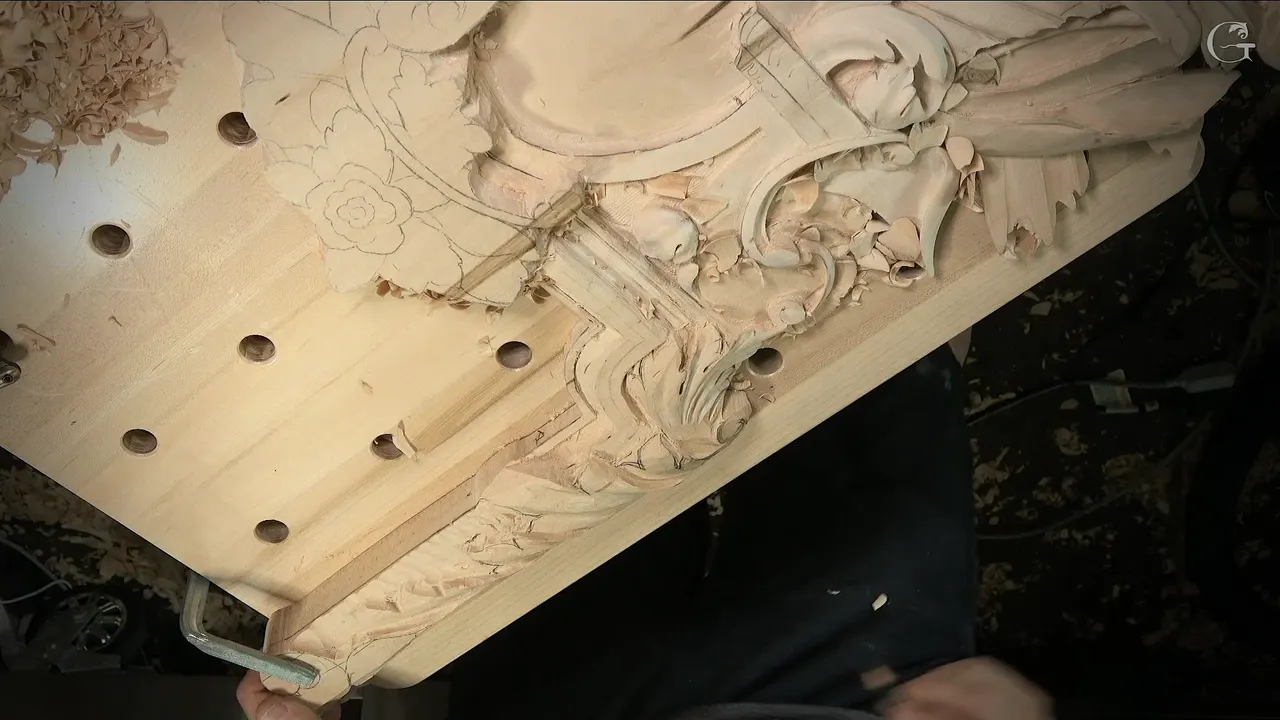
Venetian style wood carving, the way I carve it in my Venice Room, is the ornament of one city, Venice, in the later 15th century and the beginning of the 16th. Part of its acanthus has to be almost like a ball. Its pipes stay thick. And 163 is the last workshop of that room.
Have you seen an acanthus leaf carved on old furniture, or high up in a church? Did you ever wonder where and when somebody first carved a leaf that way? Place and century are what a style name should carry, and for my room they are Venice and the years around 1500.
I'm going to be honest with you about how this page is built. Workshop 163 runs three short parts, about 20 minutes, and in it I mostly carve. My words about the style itself come from my April 2020 livestreams, and I name each one where I use it, so you can go and hear it in my own voice.
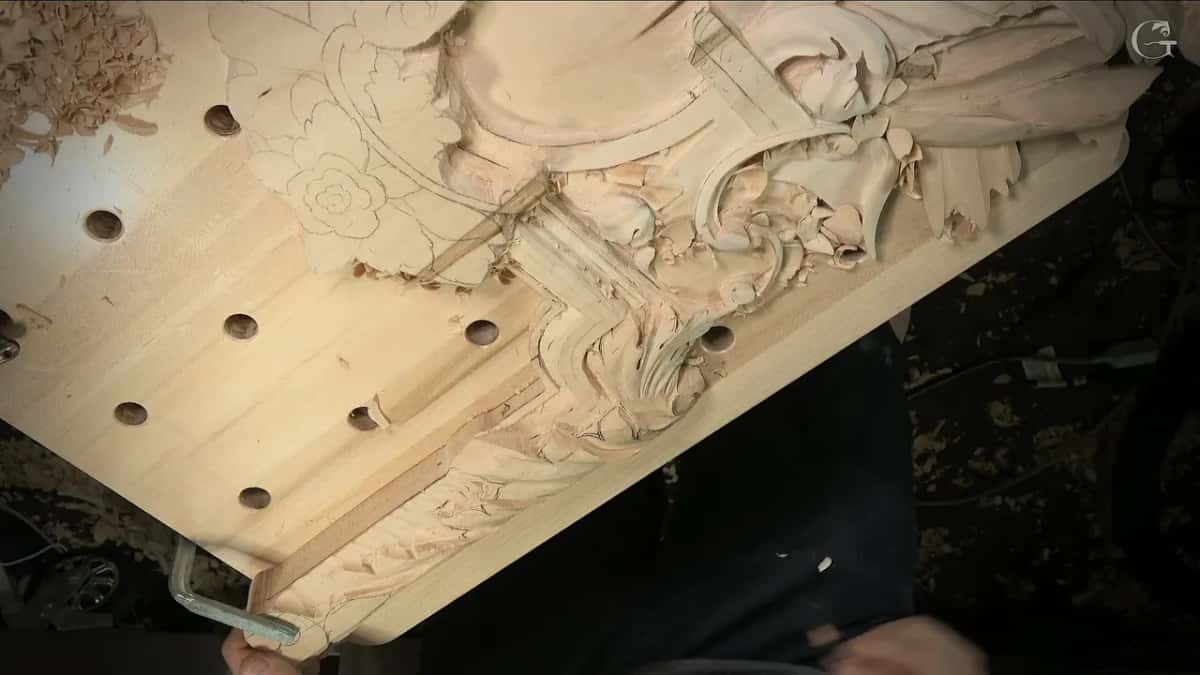
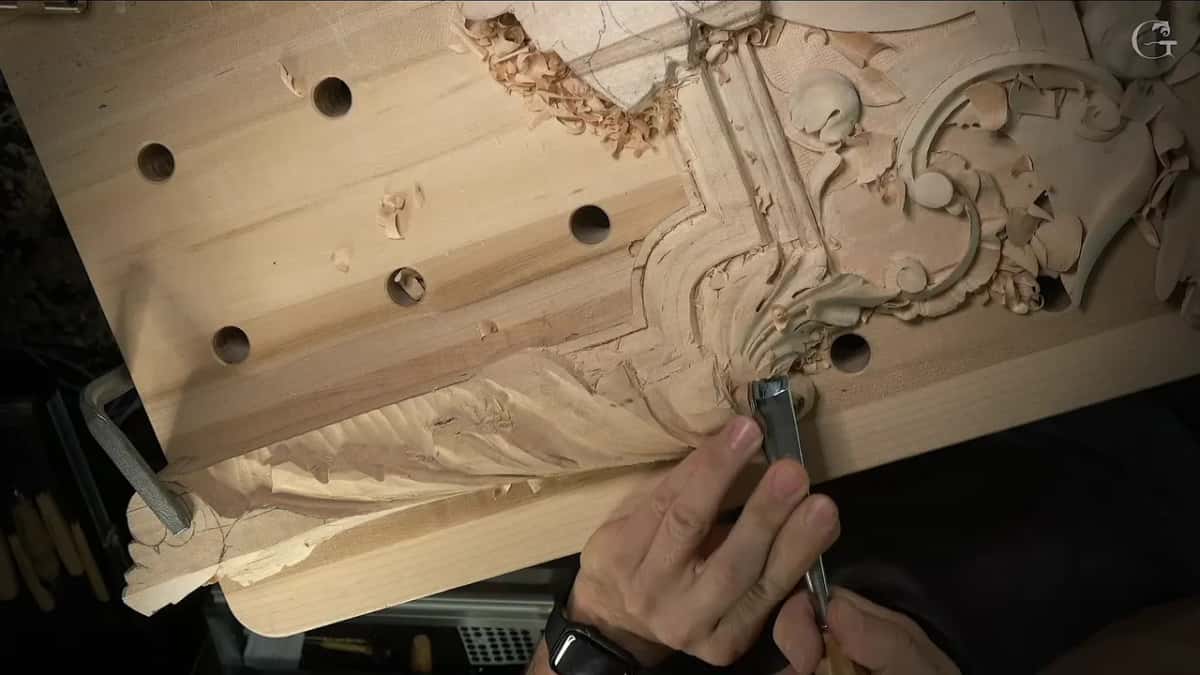
That first picture is the panel from above, with a pencil rosette still waiting to be carved next to the carved scrolls.
The style in five short lines
My room belongs to Venice, around the year 1500.
Part of a Venetian acanthus, I said, has to come out round.
Pipes stay fat on purpose.
Carvers then learned inside a shop, watching a master at work daily, and they worked out a leaf of their own.
Baroque alone says little; add which one, and when.
What is the Venetian style in wood carving?
For my room it means Venice around 1500, the dates I gave on camera in one livestream while I was working on a single section of it, with specific tools, I said.
That section was about 10 feet, roughly 3 m, long. It's big, I said, and it's still only one section. Corbels come on this side and on the other side too, big ones, huge, all the way to the end of the board. And the whole thing has to extend up, all the way to the ceiling.
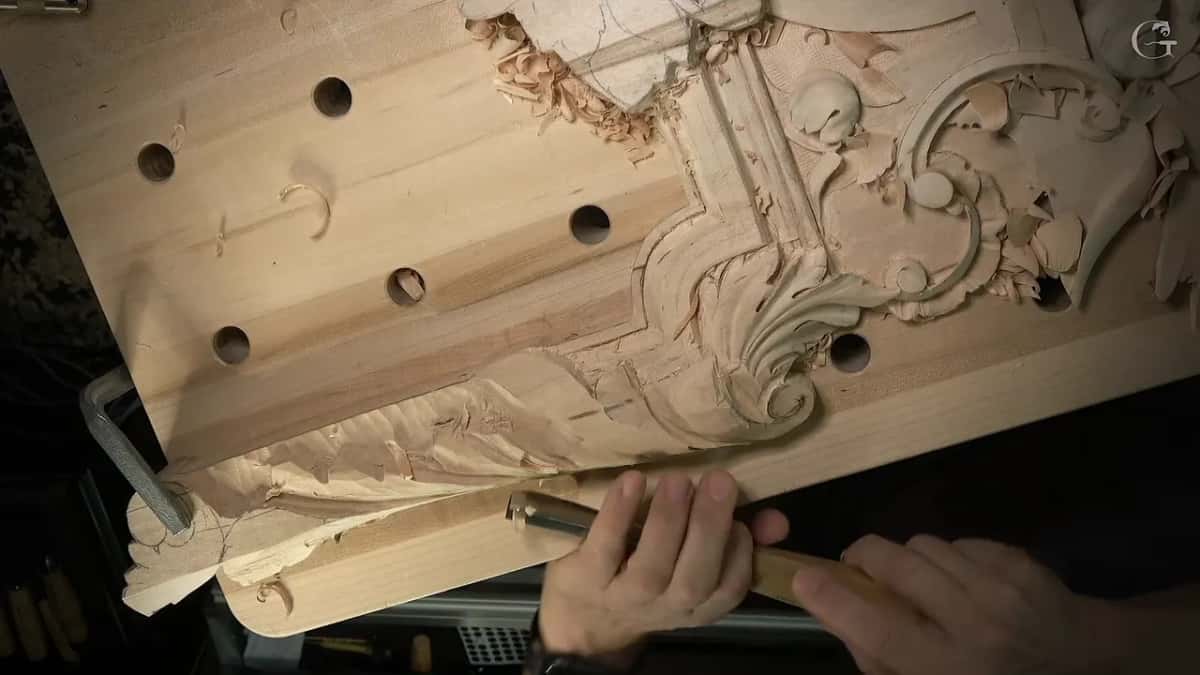
Where does workshop 163 begin?
On the Byzantine carvers and their gold, as it happens, a story the course page for Part 14 tells in full. Back to the leaf after that. A ridge on the right side stays somewhat raised, but it doesn't have to stand completely up. It could rise and slowly go down, I said, to give it a smoother look.
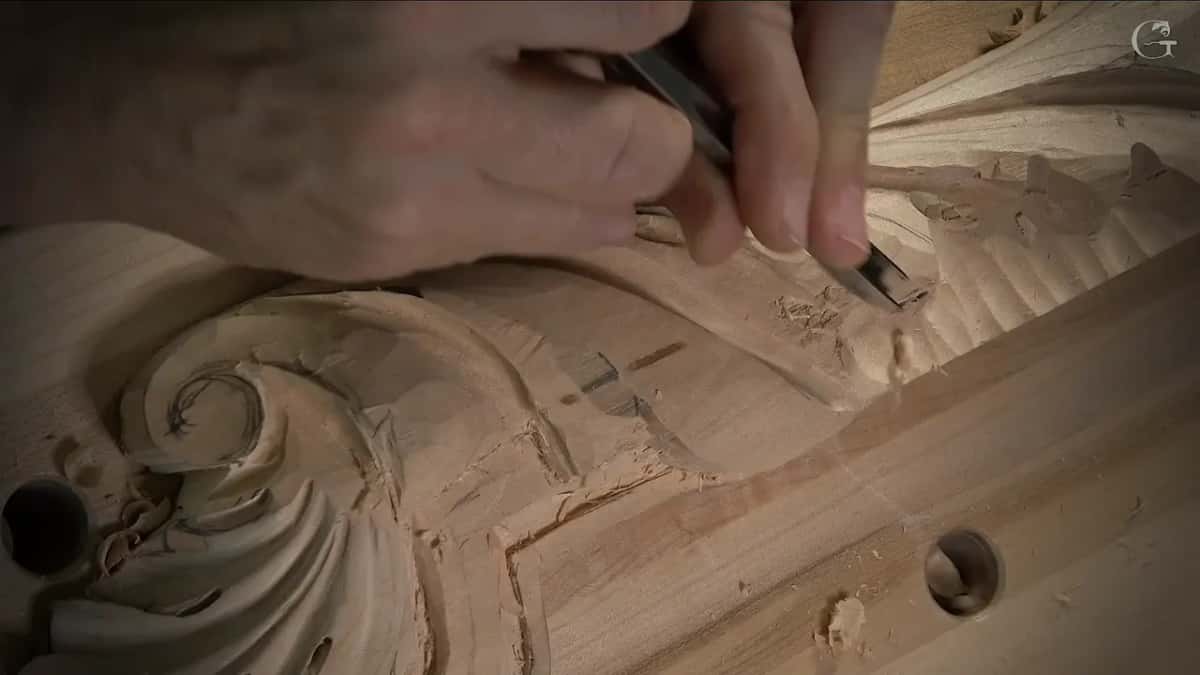
I said I could take a number two again, or a number three would work, I don't know, I just kind of change my tools. After that I blended until I had a really, really pronounced pipe. Obviously a pipe like that needs blending in both directions.
One more cleanup pass came next, with a big one, 5/8 of an inch (16 mm), to make another concave in that area. You can see it's already establishing the movement, I told the camera, and I love it. So far, I love it.
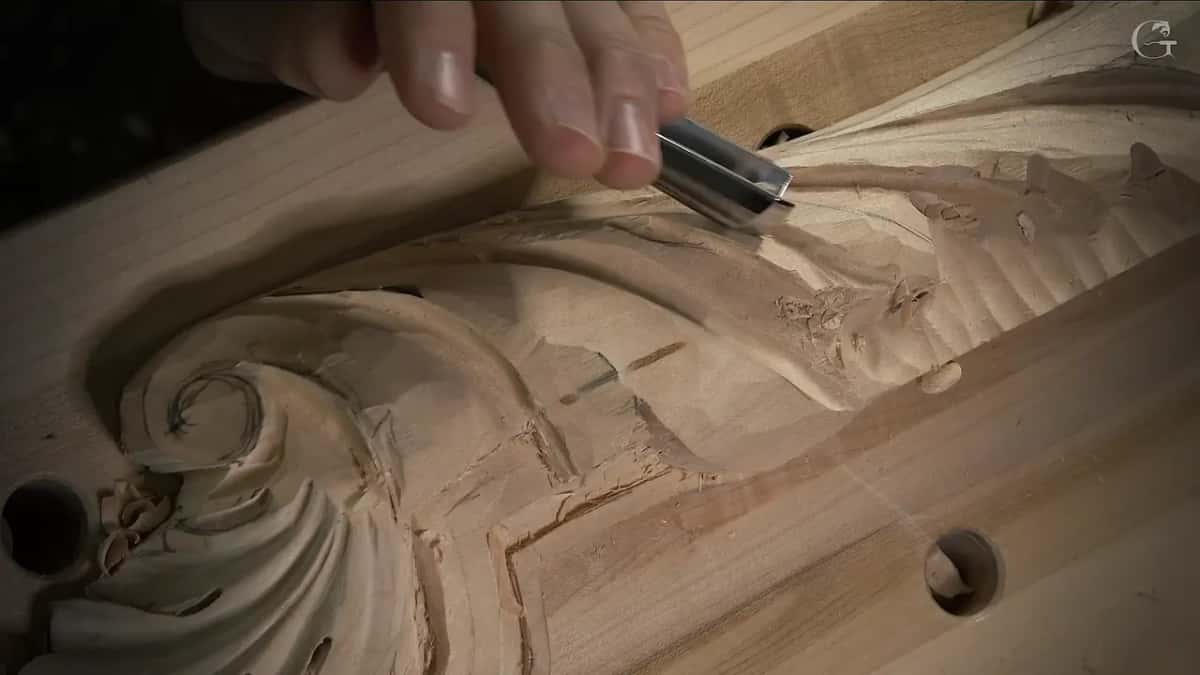
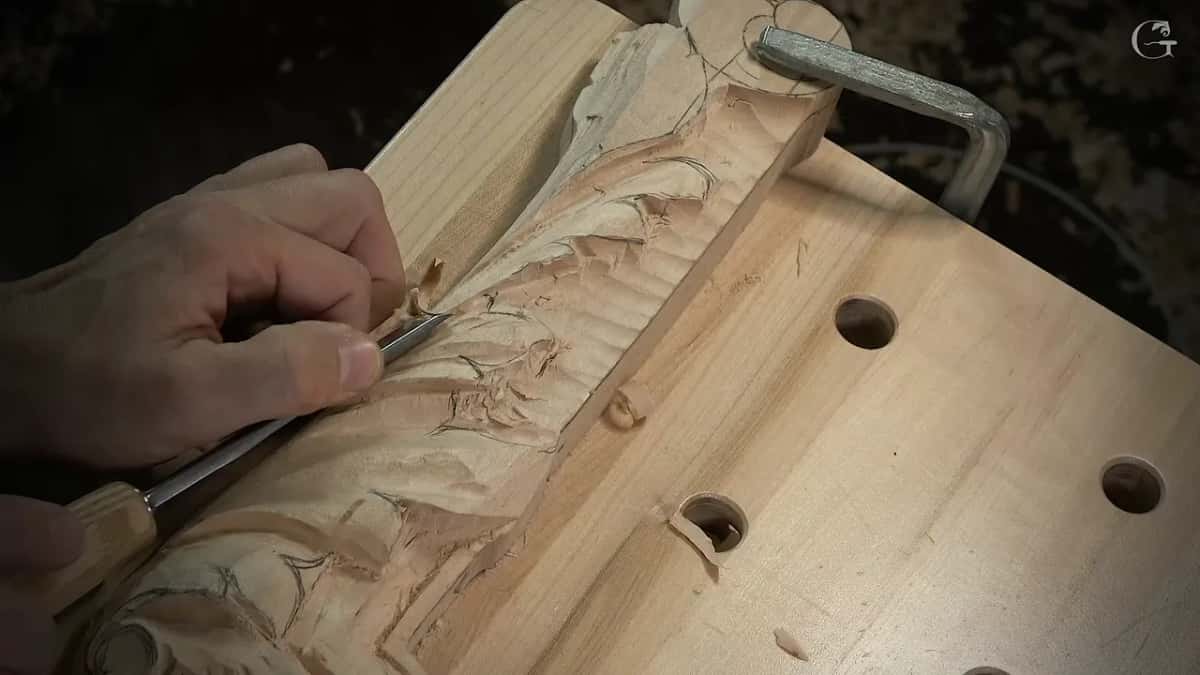
That frame comes a few seconds after I named the big one, and it shows a deep gouge over the leaf.
The other side got a lesser pipe. Still an important one. That part was already raised, so I didn't do anything too extreme there; I just rolled it, and there's almost no concave.
To blend it in I reached for a number two at 10 mm (3/8 in). Ten was a little too big, so I tried 8 mm (5/16 in), and eight was good. A number 11 at 4 mm (5/32 in) then cleaned a little underneath.

Right then I thought about exaggerating the eyes of the acanthus, before I lost the position of them. On one I wasn't sure I'd do an eye at all. Maybe I really don't need to, I said. Just keep it smooth.

How does one long concave change the leaf?
In lesson 163 a long concave raised the middle of the main movement. I was somewhat happy with the leaf, except it did not look too good yet, so I needed a long concave again to raise up the middle part of that main movement. Long and big, I said, and that meant 15 mm, close to 5/8 in.

Even bigger would do, I said, so I took 20 mm, about 3/4 in, with just a little blending after it. I love the overall shape. See? I think it's beautiful.
Next, with the same big number 11, I began working my way toward the volute. Really not convenient, I said, because of the camera positions.
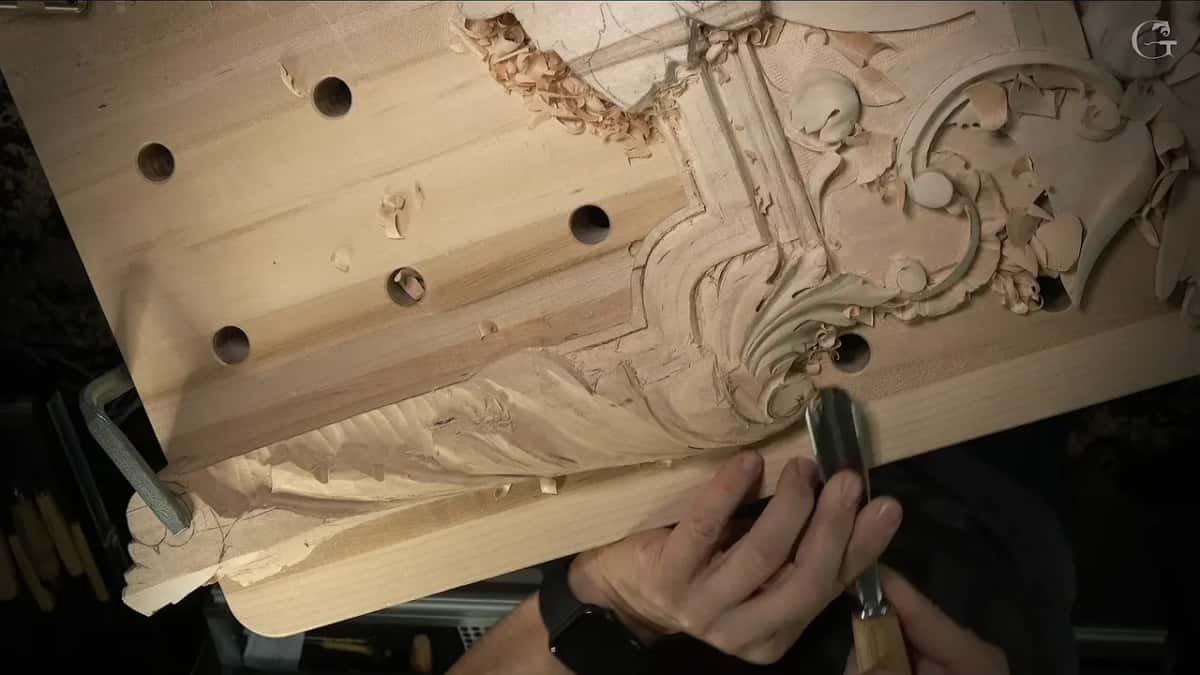
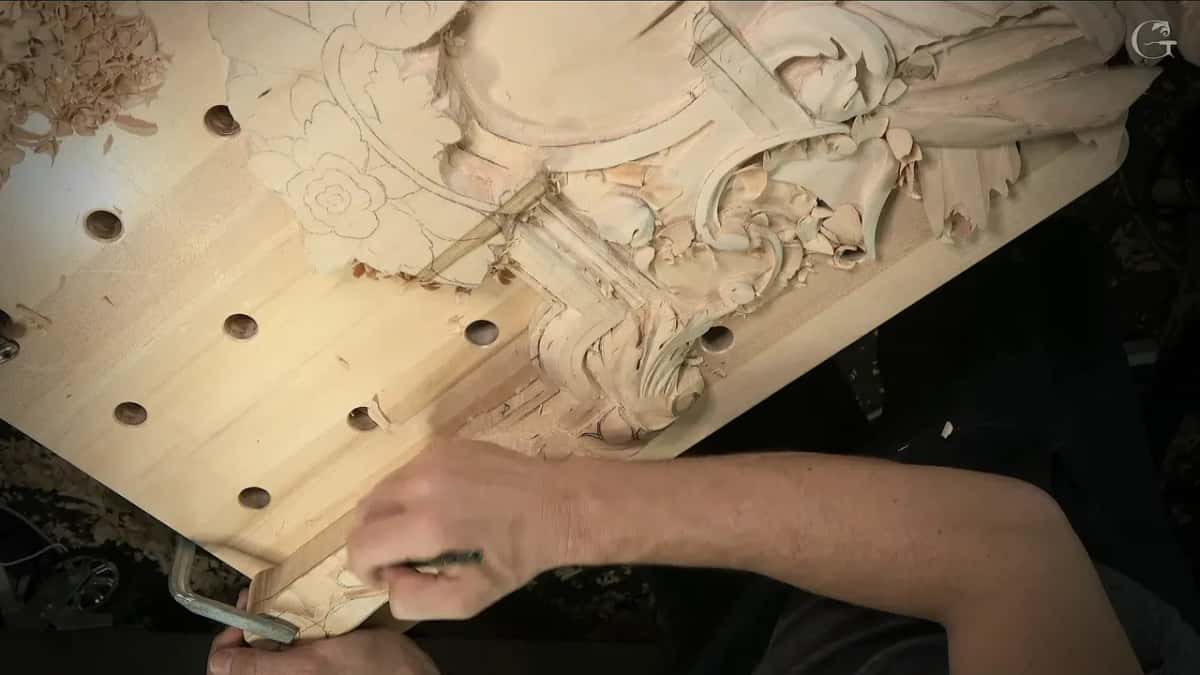
That frame is part two, seen from above, with the bench dog holes on the left and my hand at the corner of the panel.
Why are the pipes on a Venetian acanthus so thick?
I really love really thick and big pipes, I said in my wood movement livestream that April, and on that panel it was because I had to be authentic to the Venetian style. Those pipes were going in right there, and all of them were supposed to go to the center.
Near the end of the room, workshop 163 has pipes of its own. The main one came out really pronounced, as you saw above, and the lesser one on the other side got almost no concave, rolled rather than hollowed.

What shape should a Venetian acanthus have?
Round, close to a ball, in one part of it. In the livestream where I talked about plastic as a carving tool, I looked at the acanthus I was developing. I could see already, I said, that I wasn't accurate to the Venetian period, because this part of a Venetian acanthus has got to be almost like a ball.
Like round like this, I said, and that was my correct boundary, with the next part round as well. That is really, really important if you know a little bit about Venetian style, Italian. And there are different acanthuses, of course.
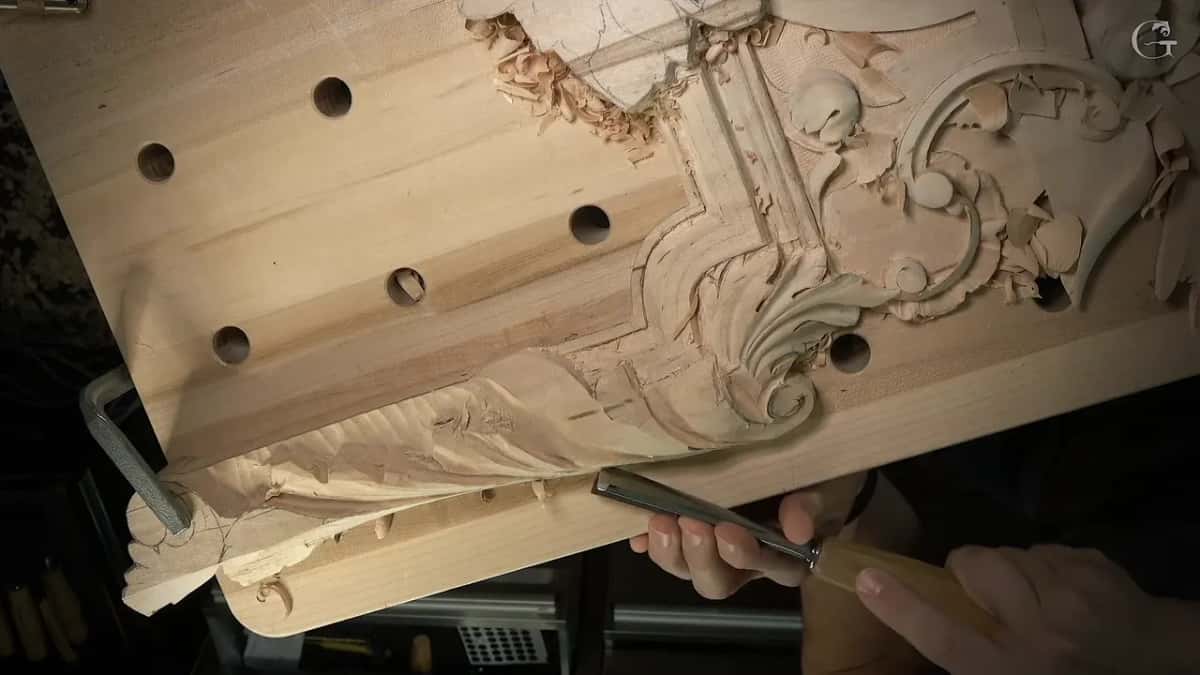
Workshop 163 had a smaller problem of its own. In part two I wasn't sure whether to lower one spot or give it another division. A spot was just a little too high, so I rolled it a little and blended it nicer, and now it blends much better, I said. A nice and smooth movement came next, a long one.
Who carved acanthus like this in Venice?
Masters in their own shops, with young people watching them every day. Back then, in those two centuries, people mostly stayed home and learned from the generations before them in the same town, which the page for part one of the room tells in full.
In Venice, I said in a livestream, they also had some type of guild. It's not exactly like a guild in the UK; it was a bigger idea. I described a guild as one main guy and a lot of apprentices working for seven years before they actually start carving, and I said Venice had a similar idea.
They had a woodworking shop, maybe more than one, and a stone shop with stone carvers too. The masters who knew how to carve stone or wood gave that skill to younger generations just by showing the techniques they used.
Apprenticeship is not like lectures, I said. Those people were inside the shop daily, watching the process and getting the way the masters did their work. So the Venetian development rested on one guild at that particular time, and they developed their own idea of acanthus leaves and their own idea of shells.
I was an apprentice myself at 16, the only one under a fine art master in Russia.
Where did the Venetians get the style?
From work that takes its roots in the Byzantine, in my own telling. In the spoon gouge livestream I said that if you go to Orthodox churches in Bulgaria, Romania, Russia and Ukraine, you will see similar work, and that pretty much the Venetians adapted that style.
And it is gold leaf on the inside and also on the outside, I said. My room is not. In lesson 163 I called it just paint grade.
Source | Said | Where | Shows |
|---|---|---|---|
Questions livestream, 2020 | Venice, late 1400s into the early 1500s | one section | about 10 feet long, ceiling high |
Plastic tool livestream | this part has got to be round | my boundary | the leaf nearly round in places |
Wood movement livestream | I love really thick and big pipes | every pipe | runs toward the center of it |
Same questions livestream | one main man, apprentices, a stone shop | inside daily | their own acanthus and their shells |
Lighting livestream, April | calling it just Baroque, a big mistake | silly label | a style name needs a century |
Lesson 163, Venice | a pronounced pipe, then a lesser one | 20 mm | long concave lifts the main movement |
Each row in that table is one thing I said, where I said it, and what it shows on the wood.

Is Baroque the right name for this kind of carving?
A style name needs a place and a century, by my own words in another livestream that April. My piece is specific to the Venetian style, I said, to Venice, 15th and 16th century, because you can't just hang a general style name on it. A lot of people make a mistake when they say, oh, I carve Baroque.
What type of Baroque are you carving? It would be silly just to say you are carving Baroque. Baroque from France? If yes, then let's say which Baroque, and from what century.
How does the room end in workshop 163?
With divisions, small shadows and a few passes saved for off camera. I lowered one area and started my divisions: a big one, one running right on the side, and soon I had three divisions, with another long one after that. One piece stayed untouched. Everywhere it's going to be the same pretty much, I said, and not too detailed in this case. I really don't need to.
Another area I wanted to wrap somewhat lower, almost to the level of that future molding, and I said I'd probably develop it a little later. The wrapping part goes off camera, since I really need to turn the piece the other way to attack it. From that position it would be hard for me not to cover the cameras, I said.
In part three I changed the position a little; you don't see it, I said, but it's there. Cleaning came next. I attacked from that side with a number 11, and a smaller number 11 went right underneath. A smaller one still followed, since I didn't need much space there, and with it, at 2 mm (5/64 in), I made another pass.
It's still going to give me a shadow and really good separation, I said, and I think it's going to blend much better. One millimeter came after that, about 1/32 in, and I wasn't sure if I should. Maybe it's overkill in this area, I said, but it gives me a beautiful shadow, even if you don't see that much on the camera.
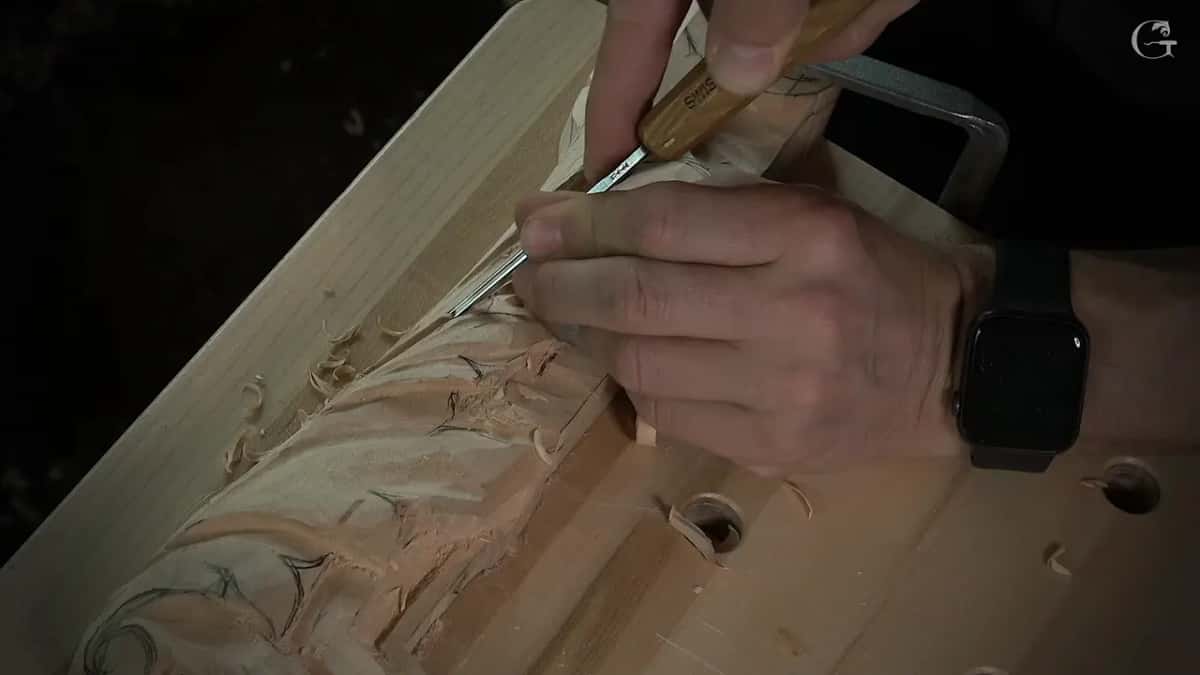
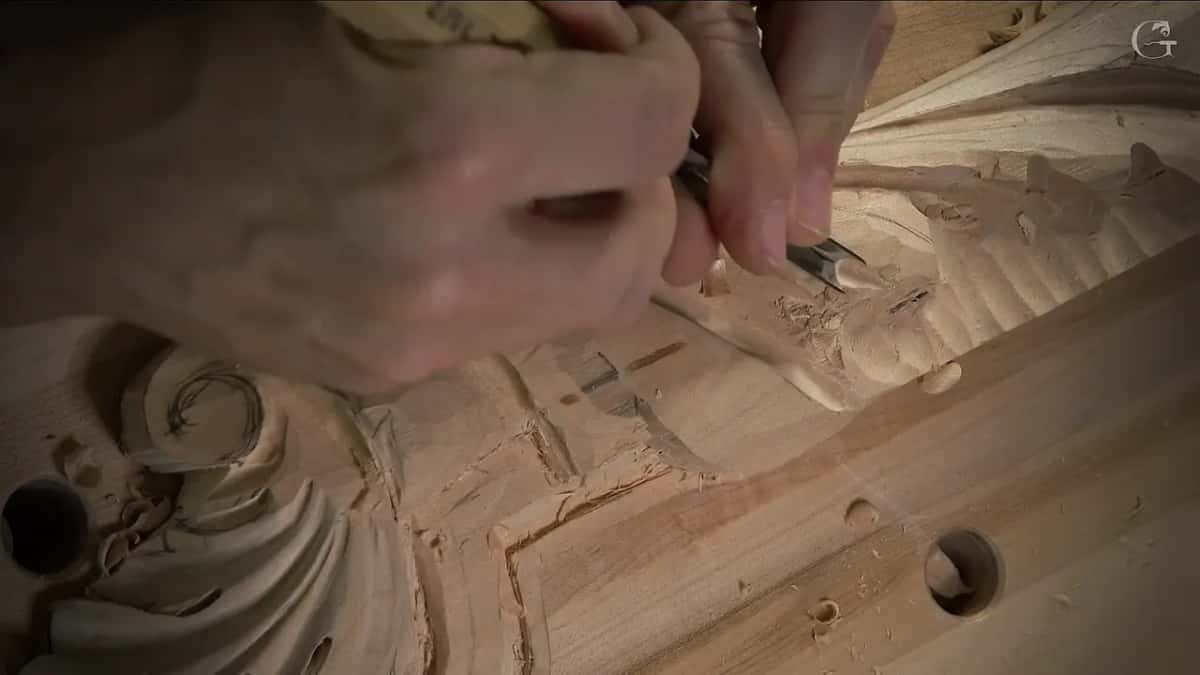
Relief cuts went inside those triangles. The rest I said I'd do off camera, because I have to attack it from a position where there is almost no way to readjust the cameras. The flower too, the same flower as before, and if you want to know how to do the flowers, I said, the best project to watch is probably Hashemi.
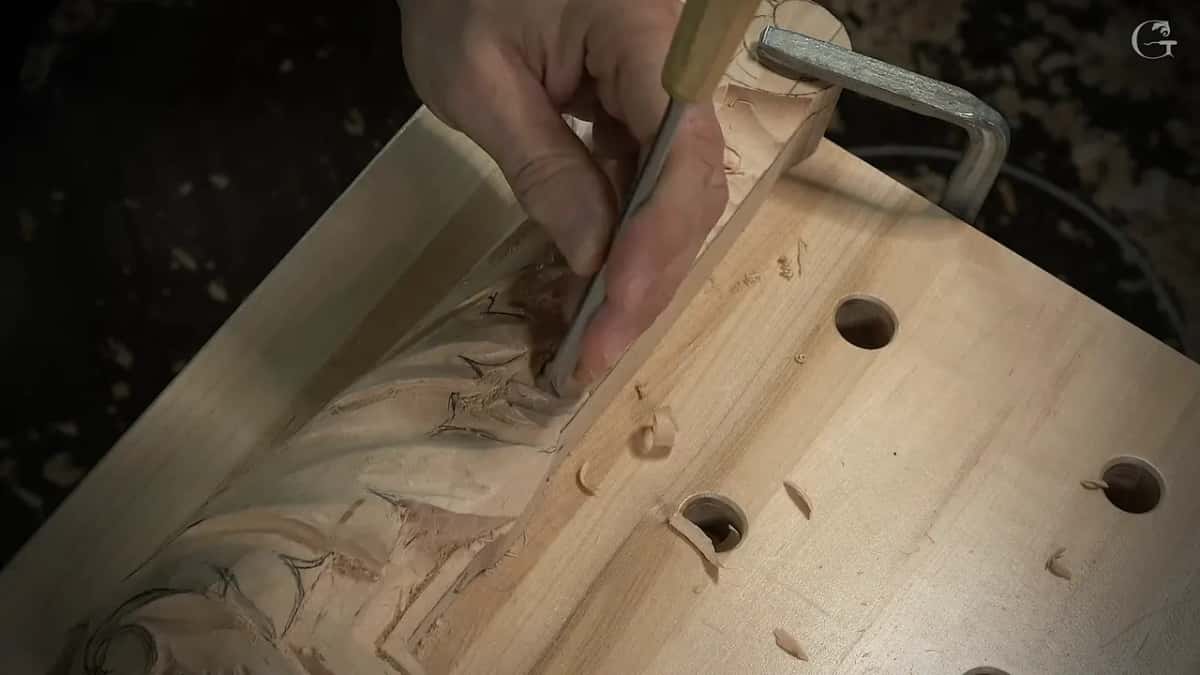
In that frame the gouge stands straight up, a few seconds after I named the relief cuts.
Yes, I will make the details, I said in part two, but you should be able to get the idea. You should be able to see how it looks in overall movement, and of course I'm going to show you. At the close of part three I said I would readjust my table, work on it and show you the final result, and the other side gets exactly the same.
How I carve an acanthus head in this style earlier in the room is on the Part 2 course page, and a flower rosette in the same Venetian manner has a course of its own.
The rest of Part 14 is close by. Lesson 156 is about which wood is waste, 157 about the number 6 gouge and 158 about blending. Number 4 belongs to 159, while 160 is measuring against your eye, 161 carves an ogee by hand, and 162 is about the part you cannot see.
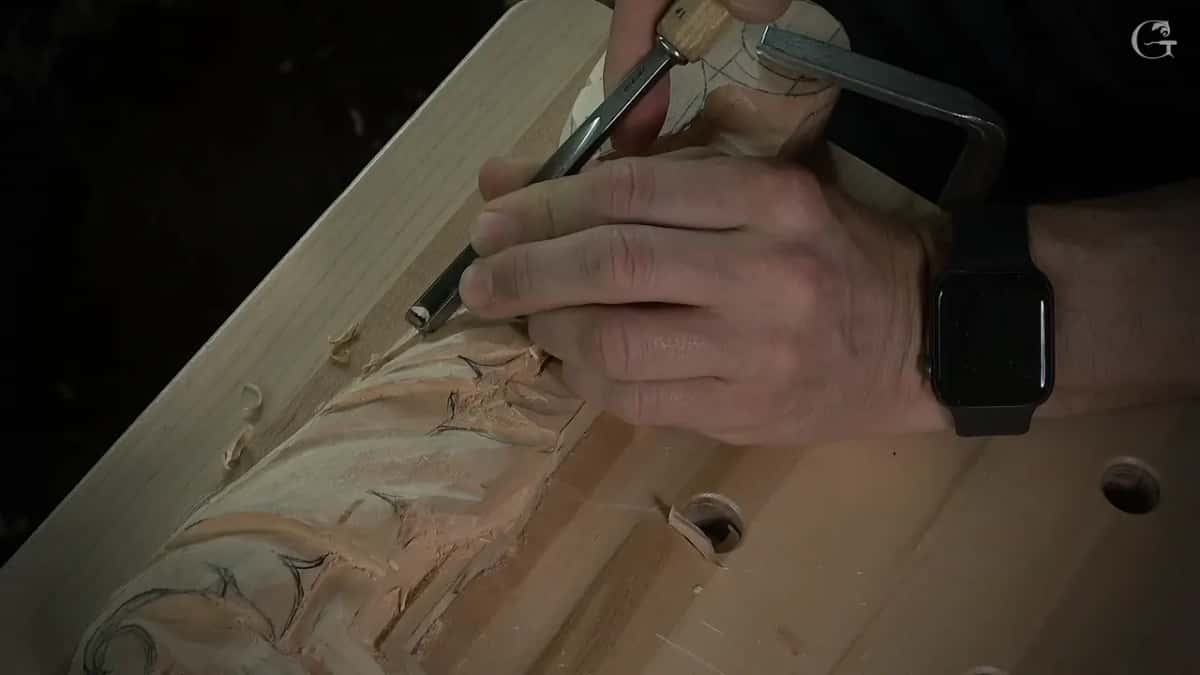
Would you like to watch these last passes up close, pipe by pipe? Do you want the room around them too? You can watch lesson 163 in its three parts, and it all opens with tuition to the school, monthly or yearly, renewing automatically until you stop it.
How it's done
- Name the city and the century. Before you call it a style, say where and when. Mine means Venice, late in the 1400s and early in the 1500s.
- Bring a section round. Bring that section of the leaf almost round, the boundary I set for a Venetian acanthus in one livestream.
- Leave the pipes fat. Keep the main pipes fat, and run each one toward the center, as on my April 2020 panel.
- Blend each pipe both ways. A pronounced pipe gets blended in both directions. A lesser pipe on a part that is already raised only needs a roll.
- Lift the middle with a long concave. Beside the main movement, a long and big concave raised its middle in lesson 163, first at 15 mm, then at 20.
- Finish with small number 11s. Right underneath, a 2 mm number 11 gave shadow and separation and blended better. A 1 mm followed, and then relief cuts in the triangles.
Frequently asked questions
How old is the Venetian style in your Venice Room?
Late 1400s into the early 1500s. I put it in the later 15th century and the beginning of the 16th while talking about one section of the room in an April 2020 livestream: ten feet long, with corbels planned on both sides and carving running up to the ceiling.
What shape tells you an acanthus is Venetian?
A round one. Looking at a leaf I was developing, I told a livestream audience I wasn't accurate to the Venetian period yet, since that part must be nearly ball shaped. Fat pipes count as well, and I like mine really thick on a Venetian piece.
How did Venetian carvers learn their trade?
By watching, every day, inside a working shop. I described a guild with one main man and many apprentices, and said Venice had a similar idea, with wood shops and a stone shop. Masters passed the skill down by showing their techniques, not by lectures.
What to carve next