

Alexander Grabovetskiy, woodcarver, School of Woodcarving · Published 2020
What does approximate mean in wood carving?
Quick answer: Approximate is my word for a line, form, depth or size that is close and not yet final. In part 7 of workshop 31 I used it for a boundary I set and for a movement I checked from below. Other lessons use it on forms, depths and sizes.
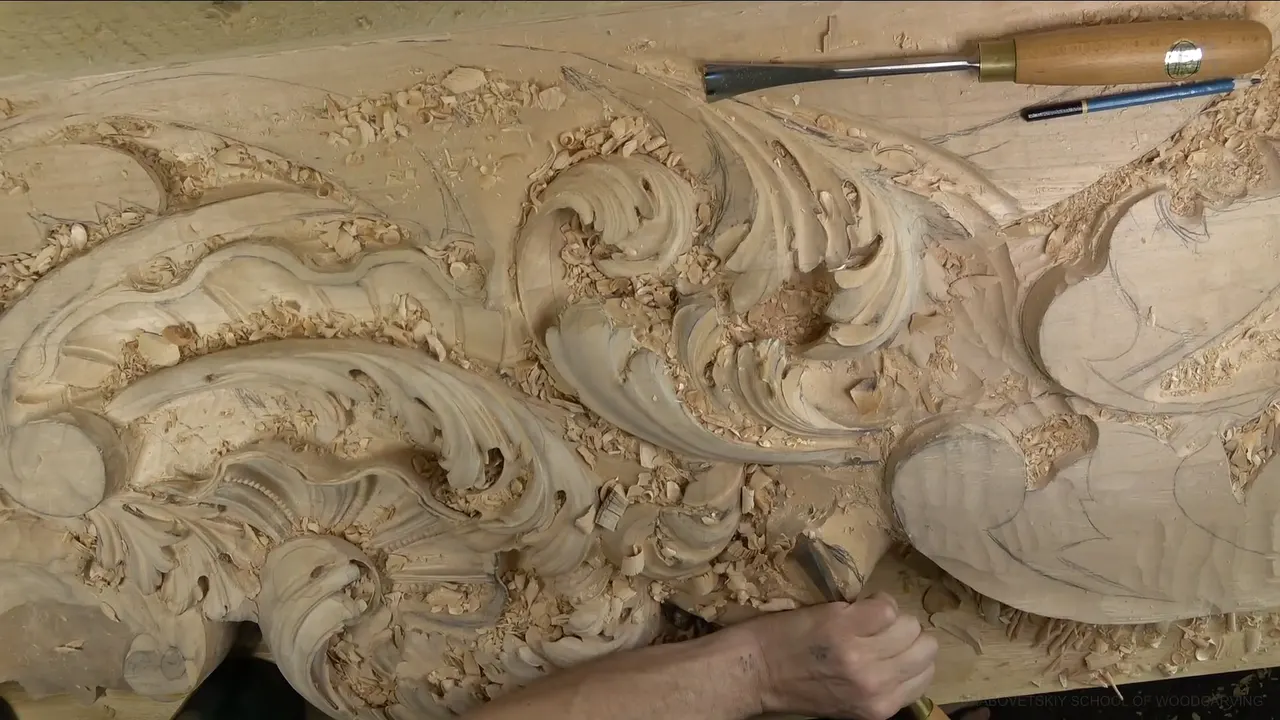

Approximate is the word I used in Venice Room 31, part 7, for a boundary line, and again for a movement I was checking from the bottom up. Work still waited after each one. Other lessons of mine use the word for forms, depths, positions and sizes, and the numbers are on this page.
Ever marked a line on a wood carving piece and wondered how exact it must be? Would it help to hear what I mean by close? The part comes first, then the other lessons where the word turns up. For the general idea, Wikipedia has a page on approximation.
What did approximate mean in part 7 of workshop 31?
It begins with a slope, which I show "from a little farther" so you can see how it is supposed to look. Then I add that I can give it "an even bigger slope. A more pronounced one." My next words are "Just like that."

Next I clean the side, "material I'm not going to need." Maybe number seven, I say, and then "number seven is good." My verdict on the slope has a limit on it: "pretty close to the slope I want to see, except I need to clean this also."
Now the word itself. A line sits "somewhere right here," and it is my stopping point. I have to "keep in mind how I'm going to develop that detail," and I can start shaping that direction, maybe with the same tool, to "just remove what I don't need." The line this page is named for arrives here: "So that is going to be approximate boundary."

My own correction follows. "And yes, I need to shape it much better." So an approximate boundary was not a finished one, and the shaping still waited. Maybe number 11 comes next, to clean again, and I could go even deeper if I wish, which would give me even better detail.
"Okay, that is good." Next comes a need, to pre-establish the main movement "that way," and to probably clean "this way, too." My next line is "I attacked from the right position now."

Which tool came out next?
A chisel is next, "skew chisel, I should call it." In England, I add, "it would be a number two." Near the end comes a plan to "check and double-check how nice it goes from the bottom up."
The second use of the word comes right there: "And that is approximately what I want to see." The limit follows: "Except I kind of don't like overall movement right here. But I can always take care of it with no problem." Close, with one movement still to fix.
Can a line be approximate?
I said so in another one of my courses. Modern Acanthus 2, part 1, opens on drawing: "You don't have to be exact," I say, and I tell you to draw right on the inside. "You know those approximate lines." Developing that section is the job ahead, which is step number two.

A boundary can be approximate too. In Venetian Flowers Rosette 2, part 2, I do not want to make something too big, "because right now it looks huge." "I need to be in my approximate boundary," I say. My center is still to be decided, and I will probably relocate it somewhere right there, so it points that direction.

The main shape is done in part 3 of Venice Room 132, and I have to redraw everything. "Got my line work reestablished. Approximate, okay, so it's not really critical for me." Now I can see "exactly what is going on," and what I have to clean.
Boundaries come up in other lessons too. The nearest to my own words is part 4 of Venice Room 90: "For me, it's really important not to rush it." Then, "So that is approximately the boundary, my preliminary cut." Carving across the grain waits, with a bigger tool, and I can use a number seven. Also, "I have to be really careful not to hit this line because it would be big mistake."
A jigsaw gets the word in Venice Room 75, part 1. I think I can just use a normal jigsaw and "cut this roughly. I don't need to really be on outline. It's approximately." Then, "That is the boundary I have to cut out." Before that, I say, I removed a section on the other side with the gouges.
What does an approximate form look like?
Rough, with a promise. In Venice Room 52, part 4, a center line is coming, and I hope you can see the overall picture. The relief cuts are done, and now I am going to just chop. "Chop to approximate form. It's not the final form yet, but approximate." Concaves and convexes wait on the side, "but at least I have something to work from."

Venice Room 132 uses the word again, in part 1, on a plan. The carve has to go straight down, or I lose the position of the lines. It is "not really critical right here," yet it makes the next part easier, one right and one left, "to calculate approximate shape."
Vase with Grape Leaves 3, part 2, puts it on a result. I make vein movements with a number eight and say you could use a number 11, "I really like the number 11." I point at the work, "approximately" the look we want. Every concave creates some kind of triangle, I say, and we want to exaggerate the triangle.

A shell is the subject of Venice Room 5, part 3: "It is going to be a beautiful shell." A check follows: "The distance right here has to be approximately equal everywhere, which is not the case right here." My move is toward that direction, and then: "Now it's close." Inside, the distance is "about the same," or "supposed to be approximately the same."

How close is an approximate depth, height or position?
The lines here carry no number. For Venice Room 85, part 8, I say, "Let me clean first. Not clean, but somewhat clean, I should say." Later a flatter gouge could do it, or even a number seven, and then, "Just get to my approximate depth."
The words "approximate height" come in Venice Room 87, part 6, and soon "the highest spot." About the position I first say it is right, and then change my mind: "Well, actually not, I have to measure from both sides."

Venice Room 46 gives "approximate position" with a complaint, in part 8: "I'm not really happy about this chunk being that far, so I want to hide that somehow." Then, "Let me get a little closer to this one."

A separation is the subject of Venice Room 62, part 8. I could do a middle line there and put the separation "somewhere right here," which brings it "in to this point approximately." I think it will be good. Another separation on the inside comes next, and I need "beautiful roundness" in that area.
Calipers join the word in Venice Room 86, part 7. I want a point "approximately" right there, and I say why: "that's approximately because it changes the plane, but I should be okay. I can always refine later on." A few lines before, I said what I had left, "maybe six millimeters, maybe seven millimeters" (about 0.24 to 0.28 in), and "that's plenty for me."
How much wood do I leave when I say approximately?
Here the lines give numbers. Each row below is one of them, in millimeters and inches, my figure first with the other unit in parentheses. I gave a number each time, with "approximately" or "about" beside it.
| Lesson | What the spot was like | What I said about the size |
|---|---|---|
| Hazelnuts 1 | A final outline, with wood left before the line | Three-sixteenth of an inch, about five millimeters |
| Corinthian 2 | The background cleared with a big gouge beside the line | About 1/16 inch (1.6 mm) |
| Greek 11 | A rough carve beside a rib with the corner of a tool | One 16th (1.59 mm) |
| Chamomile 3 | A border for the beads, marked by eye | 3 millimeters, an eighth of an inch (0.12 in) |
| Roman 12 | A return on the eyes, eyeballed | Half an inch, about 12, maybe 13 millimeters |
| Roman 12 | A pipe lowered, with room to undercut | Maybe a 16th down (1.6 mm), then about 3/32 (2.4 mm) |
| Furniture 16 | Work around some elements, with extra wood left | About 3/32 of an inch (2.4 mm), a couple mills |
| Venice 50 | A number 11 for the separations | 15 millimeters (0.59 in), about five-eighths, not exactly |
Hazelnuts 1, part 1, gives a reason for the gap I leave beside the line. A final outline, I say on the hazelnuts course, is "not that critical." Still, I would like to stay away "approximately, I would say, three-sixteenth of an inch, about five millimeters" from the line, "just to make sure you don't hit that thing when we're going to remove the whole chunk." I add that I have seen "a lot of guys who made the mistakes" in how they handle that operation, "just removing a lot of chunks."

In Corinthian Acanthus 2 I say a smaller gouge could do the same job, even a number nine, 20 millimeters (0.79 in) in my case. But "I prefer the big gouge because I can take a lot more material at once." The rule is short: "You stay approximately, I would say, about 1/16 of an inch from the background line, and you'll be safe."
The Greek lesson 11 has a rough carve beside a rib: "I'm staying approximately 16th of an inch from this rib down." The reason for staying high is in the next breath: "Later on, I can bring it up, but for now, it's a rough cut, and it is safer to stay a little higher."

Furniture Panel 16 has the other side: more wood, on purpose. I plan to leave a little more material than I need, because "later on, I can always make it smaller, or I should say narrower." For now, "I'm going to leave approximately 3/32 of an inch, a couple mills," and some spots may be thinner. Then, "Just go around."
Marks are approximate when I set them by eye. In Chamomile and Bow Rosette 3, part 2, I recall, "I left approximately 3 millimeters, eighth of an inch border, and I eyeballed that, of course, and placed my line." Advice follows: "make sure you do that as accurate as possible. For me, eyeballing is probably one of the best methods." Beads come next on the chamomile rosette.

Roman Acanthus 12 shows a return on the eyes of a leaf, which I say artists and sculptors in history added. "I'll do just approximately maybe half an inch, about 12, maybe 13 millimeters, and I'm eyeballing." Then "about maybe 10 millimeters right here," and "about three-eighths of an inch, 10 millimeters." Later in that part a section of a pipe goes down: "approximately, maybe I am doing about a 16th of an inch down. You could do a little more," and then "about maybe 3/32nds."
The 3/32 would give "ability to undercut and create extra shadow, which is going to look beautiful also," I say, and I plan to refine those ridges later and make them round. Each number here is a size I said aloud, with a hedge word in front of it.
When does approximately not mean exactly?
I say so out loud when I know a figure is off. In Venice Room 50, part 2, a number 11 comes out, "15 millimeters again" (0.59 in). Then: "Approximately five-eighths of an inch. It's not exactly five-eighths of an inch, but approximately." Five-eighths is 15.9 mm, so the two numbers sit a hair apart, and I say so.

An angle gets the same treatment. Leaving a slope is the choice in part 8 of Venice Room 87: "Originally, I didn't plan to have that slope, but I think it's going to give me really nice movement." Of its angle, I say, "approximately, I don't know, it's not exactly 45 degrees, but it's still angled." Then I add, "I'll change that design a little bit."
In one lesson I took the word back. The final assessment of the butterfly plate course uses calipers, and a compass would do too: "Get pretty close to the center. Approximately, not exactly to the center, but approximately." About the center of whatever sits inside, I say it is "actually exactly the center." Both sit in that butterfly lesson.

What would I look at on my own board?
Which pencil line on your own piece is only approximate today? Is it a boundary like the one in part 7, a form like the one in Venice Room 52, a depth, a height, or a size you mark by eye? And what comes after it? The part 7 video went shaping, then cleaning, then a check from below.
The lessons linked here show me working through each of them. For my lessons in one place, start here. The workshop 31 lesson and the Venice Room course for workshops 26 to 37 hold the rest of this carving. These videos come from my Venice room carving and other courses, and the numbers on this page are mine.

How it's done
- Set the boundary. I pointed to a line somewhere near and called it a stopping point.
- Remove what you do not need. I could start shaping that direction, maybe with the same tool, and just remove what I did not need.
- Call it approximate. I named the line an approximate boundary and said it needed much better shaping.
- Pre-establish the movement. The main movement needed pre-establishing, and probably more cleaning one more way.
- Check from below. I had to check and double-check how nice it goes, seen from underneath.
Frequently asked questions
What was approximate in workshop 31, part 7?
A boundary, and a movement I checked from below. I called the line an approximate boundary, and near the end I said it was approximately what I wanted to see. Shaping and cleaning still waited.
Did I give a number for the boundary in part 7?
No. I named a line, a stopping point, and said I needed to keep in mind how I would develop that detail. A number does not appear in those lines.
How much wood did I leave from a line in other lessons?
In Corinthian 2 I said to stay near 1/16 inch from the background line, and in Greek 11 a 16th for a rough carve. The furniture course planned on a couple mills. Each one was said with the word approximately or about.
What to carve next