

Alexander Grabovetskiy, woodcarver, School of Woodcarving · Published 2020
What does hopefully mean when a wood carver says it?
Quick answer: Hopefully is my way of saying I hope you can see, and I mean what the cut did. Venice Room 31.9 has it right before I say I will go deeper. Other courses use it for tiny details and for cuts I am not sure about.
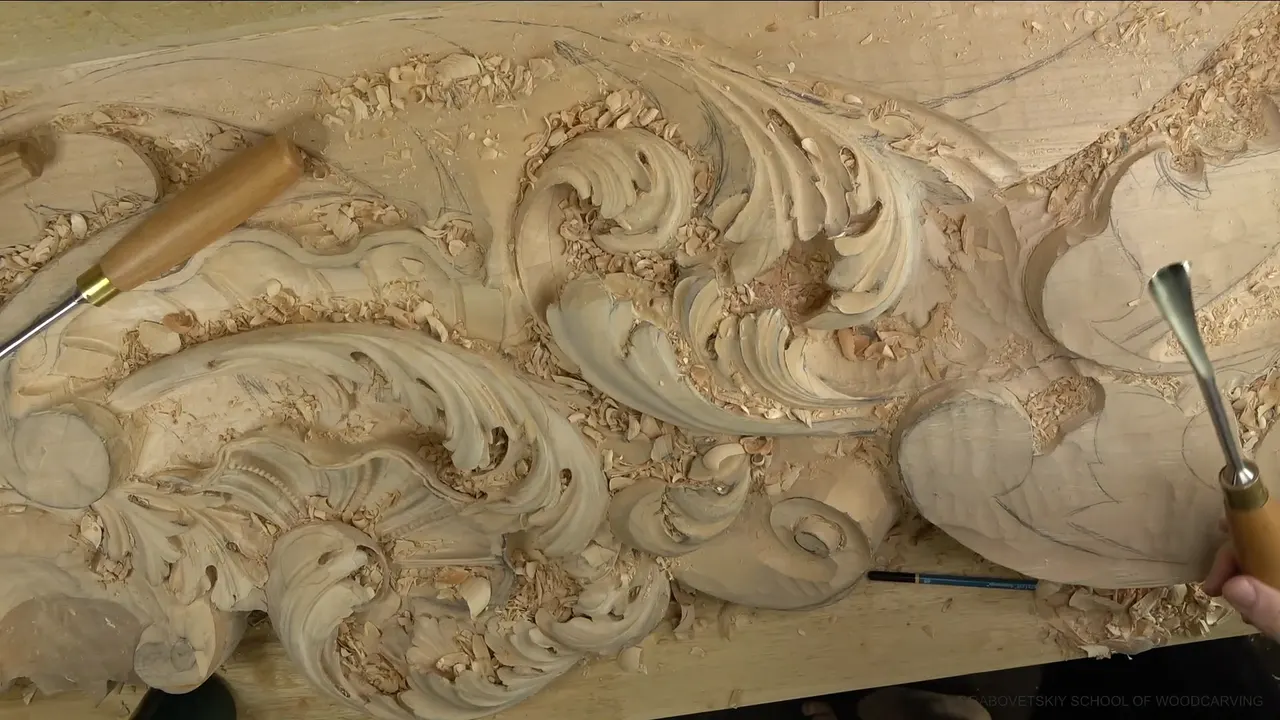
Hopefully is my word for hoping a cut shows on the camera. In Venice Room part 31.9 I said hopefully you could see it, and in the next breath, "I'm going to go even deeper." My other courses use the word for tiny details, and for cuts I am not sure about.
Ever watched a carving video and wondered what the carver wants you to look at? Does a small cut vanish on your screen? Follow one word of mine through my carving lessons, and watch what each line is about.

What does hopefully mean in wood carving?
The first case sits in 31.9. Eight seconds in, I told you I could probably give the overall movement a much better shape, and that I would "just kind of shave around." The shape was not final, "because I still have to roll it this way." My plan for one spot was the number 11, and a little later I wondered if it was a little too big of a tool.
At about two minutes the plan was to take wood off in one direction and "expose more of that middle part of a volute." Half a minute passed. Then came the line this page is named for: "And hopefully, you can see. And yes, I'm going to go even deeper, and it's going to create a really nice movement on inside."
Look at what the word does there. More depth was still ahead, and I hoped you could see the cut anyway. A little under two minutes later I asked for more of your effort: "if you look closer, so you'll see what I'm doing."

Which cuts should the camera catch?
A movement, in several lessons. In workshop 70, part 3, I wanted to make a shape nicer. The way to do it was to "just chop a little bit this side, because otherwise, it's just too much curvature." The word came with "preliminary movement," and with a warning that it still needed cleaning, "but the idea is still the same right there."
Back in 57.1 I needed a lot more material, some of it to go underneath. Moments later "hopefully" came again, this time for "the development." The shape could be finalized pretty much then, I said, with a number five as the gouge, "in this case."

One sentence carries it in 55.11: "And hopefully, you already see the main idea." Then the phrase came again, alone: "The main idea." I had a small chop to make on that side, and I had to be careful how I attacked it, because part of a shell was coming.

The Lily Box course gives me several. In Lily Box 12.3 I told you it is almost out of sight, but you can almost supernaturally detect it. I said I needed to clean that and brush it out, and I hoped you caught the movement. The opposite movement came next.
Lily Box 3.3 adds an undercut. The line was about what I achieved: "It just goes underneath and then flips backward." Cleaning a little bit was next. In 7.3, a cut would go underneath straight, and then I would rotate and go downhill. Not too much force, I told you, and I hoped you saw what I had just done. A really nice movement, I called it.

What if the detail is too tiny to see?
I say so. Hashemi 12.3 has me out of material, and "I can't dig anymore," I said. I still wanted a curl really pronounced. The camera had to catch that, I hoped, and a moment later I called it "a really, really pronounced curl going this direction."

The plainest case is Hashemi 23.2. Number five looked like it worked fine, and I could use number seven in this case. As I set about cleaning the top of the detail, I owned up: "I know this detail is kind of tiny, but I hope you can see the result of it."

A hole comes up in Hashemi 45.6, where the goal was a more realistic-looking one. The hope rode along with a plain fact. I was through to the other side, and that made me really happy, even if it stays out of view. Then my own doubt: "Well, maybe it will be visible."
Over in the Furniture Panel course, 21.5, I said maybe a mallet could take a slope a little deeper. The aim was that you would see what I was trying to achieve. If you look at it the way you are supposed to, I told you, "it should look fine." Going "all the way down" was out, I said, because I needed some thickness to finish that part.
Tool use shows up in Roman Acanthus 16.2. My plan was to keep my tool going as long as possible before I switched. Dropping it for the next tool, just for cleaning, would not be productive. But hopefully you could see that it "actually leaves a really, really nice and smooth surface. Almost like if I would use a router."

What if you cannot see all of it?
I tell you that too. At workshop 91, part 6, I wanted a concave. I wasn't sure you could see it a little better, "but you don't see completely," and hopefully you would understand. This section would be a little different, I added, and the concave would go maybe from underneath.
The Modern Acanthus course, 7.2, had a big chunk of wood to remove, and there were a couple of ways. One was a big tool, "like number nine in my case and 20 millimeters," about 3/4 in. One approach was to start excavating, and "hopefully you're gonna see" it. Then came the admission, "And I know you don't see it," and soon after I asked for just a second.

A knot gave me another reason. In Roman 16.5 I corrected myself on a spot: it was a knot, and it continues to grow "all the way up." "Hopefully, you can see that knot." I wanted to check whether I could get that close. A very small move turns up in Roman Acanthus 3.2: a straight cut down, then a little wiggle. "Just a slight wiggling," I said, and the next spot got exactly the same.
Does the word help with scale and angle?
Scale is one reason. Workshop 65, part 5, has my wish that you feel the scale of the work, how big that piece is. "I want to show you from the side view. So hopefully, you'll be able to catch." The piece runs 10 feet (about 3 m), I said, "to extent above."
Angle matters on a small piece too. In Greek Acanthus lesson 8, part 2, my grain met in one spot, so I had to approach from the opposite side. Hopefully the camera showed it. Next I planned a knife to bring that side to the center. In Hashemi lesson 12, part 8, the tool was a number 12 of eight millimeters (about 5/16 in), and the video ended with my wish that you see my separation from different points of view.
A closer look comes in Roman 16.6. "You can see that better," I hoped. A knife alone could create exactly the same idea, I said. I said not to press too hard. Hashemi lesson 10, part 10, shows a result. "Now you can see what I am trying to get," I said. It was already looking three-dimensional, "at least for me."

A plan sits in Hashemi 16.2. Two concave cuts would sit on the sides of a pipe, and one more on another side. My hope was to show the pipe as it would be. That was just preliminary, I said. I could blend and make that concave cut with a number seven of about 10 millimeters (3/8 in). In 6.12 of the first Venice Room course, number seven worked just fine, "in this case," and I could not rush it. Those beads, I hoped, were already coming alive for you.
The Furniture Panel design lesson 12, part 4, has one with a shade. Some shades would help me see my main idea clearly, and I would shade the piece from underneath. You could see the overall picture, I hoped, and the sense of it. "Well, at least it makes sense to me."
Do I hope you understand what I mean too?
Same word, same job. A marker comes first in Hashemi 8.3, and all of that had to be gone, I said. That would be my main shape, like a boat shape, I said. Then: "Hopefully, you understand what I mean by that." A V-tool was next, and I would approach from one direction, really carefully.

Down in workshop 49, part 12, the same idea runs. A few parts needed movements of some kind, and I hoped you understood what I was doing. My middle line would go underneath and continue on the backside, so I needed some kind of divisions. "Otherwise, it's not going to look good."

Two more come from the Lily Box, and lesson 4, part 8, brings a reason. A hit on my background would leave marks, and I did not want to see those marks. "Hopefully, it makes sense what I'm saying." Next I wanted a concave on the inside. Lesson 6, part 5, goes the other way, to the result. We sloped that two ways, so a more three-dimensional movement would come. You might see exactly what I meant, I hoped, and then I would recreate this volute.

Closer to home, workshop 35, part 1, has it after I planned to blend a cut out to that side. The hope was that you could "detect the idea." Then: "So that is going to be a separation." In workshop 76, part 12, I had been talking about how I clamp my vise. "But I really want to show you," I said, and I hoped you would catch it. Fifteen seconds later, flatly: "And you will be able to see it."

Does hopefully only mean the camera?
Sometimes I hope a piece holds instead. In the Maine class, 13.3, I was going against the grain and going upward, and it did not give me a really nice result. That was just preliminary. "I want to remove a lot of material. And hopefully without breaking." Seconds later: a big chunk. "Good."

Maine 7.2 had me planning to start excavating right underneath. I wasn't sure whether my hand would cover the spot. "Hopefully not." A few lines later: "This flower is really important. Okay, that detail makes the whole world of a difference."
A trial comes in the Venetian Flowers Rosette course, where I would show you different lights and how the piece looks in the shadows. I hoped it would work out, and I told you to hold on just a second. The main lights would go off, and I would rotate the piece to show it from different points of view.
A doubt sits in Lily Box 2.7. The overall picture was not visible yet, I said, but once the undercutting was done you would see all the movements. "Well, hopefully," I said, hoping it would look good. The tiny leaves were not the focal point, and they were more or less like a frame for the main idea.
The last one sits in this very course. Workshop 29, part 6, has a concave that would give me really beautiful movement, "hopefully." A big, deep concave was not the plan, I told you: "It's going to be only number seven."

What did each line hope you would catch, row by row?
| Where | What I hoped you would catch | Also in the same video, nearby |
|---|---|---|
| 70.3 (Venice) | a preliminary movement you could see, before any cleaning | The idea stays |
| 57.1 (Venice) | the development, just before I said the shape could be finalized | A number five |
| 12.3 (Lily Box) | that movement, right before I made the opposite movement | Brush first |
| 12.3 (Hashemi) | a pronounced curl on the camera, once I could not dig any more | A sharp edge |
| 23.2 (Hashemi) | the outcome of a tiny detail | Number five |
| 16.2 (Roman) | smooth, nice surface from a tool kept in use | Like a router |
Each row is a line from a different lesson of mine. The third column holds what I said next in the same video.
Which cut of yours does the camera miss?
When you film your own work, does a small cut vanish on the screen? Would a few words from you help the viewer find it? The twelve parts of workshop 31 sit in the Venice Room course, workshops 26 to 37, a room board full of acanthus leaves, and 31.9 is the one with the volute. Access to the course opens every part, and I tell you the truth about what each one shows.

How it's done
- Ask for a closer look. In 31.9 I asked you to look closer.
- Say what you want shown. Workshop 76 shows me on a mission to show you.
- Point at what the cut did. The box course lesson 3.3 names what I achieved: it goes underneath and then flips backward.
- Admit when a detail is tiny. A Hashemi lesson calls its detail tiny and still hopes you see how it came out.
- Change the light or the view. In the rosette lesson I planned to turn off the main lights and rotate the piece to show other angles.
Frequently asked questions
Is hopefully a sign that you are unsure?
Sometimes. A plan for a concave in workshop 29, part 6, ends with the word, and another Lily Box lesson does the same for a look. In other lessons the hope is about what you can see.
Can a camera show every cut?
Not every time. One Lily Box lesson says something is almost out of sight, though you can almost supernaturally detect it. A Hashemi lesson calls its detail tiny.
How do I ask you to look closer?
Venice Room 31.9 has me telling you to look closer, and workshop 76 says I mean to show you.
When does the word come in 31.9?
What to carve next