
Alexander Grabovetskiy, woodcarver, School of Woodcarving · Published 2020
What does "final destination" mean when a wood carver says it?
Quick answer: The final destination is the last depth, line or shape the work is heading for. Part 2 of workshop 32 opens on it. In other lessons it is also final depth, with some wood left before it so a clean pass can still happen.

"Final destination" is what I call the last depth, the last line or the last shape the work is heading for, and in several lessons I say it before I get there. The second part of workshop 32 opens with the words, and twelve other lessons of mine use them the same way.
Ever carved down toward a line and wondered how close is close enough? My videos show what I do there. This page starts with that part, then goes through what the two words mean in the rest of my woodcarving courses.
How does workshop 32, part 2, use "final destination"?
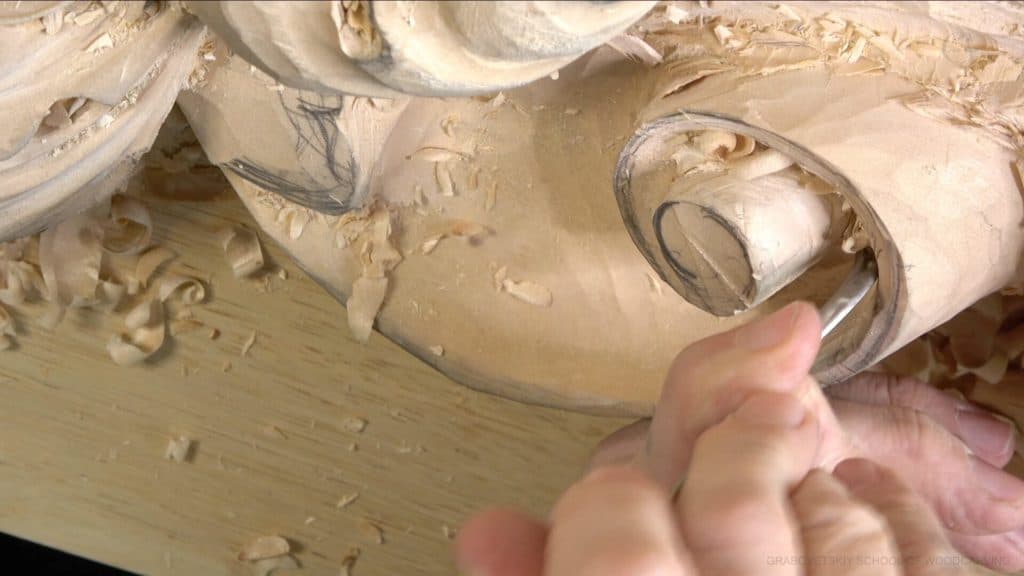
One line opens the part: "Carefully just approach my final destination." The plan is to clean "on the inside all that mess," and then we can work the details on the outside. Another spot I could probably attack, and the backside I can clean when I'm ready for all the backside work.

My tool is the same four millimeters (0.16 in) I used before, a number 11. It makes "much better and cleaner cuts." Then comes a plain statement of the job: "I'm not excavating deeper. I'm just trying to hit the sides." One spot needs to go much deeper, because logically it has to go more excavation right there.
With the number 11 again I go, and go, and go. There will be a stopping point, I tell you, "somewhere," and the only depth figure in the part comes next. "What I need is just to create about quarter-inch wall," so you can feel the movement. "I achieved that already," I add, "and I really don't need to go deeper than that." A quarter of an inch is 6.4 mm.

I use the word destination once in this part, right at the start. The quarter inch comes later, after I mention a stopping point, and I don't call it the destination. After that I plan a little bigger number 11 for "a little cleaner transition," and that is "already giving me a beautiful shadow."
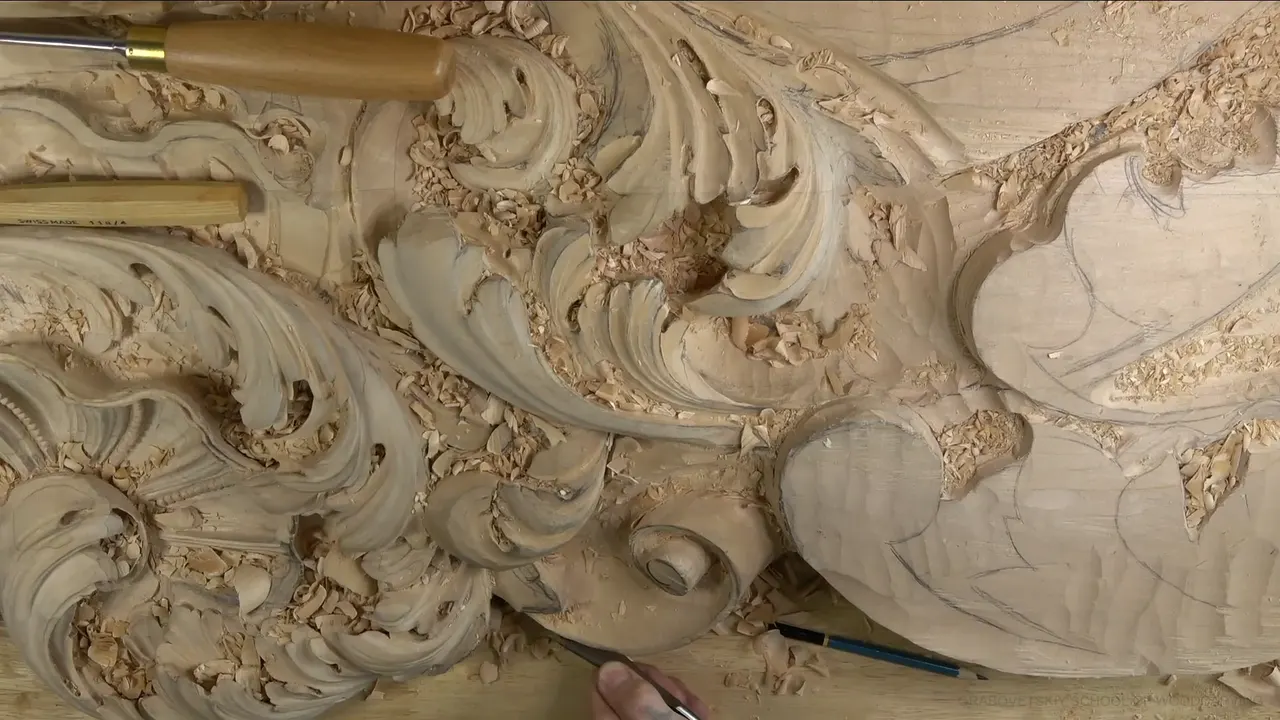
Care comes up too: "Check and check and check again. Can't afford to make mistake." Right behind it comes "We are in the art of deduction," and once more, "I cannot afford to forget that." Next in my plan comes a number three, to chop a little deeper around this volute, and I can clean nicer around it right now, I say, "this way, with the four millimeters."

I really love those volutes "for some reason." They give "a really beautiful organic look," I think. One limit is clear: "I don't have to create undercut all the way right there," yet "I still have to clean and blend all those movements together." The last plan in the part is a tool, "maybe smaller, number seven."
The part before it, 32.1, holds a brake of the same kind. I stay "a little bit away from my final line because I don't want to create a weak point," and I add "as of now, at least." Earlier in that part I name what I'm after: the point from here to the end is "supposed to be about equal size right there," and I say it twice.
Does a final destination mean the same as a final depth?
Depth is one meaning, and in Furniture Panel 18, part 4, I spell it out. The router plane, I say, can "make it to the final destination." And I explain: "What I mean by that, final depth." Double-checking follows. A little later I say, "Maybe a little too aggressive. Make it higher a little bit," and the line "a little too high" follows.

Furniture Panel 16, part 12, brings the router plane out again. I can probably fit it, I say, "and get most of the final depth." Next: "let me double-check." I'm pretty close but a little too high, because "I left a lot of material because I don't want to make a mistake." I'll raise it high first, I say, and try to work my way in. Further on: "now it's almost final depth." Last comes a check and a line: "And yes, I'm at the final destination."
Measuring joins in at part 9 of lesson 18. Measuring from the middle part of the panel is how I plan to reach the final depth. Then: "Here you go. That is my final destination." Seconds later I take it back: "Well, not really final destination. I apologize. It would not be accurate if I would say that."

Why do I stop short of the final destination?
Wood left over gives me room for a clean pass if I need one. In that same part I still kept 1/28 of an inch (0.9 mm) for myself, "just a little higher, just in case if I'm going to need to clean it." The rule in my words follows: "it is always better to keep a little bit higher."
Lesson 18, part 6, does it with a number. Here I say, "That is not the final, final depth," and I left "approximately like half a mil, maybe even less, to the final destination, for I can always do the clean pass if I need to."

Two lines in part 7 carry it as well. First I say I've "got almost to the final destination," with "just gouges pretty much." Then: "That is my final, final depth." Not the very last, I add, because I still have it a little higher than this side, and "I left that on purpose." Much later in that part, I tell you I'll get a couple of really good depths, "but not as deep," and "right before I hit the final destination, I'll stop."
The reason comes in plain words in Venice Room 2, part 14. It is "still going to go even lower," yet I want "to leave some meat" for now. The reason is that it's going to be much easier to "later on, clean everything and just get to the final destination."

In part 11 of lesson 18, a background gets the same promise. Once we work on details, I can always clean it "to the final, final destination." So here the word promises a return visit.
Where do I go before the final destination in a deep hollow?
One unfinished piece gets its explanation in Venice Room 52, part 11. Last time I knew I wanted to excavate a lot more, and I didn't want final details in until I made a "final destination of depth," how I want to go in. Before that, I tell you, I want a deep excavation because I want to cast a lot of shadow, and I ask, "See how much material I'm removing?"

A caution lands right after it: "See how deep I go? But I have to be careful." I do have a lot of material, yet I have to be really careful. I did that with the 10 millimeters (0.39 in), and now I have to switch to a smaller one.
Over in Venice Room 48, part 1, the words are "all the way to the final destination." Inside, where you don't see it, there also needs to be "much more deeper excavation and cleaner, of course, excavation." A little of the mess gets attacked next, in my plan, and a number six or a number seven will work.

Part 4 of lesson 18 has the same number three at work again. It goes at three millimeters (0.12 in), my plan to remove most of the material, and "easy to remember, three three," I call it. "I can go almost to the final destination." The warning comes right after: "This is a really important area not to mess up." Later I add, "Every little detail in this type of carving counts."
Part 6 of that lesson has a brake: "Again, do not chop too deep. Okay? Really important not to." A smaller one is next, a number three at six millimeters (0.24 in), to get really close to the final destination.

Does "final destination" only mean depth?
Depth is not the only meaning, and Furniture Panel 26, part 2, is the best case. I have to figure out what I designed. What I designed is going to be the final line, a separation, and the canes will overlap this section, so "all that has to be gone." After that I should be really close "to the final destination, to the final design, I should say."

A place is another meaning. At Venice Room 131, part 2, the flower needs care first. Of this one I say I could "refine somewhat the edges," and it's "somewhat to the final place, destination, if you wish." For those edges the word means a place to refine to.
Next, a line on paper. In part 3 of lesson 2 of the butterflies plate, about 1/8 of an inch (3 mm) is planned between the lines, and the other side goes to approximately the same point, "same destination." A marker comes in part 2, "just for the camera sake," along with a point liner that draws a really tiny line. I tell you I'll get that line to the final destination and plan an S curve. "I don't have to," I say, "but I think it's gonna look good."

What happens when I say it is not there yet?
Small slips are allowed. Over in the grape leaves vase course, lesson 2, I say "just blend," and if I'm digging a little bit inside of my previous cut, "that is okay," because it isn't the final destination. Blending it "to the line" comes next.
Waiting is a second thing it allows. Early in Venice Room 2, part 1: "That is not the final destination yet, so maybe it's too early to clean." I repeat it a moment later.
An edge is a third. At the Tray of Blessing, lesson 3, part 2, it is not yet the final destination, because "we are gonna refine that later," and the edge could end up "there or there." It could sit in different positions, and we'll determine it later.

Floral and Molding for the Panel 3 holds a promise. A number five at only one-eighth of an inch (3 mm) is my plan for cleaning a concave, and once I work on a flower, "I'm going to always get to the final, I should say, destination." For now, "I am somewhat happy." Going around again with the same tool, I can get "really closer to the line," where "the line is little too thick."

| Source | Meaning | Next |
|---|---|---|
| Panel 18, part 4 | Probably the router plane makes it to the final destination | One more look |
| Panel 16, part 12 | Probably a router plane fits and reaches the larger share of the final depth | Double-check first |
| Furniture 18, part 6 | A small margin stays between my tool and the final destination | Clean pass later |
| Furniture 18, part 9 | Called final, then taken back, so a little wood stays on top | Higher, for cleaning |
| Workshop 2, part 14 | Some meat stays on the wood, though it is still going even lower | Clean it later |
| Venice 52, part 11 | A final destination of depth comes before any final details go in | Details wait |
| Lesson 26, part 2 | Right near the final destination, which I also call the final design | Waste goes |
| Venice 131, part 2 | This one gets its edges refined somewhat to the final place | Flower first |
| Workshop 2, part 1 | Not there yet, and I think it is too early to clean | Wait, then |
Which tool takes me to the final destination?
Tools get a rule in Venice Room 4, part 1. When I start my work I use bigger gouges, and closer to the final destination, final depth, I switch to the smaller ones. Thin metal matters too. A thicker gouge puts a lot more stress inside the fibers, I tell you, and you can see the marks inside the wood, "which is really a stress, and it becomes really weak." To get there, it is better to use "not necessarily smaller gouge, but thinner metal."

The tools I name beside the word are a router plane, "just gouges pretty much," a number three in two sizes, three millimeters and six, and a number five at one-eighth of an inch.
Furniture lesson 18, workshop 32 and the whole Venice Room course for workshops 26 to 37 hold more of the same.
Now think of your own board. Is there a line you are carving down to, and a bit of wood you could leave before it? Near the end, take the next smaller tool and leave a little wood, the way I do. For the whole run of my videos, start here.
How it's done
- Name the line you are heading for. I opened that part with the words "carefully just approach."
- Stop short on purpose. On the furniture panel I left a small margin before the end.
- Keep some wood for a clean pass. In lesson 18 I kept a little wood higher, in case I needed to clean.
- Check again. I said in that part that I can't afford to make a mistake.
- Switch to the next smaller tool. My tool for the inside was a number 11 at four millimeters.
Frequently asked questions
What was my one depth figure in this part?
About a quarter-inch wall, enough to feel the movement. I said I achieved it already and did not have to go deeper than that.
How much wood do I leave before the end?
The furniture panel got half a mil, maybe even less, and another part 1/28 of an inch. In workshop 2 I left some meat.
Is depth the only thing final destination means?
Furniture Panel 26 ties it to the final design, and Venice Room 131 to a place where edges get refined.
Is it okay to dig a little into an earlier pass?
What to carve next