

Alexander Grabovetskiy, woodcarver, School of Woodcarving · Published 2020
How do you carve when part of the carving blocks your tool?
Quick answer: A part in the way is any piece of the carving that blocks my tool or my view. In Venice Room workshop 32, part 11, I said one side needed more knocking down, while another area stayed above for undercutting. Other lessons show a spoon, a bent gouge, or working around it.
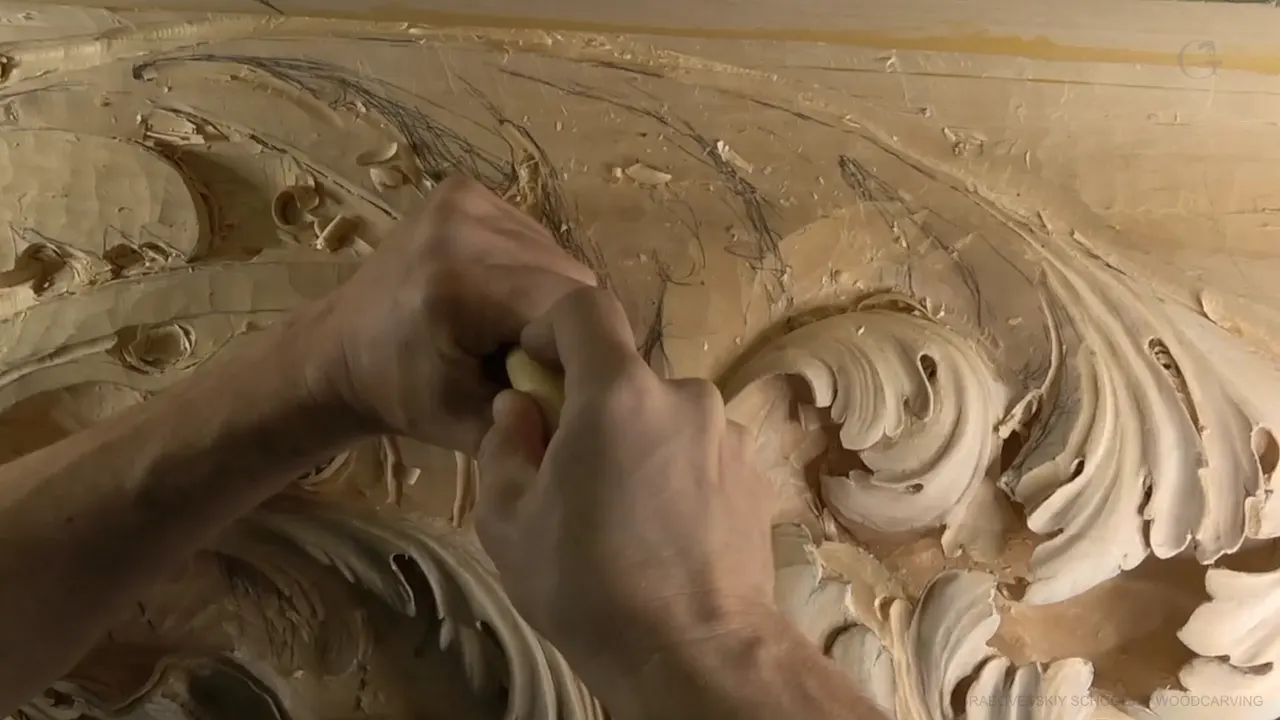
A part that is "in my way" is a piece of the carving that blocks my tool or my view. Workshop 32, part 11, shows one case. I said a side was in my way, which meant I needed to knock a little more of it down. Other lessons give other answers. Each one comes with its place, and the twelve parts of workshop 32 sit in one course.
Ever reached for a gouge and found a high part of your carving right where the tool needs to go? Did you stop and wonder whether to carve that part down or change the tool? I did both on camera, and I say where.

What does it mean when something is in my way?
On camera it is a plain complaint, and I make it about very different things. A chunk got the word in workshop 6, and a chunk again in workshop 63, where I wanted to see a ridge. The ceiling part got it in workshop 28 and workshop 31. In Hashemi lesson 14 it was a spot that a normal gouge could not reach. The words were the same.
What did I do in part 11 of workshop 32?
The video opens mid-work. "I can probably go right now a little deeper with the same tool." A second wish comes next: "But on another hand, I really don't want to make this part lower." And a warning to myself, "I just have to be careful not to lower that too much."
Here is the rule for that spot. "Maybe partially, maybe some parts of it, because I can go down right here, but not here because it has to be above, and I still have to have a space for undercutting." I added, "Hope it makes sense."
"Around these areas, I could go deeper." A wall follows right away: "there's some limitations I'm facing right away pretty much." Then comes the line this page is named for. "I need to knock down little more this side because as of now, it is in my way." Next, the tool: "And I'm using just number seven."

Deeper stayed on the table. "I could go really deep in those areas right here. That can give me really good dimension." The view from the bottom comes into it, though. I said that area would be visible from there, that you see it only partially, and that it was already starting a movement upward. "Maybe that is okay."
The depth got a number: "about 20 millimeters in, about three-quarter of an inch deep. I think it's deep enough."

Another spot got a different call. "I'm not going to go deeper in this area because I need to make sure that is a little raised up." Here is the look I wanted: "I don't want to make it look awkward. So it has to be a more organic look."

On the side I cleaned next, I was working against the grain, and that did not bother me. "That's just position I'm in," I said of it. A Hashemi lesson gives another reason for the same thing. It comes up below.

At 05:05 the depth came back: "About 20 millimeters, three-quarter of an inch in." Just before, making it deeper later would be no problem. The step closed with "That is enough for now."

The last minute is all plans. "Now let me draw the movement what I want to see right here." I was going to lower down a spot to create a movement like that, one that would still be readable and give me "much better look." For the tool: "I can use a flatter gouge," and "Maybe number five and knock down that."

Do you take the part down, and how far?
Back in workshop 6, part 6, I had a plan. I had just named a number eight back bend for my first cut. Then a chunk interrupted: "But you know what? This is in my way, this chunk, so I've got to take care of it first." Next, a number seven to remove some of it, and a warning about the grain, which changes direction.

Back in workshop 63, part 2, a chunk got the same treatment. "I really need to see this ridge, and right now that is in my way." Out came a plan: "I think I'm going to need to get rid of it." Number three was my plan. If I needed to recreate an even deeper concave, I would, and I was okay with that.
Look at workshop 88, part 10, for a forecast. One piece was about to curl one way, and my answer was "Let me chop right away. Otherwise, it's going to be in my way."

The Lily Box course adds a limit, in workshop 5, part 8. A movement was set to go downhill, and it was "kind of in my way." I needed to lower it, and I named a number seven at a quarter inch (about 6 mm) to "move it below a little bit." The limit followed: this part goes underneath, "so I can't go too low right here."
Same balance as 32.11, where one area could go down and another had to stay above.

A flat tool shows up in Lily Box workshop 7, part 5. After making a concave, I found "this part is in my way, so I need to take care of it." Removing it was the job, and the tool came next: "A flatter gouge, maybe number three."
The Furniture Panel course has a weak section. In lesson 19, part 10: "Not going to do it anymore. It's becoming too weak. I got too deep." Of a spot like that I said "this part was in my way". Raising it a little bit, I kind of "cranked it up." The fix I named: "Let me just do small separation cut, small notch," and "remove the section which became too weak."
When do I switch to a spoon or a bent gouge?
The part can stay, and the tool changes. Over in workshop 31, part 1, the words were "ceiling part in my way, so I need to change and use..." The next words were about a spoon. "Yes, I do have a seven-millimeter spoon." That is 7 mm, or about a quarter of an inch, and the plan was to "match the profile and go that direction right here."

Again in workshop 28, part 10, I complained: "I need to use a small spoon gouge because, again, I've got the ceiling part in my way." Next came workshop 37, part 10, with a wish. "The ceiling part is in my way." A three-inch spoon would help me, I said, "but I don't think anybody makes it." Three inches is 76 mm. A smaller spoon was the plan, "for beginning."

A spoon gouge comes up first in workshop 33, part 12. A straight tool was almost impossible to use there, I said, so I should probably use one. Then workshop 42, part 3: I could use a straight 11 only "to a certain degree." Next came a try: "let me try from this side."
Hashemi lesson 14 goes the same way. "Let me take a spoon gouge number three and attack that from here." With a normal gouge I would not have reached that area at all, because that spot blocked it.
A back bend gets the call too. For workshop 28, part 9, everything stood in the way, and "it's the only tool I can get in here." And for workshop 62, part 6, it is "I can't use a straight tool," plus "a back bend just helps me."

Venice Room 52, part 6, adds the ceiling. "You can see I hit the ceiling and my tool not even reaching right here." With that straight tool I would be "digging too deep and creating the wrong idea."
Greek Acanthus lesson 10 has a knife in the picture. "I could use just a knife right here, but back bent is actually excellent tool." And then: "This piece is in my way." With the back bent, I said, "I still can use just the edge of my tool and still get really deep."

The video right before this one, 32.10, sits on the same choice. "I'm still able to use straight tools, but logically, this case, I should use probably long bent or short bent." A little later: "I think I have to use a long bent in this case because of the ceiling part." The tool I named was a number 11 at about three-eighths of an inch (about 10 mm).
Early lessons say it plainly. In the first Venice Room course, workshop 5, part 2, a part sat in the way, so a gouge or veiner had to bend. In this case it was a veiner, a number 11 with a long bend.
What do I do when I just work around it?
I carve on, and I tell you it is not comfortable. Over in workshop 67, part 6, the tool was a 12 millimeters, a half an inch, and I said "it's not that easy, I should tell you, because everything is in my way." From one side, I could not attack, because the grain runs that direction. And then: "But it's okay. Every project like that, there is some areas which is inconvenient, really inconvenient."
A second thought comes in workshop 36, part 1. We needed to put eyes and nicer divisions inside, and I said it would be tough, since everything blocked the tool. Then I took it back with "I shouldn't say that at all," and settled on "it could be tough, I should say."

A client comes into workshop 38, part 3. "Everything is in my way, but probably the client will not understand how hard it is to do it." It "just makes me happy when I have stuff like that, which I know is really hard to do, but I'm able to."
From workshop 70, part 7: "I've got my main carving in my way." Not a convenient area, I added. On a camera it looks easy sometimes, but "I'm working on a slope, and that's not too convenient." I did not want my head in the camera, and I had to position the carving a little farther away from myself.
Hazelnuts lesson 4, part 1: a block sat in the way, and the plan was to outline the hazelnut leaf with the same tool anyway. "Although this block is in my way, but it's okay. I can outline it." The outline would be "not that deep," and I had plenty of space to go much deeper.
A reason for the grain direction turns up in Hashemi lesson 12, part 2: "I really can't attack that from this side because I do have that movement in my way." My line in 32.11 was shorter: "That's just position I'm in."
Measuring needs room too. The Floral and Molding for the Panel course, lesson 1, part 2, has me adjusting a transfer to the piece. Some stuff stood in the way, and the fix was to "change the position how I measure it." The plan: extend a rod, "the best position to extend that rod."
Part 5 of workshop 61 has one more. Something was in the way, and I said "I can't really reference my hand." Then: "I have to be just like almost airbrushing."
What changes when nothing is in my way?
Two lessons show the other side, and each one comes with a size. For workshop 25, part 1, the line was "I could use probably even straight number 11." The condition: "If nothing going to be in my way, maybe 12 millimeters, the bigger one." That tool would be much quicker, I said. Twelve millimeters is about 1/2 in.

Greek Acanthus lesson 11 starts with a number 3, "just about half an inch, about 13 millimeters," and digging deeper. "Nothing in my way," then "I really don't need any back bend in this case. Because nothing actually stands right here."

Where did I say it, and what came next?
| Where | Said | About | Next |
|---|---|---|---|
| Venice Room 32.11 | I need to knock down little more | One side | The only tool named, number seven |
| Workshop 6.6 video | This is in my way, this chunk | A chunk | Number seven, remove some of it |
| Lesson 63.2 video | I really need to see this ridge | This chunk | Number three, get rid of it |
| Venice 88.10 video | that is going to also curl this way | A curl | Chop it right away, I said |
| Lily Box 5.8 | This movement, also going to go downhill | A movement | Number seven, quarter inch, lower it |
| Venice 37.10 video | But I don't think anybody makes it | A spoon | Use a smaller spoon for beginning |
Each row is a different lesson page on this site, and the last column is the tool or the move that came next.
Which part blocks your tool on your bench?
Which spot on your bench is in your way right now? Could it come down a little? Does the part next to it have to stay high? Would a spoon or a bend get you past it? The twelve parts of workshop 32 sit in the Venice Room course, workshops 26 to 37, a Venice room board full of acanthus leaves. Access to the school opens the whole wood carving course.
How it's done
- Name what blocks the tool. In this video I picked out one side that blocked my tool.
- Lower the blocking side. Knocking a little more of it down was the plan, with a number seven in hand.
- Keep one area high. Another area had to be above, since I still needed space for undercutting.
- Put a number on the depth. I gave the depth as 20 millimeters, or three-quarters of an inch, and called it deep enough.
- Leave room to go deeper. Deeper later was possible with no problem, I said, and the step closed with enough for now.
Frequently asked questions
Must you take a blocking part down?
My lessons show more than one answer. I planned a number seven for a chunk in workshop 6. The Hazelnuts course has me planning to outline a leaf beside a block, and calling that okay. In workshop 36 I called an area tough, then took it back.
How far can you lower the part that blocks you?
It depends on what has to stay. A Lily Box movement could not go too low, since it goes underneath. In 32.11 one area could go down while another stayed above, to leave room for undercutting.
Which tool do you pick when a part blocks your gouge?
Mine changed from lesson to lesson: a seven-millimeter spoon (about 1/4 in) in workshop 31, a small spoon gouge in 28, a long bent number 11 in 32.10, a back bend in 62. In Greek lesson 10 I called the back bent an excellent tool.
What to carve next