

Alexander Grabovetskiy, woodcarver, School of Woodcarving · Published 2020
What does barrel mean in wood carving?
Quick answer: Barrel is my own word for the round body of a carved shape, most often a volute, and I know it isn't the technical name. In Venice Room workshop 36, part 2, I planned a ceiling volute whose barrel would show from below. I used the same word for nuts, tulips and leaves.
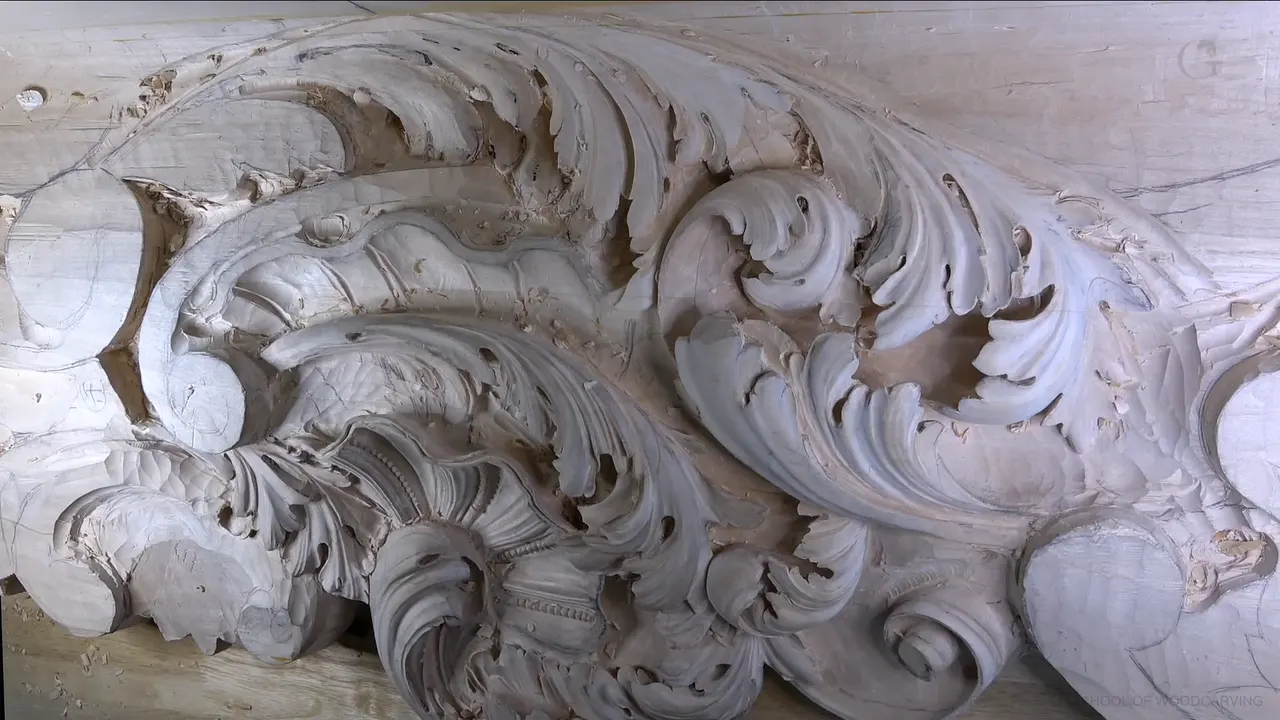
Barrel is my name for the round part of a carved shape that goes around and around, and most of the time that shape is a volute. It isn't the technical word. I've said that on camera more than once. In part 2 of Venice Room workshop 36 the word came up while I planned a new volute on the ceiling board, and I said the barrel itself would be visible from the bottom.
Have you ever seen a carved scroll on an old building or a piece of furniture? Did its end curl into a spiral? In volute carving, the round side of that spiral is the part I call the barrel. Below I follow the word through part 2 first, then through 21 more of my videos, on hazelnuts, a tulip, one grape leaf tray and plenty of volutes.

What the word covers, in six lines
- It's my own word. On one Venice volute I said the right name is just volute, or voluta.
- In part 2 of workshop 36 the barrel belonged to a new volute on a ceiling board, where people below would see it.
- My quickest way to take the wood down around it was a number 11, 18 or 20 mm wide (0.71 or 0.79 in).
- Roughly 10 mm (3/8 in) stayed over the acanthus under that volute.
- Round, or close to it, is how I said one Venice barrel should come out, and on the Cabernet tray I said not to undercut until you see a full one.
- I used the same word on a nut, on a tulip and on a leaf, and once on the middle of a flower.
Where did the barrel sit on the ceiling volute in part 2?
On the new volute's own side, where anyone looking up from below will see it. Part 2 opens with me still watching something that was eating a lot of CPU, for some reason. Logically it shouldn't have. It still did. The leaf got two extra separations from a number 11, 5 mm wide (about 3/16 in). That was about all I wanted in that region at that point, because I still had to develop the movement there.
So I jumped. I do that once in a while, moving to another area before I finish the first one, since staying on one too long wastes much more of my time, for some reason.

The jump followed a movement that goes all the way around and ends up in one spot. That spot got the new volute. My plan for it was plain enough. I would start the excavation at one point and go down around a line, really low, then carry it the other way to the highest point. One part goes lower and around, and another stays higher. It's not going to be a really high volute, I said. But the side of it will show, and the barrel itself is going to be visible from the bottom.
A ceiling board is seen from underneath. The bottom is where people stand and look up.
Why did that spot get a volute and not an acanthus head?
A head of acanthus could have gone there, and it would have been a mistake. It had to be a volute, just like that, only a starting point. We can do a beautiful volute right here, I said. Then I said it once more. Beautiful volute.
A couple of minutes later I named the kind of volute I wanted. I still have to carve the side corbels later, and on those there's a specific type of volute with multiple line work. It would probably be really wise, I said, to replicate that right here too. A corbel is a bracket of stone, wood or metal that sticks out of a wall to carry weight.
I was 16 when I became the only apprentice of a fine-art master in Russia, and he taught me that design is the laws of space, rhythm and repetition. Later in this same workshop, in part 9, one detail on the board was missing the side detail another one had. I set out to add it, because it has to be the law of repetition.

Before any digging I had to position the volute right, or draw it more accurately, since right then it just wasn't accurate. I planned about half an inch (13 mm) of space in one place and said the figure twice. One side didn't look like it was in place. I checked it right away with a skew chisel. Working out the tension with numbers is an ancient tradition too, I said. I eyeballed it anyway.


How do you lower the wood around a barrel fast?
With a bigger gouge, when nothing in the way is worth keeping. First I needed to outline nicely around the volute. The quickest way was a bigger tool, a number 11, and I said I could use 18 millimeters (0.71 in) or even 20 millimeters, like three quarter of an inch, because I had to lower that area a lot.
There was nothing to be afraid of there, I told you. I wasn't going to lose anything. Even so, I needed to be mindful of the direction of the grain, and a few seconds later you could see why. If I kept going that way I'd damage it. I didn't want to, so I went the other direction.

By the end of the part I said it will be low, not really low, but still low enough.

Part 3 picks up the same volute. It still wasn't low enough, so I went much lower, almost all the way to the acanthus, and left about 10 millimeters, about three eighths of an inch, above it. The same 20 millimeter tool took the next stretch with exactly the same idea. There too I left no more than 10 millimeters down to the bottom part. It just looks more organic.

I held the consistency next. With 10 mm here, I kept 10 mm between my highest point and the future ridge, and I checked it from all the sides, because it has to be a gradual movement. A shell will sit underneath there later, so I had to keep that in mind too.
At the end of part 3 a number 1 skew cleaned it up, or a number 2 if you're in England. Hold it in the same position and all the high spots are gone, and what you get is a gradual movement. That's why I love using those tools.

Is barrel the proper name for that part?
Volute is the proper word, or voluta, and I said that myself in workshop 46 of the Venice Room. I was about to excavate around that barrel and caught it mid-sentence. Not the barrel, but it's how I call that part, I said, and it's not a technical name for it, by the way.
One workshop earlier, in workshop 45, I put it even plainer. When I'm saying a barrel, it doesn't mean it's a barrel, I told you. It's just the volute. It goes around, around, down and up. That same video has me calling the spot my barrel top or volute top, both names in one breath.
The slip shows up in other workshops too. In workshop 31, on the twisted volute of this same course, I talked about a couple of ways to attack this barrel, then caught myself and said I meant this middle part. Two parts later it came out again. Something sat a little too far from the barrel, not the barrel, I said, but the main volute, so I moved it closer.
The Floral and Molding panel has me giving up on a better word. Let me attack that barrel, I told you there, and I don't know how else you can call that thing, so I call it like a barrel of volute. The Lily Box got a simpler reason. You can call it the barrel side, because it looks like a barrel.


Volute is an architecture word. A volute is a spiral, scroll-like ornament, and four of them sit on a normal Ionic capital. A real barrel is a hollow cylinder with a bulging middle, made of staves, and it's longer than it is wide.
How round should a carved barrel be?
Complete, or almost complete, round. That's how I put it on a Venice volute in workshop 46, part 2, before I picked up a bigger tool to get a better look out of it. That tool was a number 7, but it feels like a number 8.

The barrel in workshop 45, part 9, had a slope I liked and didn't want to change. One figure I gave there was about 15, 16, maybe 17 millimeters (0.59 to 0.67 in) at the beginning, the chunk I needed, and I said it would change later. The barrel was supposed to go inward, inside, so I excavated a little beside it with a 12 millimeter number 11 (0.47 in). A couple of minutes on I said I want to keep the barrel. It would be exposed.

Workshop 62 put a barrel on a slope, and I warned you that it's hard to understand and hard to see if you've never done one like that. The goal, I said, is not to just destroy that barrel. That barrel is really important. There are lots of ways to approach it, and the one I chose there was to outline just its sides, carefully, with a number 11 of seven millimeters (about 9/32 in).

Workshop 88 gave the word its plainest meaning. There will be a barrel exposed, I said. Part of it will show the way a barrel does, and that's what I mean by the word. Two parts later I needed a much deeper excavation and still wanted to keep the barrel look, with more carving to do around it. I wasn't sure I was doing the right thing. Too late anyway.
In the Maine class named for Grinling Gibbons, one piece needed a barrel look, just rounded backwards, and later in that same video I said to make sure it looks really round.
When is a barrel ready for an undercut?
Once you can see a full barrel, a full block. On the Cabernet Sauvignon tray I had three quarters of an inch (19 mm) one way on a leaf flip, so three quarters down would be more pleasing too, and that gives a full barrel. From that point downhill I was safe to excavate to the three quarters, staying slightly away from the line, since I can always go to the line later.

A number 2 of 10 millimeters (0.39 in) set the outline, a number 9, also 10 mm, took away material around it, and the number 2 went back in to roll underneath slightly. Some people struggle to roll it, I said. They can grab a smaller tool and start undercutting. But don't undercut too soon, before you see you do have a full barrel, or it'll be too squished and won't look good.
Can a nut, a tulip or a leaf have a barrel?
A hazelnut can. In lesson 2 of the hazelnut course I said what I was after, a barrel with the right direction, a better looking shape, like a better barrel. Be careful with the grain where you have to attack into it, I told you, and don't rush it. I left big chunks. I said a number 7 of about 14 millimeters (about 9/16 in) would probably work really well there too.

Two lessons later the nut itself had to sit lower. About an inch and a half (38 mm) was already down, and I needed some kind of barrel there. Maybe it was a better idea to create the barrel first, I admitted. The end grain fought me, and I wanted the barrel equal size from that point of view.
A tulip can too. For the tulip in the Maine class I said the tulip itself is not that complicated, as long as you really see it's a barrel going around.
So can the middle of a flower. In the Furniture Panel bouquet, a number 3 with a little help of a mallet took care of one corner and then another, and that left my middle barrel, if you wish to call it that way. Next, I said, the barrel needed a bevel in the opposite direction, which would give me a nice movement.

Lesson 25 of that same panel caught me mid-word again. A barrel, I said, and I named the part I meant right after, the leaf and not the petal. I went under that leaf carefully, planning no more than about a 16th of an inch (1.6 mm) deep.
On Acanthus over Moldings a number 5 of 1/8 inch (about 3 mm) went into the middle part of those barrels, and I said I'd probably need my magnifying goggles for it. Not really goggles, but still. I needed to get really close to see the details.
Where the word barrel showed up, and the tool I named
Six of those videos fit in one small table, with the tool or size I named there.
| Where I said | What the word barrel named right there | Tool named | What I wanted from it there |
|---|---|---|---|
| Venice 36.2 video | The side of a new ceiling volute | Big #11 | Show to people standing below it |
| Workshop 45.9 video | The spiral body that goes inward, inside | Twelve millimeters | Stay exposed once it is carved |
| Lesson 46.2 video | One that should come out fully round | #7 gouge | Look better under a bigger tool |
| Tray 2.3 video | A leaf flip three quarters each way | Number two | Be full before any undercut starts |
| Hazelnuts 4.3 video | Rounded shape I made for the hazelnut | Number seven | Even size from where I looked |
| Panel 23.13 video | The middle barrel of one bouquet flower | #3 gouge | Bevel the opposite way for movement |
Which lessons show a barrel being carved?
The volute from this page is in workshop 36, and the course pillar on Venice Room workshops 26 through 37 lays out the whole ceiling. For a barrel that goes inward, look at workshops 45 and 46, and workshop 62 shows one on a slope.
Ever looked closely at a carved scroll from the side, on a chair or an old door? Did it look round? Now you know what I mean when I say barrel. When part 3 ended, a shell was still waiting to be carved under that ceiling volute.
How it's done
- Follow the movement to its end. My movement went around and ended in one spot, and that spot had to be a volute.
- Decide on the slope. Slope or not was the main decision. I kept the overall movement without sloping too much.
- Draw it more accurately. I redrew the volute and planned about half an inch (13 mm) of space.
- Take the area down with a big number 11. An 18 or 20 mm number 11 (0.71 or 0.79 in) took the area down fast, and when the grain was going to damage it, I changed direction.
- Leave about 10 mm above the leaf. Around 10 mm (3/8 in) stayed above the leaf below, and I held that depth to the future ridge.
- Clean it with the skew. Held in one position, a number 1 skew took off the high spots and left a gradual movement.
Frequently asked questions
Is a barrel a real carving term?
My own, not the technical one, and I have said so on camera. On a Venice volute I called the proper name just volute, or voluta. I keep saying barrel because, as I put it on the Floral and Molding panel, I don't know how else you can call that thing.
What size gouge lowers the wood around a volute quickly?
On my ceiling volute I picked an 18 mm number 11, or even a 20 mm one, about 3/4 in. A bigger tool was the quickest way, since that area had to come down a lot and nothing there could be lost. Even then I watched the grain.
How much wood do you leave between a volute and the leaf below it?
On my Venice board I left about 10 mm, about three eighths of an inch, above the acanthus. I kept that same 10 mm between the highest point and the ridge still to come, so it looks more organic, and I checked it from all sides for a gradual movement.
What to carve next
- Advanced carving venice room 36
- Advanced carving venice room 46
- Advanced carving venice room 45
- Advanced carving venice room 31
- Carving floral and molding for the panel 12
- Wood carving workshop lily box carving first layer 6
- Advanced carving venice room 62
- Advanced carving venice room 88
- Grinling gibbons maine class 16
- The tray of blessing cabernet sauvignon 2
- Carving hazelnuts 2
- Carving hazelnuts 4
- Grinling gibbons maine class 6
- Carving furniture panel 23 main flowers bouquet
- Carving furniture panel 25 main flowers bouquet