

Alexander Grabovetskiy, woodcarver, School of Woodcarving · Published 2020
What does secondary mean in wood carving?
Quick answer: Secondary is my word for the second concave, line, bevel or cut that goes beside the main one. In part 10 of workshop 36, I say the secondary concave sits on the sides and runs much deeper. I add that the camera will not catch it, but it is visible from below.
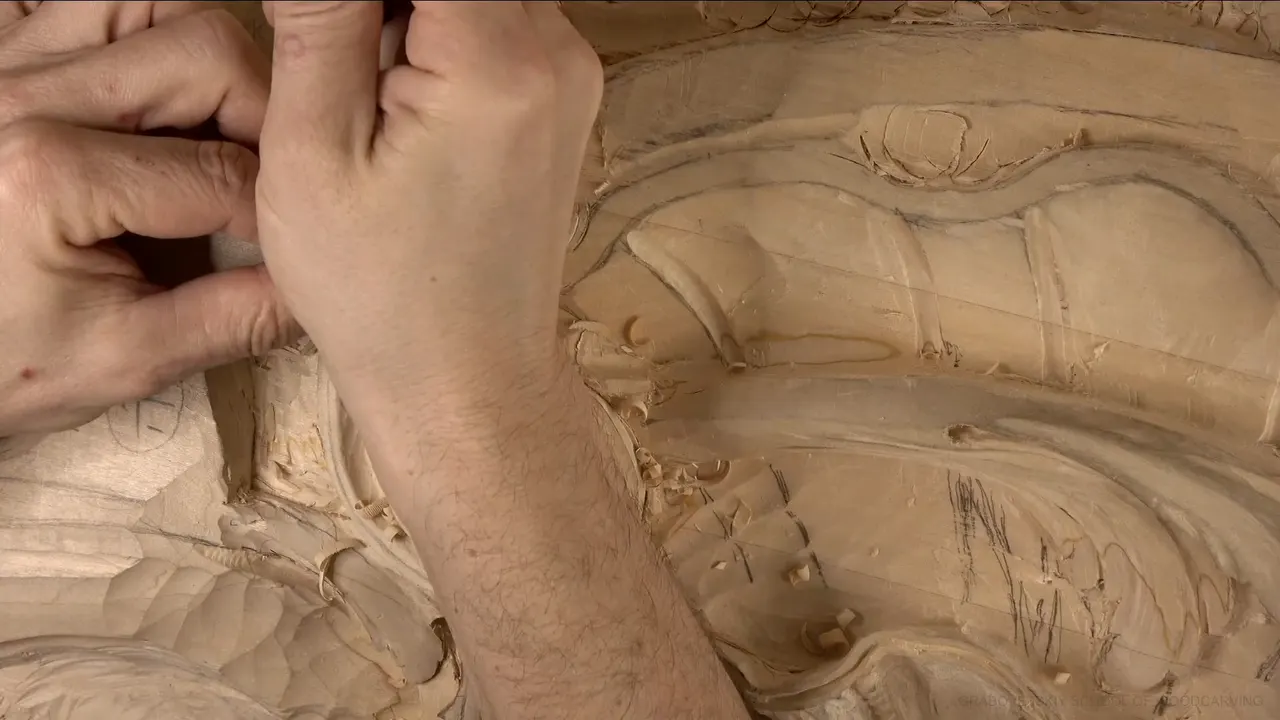

Secondary is the word I use for the second one that sits beside or below the main one: a concave, a line (or a bevel), a cut or a level. This part of workshop 36 gives it to a concave on the sides. Many of my other videos use it too. This page sets those beside it.
Ever carved one good hollow and wondered if the piece wanted a second? Below is what I said each time.
What does secondary mean in part 10 of workshop 36?
The part opens with "And go." Then I say, "I have to change the position and attack from this side." A little later comes "and again from that side." At one point I tell you the next pass will start "from this point and all the way to the line."

Next I tell you, "And I kind of like what I see, but I need to continue here, too." Then a question, asked out loud. "I'm not sure if I should make it bigger or wider, I should say, this way or not, because on another side, it is." My answer is "maybe yes, maybe I should," and "at least some spots, maybe I can just make it wider on this side." Moments later, "I think I should."

Nearby I call something "a really nice detail." A wider cut is an option, I tell you: "do wider also on this side" for "some more consistency." At least one side will be a little wider than the other, I say.
Here the word arrives. "And the secondary concave, it's going to be right on the sides, which you probably don't see, but it's still going to be visible from the bottom and from the side views." Right below, I say, with "I still have to blend a little nicer."

A size follows. I call the secondary concave "much deeper" and say "I'm going to use 3 millimeters, number 11." Three millimeters is 0.12 in, close to an eighth of an inch. A plan comes after it, "I'm going to just cut in," and the grain gets a warning of its own: "careful right here because grain changes direction. But now it's actually in my favor this way."

What the camera cannot show comes next. "I know it's impossible to see on the camera what I'm doing," I tell you, and like I said before, it can still be found "from the right point of view." One more line follows. "It doesn't have to be everywhere, by the way."

Last comes a hunt for the tool, and I ask whether I can "use the same tool or not." "Looks like yes." A spoon comes up, and the number 11 of 3 millimeters (0.12 in) is the one I need to find. "Or, I could use a number 9. That would give me the same result pretty much right here." Both are still plans, and the part ends there.

Four things sit beside the secondary concave in this part: it goes on the sides, it is much deeper, a viewer can spot it, and the camera cannot show it. It also need not run all over the piece.
What came right before it in part 9?
The same kind of thing sits in the part before this one. I name "that secondary line" and say "it's also important." You see it "from below," I say, and a line that is not consistent will not look nice. In that part I say I am leaving about two millimeters from the inner edge, which I put at 3/32 of an inch (2.4 mm), and "it's got to be the same everywhere."
So the line in part 9 and the concave in part 10 share a reason. Both are meant to be seen from below.
How does a secondary concave sit beside a main one?
Plainest of all is workshop 130, part 3, with its main concave and one beside it. First comes the main concave. Inside it, I say, there will be "a secondary concave on one of the sides, which going to give me beautiful shadow casting." Before that I say I need to lower an edge, because it will almost lie on the background. "So no more than a quarter inch."

Later in that part I say it again and name the pair, a main concave and "a secondary on one of the sides to create the double shadow cast." My tool for the main one is a number seven at about 25 millimeters (0.98 in), which I call about one inch. A side of that concave sits no more than a quarter inch (6 mm) from the surface, and "that's what I've done."
Over in workshop 131, part 1, something comes first. "I need to create the secondary concave, but before that, I need to take care of the line." I want "a really gradual movement right here, so without any waviness." With the big number 2 I can ride along it and hit the high spots. "So I need a really beautiful line. That is what I'm after."
My reason for waiting is clear after that. "So now I am ready for the secondary concave, but I have to be really careful and attack from two sides." My first pass, I say, will go "closer to the center line." On a ridge of the same piece I add, "I have to attack that from opposite side, from opposite direction," and the grain is the reason.
The workshop 37 version sits in part 5, and it starts with depth. "Deeper, but not too deep, not too extreme. But still deep." I also could leave a secondary bevel, I say, "just to give the same idea as what I have right here to this volute." And "I think I should do that." Next comes a secondary concave as a possibility, and I expect "a really nice movement. Beautiful movement." The acanthus has to go underneath, I add.

In Lily Box 8, part 5, I hunt for a small one. "I could actually create secondary concave on a secondary separation. And I don't want to make it too big concave, but still, I want to make it detectable." This would be my ridge. Tool-wise, "let me try just number three. Almost flat." It would still give a concave and a ridge, "and again, this is all about the lights and the shadow."

Is it a line, a bevel or a slope too?
A bevel and a slope borrow the word too. A volute in Furniture Panel 20, part 5, will curl a little inside, "which means going to draw secondary line." That secondary line, I say, decides how it looks. The upper part of a panel gets looked at straight on, I add, so for a more three-dimensional look I have to lean the overall move in that direction.
Over in Furniture Panel 21, part 5, I weigh a smaller volute. It would help me, I say, and I would create "a secondary bevel." Right there, I add, comes "the secondary slope. So we're just going to repeat." Design-wise it would be "more attractive," and a lot more appealing. I want to be sure to save that slope and work around it.

Floor level shows up in workshop 24. I continue a cut, and it will look really good, I say, "when you're standing on the floor and looking up from this position." Then, "gradually, you will see the secondary edge from the bottom even."
What is a secondary convex?
Raised shapes get it too. Workshop 75, part 6, gives me a separation number one and a separation number two, which means my convex, "the main convex," goes this way, and the other one is "the secondary convex going that way." A check follows. "Right now, it just looks like almost rectangle, which is no good." I kind of have to create a more tapered look and skew it a little, and then, "so now it's better."
Workshop 74, part 9, counts them. With three divisions "it should be two eyes," and "if you have an eye, you always have a convex." That makes two main convexes. Inside the three divisions comes one more each, for Venetian style. "Five total convexes. Two main ones out of the eyes and three secondary and inside of each division."

Can a secondary cut be a knife cut or a level?
It can. On Furniture Panel 22, part 10, one flower is the main flower, and it is higher. Another one sits "on a secondary level," which is "lower level." At the edge, straight down at 90 degrees "would not be appropriate." My words for the edge are "I can probably give right away somewhat undercut," and "just lean little inside, inward."

Next is the cut I called secondary, with a knife. I "just made my first cut," I say, and for the secondary cut I plan to "lower down my knife even lower and get in just like that." Mind the edge. "Just make sure you don't go too much in because you can break the edge."
Butterflies 9, part 3, has a secondary cut I call "somewhat flat." It is "supposed to look like a gouge cut." My pinkie lies on the work and gives me a supporting point, and "I'm not pushing too hard, but it gives me really good support."
Do carvers put a second cut on the side?
I say they did. In Chamomile and Bow Rosette 3, part 1, my words are "if I want to be really authentic to those people who lived long time ago, carvers, they used to put secondary cuts right on the side like this." Why? "You can see it creates an overall idea that there's a bowl, and it just kind of moves around."

Earlier in the same video I had my own plan. "Good idea for me to create right now the second cut on that side with the same number nine." What those old carvers did is my account of it, given as I say it.
Is a second movement a must?
Not always, and I say so. Floral and Molding for the Panel 10, part 3, recalls an earlier piece of mine with "a secondary movement on inside." A kind of extra movement, "which creates extra shadow." Where do I stand? "I really didn't have to do it." Another line goes, "totally don't have to do it, okay? But I like that stuff. Why not?" Then, "so let me do it," and I say I will take number 11 again.

Both sides show in workshop 44, part 11. Subdividing a piece that way means a secondary division, and I am not sure whether I should. Then "at least I need to do those subdivisions." Then, "that subdivision must. Other ones I could get by without, but that is a must."
A little later in that video I say I am cutting more accurately because it is "a somewhat final cut." "It gives me really beautiful concave already, and really, I don't need to redo it if I can get it just in one cut." And "maybe that is enough without the secondary separation. At least for now, I don't see the need for it."

Is secondary the same as less important?
Sometimes, yes. Venetian Flowers Rosette 4, part 1, wants few movements on the inside, not "too many concaves, convexes." The reason is the main idea, "the cluster of the flowers." "I don't want to take attention from the main flower cluster," I say, and "those are secondary, just serving as a framing if you wish."
A leaf gets the word in Carving Grape Onlay 9, part 2. "I can actually create a, like a secondary leaf sticking from underneath, and that's gonna look much better, and the secondary can point that direction." And workshop 142, part 1, weighs a second leaf "below the main one." That second leaf would be "secondary," and that is "probably, I would say, most logical."
Is there a secondary bevel on a tool too?
Yes, and the job is different. The in-person sharpening class, part 2, has me say, "we establish main bevel first, and we establish secondary micro bevel on inside." That point "becomes really strong." In that class the word names the bevel of the tool and no cut in the wood, and the idea of a main one with a second one on top stays the same.
I give two reasons in that class. The point is "no longer weak." And "sometimes we use tools upside down," and "without that micro bevel, you really can't use that upside down." A tool without it will dig in, I say, and you cannot escape. My sum-up line is "main bevel, secondary bevel."

| Where it came up | What the word sat beside, in my own plain words | What I said with it |
|---|---|---|
| Workshop 36, part 10 | On the sides of the work, much deeper | Seen from below |
| Workshop 36, part 9 | A line around the whole inner edge | Consistent |
| Workshop 130, part 3 | The main concave gets one on a side | Two shadows at once |
| Workshop 131, part 1 | A concave only once the line is gradual, no waviness | Careful, and from two directions |
| Lily Box 8, part 5 | Secondary separation, then a concave with number three | Detectable, not too big |
| Workshop 74, part 9 | Convexes inside the divisions, five in all, two of them main | Three secondary |
| Furniture Panel 21.5 | A bevel that I also call a slope | More appealing |
| Furniture Panel 22.10 | A level for a flower, not the main one | Lower |
| Workshop 44, part 11 | A separation | Maybe enough without it, for now |
| Venetian Flowers Rosette 4, part 1 | The parts that serve as a framing, as I put it | Not too many details |
What do you look at before you add a secondary?
Read the pairs in the table and a few questions come out. Who will see the spot, and from where? Parts 9 and 10 point to the bottom, and workshop 24 to the floor. Is the main shape settled? Workshop 131 wanted the line gradual before the secondary concave went in. Is the cut a must? Workshop 44 had one I called a must and others I could do without.
Then look at your own wood carving. Is there a spot where one shadow is not enough, or a face that gets looked at from underneath? Part 10 sits among the videos on this page. In it I put the second concave on the sides, and I said it need not be everywhere. For the whole run of my videos, start here.
How it's done
- Settle the main shape. Part 10 opens with passes from different positions, and I tell you the next one starts from one point and goes to the line. Workshop 131 wanted the line gradual first.
- Pick a spot for the second one, beside the main one. Part 10 puts it on the sides. Workshop 130 puts it on one side of the main concave.
- Make it deeper if you want a shadow. I called the secondary concave much deeper in part 10, and workshop 130 had me say the pair gives a double shadow.
- Watch the grain. In part 10 the grain changes direction in one spot and works in my favor. Workshop 131 had me attack from two sides, and I said the grain is the reason.
- Decide if it is a must. Workshop 44 had one subdivision I called a must, and others I could do without.
Frequently asked questions
Where does the secondary concave sit in part 10?
I said it would sit on the sides, right below, and run much deeper. You probably don't see it, I added, but it is still visible from below and from the side views.
Can the camera see a secondary concave?
I said in part 10 that it is impossible to see on the camera what I'm doing. I added that you can still find it from the right point of view, and that it does not need to run everywhere.
What do I settle before a secondary concave?
Workshop 131 had me take care of the line first. I wanted a really gradual movement with no waviness, said I would use the big number 2, and could hit the high spots. After that I said I was ready for the secondary concave.
What to carve next