

Alexander Grabovetskiy, woodcarver, School of Woodcarving · Published 2020
Does wood carving train your brain?
Quick answer: Training your brain is part of wood carving, in my lessons. My teacher had me repeat one knife drill for hands and brains at once, and eyeballing trains it too. Part 10 of Venice Room 47 needed it. Another element sat under my dark spot, and I warned against digging too deep there.
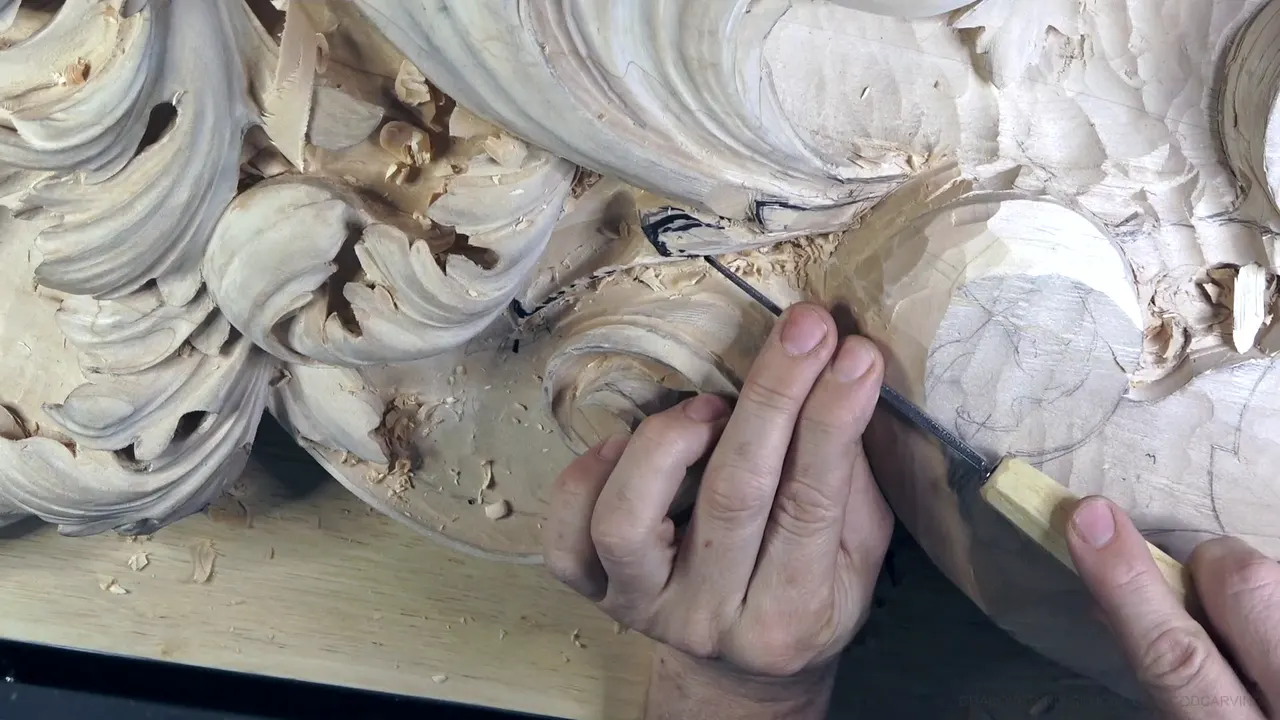

Brain work in wood carving is the thinking every pass of the tool asks for, and carving trains that thinking the longer you do it. In part 10 of Venice Room 47 I was digging a dark spot for an eye on an acanthus leaf, with another element sitting under it, and I said out loud what that spot needed from my head.
Do you remember your first week behind the wheel? Did every turn and every push of the brake take real thought? Carving starts the same way.
Part 10 is short, about seven and a half minutes of work on one leaf. So beside it I put my other lessons where the brain came up, among them the knife drill my teacher gave me and the day my own brain got tired, and you can see which parts of the work train it.
What wood carving trains in your brain, in six lines
- Under the spot I was digging in part 10 sat another element, so I said you still have to use your brains and not dig too deep.
- When I learned the trade, my teacher would ask me to repeat one kind of knife carving many times.
- Eyeballing a width trains your brain, I said in Venice Room 57.
- Switching over to tiny details after big, aggressive passes can take a while.
- A shape can look good in your head and still not come out that way in the wood.
- The limit of hand carving, I said on a furniture panel, is just inside your head.
What did using your brain mean in part 10?
Knowing what sits under the spot before the tool goes deeper. Eyes were going into this leaf, and every time I create my eyes, I said, there's going to be a movement right there that I probably have to fix somehow.
This one didn't look good yet. I needed to blend and get rid of a ridge, so the spot would look like an eye, and a piece was supposed to go right above it. The same thing was coming on a second spot, only on a smaller scale. That ridge has to be gone, I said.

Here is where the thinking started. To take that ridge off I could use a back bent gouge, and in this case it would be the best tool, probably. Then I took it back. Maybe not necessarily, actually, I said. I could come in from the other side and still get the same effect.
A few seconds later came the words see, now it feels like it's growing in, and this flips above. That was the look I was after.

Depth came next. I needed to excavate much deeper, because I really needed to see that shadow, and I said it twice. A number 11 went back in, and I dug a little deeper in that area.
That one was 2 millimeters (about 5/64 in). The 1 millimeter (about 0.04 in) was an option too, I said, and it's always a good idea if you want an even deeper shadow, a darker spot.

Then the line this page is built on, about two and a half minutes into the part. Be mindful, I said. Another element was sticking underneath, so you still have to use your brains and not dig too deep, or you lose the idea of where that one sits.

Which small calls came after the deep spot?
One after another, through the rest of the part. For the next spot my plan was to do exactly the same, maybe much deeper. Deeper, but not too extreme, I said, and like I said before, I need to blend it.
Then the marker. Clean a little bit of that marker, I said, just too much black, and I went on right there.

Once that spot was good, wonderful even, I could work a little on the surface and start my divisions. Clean it out, I said, and I have to come from the opposite direction.
What came out was somewhat what I wanted to see, and I said I really like the idea. The texture goes above, then it goes in a little bit, and that part just grows underneath. This could come down a little more, I added.

Then came a short break for the light. Hit the light and turn this off, I said, and a few seconds later, now it's on again.
My next plan was to go lower. That could go a little lower, actually, I said about one part. Then a bigger idea came. I could go even lower and make one of the divisions right there higher than this ridge. I think it's possible, I said, and that's going to look actually really good.
Listen to what came right after. It should look good, I should say, and twice more came the same words, so my going to had become a should.

The part ends on depth again. Clean that a little with the number 11, I said. Next I said I can take a smaller one, 2 millimeters, and excavate inside, and my plan was a shadow effect there to separate those two elements. Hopefully you see what I'm doing, I said near the end.

Where does that training come from?
With repetition first, the way my teacher did it with me. I was carving since childhood, but when I started carving as a skill, as a trade, he would ask me to do one type of knife carving many, many times.
That kind of carving is training your hands and training your brains with just the one tool, I said in my beginner cutting board lesson. You still need to feel how deep your knife is supposed to go, and especially on a straight-down cut. Start straight down and finish with the bevel, and you have to set that feel inside of you for when the movement turns toward the bevel. It is not as easy as it looks. I said that over a cutting board with a bird carved on it.

Design is the first thing to train, the way I listed it on a live stream in April 2020. Number one, you have to train your brain in a three-dimensional world, and that is the design process. Sharpening came second on my list. Third was how you carve, meaning the angles, the movements and where your hands sit on the tool.
Copying doesn't do it. On my Tray of Blessing I said I don't like the idea of a replica. Many people asked why we don't just bring the finished piece, look at it, and carve from it. But then you're not going to teach your brain to think, I said, you just replicate.
Copying is like learning to drive when someone says push the brakes, turn right, and you have no idea why you push the brake or why you turn. When we carve together and you learn to see in three dimensions, it's much easier for you later on. That's why I have lots of people coming back, I said, and their projects get more and more complex.

Does eyeballing count as training?
In my lessons it does. Venice Room 57 had me widening one part to about 10 millimeters (3/8 in) at its end and about 6 millimeters (about 1/4 in) at the other spot, a taper, and I was just eyeballing it. You could measure, I said, that's okay. But it's a good skill to develop if you can just eyeball. It trains your brains to read a little differently.

My Roman acanthus lessons give a way to check yourself. Do a distance by feel, and then check whether it's accurate or not. On more complicated pieces there is absolutely no way you can measure, and there the eyeballing abilities of the brain help you a lot. I would suggest eyeballing as much as possible, I said.

My furniture panel had one thing I didn't want to measure. If you feel you have to measure it, you can, I said, but eyeballing develops the ability, the way your brain reads the three-dimensional world. Not every project lets you measure. In sculpture you really have to go by eye, and a project like that trains your eye.
Why is it hard to switch to small details?
It takes the brain time to readjust. Partway into Venice Room 78 I said let me use number eight, and soon after, maybe it's a little too big. I wasn't too careful at the beginning, I said. That happens sometimes when you're working on a big part with really aggressive cuts, and then you're switching your brains over to tiny details. Sometimes it just takes time to readjust.

A new point of view does the same to the person watching. Back in Venice Room 22 I changed the camera, so you could see one movement from another side, my pencil on it. I know it's sometimes confusing for the brains when I'm changing the points of view, I said. My goal was just to show you the idea of how it's supposed to be developed.

Easy-looking parts fool you another way. Carving the olives on my Lily box, I said it looks like there's nothing to do there. That part was thicker than the stems, though, and the pressure was not as easy to control. Don't be fooled, I said. Inside of your brains you think some stuff is easy, and you are not as careful as you should be, and usually those easiest parts give you a lot more trouble.

And sometimes the picture in your head is just wrong. Workshop 16 of the Venice Room is where I had already made the decision how one spot was supposed to look. Still, you can think in your brains it's going to look good, I said, and when you work on it, it doesn't always bring you the same result. A little later I called it much better, but still not there yet.
The picture can also be right and hard to share. My furniture panel design gave me that trouble. It's almost impossible to see what I see, I said, because I do have a picture already established in my brains, and that's so hard to explain.
Can wood carving make your brain tired?
Mine got tired on camera. On my Floral and Molding panel I had a number nine, 10 millimeters, three-eighths of an inch, for one little part. I wanted to make sure I wasn't hitting the line of my, what's that thing called? Volute. Okay. I'm getting brain tired, I said. The volute, of course.
Then I left approximately a sixteenth of an inch of space there, about one and a half millimeters, and went all the way down.

During Venice Room 61 it hit me in the middle of a sentence. The next step was the middle part between those pipes, I started, and then I said I'm sorry, just my brain stuck. Then it was back to the space between those pipes.
It happens to people learning design too. In one design lesson I said I think it's enough today for the design part. I know some of you are probably brain tired already.
Some work is the other way around. Venice Room 56 is where I said I'm carving all day long and every day, and it's so peaceful. Your hands become like a machine, really auto mode, and you still have your brains free. You can listen to audiobooks, if you just want to. I found that a good thing, your hands working and your brains still there to use.

Does your brain read a carving with no explanation?
In my design lessons it does. The easy way to explain the golden ratio is the golden spot, and your brain catches that as the most important spot on a canvas, I said in my design course. In every design I have to find that spot, so it would look beautiful without explanation.
Nobody's going to apply a ruler to it, I said in Venice Room 72, well, maybe some people. Most people don't know about those rules and the geometry in wood carving. The eye still finds it pleasing. A human brain is going to read it, and that's a lot better for the human brain.
The brain even fills in what it can't see. In one furniture panel lesson, the lip of a frame would cover about 10 millimeters (about 3/8 in) of the design. That edge won't show, I said, but inside your brain you're still going to visualize it.
A leaf on my panel background was flipping over something underneath, and even if that something is invisible, your brain is still going to pick it up, I said. In the panel design I wanted one movement read both directions, left to right and right to left. I'm trying to confuse brains, I said, and unite two worlds.

The part on this page asked something close to that of my head. The element sticking underneath that relief spot was part of the picture, and losing track of it was the risk I named.
Seven of these moments sit in the table, close to the words I used.
| Lesson | What I said | Where |
|---|---|---|
| This part, 47.10 | Be mindful, another element sticks underneath | A dark spot |
| Beginner knife board | Hands and brains trained with one tool | Straight down, then bevel |
| Venice 57 | Eyeballing trains the brain to read differently | A tapered width |
| Workshop 78, Venice | Tiny details after aggressive cuts need time | One small part |
| Venice 16 | Looks good in your head, not always in the wood | One spot on the panel |
| Floral panel | Lost the word volute and got brain tired | Close to the line |
| Design course | The golden spot is the one your brain catches | A blank canvas |
Where do you start training your brain for carving?
With one tool and one board. The knife drill on my beginner cutting board is the kind my teacher gave me, and how deep the knife goes is what it trains.
Eyeballing comes next, with a check after it.

The Venice Room Part 4 course holds workshop 47, and the tuition opens every part of it, the hidden element and the darker spot included. Carve one straight-down line with a knife today, and notice how far down it wants to go.
How it's done
- Repeat one knife drill. One type of knife carving, done many, many times, is what my teacher asked of me. One tool works on hand and brain together.
- Feel the knife's depth. Start straight down and finish with the bevel. Set that feel inside of you for the moment the movement turns toward the bevel.
- Eyeball, then check. Do a distance by feel first. Then check whether it's accurate or not.
- Know what sits underneath. Before a deeper dig, be mindful of any element sticking underneath, and keep track of where it is.
- Watch the easy-looking parts. Be careful where it looks like there's nothing to do. Don't be fooled. Usually those easiest parts give you a lot more trouble.
- Carve along instead of copying. Carve along with me and pick up the three-dimensional view, rather than replicating a finished piece.
Frequently asked questions
Do you have to think while you carve wood?
At some moments, yes. In workshop 47, part 10, another element was sticking underneath the spot I was digging, so I said not to go too deep and lose the idea of where it sits. Other work goes on auto mode, and in workshop 56 I said your brains stay free.
Is copying a finished carving a good way to learn?
Not for the brain. Working on the Tray of Blessing I said that if you just replicate, you're not going to teach your brain to think. When we carve together and you learn to see in three dimensions, I said, it's much easier for you later on.
Why does a carving look different from the picture in your head?
One spot in Venice Room 16 did that to me. I had already decided how one spot should look, and I said what you think in your brains will look good doesn't always bring the same result on the wood. A little later I called it much better, still not there yet.
What to carve next