

Alexander Grabovetskiy, woodcarver, School of Woodcarving · Published 2020
Is stone carving easier than wood carving?
Quick answer: With no grain in stone, there is nothing to fight, and I say limestone is a little easier than wood. But stone is heavy, its dust is hard on the lungs, and in Venice Room 47.12 I say it can't take much undercut, because it gets too weak.
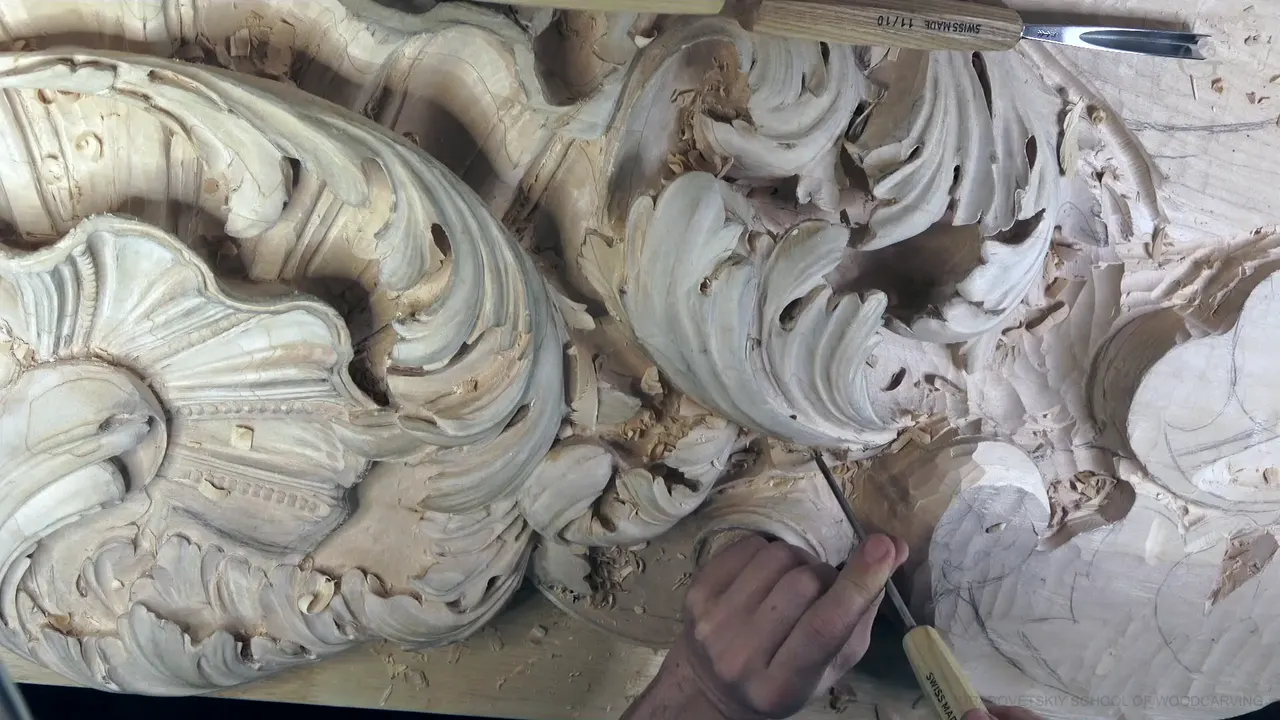

Stone has no grain to fight, so in my book limestone comes out a little easier to carve than wood. It is also heavy, its dust is hard on the lungs, and you can't undercut it too much. The undercut line comes from Venice Room 47.12. More of my videos back the rest from the stone side.
Ever picked up a gouge and wondered if stone carving would go easier on you? This part is short, 561 words. The rest of the page comes from other videos of mine, from this workshop and from other courses.
Part 12 of workshop 47: what did I say about stone?
At 03:08 I bring up "some of the original work." A lot of stone carvers and wood carvers, I say, stone carvers most of all, "left the wall." Then I name it: "And that's what I call wall right here. So that space right here." Those old carvers, I say, did not undercut that space. "They did maybe little bit, but not much."
A debate follows over why they did it, and the answers differ. Some say it's just a more classical look. My view, "just in my opinion," is that it still looks good, "but it's much quicker not to go in and extremely undercut and so on."

Here is the line that names this page. "And stone, of course, is different story. Okay, you can't undercut too much with the stone carving. It's going to become too weak." For wood, I say, it's different. When you're doing an extreme undercut in wood carving, it actually looks really good.
Timing gets its own line. "But undercut always done later. Okay? So not right away because I still have to, in this case, establish the movements." Back at 03:01 I had said it: "later on I will undercut."
What was in my hands when I said it?
The part opens on the form I'm after. "This little too small," I say, and I need to get something bigger for this moment. Later: "And this one needs to be small. That's too small that way."
At 00:49 comes the job. "And now I need to excavate all that mass out." I plan to take two millimeters (0.08 in) first, with a number 11, as I say a few lines later. "Carefully just going to hook this out and remove it."

A reason follows at 01:42. I'm doing the excavating before I finalize the forms. Some concaves and convexes are still coming, but I'm cranking against a few of the pieces, and I don't want to make them too weak too early. Now the job is to excavate to the right depth, which I think is somewhere right there.
"Let me kind of slightly attack this side," I say next. Then comes a tip: "Sometimes it's a good idea to use number one double bevel and get rid of some of the mess right there."

Look ahead, at 04:30. There's going to be another division, and it's going to flip this way. This part is going to go underneath and create a full motion. By 04:59: "See, it's already becoming curly." Now I have to be more careful how I do my stuff, "a lot more careful."
Then I plan to blend a little bit in and create a separation. "Two millimeters, that's what I'm using. Number 11, of course, and it's two millimeters." The edge is good, I say at 07:11, before my last plan, which is probably number 11 again, but sideways.

The two parts before it fit together. The tenth has me saying I need to excavate much deeper, because I really need to see that shadow. A number 11 does it, "that was two millimeters," and I add that I could go with one millimeter (0.04 in) and should be mindful not to dig too deep and lose the idea. The eleventh says the inside will be all hollow later on, "but now I need to create that shadow effect."
In my own words, which is easier, stone or wood?
I have answers in a few courses. The clearest sits in the Q and A on carving with the grain. I mentioned stone carving on day one, I say there, and I don't like it just because of the dust. "I love wood carving because of the media I use. It's warm, it's beautiful."
Then comes the comparison. "My point is stone doesn't have a grain. You don't have to fight the grain. Stone carving has a lot less tools and a lot of sanding, polishing, and so on." In some degree it is easier, I say, "but harder on your lungs."
Weight gets a line too, and so does dust. "And it's heavy," I say. "Stone is heavy. It doesn't matter what kind of stone you use." I list marble, soapstone and limestone, and "all dust gets inside of your lungs," I say. Back to wood: "But wood has grain." Wood carving takes a lot more tools, and I look at mine as my army.
Do I treat limestone and marble the same?
In Carving Flower Rosette 3, part 3, I say that for me, carving stone is "much easier because you don't have a grain." There's no need to keep thinking about the direction of the grain, and "you're just establishing a form." A hedge follows: there are different stones, and maybe that doesn't apply to all of them. "I'm talking about carving limestone. It's easy. Much easier, actually, than what most people think."

Workshop 147 pushes back on a claim. I watched a documentary about professions where people work by hand, I say, and they said wood carving is easier than stone carving. "And that's not true. It's not necessarily true. It depends what kind of stone you carve."
Marble is the hard case. Stone doesn't have a pronounced grain, I say, "except if you carving marble, then you have some difficulty." I think plain limestone comes out a little ahead of wood for ease, because it lacks a grain, so there are no directions to calculate. That all sits in Venice Room 147, part 1, if you want to hear it for yourself.

When does a piece of wood feel like stone?
It can, in my words, when it is dense, as in Lily Box 10, part 9, with "Really dense. It's like almost not even carving." Then: "It feels like you're working with the stone." Even then, limestone would be "much easier than that." The reason I give is that grain is not something you have to deal with in limestone.
A little later, at 01:44, I say to use a mallet and that I'll try to excavate, and I'm using a number 11 at one and a half millimeters (0.06 in). The next video finds me about 3 millimeters (0.12 in) in, with a plan to undercut this side too with the same back bend. This side is a little tougher, I say, because I'm getting really close to the heart of this slab. "Like a stone."

The same feel comes up in Lily Box 4. I'm using a smaller number 9 there, maybe about 14 millimeters (0.55 in), and I say, "It feels almost like you are carving marble. It's about the same feel." I mean stone carving.

Did one school carve in both materials?
In Venice Room 18, part 5, I say the Italians had a lot of stone carvers, and they used a lot of marble. "And marble, you really have to sand. You have to make it smooth, otherwise it doesn't look good." It was "pretty much the same school who did the stone carving and the wood carving because essentially it's almost the same trade. Almost. Pretty close."
The next video adds a place and a contrast. Italy had both stone and wood supply, I say, so they did a lot of stuff in both materials. At about the same period in Germany, there were no skilled stone carvers, but a lot of skilled wood carvers. In England, I say, a famous wood carver also tried some stone carving. He did not succeed. My opinion of his stone carving is that it looks really terrible, and it doesn't look too good at all.

Acanthus shows up in stone work too. Venice Room 32, part 10, has me saying that if you look at the work of ancient carvers, the carvers of old, in stone and in wood, who did those acanthus leaves, they usually had at least three divisions. Some had five divisions, or eight, and I follow that with this: "So it's equal to a Fibonacci number."

How did both trades treat a surface?
For smoothness I go to Venice Room 9, part 3, in which the Greek and Roman cultures, I say, really liked smooth surfaces. They worked with marble and stone, and "you never would see any rough marks." "And they actually invented the idea of making surface smooth." They used crushed stone, I say, and sanded pretty much everything.
A little sanding on my own carving would be a good idea, maybe, I say, since it's Italian style. I probably could use a sanding, and it would be even more authentic to the original. "I don't have to, but I think I can create an even better look that way."

Ridges are another. In Roman Acanthus 16, part 5, I'm doing only a 16th of an inch (1.6 mm), shaving a ridge. "But it gives me that classical Roman, I would say, or Greek look. They use that technique, actually. And that's common in stone carving, architectural carving, I would say." The point, I say, is to create those extra ridges.

Edges come next. In Antique Style Rosette, workshop 5, I'm leaving my edge as a high point, a high spot. "It was common, actually, practice to leave the edge of the leaf edge as a high spot." I tie it to the Romanesque style, in stone and in wood, where those edges would be higher than the inner section.

How does stone change the way I measure?
In Carving Furniture Panel 18, part 9, I talk about a pointing machine. It works from the depth of cut, I say, so you measure the original and translate that to the workpiece. In sculpture you make your sculpture first from clay. If you then want to carve that out of stone, like limestone or other types of stones, "you can always measure on an original, translate that to a marble or stone, whatever you work on."
I say the payoff is a fit where "you can be really perfect, actually," with "a lot less chance to make the mistake."

From the other side, Venice Room 55, part 5, describes stone carving. "You're not adding stuff on, you chopping out." You are taking away what is not supposed to be in that particular piece, I say. I tell of a sculptor who took a big marble stone and chopped to create the form and reveal what is inside.
Where did my first chisel go?
I start with my introduction, where I say my grandfather gave me a first chisel. "Well, I shouldn't say he gave me. I took it, I guess." That chisel went to a brick: "It wasn't wood carving, it was stone carving or brick carving." And of course, I say, "I killed completely that chisel."
How do the places fit side by side?
Here are the eleven moments, with what I said about stone and what came with it.
| Where | What I said about stone in that moment | What came with it |
|---|---|---|
| 47.12, Venice Room | You can't undercut stone much, it gets too weak | Extreme undercut in wood, a different story |
| Techniques course, grain | No grain, so nothing to fight | Less tools, a lot of sanding and polishing, and so on |
| Flower Rosette 3.3 | Limestone is easy, easier than people think | Just establishing a form |
| 147-1, Venice Room | Limestone slightly easier, marble has some difficulty | It depends on which stone you carve, I said |
| Lily Box 10.9 | Really dense, it feels like working with stone | Limestone would be much easier than that |
| Lily Box 4.2 | Feels almost like carving marble | A smaller number 9, about 14 mm (0.55 in) |
| 18.5, Venice Room | Marble you really have to sand | The two trades were almost the same |
| 9.3, Venice Room | Greek and Roman work shows no rough marks | I probably could use a sanding |
| Roman Acanthus 16.5 | Extra ridges are common in architectural stone carving | A ridge shaved 1/16 in (1.6 mm) |
| Antique Style Rosette 5 | Leaf edge kept high, in Romanesque work in both | Those edges higher than the inner section |
| Furniture Panel 18.9 | Clay model first, then stone, measured from the original | A lot less chance to make the mistake |
Most of those rows use stone as the comparison, but in the two from Lily Box it runs the other way, with a dense piece in my hands and stone as my word for the feel.
What do I take from all of this?
Two things stand out. Wood carries a grain to read, and stone has none. And stone, I said, can't be undercut much or it becomes too weak, which is a different story from wood. Both are in my own words in the videos above.
Look at the piece in front of you. Is it wood with a grain to read, or something dense that feels like stone? My lesson 47 page covers the whole workshop. For all my lessons in one place, start here.
The Venice Room course for workshops 38 to 49 holds the rest of this carving. These videos come from my Venice room carving and other courses of mine, and every figure in millimeters and inches on this page is mine, with the conversion beside it when I did not give one.
How it's done
- Check for a grain. Stone, I said, has no pronounced grain, so there are no directions to calculate. But wood is another story: it has a grain.
- Name the stone. Limestone is the easier one, I said, by a little. Marble gives you some difficulty.
- Think about dust and weight. Heavy was my word for stone, and whichever stone it is, I said the dust gets inside your lungs.
- Hook the mass out with a small tool. My plan in part 12 was 2 mm (0.08 in) first, with a number 11, carefully, to hook it out and remove it.
- Leave the undercut for later. In wood, I said, the undercut is done later, after I get the movements in place.
Frequently asked questions
Which stone did I call a little easier?
Limestone. In workshop 147, part 1, I said it is a little easier because there is no grain to calculate. Marble, I said, brings some difficulty.
How did I describe the dust that stone carving makes?
Harder on the lungs, I said. In that grain lesson I added that whichever stone you use, the dust still gets inside your lungs.
Can stone take as deep an undercut as wood?
In part 12 of workshop 47 I said stone is going to become too weak with too much undercut. For wood, I said, an extreme undercut actually looks really good.
What is the wall I mention in part 12?
What to carve next