

Alexander Grabovetskiy, woodcarver, School of Woodcarving · Published 2020
What does a wood carver mean by "a deadline"?
Quick answer: The deadline I name in part 8 of workshop 56 is about a month, when the piece gets installed. In other lessons I talk about a customer who asks for a deadline, a tight one, rushing, and what I say with no deadline at all.
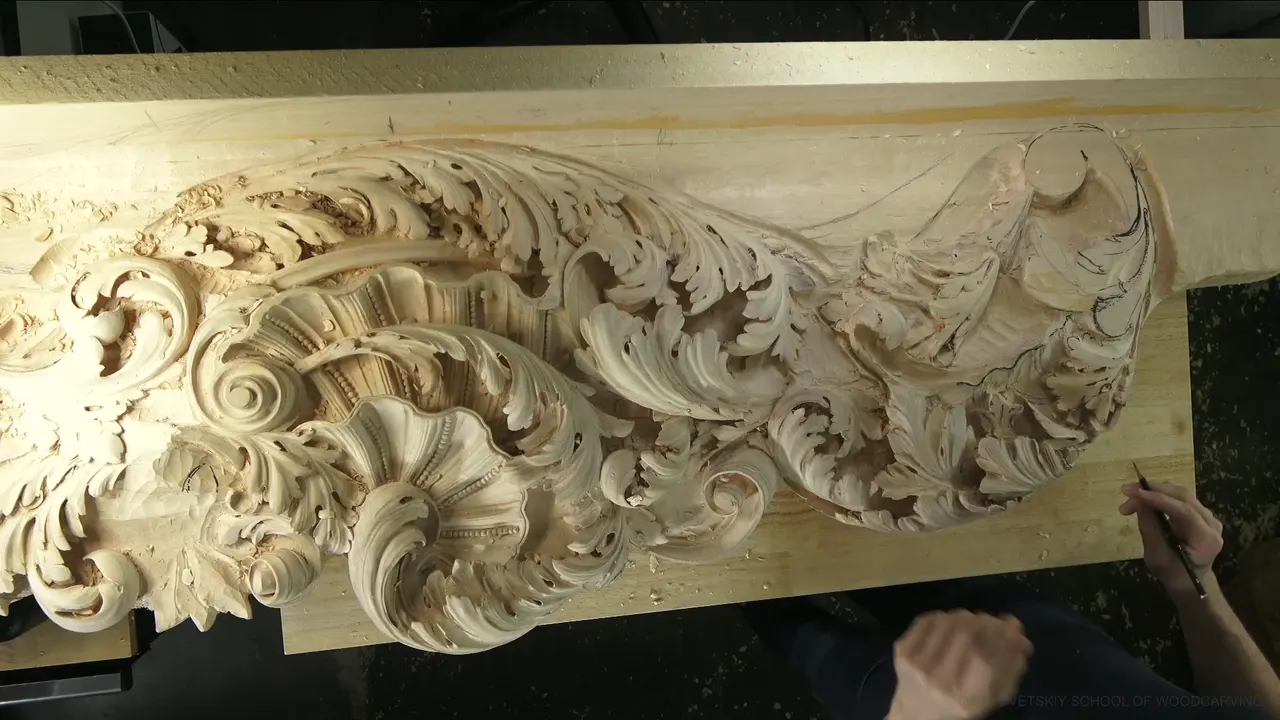

In workshop 56, part 8, I said, "I do have a certain deadline I have to meet." More like a month than a day, I said, the month when the piece gets installed. This page follows that one word through my lessons.
Ever asked a carver how long a piece will take, and heard a range back? Does a month sound long for a carving like this? Would you like to hear how I talk about time when I work? We start at my bench in workshop 56, part 8, then visit the lessons where I used the same word.
What was the deadline in workshop 56?

At the start of part 8 I said I was going to continue on the right-hand side of my development, and that I have to work a little faster. About the deadline itself, my words were "more like a month when it's going to be installed."
The project is going overseas, so it has to be shipped and also conditioned. Really important, I said, to condition it to climate, weather, humidity and temperature, and so on. I have an idea when it has to be done, and I have to work really fast, pretty much.
Why film the work when time is short?

I decided to film that for the school, and if I wouldn't, I would be much quicker, probably. Still, I think filming is "a really, really, really good thing I'm doing," because you actually see the reality, the real life approach to this trade, to that art.
For me, it is not a hobby. Yes, it is: I love it with all of my heart as a hobby, and my hobby became my main business.

Over in part 9 of the same lesson I talk about the work I did before. Even while carving, I was building homes: about nine years as a builder of custom homes, mostly high-end. I also had a kitchen and bathrooms company, like a cabinet company, with multiple employees. One day a woodworker who runs one of the biggest woodworking companies in the world came to my shop and asked, "Why don't you just concentrate on wood carving?" My answer was, "Yeah, why don't I do that?" I switched to carving full time, pretty much, quite a few years ago.
What did I say about the live stream and my school videos?

I am also going to show some of it in a live stream a little later today, and that will be recorded too. To the people in my school I said, "I want to reassure you." A live stream is not a replacement of our school videos. The school videos are all the process, "without shrinking anything, without cutting, editing anything."
The live stream gives me a chance to understand a little more of what needs to be done and what questions people have, and also to raise some interest to the school. That is why I'm starting to do some live streaming. It is by no means a replacement for the school videos. Absolutely not. You are a member, and only you can see most of the videos.
And I have to keep an eye on time, because I have to hit stream at a certain time.
What did I do about the chunk I did not like?

My plan was to attack the future shell. Then: "Well, actually, no. Let me jump probably on this side and develop some idea." I think it will be better right here.
The detail I wanted to develop was interesting for me, but it doesn't really make too much sense. One of the divisions goes in that direction, and right here I need to make the decision: what am I going to do?
"Let me think. What I could do and what I should do." I have a pipe, but it doesn't make much sense unless I bring that pipe all the way past this pipe. The main development got to be on this side.
This chunk, this movement right here, I don't like, and I have to change it. My plan is to get rid of the chunk and turn this way, and to open this section to the shell. A shell will be on the inside, of course, and that way I think it will make a lot more sense.

One more thought, half said: "Unless if I have to just bring that, no, it's not. It's not going to look good." For the chunk I said I would use a mallet and "number seven. I'm sorry, seven millimeters, number 11 veiner" (7 mm is 0.28 in). I'm going to start just to chop little by little, but I have to be really careful to attack that from the right position.
Why did I keep going when I was sick?

I really do appreciate all of you who emailed me and said you are thankful that my school is still going. That really means a lot.
I try not to stop for any of the circumstances. In some of the videos you can see I was a little bit thick, I said, "I mean, not thick, but sick." I had some flu. I kept going for you people who want to see what I'm doing, and because I really have to finish my work. "I can't stop."
What do carving and talking do to my day?

In part 7 of the same lesson I said I kind of love the overall development. I accumulated the tools, which I usually don't, and that happens only when I'm getting tired. When I'm filming and carving, I get tired a lot quicker, because I have to talk and explain what I'm doing and why I'm doing it. As long as you like it, I'm happy.
That shell is going to be deeper than those leaves, I said in the same part, so I'm not afraid of hitting a little harder, but I still have to be careful.
How long will it take, and what do I tell a customer?

In Venice Room 3, part 12, some of you asked me in a comment how much time a carving takes me, approximately. Always the hardest question for me, and the hardest one is deadline.
I used to build kitchens and furniture. For a kitchen it's much easier to estimate: you know how long it takes to build the cabinet and install all the hardware, to install the kitchen, and for the countertop to get in. You can estimate and not miss the mark really, really easily.

With wood carving it's really hard. Sometimes you are working like Speedy Gonzales and making a lot of progress, and in some spots "it gives you so much trouble sometimes" that you're not able to move past that place for the whole day. When a customer asks me the deadline, I usually give a range, trying to be on a safe side. It's almost impossible.
Some work I just can't take: "I'm turning some architects and designers who really don't get it, that is a manual work." I also said I'm not turning people away. It is labor intense, not machine work where you place it on CNC and let it work. Even for the CNC, it's a lot of work.
When they ask for an estimate and say they've got only a month or four weeks to do that, I wish to answer, "Go ahead and do it or find somebody else who is able to." Usually they don't, because they don't get it, and other trades are not the same.
Does a deadline cost quality?
The idea of deadline nowadays is probably everywhere in every country, but it wasn't like that a few years ago. I would say it was developed mainly in the United States, because it's always about go, go, go, get it done. The problem with that is you are losing quality.
It's really hard to keep in pace and not to lose quality. You can't concentrate. Well, I shouldn't say that, you're still able to concentrate, you're just not paying attention to the details.
Can a whole room fit on a calendar?

Over in Venice Room 50, part 12, I said not many people are able to carve a whole room like that. I'm talking about carving it on time and getting the result done, not about the ability to carve.
Some people would take a project like this 10 years or so, or four years. In four years I can do a lot of beautiful stuff if I can work on just the one piece. I can make it, but now we don't have that luxury. Customers nowadays want it done yesterday.
That's probably the worst question I have to answer all the time, I said: how long it's going to take, and what the deadline is. "That's new invention, it wasn't like that before."
How far do I go to save time?

I was carving toward myself in Venice Room 57, part 5, which is a little bit dangerous, but in this case it's the only way I can excavate. A smaller carving would probably be better: rotate the piece or walk around and attack from the opposite direction. That would be smarter, safer.
But sometimes I have to deal with huge pieces like that, and I just can't walk around. I would spend too much time, and for me that means I'm not going to make it. "How to say that easier? I do have a kind of deadline. It's not a real deadline, but deadline where I want to get the stuff finished." If I can save a minute, I'd rather save a minute and not walk around.
Only if it's still safe, I said. If it's a safety concern, no, I won't save that minute.

I used some rasps in Venice Room 144. They expedited my work and made it a little quicker, and I'm probably going to do the same thing from now on, because it's a paint grade and I don't need to worry about the tool marks. I can probably just make it quicker. "And the deadline is coming sooner than I wanted to, but it's okay."
Is there a rush when there is no deadline?

In Furniture Panel lesson 19 I said it is probably a big question for some of you, why I spend so much time on just a small detail. First of all, I don't have a deadline, and I can get to the perfection if I need to. "This panel is not for a client, no deadline, so I really don't have to rush it."

Without the rush I can probably create a much nicer project.
In lesson 18 of the same course my plan was a router plane with a smaller blade, and I said there's no rush for me on this project, so I don't have any deadlines.

Lesson 25 is where I was doing that panel "just for school," with no customer or client behind it. I just didn't have enough time to carve because I had a huge project, and if it's a real life project I have to honor the deadlines and so on.
In Floral and Molding lesson 2 I was going to grab a small tool, number nine and three millimeters, one-eighth of an inch. For this one, I said, I don't want to rush it, and there is no reason. "Even if there is a deadline, rushing is not really a good thing." Woodcarving is an art of deduction, art of subtraction, and once you take too much, you can't put it back.
Can a tight deadline be met with one knife?
On a live stream in April 2020 I told a story. Over 20 years ago, I believe, maybe more, maybe 23, 24 years ago, a client wanted a coffered ceiling with the sides hand carved. The only problem I had was a tight deadline.
In one month, a traditional carving would be almost impossible to cover, with all the cantilevers and those sides. I designed a carving for just one knife. It took me one month, and I made it right on time.
I made good amount of money just in one month, and it's possible actually to make business with just pretty much one knife.
Which lesson held which line?
Here are the places side by side, each with my words.
| The lesson | The work I was doing at that spot | The words I used |
|---|---|---|
| Part 8 of workshop 56 | A piece going overseas, to be installed in about a month | a certain deadline |
| Venice Room 3 | A customer asking how much time a carving will take | the hardest question |
| Workshop 50 | Carving a whole room, and carving it on time | the worst question |
| Part 5 of workshop 57 | A huge piece where I just can't walk around | a kind of deadline |
| Venice Room 144 | A job where some rasps made my work quicker | coming sooner than I wanted |
| Furniture Panel 19 | A panel with no client behind it | no deadline |
| Furniture Panel 18 | A plan for a router plane with a smaller blade | I don't have any deadlines |
| Floral and Molding 2 | A small tool, a number nine at three millimeters | no reason to rush |
| Live stream, April 13 | A coffered ceiling carved with one knife | a tight deadline |
Where can you watch these lessons?
This page's lesson, Venice Room 56, sits inside Venice Room Part 5, right after workshop 55. The other courses are one click away if you start here.
How it's done
- Watch the time. Hit stream at a certain time, I said, and keep an eye on it.
- Pick up the pace. A little faster on the right-hand side of my development, I said.
- Think it through. Think, I said, about what I could do and what I should do.
- Change what makes no sense. I don't like this chunk and I have to change it, and my plan is to open this section to the shell.
- Start on the chunk. I'll use a mallet and a 7 mm (0.28 in) number 11 veiner, and I'm going to start just to chop little by little, careful to attack from the right position.
- Condition the piece. The project is going overseas, and I said it's really important to condition it to climate, weather, humidity and temperature.
Frequently asked questions
Would I be quicker if I did not film?
Probably, I said, much quicker. Still, I decided to film for the school, and I called that a really, really, really good thing, because you actually see the reality of this trade.
Is a live stream a replacement for my school videos?
By no means, I said. Absolutely not. School videos carry all the process, without shrinking, cutting or editing anything. A live stream also gives me a chance to understand what questions people have, and to raise some interest to the school.
What do I tell a customer who asks for a deadline?
I usually give a range, trying to be on a safe side, though it's almost impossible. When they say they have only a month or four weeks, I wish to answer: go ahead and do it, or find somebody else who is able to.
What to carve next