
Alexander Grabovetskiy, woodcarver, School of Woodcarving · Published 2020
What does a wood carver mean by "accumulated"?
Quick answer: In part 7 of workshop 56 I use the word for junk, and later for my tools. In other lessons I use it for waste in a deep hole, dirt on a carving, tools again, and water in a board.

In workshop 56, part 7, I said "Too much junk accumulated," and in the same part I said I accumulated the tools. The same word is in other lessons of mine, so this page follows it from one video to the next.
Ever looked at a wood carving bench and seen chips piled in every hollow? Maybe your own tools crowd the board too. Would it help to hear what I said about both piles, in more than one lesson? We start in part 7 of workshop 56, and then the other lessons follow.
What was I doing in workshop 56, part 7?
Number five is what I said I will need, after "Let me see which one." Maybe about, I said, "I would say 18 millimeters" (0.71 in), "about three-quarter of an inch," and establish that edge.

"Okay, can you see that? You should." I need to go that direction now, I said. Later on I can develop my letter S movements and so on, but as of now all I need is just clean cuts. Here I have to be careful how I do that, because it's raising up right now.
Of my own way of doing it I said it is "a little too dangerous, by the way. I shouldn't do it." I should use a really long bevel like this tool, I said: it creates a lot less stress on the fibers. "Okay, wonderful."
Next, I said, I need to attack that from that side and clean a little. I need at least a long bent, and I will use a number four long bent, about 10 millimeters (0.39 in), "three-eighths of an inch." And clean it.
What came after the word junk?

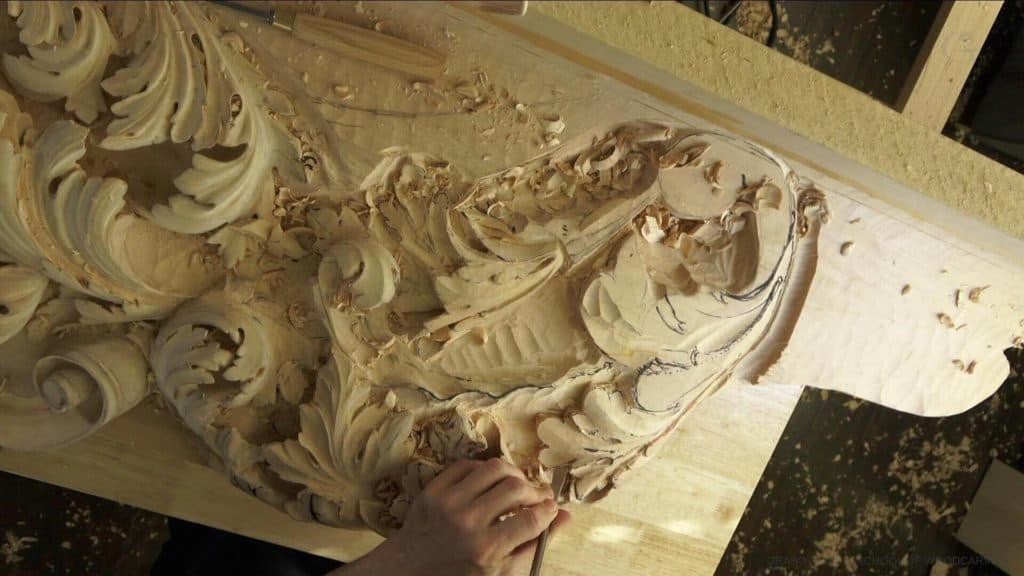
"Too much junk accumulated." Right after it came a plan: "And again, I'm going to hit a little harder underneath of those leaves." "Slightly in."
I still must be careful how hard I hit, I said, because I really don't want to deal with the background cleaning later on. If you carved something like that before, you know exactly what I mean.
"When you dig your tool too deep in the background, then you have to spend time and clean everything. And to clean sometimes takes much longer than just to create initial idea, unfortunately, but it's true."

"All right. Can you see the development of this? Of course, you see it, it's right on the camera." And go and clean around, I said. I can actually get a bigger number four, I said, maybe about 20 millimeters (0.79 in), "three-quarter of an inch," and clean that even better, as a preparation for the future shell. A shell will come, of course, and we can get ready for it.
With the same tool, I said, I will hit that a little bit. That shell will be deeper than those leaves, I said, "so that's why I'm not afraid of hitting a little harder." Careful still, "but not as careful."
Why were my tools piling up in part 7?
After "I'm going to blow again. Cover your ears," came this: "I kind of love it, actually, overall development, how it looks."

"And I know in this position of the camera, you're not going to be able to see, and I accumulated the tools, which I usually don't. It happens only when I'm getting tired."
And when I'm filming and carving, I am getting tired a lot quicker, because I have to talk and explain what I'm doing and why I'm doing it. Getting tired, I should say. "But it's okay. As long as you like it, I'm happy."
Is junk in a deep hole a worry?

Part 3 of this same lesson has the same line inside a hole. I could probably do a full rotation movement, I said. Drill as much as I wish. The line: "There is a lot of junk accumulated on inside, but it's a really deep hole."
I don't really worry about cleaning it right away, I said. This section will be excavated too. It will be a lot easier for me to get and clean, I said, when I excavate around. The same tool will do it, I said.
One more thing in that part. I have to create the undercut underneath of this small section, but I have to be careful not to be too close to the edge, I said, or it gets "too fragile." So I am leaving approximately three millimeters (0.12 in), I'd say, of thickness, "about one-eighth of an inch."
How does a chip pile look in other lessons?

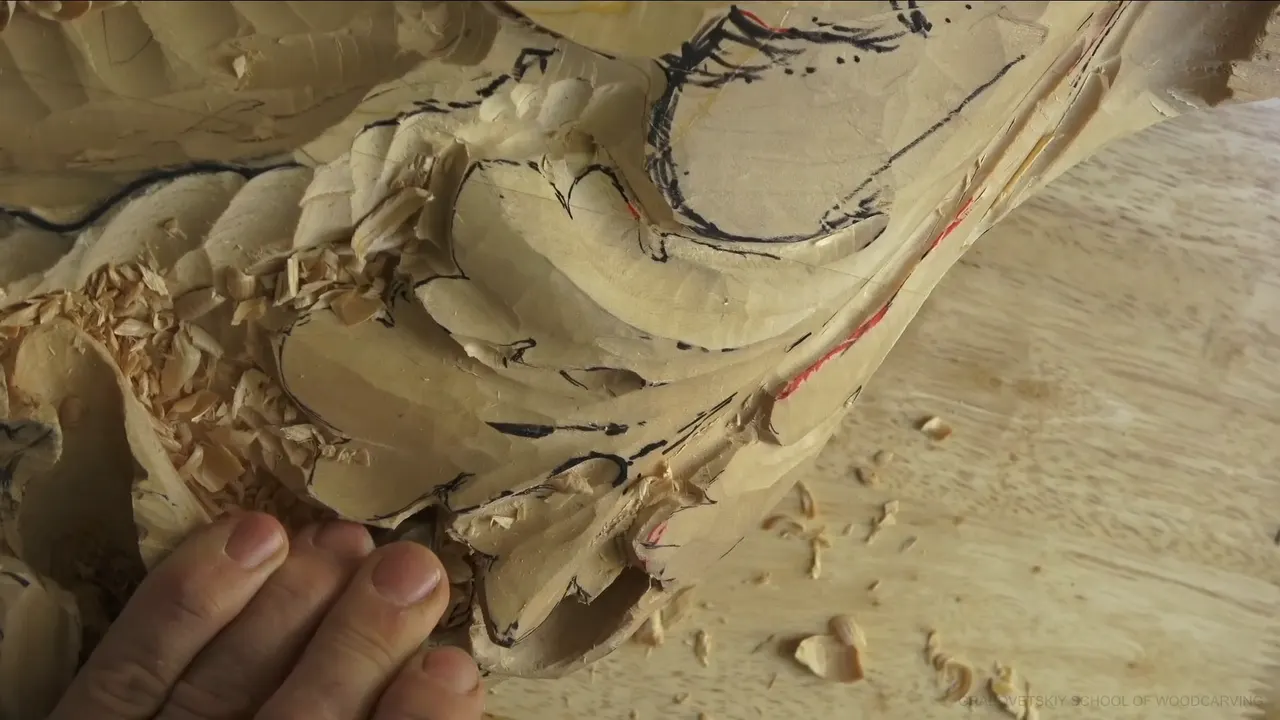
In part 1 of workshop 50 there is a pile: "By the way, you can see there's a lot of junk accumulated, a lot of chips." Usually the wood carvers just blow on it, and it's flying away. "But there's another trick."
That trick is a hair dryer, if you have an old one and you don't like the noise of an air compressor, I said. "Couple seconds, and it's all gone."

Workshop 58, part 6, has "junk accumulated" again. Another line sits in part 6: "Let me clean a little bit nicer," and, although it's not the final cut, I still going to clean it.

The Hashemi Flowers course, lesson 47, part 6, has waste on the inside. "And I accumulated a lot of waste on inside. Which is absolutely okay." Just little by little, I can remove all that waste. A lot of that waste is just wood chips that fell inside. That needs cleaning out, I said.
What did I call the stuff at the edge?

The Furniture Panel course, lesson 18, part 2, gives me a couple of ways to clean around. One of the ways, I said, I can take a specialty number 23 tool, go around and carefully shave out all those wastes, "or whatever the stuff accumulated at the edge."
"But like I said before, I really love that tool just because it leaves me a 90 degrees wall. Beautiful." Then: "Clean this side right away."

My plan in workshop 43, part 4, is to work up to the pencil mark from the edge, and "I don't think it's enough." It looks like I've done something, but not really, I said, "because I just took oxidation or whatever, the dirt, it's accumulated. Not good." I'm probably going to go deeper, I said, maybe with number seven, at least at some point.
Is dirt on a carving a problem?

In the Chamomile and Bow Rosette course, lesson 4, part 1, I said graphite paper is absolutely okay to use, and that's probably what I will do. Next came: I trace that, and that is my main element. "The only problem that I have with that method is how much black dirt it just accumulates." It's the only problem, because it's just black carbon. "But it's okay. I'll clean that a little later."

The Lily Box course uses the word again. Lesson 13, part 7: "I can get even darker right here." Logically, if this piece is antique, that would be the hardest spot right there to clean. "So that's going to accumulate a lot more dark stuff inside, so we are making it look like it's a true antique."
Where else do tools accumulate?
The panel course, lesson 16, part 6: "Let me think. Maybe it's time to get the router plane and clean that side, and also get rid of the tools I don't need right now. Put them back." That is one of my habits I had to develop, I said: place all tools back constantly. "If I'm working all day long, of course you can accumulate your tools, and that's not going to be good." Getting really close to the final detail, I said, I really don't need to be that aggressive.

Same course, lesson 18, part 3: "Too many tools accumulated on my workbench. That's not very good." Let me lower that even more, I said, to make sure it's the same depth as the opposite side.
Floral and Molding lesson 5, part 2, shows the same habit. "Oh, you know what? Again, I don't need extra tools on my workbench." I will keep just the small tools right here, I said, "but not good idea to accumulate them." Then: "And let me attack that." Number nine, I said, and 10 millimeters (0.39 in), "three-eighths of an inch." My left side goes across the grain, I said, and I must be really careful. But the tool should be sharp. If the tool is sharp, you should be okay, I said.

The sign is in part 1 of that lesson. "The sign when I get tired, if I look at my bench and there's more than two or three tools, that means I am tired." Right now, I said, I'm okay to keep those two guys. "But when I start accumulating tools, it's time to take a break. At least that applies to me." Walk away for a few minutes, I said, and you should be fine.

Acanthus over Moldings lesson 4, part 1, has: "I try not to keep many tools." And: "It becomes really confusing really quickly when I'm pulling too many tools, not that I never done it." "No, absolutely. I've done it multiple times." And it's a good idea, I said, not to keep more than a few tools: "I mean three, five, seven."

Over in workshop 35, part 12, I said I've got "a bunch of tools" on my workbench. And like I said too many times even, I don't like it, "but I still keep accumulating once in a while." That's usually an indication that I got a little bit tired, and I'm leaving my tools right on my work. "But I usually don't like that, so that's not the best practice."

Workshop 28, part 7: "If you look in the overall picture how it looks, it looks really nice. Except I've got so many tools accumulated again on my workbench, which I don't like to do." Right after: "Let me refine those beautiful separations."

On a live stream in April 2020: "I don't like to accumulate my tools." And then: "Looks like I just did." And: "Okay, going to take number nine and about half an inch" (12.7 mm).
What else piles up?
Water. A wood movement video from the April 2020 live streams has me saying wood is just like a sponge. It takes water, and once it takes the water in, it expands. Living in Russia, what we did was take boards outside. Take that board outside, what happens? "That water which was inside accumulated during the summertime, it's actually frozen and just the water expands." Everything gets out of the board and it becomes dry, "like a freeze-dry," I said.
Water is in workshop 54, part 10, too. I like my hair dryer technique much better than an air compressor. "The reason why, because air compressor, as you know, it accumulates some water, and I don't really want the water on my piece." Even if you drain it once in a while, there's still a possibility of some water.
Which lesson said which words?
Here are the places side by side, each with my words.
| Lesson (Venice Room unless named) | What I was doing at that spot | Words I used |
|---|---|---|
| 56.7 | Planning to hit a little harder underneath of those leaves | junk accumulated |
| 56.7, bench talk | Talking about my bench while I film and carve at the same time | I usually don't |
| 56.3 | Looking into a hole I called really deep, with more excavating ahead | junk on inside |
| 50.1 | A hair dryer as a trick for a pile of chips | a lot of chips |
| 58.6 | Saying let me clean it nicer, though it's not the final cut | junk accumulated |
| 47.6, Hashemi Flowers | Talking about waste on the inside, and chips that fell inside | waste on inside |
| 18.2, the Furniture Panel | One way: a number 23 tool to go around and shave out the waste | stuff accumulated |
| 43.4 | Words about a pencil mark, then maybe a number seven | the dirt, it's accumulated |
| 4-1, Chamomile and Bow Rosette | Saying that I trace that, and it is my main element | black dirt it accumulates |
| 13.7, Lily Box | Going darker in the spot hardest to clean | a true antique |
| 16.6, the panel course | Planning to get rid of the tools I don't need right now | accumulate your tools |
| 18.3 of the same course | Looking at my workbench and saying that's not very good | tools accumulated |
| 5-2, Floral and Molding | My plan to keep just the small tools right here | not good idea to accumulate |
| 35.12 | A bunch of tools out on the bench | I still keep accumulating |
| 28.7 | The overall picture, and a bench full of tools | accumulated again |
| Livestream, April 2020 | Naming a number nine at half an inch (12.7 mm), with tools left on the bench | accumulate my tools |
| Wood movement video | Telling you what happens to a board when you take it outside in Russia | water accumulated |
| 54.10 | Choosing a hair dryer, not an air compressor | some water |
Where can you watch these lessons?
This page's lesson, Venice Room 56, sits inside Venice Room Part 5. The other courses are one click away if you start here.
How it's done
- Name the tool. Number five, I said, and maybe about 18 mm (0.71 in), and establish that edge.
- Name the long bevel. I should use a really long bevel, I said. It creates a lot less stress on the fibers.
- Mind the background. Careful how hard I hit, because I really don't want to deal with the background cleaning later on.
- Watch the bench. My tools piled up, I said, which I usually don't. It happens only when I'm getting tired.
- Name a bigger tool. I can actually get a bigger number four, I said, maybe about 20 mm (0.79 in), and clean that even better.
- Clear the chips. A blow is coming, I said. Cover your ears.
Frequently asked questions
Why hit harder under the leaves?
That shell will be deeper than those leaves, I said, and that's why I'm not afraid of it. Careful still, but not as careful.
How much cleaning follows when you dig too deep in the background?
You have to spend time and clean everything, I said, and to clean sometimes takes much longer than just to create the initial idea, unfortunately, but it's true.
What made me tired in this part?
Filming and carving, I said: I get tired a lot quicker because I have to talk and explain what I'm doing and why. That is when my tools piled up, something I usually don't do.
What to carve next
- Venice Room Part 5
- Venice Room 56
- Venice Room 50
- Venice Room 58
- Venice Room 43
- Venice Room 35
- Venice Room 28
- Venice Room 54
- Hashemi Flowers 47
- Furniture Panel lesson 18
- Furniture Panel lesson 16
- Floral and Molding lesson 5
- Acanthus over Moldings lesson 4
- Chamomile and Bow Rosette lesson 4
- Lily Box lesson 13
- live stream in April 2020