
Alexander Grabovetskiy, woodcarver, School of Woodcarving · Published 2022
What size gouge should you pick up first to rough out a carving?
Quick answer: The first gouge for roughing out a carving is the biggest one that fits the job. On my acanthus leaf, a number 9, 20 mm wide, three quarters of an inch. In my words, a bigger tool goes in first, and the smallest tools wait until there is detail work left to do.
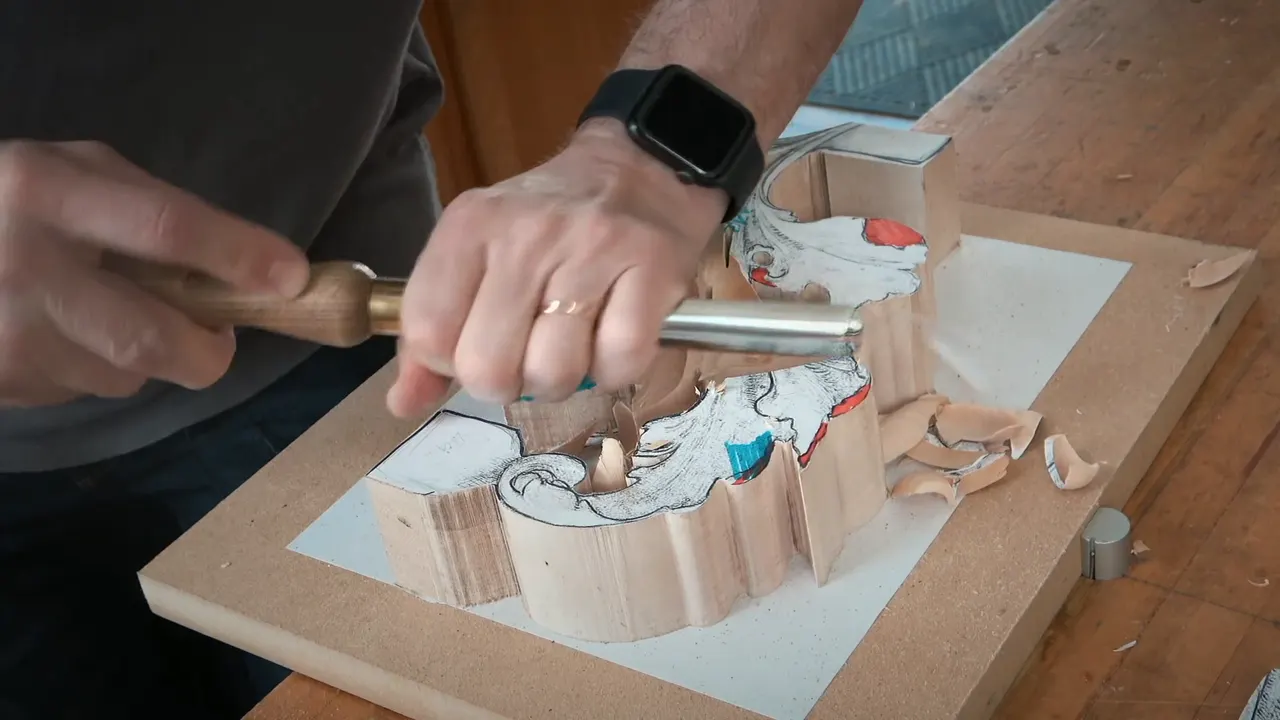
The first gouge to pick up for a rough out is the biggest one that will fit the job. On the modern acanthus leaf in this video, mine was a number 9, 20 mm across (3/4 in). If one of my three and one-eighth inch gouges (about 79 mm) fit the job, I said, I would grab that one instead. Here is the first video of the first lesson of Carving Modern Acanthus. Plain wood carving, a gouge and a leaf.
Ever watched your hand scratch at a board with the smallest gouge in the roll, and the shape barely changed? Does a whole evening go by with a pile of tiny chips and no leaf? Then you are the one I had in mind. On this leaf the big tool went in first, and I said so out loud.

Which gouge goes first in a rough out?
The widest one that will do the job. Before the first pass, I said tool number one would be the biggest tool. Just before, I had said it: if you can get the job done with a bigger gouge, grab the biggest one.
Some of my tools are three inches wide and even bigger, I said. If I can fit my 3 1/8 inch gouge into the work, I use that one. The tools themselves have a course of their own, All About Tools for Wood Carving.
Then came the picture I use with the class. Treat your tools like an army, I said. You are going to fight with it, and the big tool goes in first. If you do not like the war idea, call it a dance between metal and wood, and the big tool is the best dancer. Back in the Techniques class on the grain, I said it again: each tool is like a soldier, and I think it is a good picture. That class is the carving with the grain lesson.

What did I do before the first gouge touched the board?
I chopped the bigger chunks off on the band saw, and then took the piece to the scroll saw. And I said it again: keep those legs.
I know I repeat myself multiple times, but I know what I am saying, and I know people make that mistake. Draw the handles on the board and keep them. Really important.

Stage number one has a name. I called it bosting, and I said right away that it is not real English. English in England, I added, is a little different. By the third video of this lesson I had said what the stage is for: it sets the overall movement in three dimensions, without the details yet.
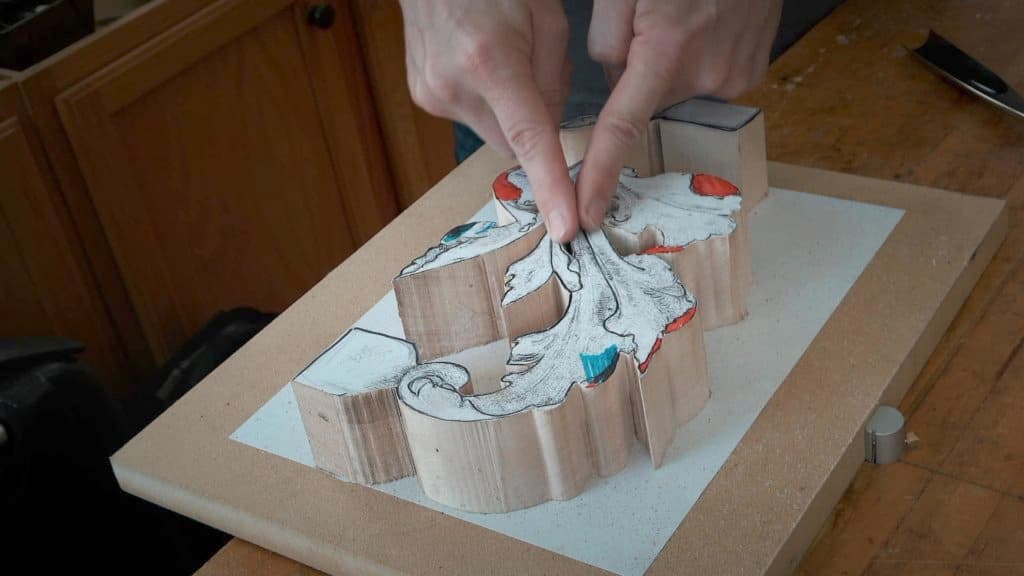
Before the gouge went in, I marked the leaf with two colors. They were orange and blue in my case. Orange was like the sunshine in the morning, and it meant a high spot. Blue was like the ocean. Easy to remember, I said, and I repeated it for the people who would rewatch the video. Anything orange, I told the class, you do not touch. Do not even think about it. Stay away. I caught myself while I marked. At one spot I stopped and told everyone, you know what, that is the wrong spot. It would curl, I said, but much lower. Some of the rolls are really high and roll back, and others roll back at a much lower level. Right then I did not mark those. Later I would use the same colors, and the class would understand, one step at a time.

Why use the biggest gouge first?
A small gouge takes forever. One of the biggest mistakes I see, I said, happens among people who just started and among people who have carved for years. They take a small tool, dig and dig and dig, spend so much time, and get frustrated.
In the Techniques class I split my tools into three sizes. The big ones are about 80 mm, three inches and one-eighth, and on a big project I take that gouge and knock the whole thing out in one day. The medium ones are around 20 mm, three quarters of an inch. The small ones are a quarter inch (6 mm) and less. A set from a store gives you small and medium, and a big tool in a set is rare. That whole class is on the page for big tools against small ones.

Now look at the two 20 mm words. Back on the leaf, I called the number 9 the biggest tool for the job. Yet in the Techniques class I called a 20 mm gouge medium. Both are mine, so I use the job as the measure, not the number on the tool. The widest gouge that fits what you are about to do is the one to take.
The way I explained it in Maine came from a trip. I live in Florida, and I had to get to a class in Maine. By airplane it took me about five and a half hours. Driving, about thirty hours, and more with stops. On foot along the Appalachian Trail, about four months, 2,500 miles. The wise way for a busy man is to fly. The huge gouge is the airplane. You can do anything with it, even take a section of the edge and carve with that section.

A medium gouge is the drive. You still get there, I said, but it takes much longer. A small one gets you there in about forever, like ten years. And I have done it. I worked on one piece for ten years, though I could have finished it in a month. The tools were not the reason, I had other projects. I gave the piece away as a gift, and I told them it took me ten years, so at least they would respect how much went into it.
So here is the rule as I said it in that room. If you have a bigger tool, grab the bigger one, and if you need something smaller, take a medium. The smallest of the smallest comes out only when we do the details.
Big first, medium if you need it.

What does a small gouge cost you on a real leaf?
I saw it in the third lesson of this course. The biggest tool, I said, and I did not know why one man in the class kept grabbing the little small one every time I came by. Scratching at that spot, I said, would take forever. So I took the same gouge I had used before, the 3/4 inch number 9. I even wanted to say number 11, but I stayed with the nine. And yes, I said, I know I am carving against the grain there, which is not the smartest.

On that spot, some material had to come out from the top, I said, because the piece would roll up and the other part had to go inside. Not too much out of the little thing, I said, because we still had to dig inside, and I went just a little at a time.
Does a big gouge leave a rough carving?
It does, for now, and I am fine with that. In the floral and molding course I said there are two approaches to finishing. Some carvers take every spot to a finished look as they go. Others say you are going to have a chance to clean it all later on. I belong to the second group, because I change the design sometimes, and that gives me flexibility and a lot less frustration. I did not spend as much time.

In another lesson of that course I gave the same reason from the other side. I am not spending time cleaning up while I establish the overall shape. Sometimes you change your mind. Say you took away too much wood and spent hours cleaning. Going back is really frustrating. Just my opinion, I said, and you do not have to do it that way. Once the shape stands, I go back and clean it.
On the Byzantine leaf I named the problem I see. People work on the details first, I said, and then they feel it is too late. They already have the details and do not want to lose them. So step number one there was the overall shape, the main movements, with no details yet.

How do you swing a wide gouge into the wood?
With a slice, not a push. I teach it on a different leaf, in the second lesson of the Byzantine acanthus. A lot of people just push the tool, I said, and that is no good. You place the tool on one side, either the left or the right, and while you drive it forward you rotate it. Every cut has that rotation, and there is a lot less resistance in the wood.
I started on the left corner of the tool and finished on the right, because I would escape to that side. And look how quickly I can take the material out, I said. I can establish my shape really quickly.

I said it another way in the first lesson of the Tray of Blessing. I do not push at all, because I do not want to get tired, and I let the tool do the work. I feel how the tool does it. Otherwise you get tired, and then you get frustrated, I said. On that tray I also stayed away from the design line, about 3/16 of an inch (5 mm) or so.

What if you do not own a number 9?
Pick the biggest tool you have. I told the Byzantine class that, almost word for word: the biggest of the biggest. A three-quarter inch gouge does the job, and less is okay too. I took the number 9, which is a half round, but you can use even bigger. I brought a number 11, one of my favorite tools, and I said I could get the job done much quicker with it. That one is 30 mm (1 3/16 in) wide.

What size did each gouge get?
The table keeps the sizes I named in one place.
| Gouge size | What I said it did | Class | Size or detail from the video |
|---|---|---|---|
| Number 9 gouge | Biggest tool on this leaf, went first | Modern acanthus | About 20 mm, 3/4 in wide |
| My three-inch gouges | Would take the job if one fit | This leaf | 3 1/8 in, about 79 mm |
| Medium size gouge | Gets you there, but takes much longer | Techniques class | Just like driving, I said then |
| Quarter inch gouge | Gets there in about forever, I said | Techniques class | Smallest ones wait for the details |
| Number 11 gouge | Could finish the whole job much quicker | Byzantine leaf | 30 mm wide, 1 3/16 in |
| Same number 9 | Same tool as before, 20 mm wide | Lesson three | I wanted to say number 11 |
How long should the first rough take?
At the end of step one I asked the class for about half an hour, maybe 40 minutes. Do not look at me for the pace, I said, because I do this every day and I am much quicker. I usually show one or two steps, sometimes three if they are easy enough, and then I give you a time for them. You do those steps on your own, inside that time.

You will catch up. But please do not get frustrated. I added that I do not like frustrated people. I even said I did not know what the word depression means until I first heard it in the United States, where everybody is depressed and everybody smiles.
One more thing from the start of the leaf. Please do not be afraid to lose the picture, I said. A second version of the drawing should already be on your bench, I said. Did you grab two pieces or one? I had a second one, and you can go and grab it right then.

What will you pick up first tonight?
Look at the board in front of you. Is there waste you could take off with a wide gouge in a few slices? Does the widest gouge you own fit that spot? Then pick that one up first, and leave the little ones in the roll for the details.
Part one of the lesson shows the first gouge going into the leaf. The other parts continue the same rough out, and the first lesson is on the Carving Modern Acanthus lesson page with every video of it. The leaf is a relief carving, and the whole course is on the course page. Open the video with your Tuition and watch the number 9 go in.
How it's done
- Pick the widest gouge that fits. The biggest gouge that will do the job is the one. On my leaf it was the number 9.
- Keep the legs on the piece. Chop the big waste on the band saw, take the piece to the scroll saw, and keep the legs and handles you drew.
- Lower the middle first. Concentrate on the middle of the leaf and lower it with slices. Leave the details for later.
- Slice, do not push. Rotate the tool as it travels, from one corner of the edge to the other, and let the tool carry the cut.
- Hold your pace. Take the 30 to 40 minutes I gave the class, and keep a second copy of the drawing on the bench.
Frequently asked questions
What if my biggest gouge is smaller than the one in the video?
I told the Byzantine class to take the biggest tool they have. Less than that is okay, I said. A number 11 would be even bigger, so use the widest gouge you own, even when it is smaller than mine.
How wide is a big gouge, and how wide is a small one?
A big gouge, in my Techniques class, is about 80 mm, three inches and one-eighth. A medium one is around 20 mm, and a small one is a quarter inch (6 mm) or less. A set from a store usually gives you small and medium tools.
Can a number 11 do the roughing faster than a number 9?
I brought a number 11 with me to the Byzantine class, and I said it could do the work much quicker. My number 9 was with me too. In lesson three of Modern Acanthus I used the same 3/4 inch nine as before.
What to carve next