
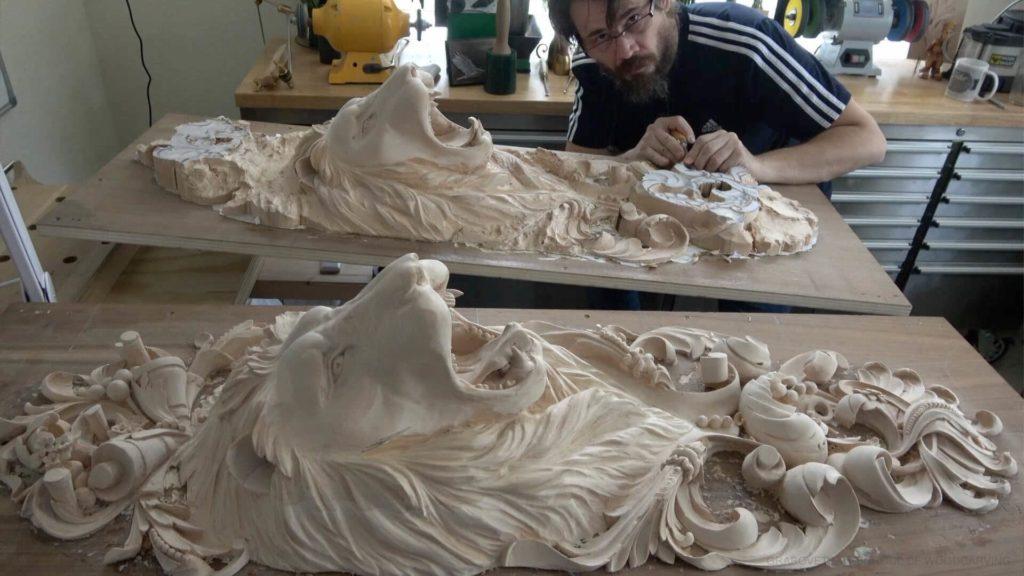
Alexander Grabovetskiy, woodcarver, School of Woodcarving · Published 2020
Who is Alexander Grabovetskiy?
Quick answer: Alexander Grabovetskiy is a master wood carver, born in the Soviet Union in 1973 and living in the United States since the nineties. He was jailed at eighteen for his faith, kept alive by furniture he carved with a homemade knife, and later won International Woodcarver of the Year.

I have been carving for over forty years and I have never once sat down and told anyone who I am. People search for wood carving, my pictures come up, and that is all they get. So here is the whole thing, the parts I am proud of and the parts I would not choose again.

I lived in Charlotte for a few years, in a good house in a good neighborhood, and my shop was in that house. My neighbor was a lawyer. For months we said good morning and good evening and nothing else. Then our families ate dinner together and he finally asked me the thing he had been sitting on the whole time. He said, maybe you are a spy.
He had worked out that I was Russian and always home, so I told him the truth. I came here as a refugee, political and religious. The longer answer is below.
Key takeaways
- Born 1973 in Dimitrovgrad, in the Russian part of the Soviet Union. About 120,000 people in the town then.
- My great-grandfather was a redwooder, a mahogany man working in the Chippendale style. I never met him. I got his hands anyway.
- Six years old when my grandfather's chisel met a brick. I ruined the chisel.
- Sixteen when a fine art master took me as his only apprentice, and taught me to draw before he let me carve.
- Eighteen when the state decided my beliefs were dangerous.
- A knife I made myself, and I believe one small gouge from a nail.
- My wages were a boiled potato, and I gave most of it away.
- Now: over forty courses online, classes in person, and a school that funds orphans and widows.


Where does the name come from
Poland, and further back than I can properly account for. My people were royalty there before the revolution took the lot.
Search in Russian for the Grabovetskiy sword and you will find the oldest sword ever dug up in Poland. It belonged to my ancestors. In English you find almost nothing, which tells you something.
Then 1917 came and the family lost the land and the rank and everything attached. Part of them was moved by force out of what is now western Ukraine into Russia. My great-grandfather landed on his feet in a workshop. They called him a redwooder, because he worked the red woods, which meant mahogany, which meant furniture in the Chippendale manner. He traveled and he got known.
I never laid eyes on the man, and I only ever met one of my grandfathers. But wood is in my blood and I did not put it there.

What happened at six years old
My grandfather had a chisel and I took it. He did not exactly give it to me.
I carried it outside and carved a face into a brick, not wood, and I have no idea whose face it was meant to be. What I do know is that I killed that chisel completely, and my grandfather looked at it, and he did not give me a hard time about it. He could have. He chose not to.
Before that I had been going at tree branches with a knife the way any boy does. After that it was not a game any more. If you are starting where I started, the first cuts course is the door.

What does a real apprenticeship actually teach
Drawing. For days, before you touch a tool. At sixteen a fine art master saw my work and offered to teach me properly, the old European way, one student only.
He brought one of his own pieces to show me what carving is supposed to look like and my jaw came off its hinges. I thought I could carve. But I could not.
So he handed me paper and a pencil and said draw something for carving. I spent a whole day on beautiful acanthus movement and I was proud of it. He looked at the sheet and said one word. Think. Think how you will carve it, which tool goes in there, and how your hand is meant to reach that corner.
Then he gave me another sheet and made me start again.
That is the whole lesson and it took me years to hear it. Design is not the ability to draw. It is the law of space, the law of rhythm, the law of repetition, and knowing your tools well enough to think like one. There is a whole course on the tools themselves for the same reason. Which is exactly why design comes first in my school and not last.

Why I went to prison at eighteen
For what I believe. I was not a criminal. At sixteen I had committed my life to God, and at eighteen the government decided that made me dangerous.
There were two judges. The first heard my story, refused the case and walked out. The second enjoyed himself. I told him the Constitution gave me the right to believe or not believe, and he laughed at me and asked whether I believed in the Constitution. Then he read out the statute. Seven to fifteen years or death, for what the wording called betrayal of the country.

The first cell was an army one. Six feet by eight, about the size of a sheet of plywood, and six of us in it. Nothing to sit on and nothing to lie on. You stood all day, and when you sat down on the floor they poured cold water on it so you could not. November, snow already, and the window behind the bars had no glass in it.
One of them ordered a soldier to shave my head with the wire cutter off a Kalashnikov bayonet. This is a tool that lives on the end of a Kalashnikov bayonet, shaped a little like scissors, and nothing like as sharp.
Then they made a mistake. They put me for a day in an ordinary room with ordinary soldiers, expecting them to give me a bad time over my faith. A man in that room believed the same thing I did. He showed me a hole in a concrete wall and where to hide on the other side of it, and I went through it. A whole platoon looked for me in that city. I was not free for long.

What carving had to do with staying alive
It fed me. The second arrest put me underground first, in a 300 year old building with no windows and mold on every surface, and then into a cell with about twenty bunks and forty men taking turns to sleep.
Then the Soviet Union came apart while I was inside. If it was hard out there, work out what it was in here. They fed us balanda, a soup with something black in it, and if you ate it you got sick.
One of the inmates was a mafia man who had already been in fifteen years. He said, I will protect you, you make something for me. He could get wood. I could not get tools, so I made them: a knife with a blade about 10mm long, and, I believe, one small gouge from a nail. I don't remember exactly, it was a long time ago. The blade was really small. How I bring an edge back today is a whole course on sharpening.
With that I made furniture. Coffee tables and other furniture, and a fifteenth century staining trick my teacher had shown me that reads like marquetry when you look at it and is nothing of the sort. He sold the pieces to the prison administration. Furniture is still where I would send anyone who wants carving that has to earn its keep, and the furniture panel course is that work.

My pay was one boiled potato a day. We cooked it on two wires twisted together. And a potato was a fortune in there, so I took mine round to other men and we ate it between us and talked about God. I carried that out of prison with me. There are no bad people. Only people who did bad things, and you can still find something in them.
Winter ran to 45 below, with no heat. You slept in your prison clothes and woke covered in frost. I walked out under 100 pounds, somewhere near 80.
The years, in order
| When | What |
|---|---|
| 1973 | Born in Dimitrovgrad, in the Russian part of the USSR, a town of about 120,000 back then |
| Six | Took my grandfather's chisel to a brick and ruined it |
| Sixteen | Apprenticed. Also the year I gave my life to God, which is what later put me inside |
| Eighteen | Arrested |
| Inside | One knife I made myself, one gouge that started life as a nail, and a boiled potato as wages |
| Out | Released under the amnesty as one of 42, married two months after, refugee papers in two hours |
| America | Landed Saturday, framing houses Monday, no English |
| Michigan and Indiana | Built a shop into the top few percent across three states and staffed it with refugees |
| Since | Sold the machinery |

The cell they put me in to break me
My mother smuggled in a Bible and the whole cell read it. None of that was permitted. When the administration found out, somebody had to be punished, and they chose me.
They took the book first. The inmates banged on the doors shouting about freedom of religion, which I did not expect and have never forgotten.
Then they took me down to a cell where men were kept to die. Eight of us, four bunks. Nobody treated them and nobody visited them. The boy next to me was eighteen and had something living under his skin, small things that crawled in and ate and came back out, and his body was covered in pus. He cried day and night. And it passed by touch. I had to touch his bed frame to climb down from mine.
So I stopped eating. Not as a protest. I fasted and prayed, no food and no water for days, because nothing human was going to get me out of that room.
I did not get sick. The guards would not step through the door of that cell, and they watched me walk out of it untouched, and it frightened them. They fried my clothes in hot air, put me back with the forty men, and gave me my Bible back. After that nobody laid a finger on it. That was the first time in my life I saw plainly that God is not a theory.

How I got to America
An amnesty, and one man who opened a door. When the union collapsed they released prisoners held for political and religious reasons, and I was one of 42 who qualified.
The day before my release an official who hated me locked me in a punishment cell, four feet by eight, rough concrete on every side. He told me plainly that the releases were theater for the West and that they would pick me up again anyway. I did not sleep. I prayed all night.
At eight in the morning I heard my door. A different man from the administration was standing there and he said two words to the soldiers. Release him. I still do not know why he did it.
I married my bride a couple of months later. I met her when I was sixteen and she waited the whole time. The US Embassy gave us refugee status in two hours once I showed them the paperwork on why I had been inside. Half a year after I left, the government came to arrest my brother, thinking he was me. They had meant what they said.


I landed on a Saturday and had a job on the Monday as a framing carpenter, with no English at all. I lasted a few days. My first stop was Grand Rapids, Michigan. Then I moved to Goshen, Indiana, Amish country, and started my own business in the Michiana area. It grew into one of the top few percent of quality shops across three states. The local paper wrote it up.
I hired other refugees. Skilled carpenters from Russia and Ukraine and Moldova who could not get decent work because of the language, the same wall I had hit. Some of them stayed over nine years. Hiring them was never a business decision, whatever it looked like on paper.

Why I sold the machinery
Two friends said the same sentence to me, years apart. Thousands of people can build a cabinet. Almost nobody can carve.
One asked me how many production years I thought I had left. A rude question, and the right one. I sold the Felder equipment, the big sliders and the belt sanders, everything a real cabinet shop needs, and I started carving full time.
It took me a few years to admit they were right, although carving had already won by then and I simply had not said so out loud.

How a man who dreaded English ended up teaching
A student named Richard asked on my behalf. He went to Marc Adams and asked him to invite me, which is why my phone rang.
I ignored the idea for two years. Not the man, the idea. My English is my second language and I was buried in commissions, and honestly I did not think of myself as somebody who teaches. Marc told me to stop worrying. If it works it works, if it does not it does not, nothing to lose.
So I went, and I loved it. The next year the same faces came back and brought new ones. In 2020 the in person classes sold out in seven minutes, and I didn't even know it.
The online school came later, and it came straight out of that apprenticeship. People stand in my shop and watch me work, and I talk while I do it. Questions get answered in the techniques sessions. This course is that same thing, seen through a lens.

What I actually think this is for
I believe carving in three dimensions changes your brain, and not as a figure of speech. It builds new cells and lights up parts of you that drawing and painting never reach. It is a defense against getting old badly.
The school is a 501(c)(3) non-profit, so the tuition does not stop at my door. It funds orphans and widows, and it pays for art lessons for talented children whose families cannot afford them, which is the exact thing I could not afford when my father left us.
Am I successful? There are men making billions and there are carvers better than me, so the honest answer depends on what you decided to count. There is more of the reading behind all of it on the free shelf.

You have read this far, so you already know the answer to the next question. Do you have something in you that has been waiting? Do you want to make things your grandchildren will fight over? Start at the beginning if you have never held a gouge, find where you are on the map, or come and stand at the bench with me. Shall we carve?
How it's done
- Get one tool you can really use. One tool, not a set. My whole kit inside was a 10mm blade and one gouge that used to be a nail.
- Draw before you carve. My master gave me paper for days and would not let me near the wood. Sit down and draw the thing you want to make.
- Think like the tool. Look at your own drawing and ask which tool reaches that corner, and how your hand gets in there. Redraw whatever it cannot.
- Learn the laws, not the tricks. Space, rhythm, repetition. These are what make a carving look right, and almost nobody teaches them.
- Watch somebody who can do it. Stand behind somebody who can already do it and watch the hands, not the wood. An apprenticeship is nothing more than that.
- Carve every day, with whatever you have got. Bad wood, one tool, and twenty minutes after supper is a real start. I carved in a prison where winter went to 40 below with no heat, so your kitchen table is fine.
Frequently asked questions
Who is Alexander Grabovetskiy?
A master wood carver, born in the Soviet Union in 1973 and in the United States since the nineties. I carve architectural ornament and furniture carving, I won International Woodcarver of the Year, and I run a non-profit school that teaches the craft online and in person.
Was Alexander Grabovetskiy really in prison?
Yes, when I was eighteen, for what I believe. The statute they read out carried seven to fifteen years or the death penalty, and the wording was betrayal of the country. I escaped the first arrest through a hole in a concrete wall and was picked up again. A Goshen News feature from 25 March 2000 tells the same story in print.
How did wood carving keep him alive inside?
It bought me one boiled potato a day. An inmate who could get wood protected me, I made a knife with a blade about 10mm long and a small gouge out of a nail, and I built furniture that he sold to the administration. I came out under 100 pounds.