

Alexander Grabovetskiy, woodcarver, School of Woodcarving · Published 2018
Does a carved flower have to look realistic?
Quick answer: A carved flower never needs to look realistic. It needs to convince, which means obeying the rules the eye already knows: one light source, things in front shadowing things behind, a petal with real thickness. Hand work makes it authentic for free. Realism you buy separately.
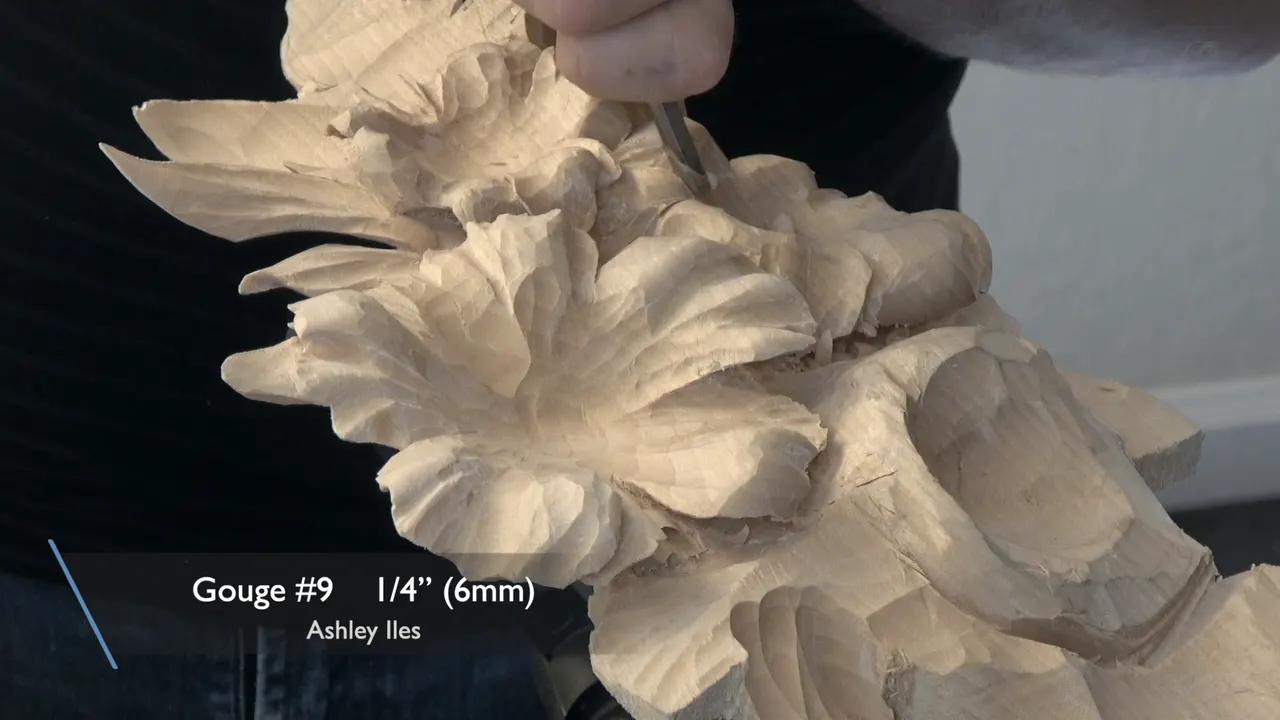
No. It has to be authentic, and it already is, because your hands made it. Realism is a separate choice you buy with undercuts and shadow, and you can spend as little or as much on it as you like. I caught myself using the wrong word on camera in this lesson and corrected it mid sentence.
Have you ever finished a carving and felt it was not good enough because it did not look like a photograph? Would you say the same about a sixteenth century church carving? Nobody does. Those flowers are nothing like a real flower and every one stops people in a doorway.
Lesson 36 of the Hashemi flowers panel takes the chunk of wood saved back in lesson 35 and turns it into a leaf growing out from under a flower. Four parts, a great deal of undercutting, one crack I decided to keep, and a word I had to take back.

What this lesson settles
- Authentic and realistic are two different things, and only one of them is optional.
- Why a leaf grows downhill rather than goes downhill.
- The four millimetre gouge, and the arithmetic behind that number.
- A split that happened by itself. I kept it.
- Finishing a surface the top petal will hide anyway.
- Removing a saw wall from above a leaf without losing the leaf.
Does a carved flower have to look realistic?
It never did. Some of the finest carving in Europe is not remotely realistic, and nobody walks past it.
What a carving has to be is convincing, which is a different job. A convincing flower obeys the rules the eye already knows: light falls from one direction, things in front cast shadow on things behind, a petal has a thickness. Break those and no amount of detail will rescue you. Keep them and you can stylise as hard as you want.
This matters more than it sounds. Naturalism is one option among several in ornamental relief, and for most of the history of the craft it was not the popular one. A Baroque flower is exaggerated on purpose, with petals no plant ever grew, and it survives three hundred years on a wall because it was designed for the wall rather than for a photograph.

What is the difference between authentic and realistic?
Authentic is free. Realistic is expensive.
Halfway through the first part I said I was making the leaf more authentic, heard it, and stopped. It does not matter what you do. It is still authentic, because you have done it with your hands, and that is the end of the argument. What I actually meant was realistic looking, and that is the thing you pay for in undercuts, in shadow lines, in the hour you spend on a surface nobody will examine.
My grandfather gave me a chisel when I was six years old. I took it to a brick and carved a face, and I ruined the tool completely. That carving was authentic. It was not realistic, and the passion was born right there anyway.

Why does a leaf grow downhill instead of going downhill?
Plants grow. Wood does not, and I corrected myself on camera over this too, which is not fussiness about words.
Going downhill is what a shape does when it slides off a board. Growing downhill gives the leaf a direction, a start and an end, and the carving follows that the whole way. Decide where it comes from before you shape it. Everything after that, every sweep and every undercut, is just agreeing with the decision.

Why exaggerate depth that is already there?
A panel hangs on a wall in one light, not in your hands under a lamp.
I dig extreme excavations under these petals knowing no one is ever going to see into them, and I say so plainly while doing it. Every small shadow helps. The carving is three dimensional anyway. The excavation just exaggerates what is already true, so it still reads from the far side of a room. Painters call the trade in light and dark chiaroscuro and spend careers on it; a carver gets it for free, and then has to arrange it with a gouge. Undercutting work nobody will ever look at is a whole lesson elsewhere on this site, and it is the single habit that separates a flat panel from a deep one.

What size gouge is four millimetres?
It is nothing on the imperial rack, which is exactly why I stop to describe it.
An eighth of an inch is 3.2 mm. Three sixteenths is 4.8 mm. A quarter inch is 6.4 mm. So a 4 mm gouge falls in the gap between the first two, a little bigger than an eighth, clearly smaller than three sixteenths, and no imperial label fits it. I keep one because that size reaches under a petal where the eighth is too weak and the three sixteenths is too fat. When I tell you it does not have to be 4 mm, I mean it. Something small will do.

Which tools shaped this leaf?
Seven, and two got swapped mid job for being the wrong size.
| Part of the job | Tool | How that actually went on the day |
|---|---|---|
| the leaf form | a 7, then a 4 at 10 mm | semi final |
| the shadow line beneath the flower | V tool numbered 16 | shallow, and watched the whole time it was in the wood |
| excavating | a 9 at 4 mm | deeper than anybody is ever going to look into it |
| taking down the saw wall | five eighths first, then a quarter inch | the big one was wrong and I said so out loud |
| tidying beneath a petal | the little V tool, the one that is barely there | 3 mm, and it fitted |
| concaves along the petals | big 9, small 9, a 5 at the very end | large movements first |
| blending | the 4, and a wide 7 | no ridge left standing anywhere on it |

How do you take a saw wall down without losing the leaf under it?
With a smaller tool than you want to use. Whole answer, right there.
The wall above this leaf was rough stock from the jigsaw, and my first reach was the five eighths 9, about 16 mm across. Too big for the job. I said so and put it down. The quarter inch one took longer and was safer, and safer is the whole point when the thing you can destroy in one pass took forty minutes to make.

What do you do when the wood separates on its own?
You keep it, sometimes. One opened up here while I was bringing the wall down to the edge, and it formed my next movement for me.
Which is not resignation. The wood had told me where it was weak, and fighting that would have cost the leaf. So the crack became a line, the line became a separation between two shapes, and I was absolutely fine with the result. Then there was another one. Same answer.
There is a limit, and it is worth naming. One that follows a shape you were going to make anyway is a gift. A split running across the grain into the body of a petal is not, and that one gets glued, clamped overnight and carved the next day. How thin a leaf can go is where most of these cracks start.

Why finish a surface the top petal will cover?
You can see the gap from an angle. And you will know.
In the third part I work the movement on a petal and admit out loud that most of it will be hidden by the shape above it. But still. A visitor walks past your panel rather than standing square in front of it, and at forty five degrees the covered part is not covered at all. Making a carved leaf catch the light starts from the same observation about how people actually look at carved work.

Does the grain ever cooperate on a flower?
It does not, and I stopped expecting it to a long time ago.
A flower runs in a circle and the grain runs in one direction, so a quarter of every petal is against it no matter how you turn the panel. I work completely against the grain in this lesson and say it is fine, because I can always fix an edge afterwards and that really is not a big deal. What is a big deal is the edge on the tool. Break the grain rules with a sharp gouge and you get a torn fibre you can pare off. Break them with a dull one and you get a hole.

Why clean a surface again?
I clean so I can see the options. A 5 goes over this petal early in the third part and say straight out that I do not have to, that I am only cleaning so I can see what movements are available.
A torn, chipped surface hides shape. You stand there guessing at a form that is already under your tool, and you guess wrong. Thirty seconds with a shallow sweep and the petal tells you where it wants a hollow. Keeping the carving clean as you go is the same habit at a larger scale, and both of them are really about being able to look at your own work honestly.

Where should a concave go on a petal?
Off centre. Put it dead in the middle and the petal turns into a spoon.
My own words while doing it were that the hollow goes roughly in the middle, then immediately, not right in the middle, more to the left of centre. That correction is the useful part. A hollow slightly off the axis makes the petal look as though something pushed it, which is what weather and time do to real petals, and the panel reads as a living thing instead of a pattern. The same goes for the movement that runs down and comes back up at the tip. Nothing in a plant is symmetrical, and the corner of a fishtail gouge is the tool that puts those small asymmetries in.

What makes a small leaf look bigger?
Air underneath it, and the angle the viewer stands at.
Lower the shape behind a leaf, let the leaf grow out over the gap, and it will look larger than the wood it is carved from. That depends on where you stand, which I point out at the time. Straight on it is a small leaf. From the side it lifts off the panel and doubles. The leaf added that the drawing never asked for earns its place the same way.

Do big movements or small ones go in first?
Big ones, always, and this lesson is a clean example of the order.
A large 9 lays in the main concaves across the whole petal, and a smaller 9 puts finer hollows inside those. A 4 then softens the ridges where two sweeps meet, and a wide 7 blends the last of it. Reverse that order and the small shapes get erased by the big tool arriving late. Blending the ridges a gouge leaves behind is the finishing half of the same idea.

Do you choose the next tool, or does your hand?
My hand, most days, and I only noticed because the camera was running.
I reach across the bench and pick something up without thinking about what it is going to be, because after enough years the choice stops being a choice. Nobody can practise that directly. It arrives on its own, as a side effect of a few thousand hours, and until it does you should absolutely think about the tool. Whether carvers have a favourite gouge turns out to have the same answer underneath.

Where this leaves the panel
Wood that was waste two lessons ago now grows out from under a flower as a leaf, undercut all round, with one crack kept on purpose and a saw wall gone. Realistic? Not especially. Convincing from across a room, which is the part I care about.
All 49 lessons of this panel sit behind tuition at the school, carved in basswood, the American lime behind every panel course here, with Ashley Iles, Pfeil and Henry Taylor on the rack. If you want proof that realism was never the point, the sculpture collection at the V and A is full of carved flowers that no botanist would recognise and nobody can walk past.

How it's done
- Give the saved block a semi final form. A 7 followed by a 4 at 10 mm. Decide where the leaf grows from before you shape it, then let every pass agree with that direction.
- Open a shadow line under the flower. The 16 V tool, kept shallow, with an eye on how deep it is allowed to go. This is the line that makes the leaf sit in front of the flower rather than on it.
- Excavate underneath, further than looks sensible. A 9 at 4 mm reaches in where nobody will see. Shadow is what the excavation is for, and shadow reads from across a room.
- Take the saw wall down with a small tool. Reach for the quarter inch instead. Slower, and it will not take the leaf with it if the grain runs out.
- Lay in the big hollows, then the small ones. A large 9 across the whole petal first, a smaller 9 inside those, and only afterwards the fine ones at 3 mm.
- Blend every ridge before you stop. A 4 and a wide 7 soften each place two sweeps meet. Any step you can feel with a thumbnail will catch light as a bright wire.
Frequently asked questions
Is stylised carving less skilled than realistic carving?
Baroque and Rococo ornament is stylised on purpose, and it is some of the hardest carving anybody has ever done. Copying a photograph and designing a shape that works on a wall are two different skills.
What makes a carving look convincing rather than real?
Three things. One direction of light, honest overlaps, and real thickness in every edge you carve. Get all three right and you may exaggerate whatever shape you like. Get them wrong and nothing rescues it.
Should you carve the parts of a panel nobody can see?
Truly hidden parts, no. The parts that only look hidden from directly in front, yes, because people walk past a panel at an angle and see straight into them.
What to carve next
- Carving Hashemi Flowers
- The leftover wood between the petals
- Adding a leaf the drawing never asked for
- What a fishtail gouge is for
- Do carvers have a favourite gouge
- Keeping a carving clean while you work
- How thin should a carved leaf be
- Undercutting work nobody will ever look at
- Making a carved leaf catch the light
- Blending the ridges a gouge leaves behind
- Tuition at the school