

Alexander Grabovetskiy, woodcarver, School of Woodcarving · Published 2021
What is dynamic symmetry in wood carving?
Quick answer: Symmetry of this kind is two sides that keep the same idea at different sizes, as I teach it. On my chalkboard acanthus one space was 1 unit and its partner 1.61. Carving the Venice Room panels, I called it a two to three ratio, and I sized it by eye or with calipers.
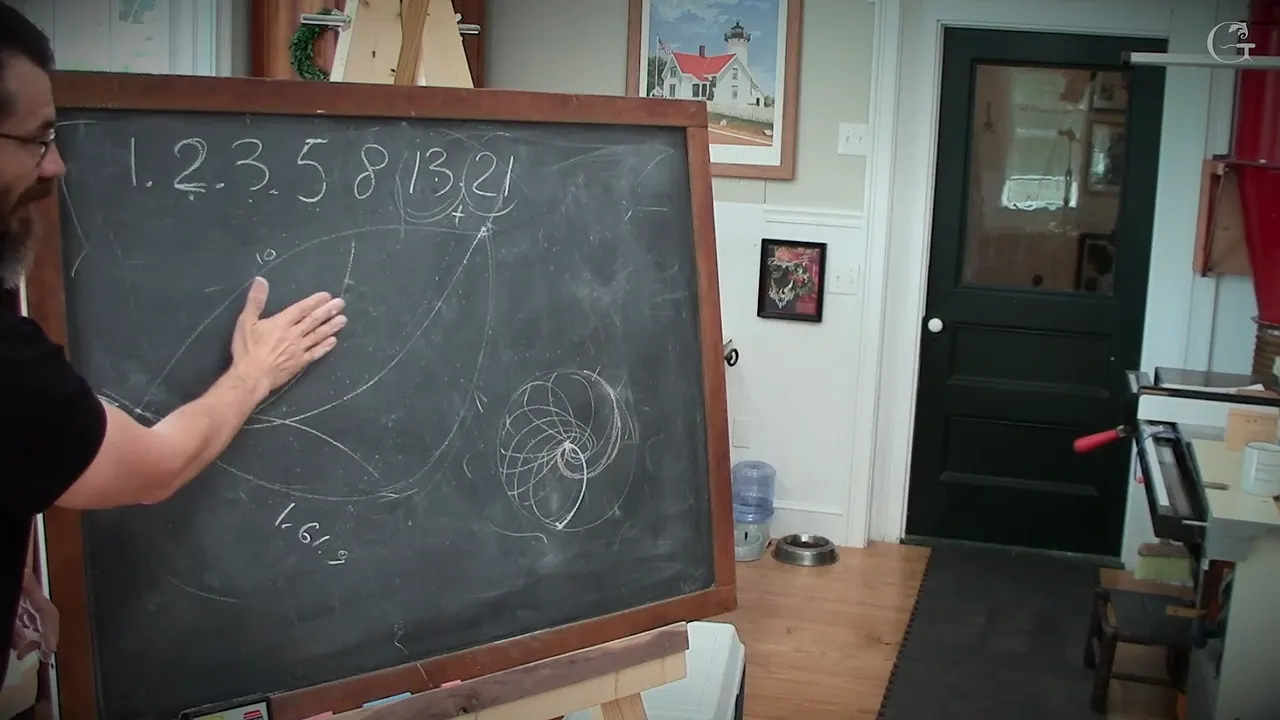
Dynamic symmetry is a pair of shapes that carry one idea at two sizes. At the board in lesson four of my design class, I drew an acanthus leaf and pointed at two spaces inside it. If this space is 1 unit, that space is going to be 1.61. The plain kind, simple symmetry, would be equal and equal.
Did you ever fold a sheet of paper as a kid and cut out a heart? Did both halves come out the same? That fold gives you the equal kind, what math books call mirror symmetry. This page is about the other kind. It starts with one short chalk talk, about six minutes with a live class in the room, and then goes to the Venice Room leaves, where I said the numbers out loud, and where I skipped measuring and used my eye.

The rule from my board in five lines
Both sides hold the same idea, and one side runs bigger.
One unit against 1.61.
Venice Room leaves got 2:3 and 5:8, and in workshop 73 two openings became one area of 10.
Calipers on the widest piece show the smaller width.
Nobody is going to put a ruler on it, and the eye still likes it.
What does it look like on one acanthus leaf?
Two spaces inside one leaf, one bigger. I drew that leaf fast, in chalk, with the class watching. It's really important, even to the tiniest spot, I told them at the start. You asked me for the design, so I'm just telling you, and I could tell you on and on.

After that I redrew the acanthus going on a Baroque movement, read from a Western point of view, and gave the leaf its cast. One part became the antihero. My hero sits right there somewhere. My upper part, my space, is going to be supporting this, I said.
Now look at the spaces inside. This space against that space, one small and one bigger. Even in depth, I said. It was a quick sketch, but you can see the difference. And if you divide those spaces in square inches and calculate, you get the same thing as with human eyes.

The 1.619 I chalked low on the board belongs to the border line around the leaf. Nobody usually sees that line. That border, and the Italian and French ways of placing the divisions, are told on the lesson four page.

What makes it different from static symmetry?
A static pair matches exactly, and this pair doesn't. In workshop 72 of the Venice Room I was deciding how to end one movement on a leaf. Maybe I should actually end up right underneath that movement, I said. That would give me a way to hide the shell. So one of the main movements goes underneath, and I had to make extra divisions.
One new division would repeat this part on the other side. So it's not like a static symmetry, I said. If you know the rule of the golden ratio, it's five parts out of eight, two parts out of three.

To keep it simple, I put numbers on it. Say it's five inches (127 mm) across from this point to that point. Of course it's not, I added. Then I have to make eight on this side, about 203 mm. Which you don't see, but you should understand.
Near the end of the same video I said it again, a symmetrical pair but not a one to one ratio. More like two to three, or five to eight. The 2 cm and 3 cm example from that video sits on the Venice Room part 6 page.
Those pairs, 2 and 3, 3 and 5, 5 and 8, are next door neighbors in the Fibonacci sequence. Divide the bigger by the smaller and you get 1.5, about 1.67, then 1.6. The farther down that list you go, the closer each pair gets to the golden ratio.
That area of the leaf was hard for me to work, and you could not see what I was doing anyway. So that part, I said, I would do off camera.
Is this what Jay Hambidge meant?
His was a different system, and the phrase is older than this class. Jay Hambidge, an American artist who died in 1924, measured Greek temples such as the Parthenon and built a system that carries the same name. His system divides rectangles. It works with the golden ratio and with root rectangles built on square roots, like root 2 and root 5.

Not everyone bought it. In 1921 Rhys Carpenter and Edwin M. Blake each published articles against his theory. An art historian later summed up their point: in its more complicated forms, the system could describe any shape at all. The carving rule on this page shares his name and his golden ratio, and it does not use his rectangles.
Why bring human eyes into a leaf?
Eyes are the pair everybody carries. At the board I said look at the eyes, human eyes. One eye is bigger than the other. And no, I told the room, I'm not looking at a bad guy.

Everybody has different eyes. One eye is smaller, the other is bigger, if you divide by square units. In lesson three I used the same eyes to show why nothing on one panel should repeat a size.
And that, I told them, is why I believe in a Creator. Without wisdom, what we see around us is impossible, even on a level like that.
Faces really are a little uneven. Scientists who measure them call the small random differences between the left and right side fluctuating asymmetry, as the Wikipedia page on facial symmetry explains.

How do you measure the two sides?
By area, by eye, or with calipers, and I did all three in the Venice Room. One section of a leaf in workshop 73 just didn't look too good. I wanted to keep the overall movement, like an invisible line going all the way, but the section itself didn't make much sense to me. There was also an eye across from it, a big one, and the one going in on the other side had to be a lot smaller.
Then came the numbers. I'm not going to get too mathematical, I said. Take that space and that space together, and say they make 10 square inches, or 10 square centimeters. This part would be about 6 out of 10, and that part only four. To be exact, 38 percent of 100 and 62 percent. That would be really pleasing to the eye, and that is what it's called, I said.

A square inch measures area. So the check compares the two openings as whole shapes, not just how wide each one is.
A video later I told you I'm not going to measure it. I would just eyeball it, approximately. I tried an easier way out loud. If one opening is two square centimeters, this one would be one, the same ratio pretty much.
Well, actually, not really. No, I shouldn't say that, I told you, and then I gave three to five, or five to eight.

Calipers were the third way. My calipers in workshop 94 were true golden ratio calipers. A small section sat on one side of my leaf and nothing on the other, so I had to add one, smaller. I put the calipers on the widest piece I could place. They showed me how wide the new one was supposed to be.

One video later I measured a short distance with them, and the other side of the calipers showed me the far distance, the bigger one. One movement on the big side, its partner on the smaller legs. That way, I said, I know it's going to look really good.

| Where | Pair | Ratio | Note |
|---|---|---|---|
| Design class 4.1 | Two spaces in one acanthus, one bigger | about 1.61 | The difference shows in depth too |
| Venice Room 72 | A new division repeats the first one | 2:3, 5:8 | Not a one to one ratio |
| Workshop 73 eye | Both spaces as one area of ten | 62/38 split | Pleasing to the eye, I said |
| Workshop 73 opening | I eyeballed it, then corrected my numbers | 3:5, 5:8 | I took back two to one |
| Lesson 94 leaf | Calipers set across the widest leaf piece | 62/38 calipers | They gave me the smaller width |
What if one side has a detail and the other side has none?
The bare side gets one too, a smaller one. I'll make it wide or wider, I said in workshop 94, and a moment later, it doesn't look good. I had a small detail on this side and no detail on that side, and I need to be symmetrical again, I said, and do something like that.
The only problem I saw was too many divisions. No bueno. A few seconds later I wasn't so sure. Maybe it's OK.
Size has a limit on both ends, too. Back in workshop 73, working that opening, I said I cannot do it too small and I cannot do it too big. I took a 5 mm (3/16 in) tool, and then it felt like I needed to get a little bigger in that section.

One way out was to pull that piece toward the edge and lose the limit. I didn't want to, because it would have added too many movements. A video earlier, I had made another call. Logically, I thought, this part should go lower and run underneath the line. And if I don't like it, then it's a problem, and I have to live with that. A 3 mm (1/8 in) number 11 went in after that, and later a 1 mm (0.04 in) number 11 cleaned up a little mess.
Does the partner have to move the same way?
It can run the other way. Working right on top of my marks in workshop 72, I saw I could slope one movement a little this way too. That has to do with symmetry, I said. If my movement goes upward, the symmetrical one can repeat, but downhill, in a counter direction.

If this one goes up, this one goes down a little. Not much, but a little.
On the plate with butterflies, in lesson four, I grew another movement from one part in the opposite direction. One curl got bigger and the next one smaller, about 40 percent of the space against 60. You don't really have to calculate, I said, and then I gave it the name this page is about, if you're familiar with that term.

The floral and molding panel has two shapes that look symmetrical and are not, and that story lives on the floral and molding lesson three page.

Will anyone notice the difference?
Hardly anybody will measure it. Nobody is going to estimate that and put a ruler on it, I said in workshop 72. Still, the eye likes it.
I said it plainer in the video after. Nobody's going to apply a ruler or look for that stuff. Well, maybe some people. But normal people would never think about it, and most people don't know about those rules and the geometry in wood carving and everything else, like architecture. Architects have their own long study of it, filed under proportion.

Whether a carving has to be symmetrical at all is a different question. I answer it on the Venice Room lesson 142 page, where one side of the panel did not copy the other.
Where did I promise a design course on it?
It was workshop 93 of the Venice Room. I had just made a small mistake, not the end of the world, and I said I don't know if I can say that I like it, but honestly, I do. Except one part, which would not have a lot of lines like the other side.

In that video I stopped on the idea itself and called it a different type of symmetry. Then came a promise. I would probably explain that a little better in a design course I was planning to do, and explain exactly how it differs from normal symmetry.
The Principles of Design in Wood Carving course is a design course, and video 4.1 is the one that puts this idea on the board, on one acanthus leaf.
What do you need on the bench to try it?
Calipers help. For the grape vase I spread the wide side of my calipers for the widest leaf, then drew two rounds, two different sizes. If you want to use a compass, go ahead and do that, I said. I don't really need it. A compass draws one circle at a time, so you size the second one yourself.
The colored marker lines on my Venice leaves were there just for the sake of showing, I said.
Got a pair of leaves on your next drawing? Make one of them bigger and let your eye judge it. The whole chalk talk is video 4.1 in lesson four of the design class, and the parts of that lesson sit behind tuition.
How it's done
- Find the pair. I look for a part that will repeat on the other side, like the new division on my Venice leaf that copied this part over there.
- Give one side the bigger share. A detail that is a little smaller here gets a partner a little bigger across from it. Five inches on one side meant eight on the other, in my example.
- Size it off the widest piece. My calipers go on the widest piece I can place, and they show me how wide the smaller one should be.
- Check the area. Once, in workshop 73, I took both spaces together as 10 square inches. One got about 6 parts and the other four.
- Let it run counter. If my movement goes up, the partner can repeat downhill. Not much, a little.
Frequently asked questions
Is a bigger side just asymmetry?
In my class the two sides still answer each other. A detail on one side gets its partner on the other, only bigger or smaller, so you still read a pair. With a small detail on one side and none on the other, in workshop 94, I said I need to be symmetrical again and add one.
What ratio should the two sides have?
On camera I gave several. Five of eight, two of three, and 1 against 1.61 on the chalkboard. I first said two to one in workshop 73, took it back right away, and gave 3 to 5, then 5 to 8.
Do you have to measure it every time?
Measuring is optional for me, and in workshop 73 I said I would just eyeball it, approximately. Calipers set across the widest piece in workshop 94 gave me the smaller width. On the butterfly plate I said you don't really have to calculate.
What to carve next