

Alexander Grabovetskiy, woodcarver, School of Woodcarving · Published 2021
What is the difference between rhythm and repetition in design?
Quick answer: Rhythm in a carving design is repetition with one more question added. Repetition puts a detail in a second spot. Rhythm also asks what sits between those repeats, and in my class the answer was the space, with one arc on the board coming back until there were five.
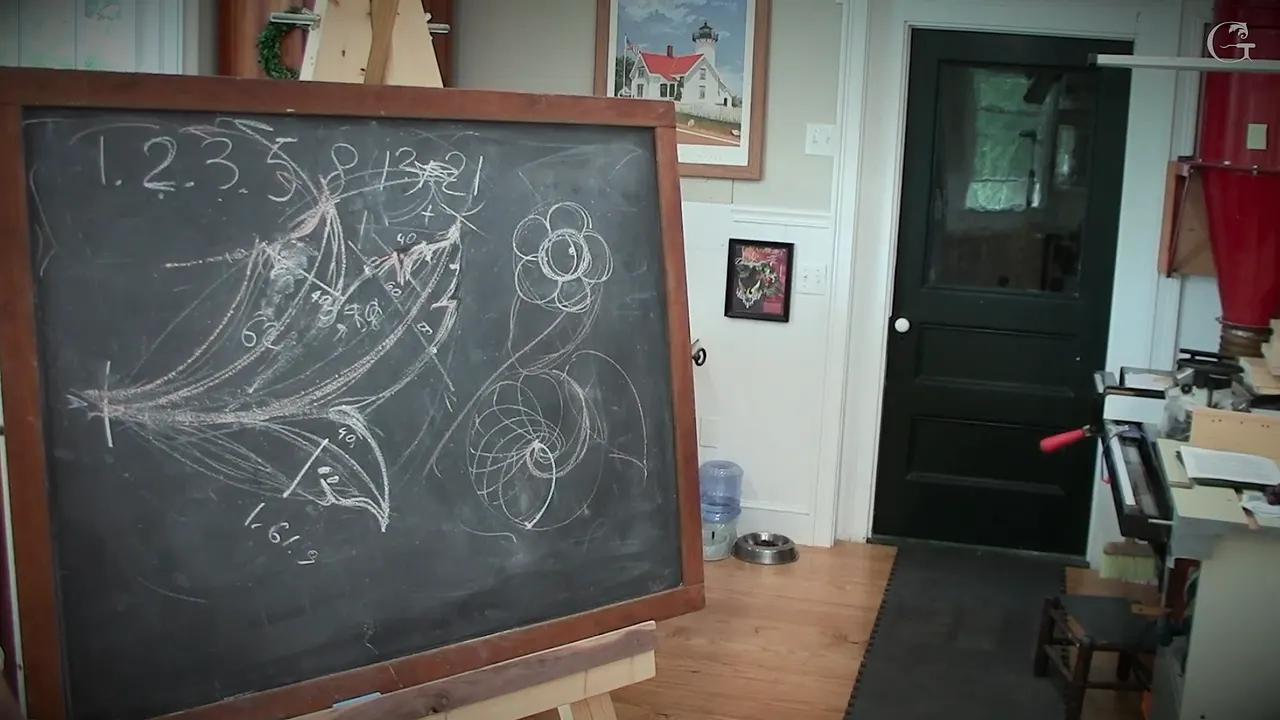
Rhythm and repetition in design are two laws I teach side by side, and one question tells them apart. Repetition brings a detail you carved in one spot back in another spot, maybe at a different scale. Rhythm keeps all of that and then asks about the space between the repeats.
Did you ever carve a curl you liked so much that you wanted it again somewhere else on the board? Did the second one come out looking a little too much like the first? Then you already know half of this. The other half is the space between them, and this page takes it from my design class at the board and from real pieces in my other courses.

Six lines to carry to the bench
Repetition means one detail shows up again elsewhere, smaller or bigger.
Rhythm asks what goes between the repeats, and my answer in class was the space.
One arc became five.
A repeat can run the same direction, or turn and face the other way.
Once a copy matched too well, so I wanted it a little bigger.
You may go off these laws a little, and I even have a joke about it.

How does repetition work in carving?
One detail should repeat itself in multiple spots, maybe at a different scale, but it comes back. I said it almost exactly that way on a livestream in April 2020, while I showed how a sheet of plastic works as a carving tool. If you are a little knowledgeable about design, I told the viewers, there is a law, there is a rule.
Why one good detail needs company is a question with its own page, taken from a Venice Room ceiling. I will leave that story there and stay with the plain mechanics.
On my lily box I carved a volute with a sloped top, so its side stayed exposed instead of hiding under a flat top, and I really liked that idea. I wasn't sure the camera showed it well, so I turned it to a different angle. So let's work on a second one, I said, exactly the same idea. We have to repeat. It's one of the laws of the design. Then I showed where the highest point sat, and which point would be highest on the second one.

The Hashemi flowers had the same moment. First I checked whether a straight number nine gouge at 10 mm (3/8 in) could get in there. Yes. I was able to. Then I repeated the idea on the inside and named the law out loud while I worked. I still had to keep an eye on how I touched that section, because I could not pry, and I wanted it clean.
Sometimes the repeat is a check by eye. On a Roman acanthus I looked straight at the leaf, just eyeballing, and refined one side to repeat the movement of the other. I said I would probably need a number three, although a simple knife would work too. I looked again, and it looked pretty much the same.

What does rhythm in design add to repetition?
In my design class I had just thanked everybody and said I hoped I did not overwhelm them. But it was not the end yet. There was one more law I wanted to tell, a really important one, and we call it the law of rhythm.
You already know about the law of repetition, I told them. It's supposed to repeat on its own. But what goes between? The space is what we talked about, back in the lesson on the law of space. And everything is supposed to repeat everything.
A minute or two earlier in the same video I had said something about that space already. Empty space, also golden ratio. How you fill the space, also. So the gap gets designed too, by the same ratio.

Put this video next to the one after it and the difference is plain. Repetition is the detail coming back. Rhythm brings it back and looks at the space between, and in the next video of lesson 4 I gave the rest in one line: Law of Repetition, but we play with the size. That's the rhythm.
Music has silences between its sounds. Rhythm, in music, is the timing of those sounds and silences. A carving has space between its repeats, and that space is what the law of rhythm asks about.
How many times should one curve repeat?
On the board I took one plain detail, the arc. Curvature, like any main detail, needs to come back, and more than once.
I drew a second one, even going the same direction as the first, then another one, and another one, and another one. Five Fibonacci repetitions, I called it. Five sits in that sequence. Through that same class I kept tying divisions, spacing and lines, even where a center line sits, back to the golden ratio. Just like supernatural almost, I said.

The same habit shows up on my furniture panel design. Partway through that drawing I stopped and thought out loud. Maybe I could, and I think I should, repeat the same detail, but on a smaller scale right there. It was an acanthus overlap, a really small detail, not the volute, and it went in just to fill the space. Maybe a couple of movements right there, I said, to make some curliness.
The next video brought another choice. Another division a little bit this way, or I can invisibly just repeat this curvature. Once it's subdivided it's going to make sense, I said. I understand it can be hard to picture what I'm doing, I added.

Does a repeat have to point the same way?
The second arc on the board went the same direction as the first, and that was fine. On Venice Room workshop 95 the same direction was the whole point. I took a number 7 at 14 millimeters, half an inch as I called it, for an S-curvature. I hoped everybody already understood those S-curvatures, but I showed it again just in case. That S had to repeat the movement of the middle line and the curvature of the leaf, so it could not go on the opposite side. It has to repeat this side, just about the same as the main movement. Then it is going to look good, and the other way it is going to look really bad.
Workshop 61 of the same room went the opposite direction. My aim there was an organic movement. Everything on that part was supposed to go to the center, and it was going to repeat itself, everything, on the opposite side. But on that side it would curl a little bit up and continue its motion upward. Close to an acanthus movement, I said, but it is not.

Repeating can reach into the depth, too. On workshop 79 of the Venice Room one shape went kind of deep, all the way to one point, because it had to repeat the shape, as I said there. My plan was a number 11, the sides first, then the channel, then a measure of the depth.
In workshop 53 I wanted a part to look lighter, almost like air. I brought an eye much closer, planned another eye on the other side, and decided to repeat that movement somewhere on that side too. That way it was going to be much more logical. It meant getting rid of some of the pipe I had made, but I could get a much more three-dimensional movement.
Even the position of one small point in a flower makes a huge difference on the overall design, I said earlier in this design class, depending on whether it goes that direction or this direction.
The Hashemi flowers had one too. A concave had to go on an angle to repeat a movement already there, and I kept the same tool in my hand, a number 7 at 1 inch (25 mm). That way the part got closer to finish, and then the main movement on that part went downhill.
Drawing a repeat that faces the other way is harder on paper. Paper is almost impossible to flip, I said on that plastic livestream, because the other side is absolutely clean and you have to redraw everything. With plastic you just flip it, and here you go. You see through it, you take the same marker, you find whatever the middle line is supposed to be and wherever things are supposed to meet, and you redraw all of your movements the opposite direction. I did it quickly there, just for the sake of explanation. Then it just repeats on its own.

That trick is really good for family crests, I said, and for any design where one side repeats on the other, a mantel or a hood.
What happens when a copy matches too well?
The law has an edge, and I ran into it on another livestream that month, one about creating shadows. An acanthus movement was sticking out from underneath. I showed the overall development, how it just flows together, and then set up another acanthus movement, with an eye I needed to outline.
I thought that eye should be a little bigger than that section. Otherwise it just repeats too much. Out loud I named the law, then went in with a number 11, a little bigger than a quarter inch, about seven millimeters.

So even under that law, a shape can repeat too much. That eye was the small proof of it, on one leaf, on a live stream with people watching.
Where the repeat changed, piece by piece
Here is every repeat on this page in one place. The last column is what I said on camera at that moment.
| Piece | Repeat | Change | Quote |
|---|---|---|---|
| Lily box volute | A second volute took the sloped idea | same idea | let's work on a second one |
| Hashemi flower, inside | Same idea came back on the inside | inner part | I'll just repeat on the inside |
| Furniture panel acanthus | A small acanthus overlap filled the space | smaller scale | Again, that is just acanthus overlap. |
| Venice Room S-curvature | The S followed the leaf's main movement | same side | it has to repeat this side. |
| Venice Room curl | Everything repeated opposite, curling a little up | opposite side | it's going to continue motion upward |
| Acanthus eye, livestream | I wanted the eye a little bigger | slightly bigger | otherwise, it just repeats too much |
| Clear plastic drawing | One side flipped over to face back | flipped over | it just repeats on its own |

Why does music keep coming into this?
I told the class it's like a music, pam pam pam. Even in music, it's also the Fibonacci sequence. Everything based on math. All those beautiful pieces of music, I said, are based on the golden ratio, and the main point in music is always going to fall on the 60 40 rule. If you don't believe me, I said, just Google it.
Musicians have their own words for the same habit. The page on repetition in music covers phrases that come back, and musical phrasing is about how a player shapes each one. Under all of it runs the beat, a pulse that comes back and back.
A minute later I came back to it. But honestly, everything, music, fine art, everything is based on those laws.

Can you go off these laws?
Earlier I had talked about it with someone, and here is what I said. Can you just go off a little bit, just because you feel like you should? Of course you can, and I like that joke. You can do anything. Feel free. You can eat all the mushrooms you wish. Just some of them only once.
Tracing a Venice Room stem in workshop 76, I said it doesn't have to be perfect, but it somewhat has to kind of repeat that shape. Doesn't have to be, I said, but that's going to be a good idea.

Where this video sits in the design class
This is the third video of lesson 4. It's really interesting, and I can go even deeper, I told that class. Before it come dynamic symmetry and the acanthus leaf, then the law of arabesque, where a repeat that runs parallel gets its own warning. After it comes the last video, the ten elements of classical design. I once taught design every day in a class. The whole course, four lessons of design principles for ornament, starts here.

Will your next panel have one curve you love? Will it need to come back somewhere else on the board? Then settle the space between first. Every course named on this page, the Venice Room, the Hashemi flowers, the lily box, the furniture panel and the Roman acanthus, sits inside the school.
How it's done
- Pick the detail worth repeating. On my lily box I liked the exposed side of a sloped volute. I worked a second one the same way.
- Ask about the gap. In class, before more arcs went on the board, I asked about the gap between them. The space we had already talked about was my answer.
- Bring the curve back. In class I drew an arc, then a second one in the same direction, then more, five arcs in all.
- Flip it for the other side. For a repeat that faces back, I showed a trick on a livestream. Draw one side on plastic, flip it, and redraw the movements through it.
- Change the one that matches. An acanthus eye on a livestream would have repeated a section too much. A little bigger was better, I thought, and then I went in with a number 11, about seven millimeters.
Frequently asked questions
Is rhythm only repetition under another name?
Not in my class. The video after this one says we play with the size, and that is the rhythm. Before that came a question about the repeats on the board, and my answer to it was space, the same space as in the law of space.
Should a curve repeat a set number of times?
At the board in this class I drew an arc and kept bringing it back, the second one even going the same direction, five arcs in all. I called those five Fibonacci repetitions. Five is a number from the Fibonacci sequence, and in that same class I tied the spacing on the board to the golden ratio too.
Can a repeated shape face the other way?
Yes. In workshop 61 of the Venice Room everything was set to come back on the opposite side, curling a little bit up there. For a drawing like that, my trick is to put one side on plastic, turn it over, and redraw the movements through it.
What to carve next