

Alexander Grabovetskiy, woodcarver, School of Woodcarving · Published 2021
What are the elements of classical design in wood carving?
Quick answer: Classical design in wood carving is a set of questions answered in order on a blank board. Direction comes first, then Baroque or Sinister, then rising or falling. One hero takes a golden point, an antagonist stands on a line, and the leftover points support. Space, curves and size come last.
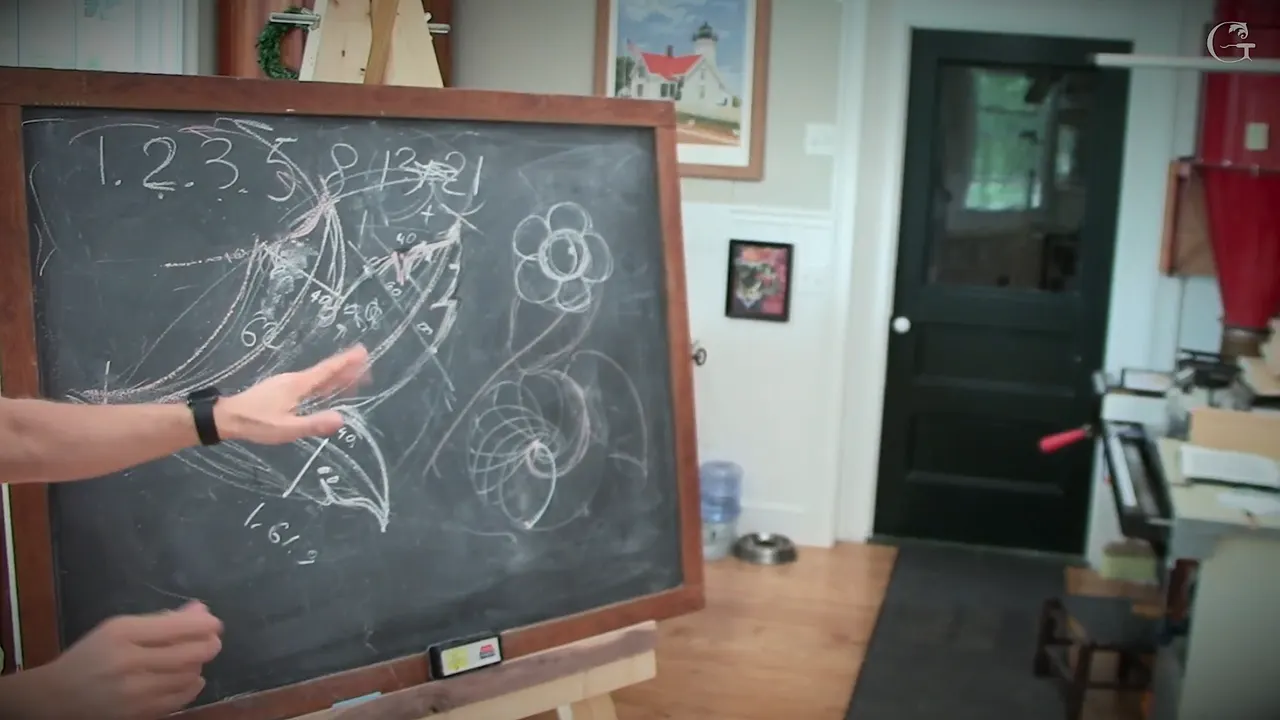
Classical design, the way I teach it at the board, is a short run of questions you answer on a blank board before any carving starts. Which way does the piece travel? Which diagonal carries it? Does it grow upward, fall, or do both? Where does the one hero sit, who stands against him, and who supports whom? Space, the curve and size come last, and they touch every answer.
Do you have a board in the shop waiting? Would you like the main flower placed before your pencil moves? Then take the questions in the same order I gave them to my class at the end of lesson four.
The elements of classical design, short
Direction first, which way the piece travels across the board, set by which side of the world the customer comes from.
One diagonal next, and Baroque here is not the period style.
Growing and falling usually happen together, and one of them has to be dominant.
A single hero on a golden point, with an antagonist standing on a line.
The two leftover points support.
Space, the curve and size ride along with every answer.
This video closes lesson four of my design course, filmed at the board with the class in front of me. I think it is enough today for the design part, I said, and some of you are probably brain tired already. My list comes first, the way I gave it. Then most of the elements go onto real wood: the Venice Room job, a lily box, and one live stream where I drew two cars.

Which questions come first on a blank board?
Direction comes first. I put it in a few words on the video, and while I talked, labels came up on the screen one by one, starting with Horizontal Movement and ending on the label for rhythm and repetition. Shortly, you've got the blank piece of wood, or canvas if you want to paint. Question number one: what direction is it going to go, left to the right or right to the left?
The second question is the diagonal. It goes Baroque, which on that drawing ran to the right, or it goes Sinister. The third is whether the design is going to grow, or fall, or both. Most likely both, I told the class. But who's going to be dominant? Our drawing in front of the class had the Baroque line dominant, and the other one was not.

Then come the golden points. I repeated it quickly so the class would recall what I had shown them on the picture. What is the main idea, and what is its position, and who's going to be the hero of the overall? Only one, I reminded them, one hero and one main idea. Next I ask which of those four points goes to the antagonist, who is supposed to sit on one of the lines, and that's how we determine Baroque versus Sinister.
The last question is who supports who, and those are the two points left over. Right away you have a picture in your head. After that you develop whatever.

Three more things travel with every answer. The law of space, meaning what's going to surround the main idea. Nothing is straight, because everything just has a curve. And a detail repeats itself, but on a different scale. The whole course sits behind that list, with space in lesson three and the curve in lesson four. My furniture panel course quotes this same list in lesson 5, so I won't walk that board again here.
Why do classical designs follow laws at all?
To be in harmony, the way I put it in this video. What we call harmony, whether God made it or human hands did, really feels good and looks good. It just communicates to my brain. A couple of strokes is not harmony to me, and I don't think that kind of art is going to last long.
I've worked for some really rich clients, and I'm not going to tell the names. I'm talking about rich, rich. The place they live is always classical. A classical house has its columns, its arches, some Corinthian capital. A condo on the ocean where they spend only one week can be modern, slick Italian, shiny and so on. Not the house they live in. Maybe I didn't see all of the houses, but I saw a lot. Everything about richness and harmony has always been classical, I said. They always lean toward harmony.

Movements travel between countries. In workshop 47 of the Venice Room I was rounding in a secondary split, and I told the camera I love that idea. It was picked up later on by French furniture makers and architects, I said. It started in Italy and then got picked up in France, those movements I was carving, the flipping above.

The acanthus is the detail you meet most. Workshop 12 is where I said that if you know a little about furniture making and carving, it's the most common detail for embellishment. A lot of people don't even know what an acanthus leaf is. And a lot of people, even professional furniture makers, have no idea there are so many different types. It's not a really big deal, I said. You can mix them, and most people won't get it. But sometimes you come across smart people who really do understand the difference, and then you can get in trouble.

Which direction should a carving travel?
The way the person it's for reads. On a live stream in April 2020 I asked the viewers something first. Do you know the brains of Westerners are absolutely different from the brains of people from the East? When we say we're all the same, I said, it's not really true. We even write absolutely differently. If you're born in the West, you start writing from the left side and go in that direction. Born more toward the East, in the Middle Eastern countries, you write from the other position. I asked if they had ever wondered why we write differently, and I told them it comes from how the brain functions. Scripts really do run both ways, as any page on the writing system shows.
Then I drew two vehicles, simple ones, one on each side. A Fiat. If you have a Western brain, that vehicle goes downhill and this one goes uphill. Born east, and it flips. I know it's strange, I said, but it's the truth, and you can check yourself. Left brain or right brain has nothing to do with it, I added.

With real jobs I said it plainly. When I have customers on the western side of the world, I develop on one line. If it's on the eastern side, I develop on another line.
Is the Baroque diagonal the same as Baroque style?
Two different things. On that same live stream I said the Baroque diagonal and the sinister diagonal don't have anything to do with the Baroque style in wood carving or stone carving, or even the Baroque period. It's just a different approach. Next I asked whether anyone knew Baroque versus sinister diagonal when you're developing design for wood carving. One viewer didn't, and I said I didn't know that for a long time either, until I was an apprentice myself, pretty much.
For a Westerner the Baroque diagonal goes one way, and all the design is supposed to follow that direction. Sinister goes to the left, and that one is the Eastern one, with the design based on that movement. Which corner each line climbs to is lesson two.

Can one carving grow and fall at the same time?
Most of the time it does both, and you choose which one is dominant. A leaf in workshop 41 of the Venice Room had to go down underneath another one, really gradually, because I didn't want to lose that part, design-wise. Even if this one is growing upward and that one is growing downhill, I said, it still gives me that feel that it's part of the same movement.
Depth was my limit there. I called it deep enough, because I couldn't go too deep, otherwise I'd lose the overall movement again. I know I repeat myself, I added. It is what it is.

Why can a design have only one hero?
People look at one place first. Lesson 10 of my lily box had the big flower as the central focal point, where people are going to look. I can't fail it, I said. Got to make it look absolutely gorgeous. That's why I didn't like a hole I had created there. Really didn't like it, and I told the camera I'd deal with it a little later. I'll make the decision, I said.

In this chalkboard class I said it plainly, that there should be only one hero. The antagonist and the two supporters come after him on my list.
Where does the antagonist go?
At one of the four golden points, sitting on a line. I had promised some architectural movements in workshop 148 of the Venice Room. Two sides there had a molding running about the same, and the only difference was a shell. On one side it went uphill and stayed kind of high. The shell on the other side would go all the way down, a counterpart, opposite from the first one.

If this is a hero, I said, that would be the antagonist, and if this is a plus, that is a minus. I called it just the logic of a design approach, and that's what I wanted to do there.
An antagonist can be small. In workshop 102 I was ready to develop whatever I had in one section, and I didn't want to make a mistake. I thought I could create an extra shadow spot right there. With this part convex, I said, I could create the anti-hero, some concave on this side, and it would cast some shadow. And I admitted I didn't know if I liked what I saw. Maybe.

Who supports the hero?
Whichever two golden points are left over. In class I told everyone those two points have to support, and I called it really important.
Back in lesson 2 of the lily box, I said it didn't look like the overall picture yet, and that once all the undercutting was done you'd see all the movements. Then I said those tiny leaves are not really the focal point of the design. They're more or less like a frame for the main idea, the lily flower in that section. I caught myself there, because I was working upside down.

Here is where each element showed up, with my words from that day.
| Element | Where it showed up | What I said there |
|---|---|---|
| Direction | A live stream in April 2020, with two cars drawn side by side | Just how the brain functions. |
| Grow and fall together | One leaf going underneath another in workshop 41 of the Venice Room | Part of a same movement. |
| One hero | The lily flower on the lily box, lesson 10 | Where people are going to look. |
| Antagonist | A shell taken low on one side, workshop 148 | That would be a antagonist. |
| A small antagonist | One concave against a convex in workshop 102 | Going to cast some shadow. |
| Supporters | Tiny leaves on the first layer of the lily box | More or less like a frame. |
What do space, curves and size add to the list?
They sit around every answer. The law of space asks what surrounds the main idea, the negative space included. Nothing is straight, because everything just has a curve. And repetition happens on a different scale. The flowers I showed that class repeat themselves, but I never put the same size. I still play with the sizes.
I keep those three short on this page on purpose. Lessons three and four draw each one out on the board in front of the class.

What do you do with the next blank board?
Answer the list for the blank board first, in order, before you develop anything. Direction, diagonal, grow or fall, one hero, an antagonist, two supporters. Simple enough? That is what I asked the class at the end.
Design is a big deal for me, I told that live stream. A couple of years before, I believe, the school didn't have the right wood, so a class had to design a piece together. I told them about the mathematics of design right there in class, and with the whole class we developed the design on a blackboard. It was an exciting project, pierced and really nice.

To sit in that class and hear the questions asked out loud, join the school and open the Principles of Design course.
How it's done
- Settle the direction. Pick which way it travels across the board. A western customer gets one line from me, and an eastern customer gets the other.
- Pick one diagonal. The Baroque line or the sinister one. My class drawing had the Baroque line running to the right.
- Choose the dominant line. Growing and falling, both, most likely. So the next thing I ask is which line will be dominant.
- Put one hero on a golden point. One main idea, one hero, and I decide which golden point it takes.
- Stand the antagonist on a line. I give the antagonist a golden point that sits on a line. If the hero is a plus, the antagonist is the minus.
- Let the last two points support. The last two points have to support. Right away I have a picture in my head, and after that I develop whatever, acanthus or anything.
Frequently asked questions
Does the same list work for a painting?
I put a canvas right into the first sentence of the list. You have got the blank piece of wood, or a canvas if you want to paint. Then comes question number one, what direction the piece is going to go, left to the right or right to the left.
Do I design differently for a customer in the East?
I do. I said on a live stream that with customers in the West I develop on one line, and for the East I develop on another line. I tied it to writing, because if you are born in the West, you start writing from the left side.
How do I spot the antagonist on my drawing?
Look for the counterpart. One shell on a Venice Room panel went uphill and stayed high, and the shell on the other side would go all the way down, its counterpart. If one is a plus, the other is a minus. Even a single concave set against a convex can play the anti-hero and cast a shadow.
What to carve next