
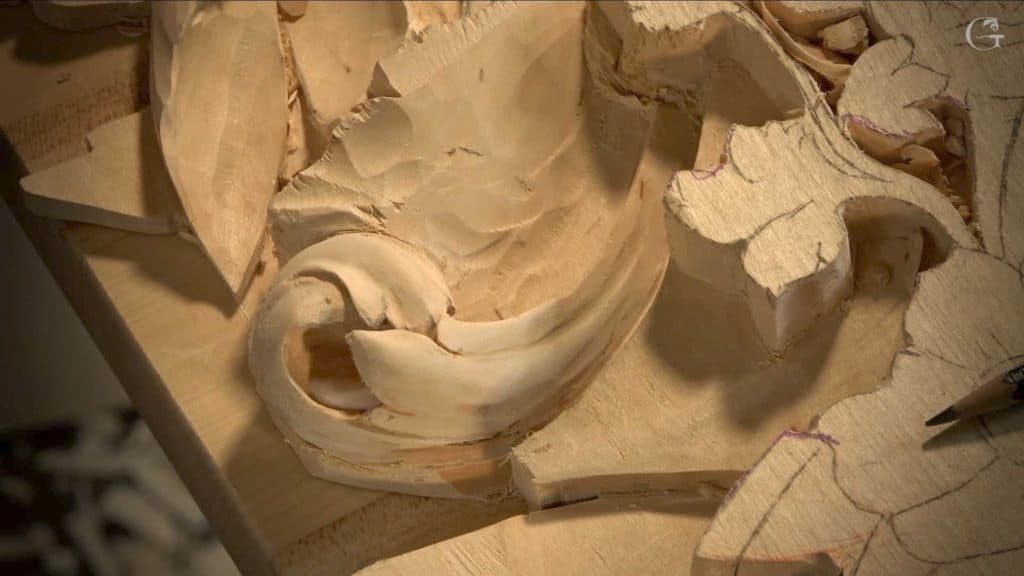
Alexander Grabovetskiy, woodcarver, School of Woodcarving · Published 2021
What does a wood carver mean by "unnecessary"?
Quick answer: In part 1 of Venice Room 112, I said I would grab a 1 millimeter tool (0.04 in) and called that step unnecessary, though it takes a couple seconds. In other lessons the same word sits beside a sharpening pass, a rasp pass, pencil marks and a tool for depth.
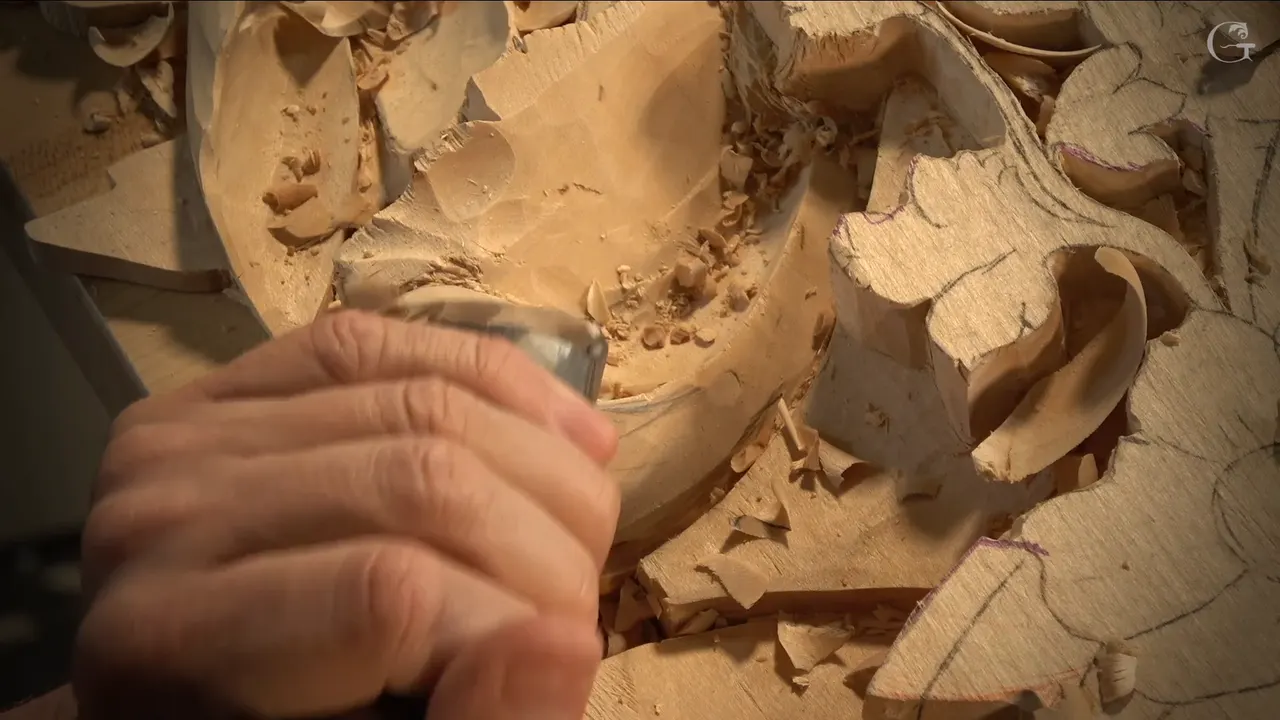

In the first video of Venice Room workshop 112 I said I would grab 1 millimeter (0.04 in) and called the step unnecessary. In my other lessons the same word sits beside a sharpening step, a clean-up cut, pencil marks and a tool.
Ever stopped in the middle of a cut and wondered whether the next step is worth doing? This page follows one word, "unnecessary," through one short video and then through wood carving lessons from my other courses, with the lines around each one so you see what came next. A second phrase, "no need," sits beside it in other lessons. Sizes come in both units, my figure first.
What did I call unnecessary in the first video of workshop 112?
It opens with "Let me get big guy again, this one" then "About three inches" (76.2 millimeters), then "And make it even more nicer." A look at a line follows: "it has to go all the way underneath."

A detail came up. "Of course, I could create some kind of eye and pipe," I said, "but there is no need because it's never going to be in the eye of any human person." It would "go just underneath." My verdict: "So don't need that extra detail in this case."
Which tool sizes came before the word?
First, "I'll take again, number 11" and "in this case would be 7 millimeters for start" (0.28 in). Then "maybe it's a bit too big" and next "I'll grab 4 millimeters" (0.16 in). Out loud I asked, "Should I or should not? Let me try." My idea was to "get that edge and bring that underneath of this ridge," so that "I don't need to create a long, long open cut."

"Now, I going to need 2 millimeters," I said, and "I'll excavate right here." Two millimeters is 0.08 in. Then the line this page follows: "And I'll grab 1 millimeter, which is really unnecessary in this case, but still it takes a couple seconds." In inches a millimeter is just under 1/25. Next: "And I do like it."
What came after the 1 millimeter in workshop 112?
"So now, let's give some form, some shape to this guy." A tool I named next could "take care of whatever the mess I left in the corners and blend whatever the facets I don't need." And then: "I could give actually extra couple separations. Really don't need to, but I think it's going to look good."

Later I named "a really small, tiny number 11, like 1 millimeter, and get that thing out" (the same 0.039 in). After that: "Now, it's just a matter of cleaning and undercutting." A verdict followed. "Right here, it's not really good. So pretty much, I'm happy with the result."
My plan for the next job was a simple process, with "just number seven" to excavate and clean inside "until I'm happy." My own comment on it: "And that's nothing new, just excavation, excavation, and cleaning up."

"So let me do that, and I'll see you after that." Next: "I cleaned inside a little more, so now you can see the light is going through." That makes it "a little more smoother and cleaner." A plan came after it: "whatever the separation I find, whatever the triangle edge," I would take "one millimeter, number 11, and prolong that slightly." "Not much, but a little bit."

The rasp comes last, "just the rasp," to "rasp it a little bit." Paint was coming, I said, and the rasp "saves me time." "Just rasp it and forget it."

What do parts 2 and 3 of workshop 112 say about skipping detail?
Part 2 has "Of course, I need to clean it a little bit, but I'll take care of it a little later." Part 3 adds "I could probably leave it just like that without doing too much to it." And next to it, "I think I like that middle ridge, and I don't need too many details on whatever those two parts." About the 1 millimeter, "Just a shadow right here, this section." All three videos sit on the workshop 112 page.
How did I follow a step I called unnecessary in other workshops?
Venice Room 118 comes first. "I can excavate around one side, and now I'm going to do also plug cut, but from the opposite direction." That would give "again, an extra shadow." And then: "It's really unnecessary step, but I think it's going to give extra beautiful detail."

Tools came next. "A small back bent," a "sweep #3" that is "small, like eighth of an inch" (3.2 millimeters), and then "I just create that extra shadow spot." To clean it I named "a small veiner, in this case, in one millimeter" (about 1/25 in), that would "hook all that stuff out."
Over in Venice Room 144 I talked about a separation line. "I could take actually even half a millimeter and excavate even deeper separation line" (about 0.02 in), one that is "still visible." Then "Really unnecessary, I guess" and "Later on, I'll just refine that cut. But as of now, I am happy."

Venice Room 146 has a shadow of its own, "still somewhat dark shadow." And "I can actually even go with half a millimeter and exaggerate that. Really unnecessary. But that's okay." The next job: "So now I need to create the convex."

How does "unnecessary" sound while sharpening?
Sharpening is where it showed up in Venice Room 69. Changing grit "just takes me so quick." Of the 800 and 1,200 grits: "I don't have to, it's already good." Then came this: "that's already a really nice, beautiful finish, but I'll still take it to 3,600 and 6,000. Again, that step, really unnecessary, I would say. I just love it. I just like to make it to the perfection if you wish." A little later I said "I did right away on the 6,000" and that it was "already giving me a really good finish."

The straight gouge sharpening lesson carries the other phrase. About the machine: "you don't have to put any water, any oil. There is absolutely no need." A glass wheel is the one I recommend, "because it's really hard and nice" and "You can do MDF." On the 6,000 grit, "which is plenty," I said, and "It's already nice."
Where did "unnecessary" mean extra marks and extra cuts?
In Venice Room 23 I said "that will be enough, because I need to make sure I'm not digging too deep inside of the background." My warning: "Otherwise, you're going to have tool marks, unnecessary marks I don't need."

Another video of that lesson has it in a question. "I could undercut this way, but my question is should I," because the spot is "visible only from the down position" and "I think it would be just unnecessary." Then "Maybe a little, not much." For cleaning I named "number nine, number eight, and about maybe 5/8 of an inch" (15.9 millimeters). A good idea, I said: "just little by little, and control."
Roman acanthus 12 says it about tiny details. "Be really careful when you're doing the micro details like this, especially on basswood." Cherry and walnut, "they hold the detail really nicely" and basswood "can hold the detail with no problem as long as you don't press it too much, don't make unnecessary cuts."

Stress is the word in Grape Onlay 3. Put the tool straight down and push, and "it looks like you're carving," but you "just create a lot of stress, unnecessary stress." Carving like that is possible: "Oh, absolutely" and "a lot of people do that," but "I would prefer still slice it."

Greek acanthus 15 has a light sanding. "At some point you have to stop," I said. The acanthus ridges got "just a sanding, but slightly" that "removes all the unnecessary pencil marks, some dirty spots, and does not destroy your carving." I added "I would not recommend to use a sandpaper."

Vase with grape leaves 1 has the word in different videos. Shortly before "Let me take my tools and we're going to start," I said "Let me see if I left any unnecessary space." And "It looks like I did not, except this space is not too good." Other videos of that lesson have "let me remove right away some unnecessary material" and, after "one of the lines threw me off," "So that is unnecessary line."

What else was unnecessary: a clean cut, a rasp pass, a tool?
Floral and Molding 10 has it at a clean-up cut, with "I'll just attack that from straight down cut" and then "it doesn't have to be really clean cut. Really, it's unnecessary at this point because I do have flowers, and I still going to change it, but just to remove some of that mess."

In Venice Room 36 I said a chunk "belongs to the shell" and that I would "give a little bit of rasp work." I added that I did not actually need it, "because it looks good even without it." Next I said it was "clean already pretty much" then "let me stop" and then "That's going to be unnecessary."
The end of Furniture Panel 18 goes another way. "That is a final depth. See how handy that tool is? Even in tiny spots like that, you are able to create exactly the same depth." After that, "I should probably say it one more time" and "that tool is absolutely unnecessary for this type of work." The gouges still do the job: "you're still able to do it with the gouges and so on."

What does "no need" sound like next to it?
Molding lesson 2 has it at the final depth. I said I did not really have to go to the final depth: "No need, okay?" The plan: "I can just attack that from the opposite side now" and see how deep the cut is supposed to be. The tool I named was "number nine, and 10 millimeters, three-eighths of an inch" (0.39 in on the metric figure, 9.5 millimeters on the fraction). A distance from the surface came later, "about six millimeters, even less, maybe about five millimeters" (0.24 in and 0.2 in).
Then Molding lesson 14: "go in, but not much. I'm not going to go too deep right underneath right there. So there is no need." My plan was a slope on "both sides" with "number seven and 14 millimeters" (0.55 in). The thinking: "I still need some connecting point underneath. And if I'm going to undercut all the way through, there's no way I can glue that on the panel." I would leave "no more than maybe a millimeter and a half, about 16th of an inch" (0.06 in on the metric figure, 1.6 millimeters on the fraction).

Earlier in that same lesson comes the same idea for a first cut. "you don't really have to dig really deep with this cut. Really no need." And "try not to dig too deep because you really don't want to smoosh your fibers inside," since "All you're doing is just creating initial spot outline to get your gouge in."
Blocking is the job in Hazelnuts 2. "please don't be tempted to go in every cavity, in every cut. So there's absolutely no need for it," because after the sloping you "lose geometry of it." All I need is "just to remove around the big material" with "number nine and 20 millimeters" (0.79 in). Not deep either: "Like 1/8 of an inch, about three millimeters" (3.2 millimeters and 0.12 in).

Cleaning comes up in Venice Room 85: "you could clean this if you wanted to, but there's no need for it because I still have to undercut later on." For a preliminary cut I named "about three millimeters, number 11" (0.12 in).
One more place: the Venetian rosette, with calipers. Venetian rosette 5 puts it like this. It would be "really hard to calculate by the inches how many inches I have to make the division, and quite frankly, there's no need." The size I had in mind, "about an inch spacing" (25.4 millimeters).
Lesson by lesson, what sat next to the word "unnecessary" or the phrase "no need"
| Lesson | What the word sat beside |
|---|---|
| 112 | A 1 mm (1/25 in) tool, plus a detail I passed over |
| 118 | A second plug cut, for an extra shadow |
| 144 | A deeper separation line |
| 69 | The last grit steps when sharpening, after a good finish |
| Straight gouge sharpening 3 | Water and oil on a grinding machine |
| 23 | Tool marks in a background, and an undercut seen from below |
| 36 | A little rasp work, and a chunk left for the shell |
| Molding 10 | Clean cuts among flowers I still planned to change |
| Molding 2 | Going to the final depth |
| Furniture Panel 18 | A depth tool, and a deep first cut |
| Grape Onlay 3 | Stress put into the fibers by pushing straight down |
| Roman acanthus 12 | Extra cuts on tiny detail in basswood |
| Vase with grape leaves 1 | A space, a line, and some material to remove |
| Hazelnuts 2 | Going into every cavity when blocking |
| 85 | Cleaning a spot before an undercut |
Is there a step on your own board you keep asking about? The Part 10 course page holds workshops 110 to 121 of the Venice Room, and everything named on this page opens inside one tuition plan. Good wood carving starts with one cut.
How it's done
- Decide how far the line goes. A line has to go underneath, with no extra detail.
- Step down in sizes. 7 millimeters (a little over 1/4 in), then 4 (about 5/32 in), then 2 (about 5/64 in), then 1 (0.0394 in).
- Give it form. Time to give some form, some shape to this guy, in my words.
- Excavate and clean. Number seven, with excavation and cleaning up.
- Add the last small touch. I planned one millimeter, number 11, to prolong a detail slightly, and a rasp at the end.
Frequently asked questions
Which tool did I call unnecessary in workshop 112?
One millimeter, about 0.039 in, which I planned to grab right after the 2 millimeters.
Which sizes came before the 1 millimeter?
7 millimeters (0.28 in) for a start, with a note that it might be a bit too big, then 4 millimeters (0.16 in), then 2 millimeters (0.08 in).
What was my call on an eye and pipe in workshop 112?
I called it extra detail and said there was no need in this case.
What came after the 6,000 grit in Venice Room 69?
What to carve next