

Alexander Grabovetskiy, woodcarver, School of Woodcarving · Published 2020
Which way does the letter S face on a carved acanthus leaf?
Quick answer: An S carved into an acanthus leaf points outward from the center of the piece. In Venice Room workshop 56 I said it is supposed to face always out, with an exception now and then. The first mention comes in part 3 of workshop 26.
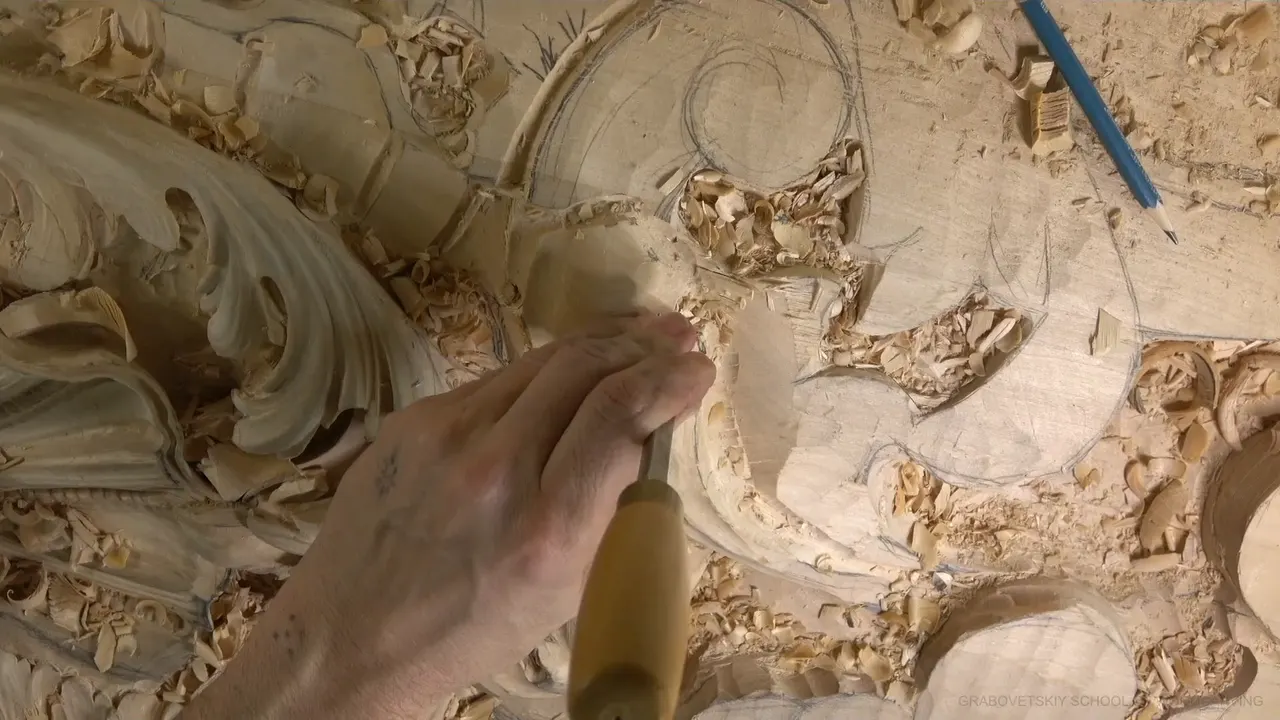
The letter S on an acanthus leaf faces out, away from the line down the middle. I gave that rule in Venice Room workshop 56. When you do a letter S, I said, it is supposed to face always out if there is a middle line of the main piece. Moments later I admitted that sometimes it turns the other way, toward the inside. So treat it as a habit of good design, with a door left open.
Have you ever carved a small curve on a leaf and felt it was off, with no way to say why? Does it look right alone and strange beside the leaf around it? Part 3 of workshop 26 is where the S first comes up on a leaf for a piece that hangs above people. This page starts there, then follows the S through five more videos. You get the direction and the reason, which tools I picked, and the place where I let one go.

Which direction does the S point?
Out from the middle line. Workshop 56, part 12, is the clearest place. I had started my divisions and gone for a semi-final form, and I could see much better. Right here I can envision a letter S movement, I told the camera. I know I already said it multiple times in previous segments, but you should not put a letter S moving forward like that. Usually it goes outward, out of the middle line. Sometimes it is an exclusion from that, and sometimes it goes toward in. But logically, you have to do it that way.
Later, I jumped across the same middle line to the right-hand side, where an S in the opposite direction fit, though you probably don't see it, I said. I asked for a better view. Both halves get their own S, and both leave the line. Read the full lesson on the public page for workshop 56 if you like.

Workshop 49, part 10, makes the same point with different words. I call it the movement letter S, like the letter, okay. I started moving like this, and then came a movement like that, so it is a true letter S, and it gives me a really nice look. I have done those a lot everywhere else, I said, and I pointed to another on the piece. It has to be only on one side, and it has to be an outside movement only. One goes outward. One is going in, but it is still outward. A middle line splits the piece, and away from it the S has to go out.
Opposite, I said I could do some S right there, pointing the other direction on that side. Wonderful, I said. Read that lesson in full on the workshop 49 page.

What is the S doing on the leaf?
It backs up the main movement of the whole leaf, and my design course says exactly why. The reason is in lesson 4, part 2, and it is a short one. I opened by telling you to look at the acanthus. A law, a really important one, is called arabesque. Nothing is straight. There should not be any straight line, and everything is supposed to connect to everything. I asked whether you can find a straight line on my flowers, and the answer was absolutely not, none.
I pointed at an arc in one section of the acanthus. That movement continues the main movement, I said, a thing I call a letter S. It still supports the overall idea, but it makes clear where the point is supposed to go.

I put a question to the viewer, too. After what I had just explained, should my letter S go on this side or that? I said it goes wherever it supports the main movement. One part goes downhill, the antagonist, and another grows up. So where does my arc sit? Top or bottom? The bottom, I said, absolutely, and then came the S.
And why do it at all? To support the big idea, I said. People do not know that, but the brain reads it absolutely differently. This goes for acanthus and for any type of leaf, I said. Without even a stem I know this one grows up, and I know that one grows down, just because of the S. Every little detail matters. The talk is on the principles of design page. Beside it sits the whole design course.
Where does the S show up in this first video?
Early, and softly. The video opens with me cleaning and saying I will check the movement, because it is not what I want to see yet. I blended the pipe nicer. In the middle I found a convex that is not big, but it is there. Then came subdivisions. There was a main boundary and one subdivision, and another pretty close to the edge. That is the nature of those acanthus movements, I told the camera, and what they did originally.
Two relief cuts went in, and I reached for a number five and about 5/8 of an inch (16 mm) to start my movement. Here is the first mention of the S, and I did not promise it. A small letter S could go right here, I said. Maybe I will. For now I just clean a little bit and see where I am.

It came back minutes later, and this time it landed on the main divisions of the leaf. One gets the letter S, of course. Another one beside it becomes the main head, I said. Probably I could give an S movement there too, I said, a really nice one. A number nine at a quarter inch (6 mm) took the relief cuts, then a number six that should fit perfectly, then a smaller number five to clean it that way.
Near the end I explained why the leaves came before the shell. That is the reason I started those two leaves first: I want to make sure all the movements are done correctly, which is going to flip above. One of them goes inward. Originally I did not plan that, but I think it will give me a beautiful detail. More of that sits in the lesson 26 page, and the Venice Room part 3 course page holds the rest of the room.

What do you do when one part has to go underneath?
Lower the neighbor. I have an eye there, so this part is going to go underneath, and I need to lower this side. Maybe a number nine, I said, and a little better cut this way. Next, a number eleven at one millimeter (about 0.04 inch), to excavate the excess. It felt kind of weak. Maybe I was just too quick, so I left it like that for now.
Same idea with three millimeters, about 1/8 inch. I needed three millimeters, I said, then went a little bit in. After that came the main divisions again.

Do you repeat a small division when you add one?
Twice I told you so. Part 4 of workshop 26 had the next one: I wanted an extra small subdivision, and if I carved it, I said, I had to repeat it somewhere else. I didn't want to destroy the main movement, so I stopped short of going all the way. That should give me the curliness, I said. Another S shape could go on the inside, which you probably don't see.
Over in workshop 47, part 11, I said it again. One division ran that way, and I had to repeat it somehow, somewhere right here. It would be an S going that way, too, and it needs to be more pronounced.

Why carve an S that nobody sees?
The piece will hang above people, and the S gets read from below. Back in part 4 I reminded you how the carving is installed, from the bottom. From where you stand at the bench that concave is hard to read, but from below it will be visible. You will see it. It did not need to be deep. The number five I used was plenty.
Back in 47 I gave you the same line: it is almost impossible to see. Again in 56: you probably can't see it. Three videos, one habit.


Which gouge made the S?
Small ones, each time, and I give the number whenever I say it. The table lists the tools I named, with my words and the video where I said them. Read it as a record of my picks and not as a rule.
| Where it was | What I carved or said there | The tool | What the video cue gives |
|---|---|---|---|
| Venice 26.3 | Relief cuts, then the first movement | Number five | About 5/8 inch (16 mm), I said |
| Next, 26.3 | More relief cuts beside the divisions | Number nine | A quarter inch (6 mm), by my words |
| Video 26.4 | Outline on the inside, kept small | Number eleven | Maybe five millimeters (3/16 in), I said |
| Video 47.11 | Letter S first cut, then flip it | Number five | Use a smaller tool, I said |
| Lily Box 7.8 | First S shape on a small leaf | Number eight | One-eighth inch (3 mm), I said |
| Second Lily cut | Second S shape with a smaller gouge | Three thirty-seconds | 3/32 inch (2.4 mm) was my word |
Two tools shaped the S in workshop 47. One movement came to a nicer shape with a number seven, because it was a little too pointy for my taste. That S needed a smaller tool, a number five. My first cut went one way, then I flipped the gouge and went the other direction. Probably you can see it now, I said. That really beautiful letter S.

What did I do on the Lily Box?
The same S on a very small leaf. In lesson 7, part 8, of the Lily Box course, I said a division goes right here, and this small detail gets another. That S shape, I said, is a common technique. It has a letter S movement, just like that, and I hope you can see on the camera what I mean.
For those movements I took really small gouges. Cut one used a number eight at one-eighth of an inch (3 mm), carefully and not too deep, because I didn't want to damage my wall. That was cut number one. The second S had the same idea, but the first gouge was a little too big, so I tried 3/32 of an inch, about 2.4 millimeters. No digging too deep and no force, I said, since tool marks on that surface were the last thing I wanted.
Next came a relief cut in those spots, those separations or notches. One millimeter would do. I used a number eleven and placed my tool carefully. The full lesson waits on the lily box lesson 7 page, any time you like.

How does extreme undercutting meet the S?
The undercut and the S came up in the same minute in part 10 of workshop 49. I was going to undercut right away, and there is a different approach to undercutting, I said. Some people really do not like a deep undercut. I call it extreme undercut. Some people really undercut a lot, and I am one of those guys.
I know why you would not want to. It depends on how the piece is going to be used. Hit every day by people, and absolutely you do not want that extreme an undercut, because it is becoming too fragile. Still, I said, an extreme undercut looks much better. Right after that I said, let me explain what I just did, and I went into the S.


Can you leave the S out?
More than once. I could have left a separation as it was in workshop 47, just moving toward in. You find that in some designs, I said, where it follows the natural movement. I did not need it, I said, twice. Here in 26.3 it was softer still: a small S right here, and maybe I will.
If you want to read more of the room, try the workshop 47 page and the workshop 27 page. The workshops 38 to 49 course page has the rest. The Greek acanthus leaf course and the Corinthian acanthus course carve the same family of leaf, if you want to compare.

A few plain words
A gouge is the curved tool that takes the wood away. A chisel is the flat one. Relief is a carving that stands out from a flat background, and wood carving is the craft as a whole.
The acanthus is the leaf I carve in this room, and ornament is the larger family it belongs to. Builders call the S an ogee. A volute is the spiral that rolls up out of a leaf. A middle line splits a piece the way bilateral symmetry does, and arabesque names the law I used above.
The diagonal on that panel is the baroque diagonal, and Baroque is the period it is named for. My design course ties the eyes to the golden ratio and the Fibonacci sequence, a 60 to 40 split, to be exact 62 to 38.
Which side of your middle line would your first S go on?
How it's done
- Find your middle line. Look for the line that splits the main piece, since the S leaves it.
- Start the divisions. Divisions came first in my workshop 56 video, then a semi-final form, and the S showed itself after that.
- Turn each S outward. Point the S away from the line. Across the line, mine pointed the opposite way.
- Grab a small gouge. Mine was a number five in workshop 47, flipped for the second pass. The Lily Box went smaller still.
- Echo each new division. Each new small subdivision wants a partner, so I repeated mine somewhere else, as in workshop 47.
Frequently asked questions
What direction does a letter S take on an acanthus leaf?
Outward, leaving the line down the center. Workshop 56 gave me the rule, and I added one exception: now and then the S turns inward. Logically, I said, you pick whichever direction fits the leaf you are carving.
Do both sides of a middle line get an S?
Each side takes its own, turned the opposite way. Across the line in workshop 56 I carved one pointing the other direction, and workshop 49 had the same pair.
Why put an S curve into a leaf at all?
It supports the big idea of the design. I told you the brain reads it differently, and that a leaf looks like it grows down because of the S, stem or no stem.
What to carve next
- Advanced Carving: Venice Room 56
- Advanced Carving: Venice Room 49
- Design principles, lesson 4
- Principles of Design in Wood Carving
- Advanced Carving: Venice Room 26
- Venice Room part 3, workshops 26 to 37
- Acacia and Olive Wood Lily Box
- Lily Box, lesson 7
- Advanced Carving: Venice Room 47
- Advanced Carving: Venice Room 27
- Venice Room part 4, workshops 38 to 49
- Carving Greek Acanthus Leaf
- Carving Corinthian Acanthus Leaf