

Alexander Grabovetskiy, woodcarver, School of Woodcarving · Published 2020
What does "before I forget" mean when a wood carver says it?
Quick answer: Stopping to do one small job at once, so the thought does not slip away, is what I mean by the phrase. In one Venice Room video the job was a separation. In my other lessons it was a clean, a cut, a depth, or a line put back.
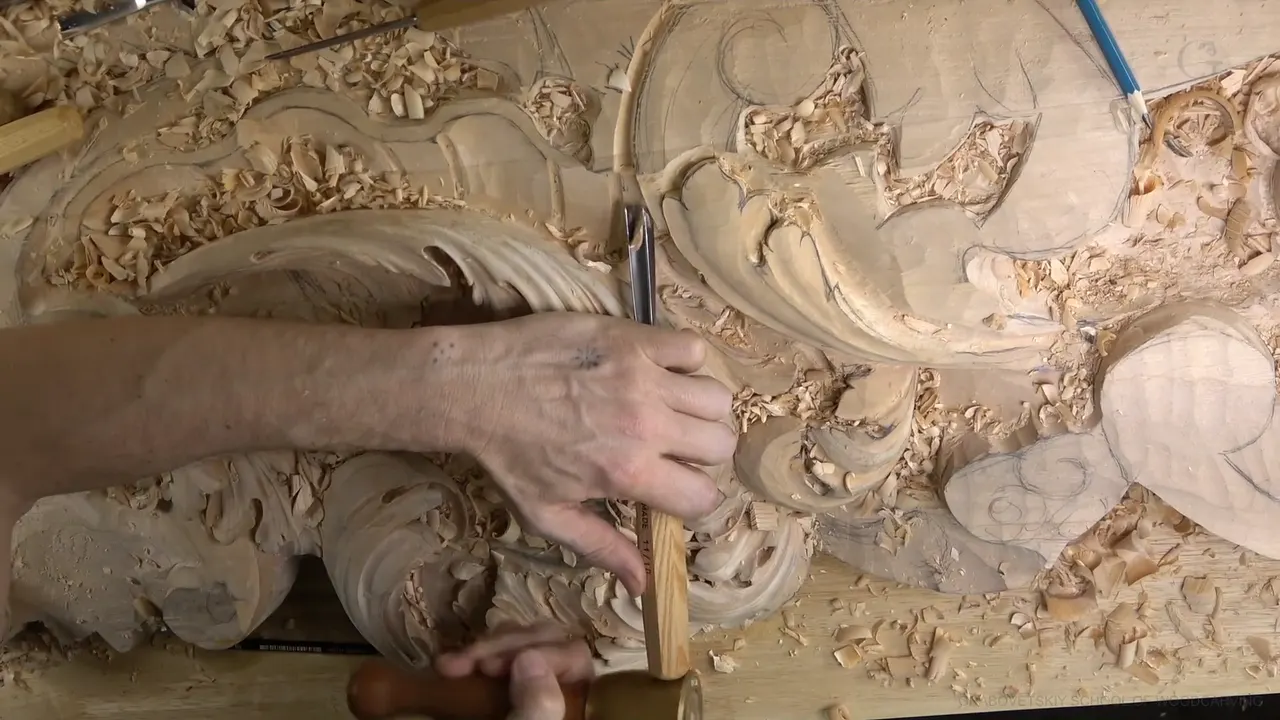

The phrase is a stop: I put one small job first, right now, so the thought does not slip away. In Venice Room workshop 26, part 5, the job was a separation. Elsewhere it was a clean, a cut, a depth, or a line to mark.
Ever put your tool down to hunt for a pencil, and lost the thought you stopped for? Do you hold one spot in my head while your hands work on another? This video is short, and the line comes near its end. After that, the page follows the same habit through other lessons of mine.
What happens in part 5 of Venice Room workshop 26?
The video opens with a plan: "And I probably should use a bigger number 11 right now." A moment later comes "That is going to be part of a shell," and a few seconds on I call it "a shell part."
A check on the movement comes next. "That is good, but now I need to make sure this movement is also gradual." One little thing needs fixing, and it will be "growing from underneath." My goal is "to blend it nicely and smoothly downhill," all the way below. "Hopefully, you see what I'm doing," I add, and I admit I have to approach it "really carefully."

One idea stays a maybe. "And yes, I could actually go up and cut a little inside, underneath of here." At the four-minute mark I call the movement "Gradual and beautiful," and add, "maybe it's not even the final movement yet, but approximately where I want to see it."
Then the tools. "Number five," I say. A beat later, "this is a little too big, number five," and I should use only quarter inch (6.4 mm). The plan is to go in "like that" and clean it "even nicer."

Next the part gives a reason. Probably I have to undercut underneath this movement, I say, or I will not be able to create "a beautiful transition for that one." The tool I name is "again, number 11 in 5 millimeters (about 0.2 in), and carefully start excavating." Then a second thought: a spoon "would give me much better control in this area." Same 5 millimeters, I say, "but with a spoon."

A pause for a check follows. "Okay, let me double-check. I don't want to do it too deep, just deep enough." The last three words come twice, then "Okay, that is good." I clean a little inside and call one spot a mess that "doesn't look too good." One request goes with it: "I did not put the final details yet. Please understand that."

The line itself is near the end. "And I can probably do this separation right away too before I forget." A tool follows. "Number three," I say. And "this one is one inch (25.4 mm)." Last of all, I tell you: "By the way, it doesn't have to be that tool. It just happened to be closer to me."
Which jobs do I do right away in my other lessons?
The same words come up in wood carving lessons from several of my courses. Each row below is one place, with the job and a few of my words. A number in a row names a gouge. A "probably" or a "can" in a row makes it a plan, and I leave it as one.
| Lesson | The job | Words |
|---|---|---|
| Lily Box 11.8 | A small concave cut between two parts, to separate them for the eye | right away |
| Floral 7.2 | A separation cut under a petal that has to go beneath another | create some separation |
| Butterflies 7.3 | A V cut in a leaf, cleaned, then my separation cut | since I'm here |
| Venice 34.9 | Eyes started with a number 11, then separations beside them | separations right away |
| Butterflies 6.3 | A line put back after too much came away near a flower | make a cut |
| Furniture 18.5 | The inside of a line that will be the final one | clean it |
| Room 113.1 | Lines put back on a section I might lower | lines back |
| Venice 27.9 | A chip taken in beautiful wood, using the same tool | can chip |
| Room 76.6 | A raised spot like a hill, to knock down with a number four | number four |
| Workshop 43.12 | Digging underneath toward a big eye, before the idea is lost | excavate underneath |
| Hashemi 47.3 | A section removed where a part can curl out, up at the top | remove some section |
| Furniture 17.7 | A spot to take to the same depth, first probably with number 11 | same depth |
Why do I stop for a separation cut?
Several of these videos hold a separation. In part 8 of Lily Box 11 I say I need an extra cut between two parts, and "maybe let me do it right away." A short admission follows: "And yes, sometimes I do forget." A moment later I name the kind of cut: "just a small concave cut between, just to separate those two. Visually, you can see that."

One petal in Floral and Molding 7 has to go right underneath another, and the plan is a separation cut there. Looking at it, I add, "Right now it looks like a straight line, and it doesn't look good." My advice is to avoid straight lines and "create some kind of wave," or an arc, "the arabesque."
Carving Plate with Butterflies 7 shows the move on a leaf with an invisible center line, which I plan to attack from the opposite side. After I clean the spot I say, "I'm not sure if you see that or not. This is the cut." Then: "Since I'm here, I can probably do my separation cut." For the same detail in other spots, "I'll just do the same."

Venice Room 34 is a quick one. An edge looks, I say, "curly enough," and "let me use number 11 and start on those eyes." Next come "separations right away," and I point to spot after spot: "right there is another separation."
A plan about older work sits in Venice Room 21. Something else I probably want to do right away, since I mentioned before what they did: they really liked really deep cuts in between the separations. Where it was not an eye, a small separation like that got longer cuts, "not really long, but longer." One right there too, I say, "just give an extra eye movement," and then "Couple spots, three spots, four spots, I don't know." That stays a plan.

When do I clean a spot or put a line back?
Slowly and carefully is how I work on a line in Furniture Panel 18. "I'm not rushing." My goal is a line "just as nice as possible, the curvature-wise." Then: "By the way, inside right here, I should take care of it right away also. This is going to be the final line." And, "Let me clean it." Then a promise to myself: "I will have a chance to fix some of the movements later on." One spot I do not like, "but it's okay."

Here is a line that came off by mistake, in Butterflies 6. A flower did not turn out as I wanted, and I say we will fix that movement a little later, when I get to the flower. Meanwhile: "Let me actually put the line back because I really don't like what happened here. I've got little too much geared away." Maybe a cut right away, I say, and "That way I'm not gonna forget."

Lines matter in Venice Room 113 as well. Maybe I lower a section too. "Let's put those lines back," I say, and the reason I give is a memory of what was supposed to be happening in that section. One part, I say, "is going to go this way." I also say I could overlap a little bit with a stem, and "I think it's going to give me a good idea."

An area with some spots left behind comes up in Lily Box 1. "Let's go back to that area where I left some spots." Then, "We will attack that. Okay, let me clean this."
A spot in Venice Room 27 gets the name marriage line, because the grain meets from two directions and you kind of have to blend it together. "It's not the final cleaning yet, of course, because you still have to develop it. Just eliminate potential danger for me." Next to it, "it's beautiful wood." I can probably chip there with the same tool. Another maybe follows: turn my tools this way, go around and make an undercut.
Care about depth shows in Venice Room 76. A part underneath is not developed yet, and a little raised part, "like a hill," bothers me. Probably I should attack it right now, I say, and a number four could knock it down. Right behind it comes "Or I could use a long bent."

Which plans does the phrase carry?
Losing a movement is the worry in Venice Room 43, part 12. A huge eye could go there, a big one. "And before too late, I probably going to excavate underneath." Then I correct myself: not too late, I say, only ahead of forgetting the idea I have in mind. Next: "So let me just excavate underneath to the eye."
The line opens Venice Room 12. The plan is to work on that side, and on the other hand I want to "indicate my future movements." A chunk will stay as part of one movement. It has to be divided in three main parts, and I want to keep how it goes underneath. One separation will go downhill.

Waviness near the top is the plan in Hashemi 47. Then I think about curling something out again: "Oh, actually, this one can curl out, and I can remove some section right there and do that right away."
Depth was the job in Furniture Panel 17. A panel that will be used must not get a weak point, I say, since "We don't want anybody to break it." I was getting to the final depths almost, with about 3/32 inch (2.4 mm) still left. Another spot gets the same depth. For it the approach is "exactly the same," and I would take "first probably 3 millimeters (0.12 in), number 11."

Later in that lesson I look the work over for anything missed. "Looks like I did not." A cut still needs doing, though, and that comes next. About the leaves I say this: they "really don't have to be perfect leaves."
A reason for leaving spots alone is in Grape Onlay 12. A couple of spots stay untouched, and some of you may wonder why. "I need to keep those high spots because I have to remember, at some point I will have to flip it and it's gonna rest on those spots." Once found, "it's gonna serve me like legs."
A small turn comes in Venice Room 41. I start the line, then take it back: "Well, of course, I'm not going to forget." What I want is the same idea on the opposite side, though "it has to be more logical in overall movement." First I have to outline it, and "I hope it makes sense what I'm doing."

What do I do about a number I might lose?
I put it on the wood. A side of Furniture Panel 18 is to get exactly the same depth, so "let me mark it." In Furniture Panel 19, one section should be only a sixteenth of an inch (1.6 mm) and the next ones really deep. I take a different marker to mark that down, and "five millimeters right here" (0.197 in).
The sixteenth has a reason, and I give it. That section is "just continuous on opposite side," so "that would be a big mistake for me to dig deeper." Then, "I'm glad I didn't create a really deep cut."
A thickness is the number in Furniture Panel 22. Depth is there, so I can go in about a quarter inch, I would say, six millimeters (0.24 in). "But I don't want to forget that my thickness of the panel is only 10 millimeters (0.39 in)." A breath later, "can't forget that."
A missing piece is the worry in Hashemi 43. Closer to the bottom, "you will have lower petals," which grow from inside out also, and "I can't forget them." Leaving them out would be a big mistake, I say.

Do I really forget on camera?
Yes, and I say so: "sometimes I do forget." After one cut in a furniture lesson I say, "already forgot what tool I used." And Furniture Panel 15 has a line I cannot remember the reason for. "Maybe I had some kind of process in my head, and I forgot about it now." Outlining it comes next, "just in case," and "I can always remove it later if I need to."

Look at your own bench. Is there a small job waiting beside the one you are doing? Do you have a pencil, or a marker, close by? The tool I named in part 5, I said, "just happened to be closer to me." For all my lessons in one place, start here.
That video belongs to the workshop 26 lesson, one of twelve in the Venice Room course for workshops 26 to 37. The other lessons on this page come from my Venice room carving and from other courses of mine, and every number here is mine.
How it's done
- Stop at the small job. A separation was next in line, and I said I could probably do it at once.
- Name the tool you pick. Number three came out of my mouth, plus a reminder that another tool would do.
- Check the depth. Just deep enough was my target, and I said so twice before calling it good.
- Clean the inside. I said to get rid of a mess inside one spot, and that the final details were not in yet.
- Write down a number you need. On a furniture panel I took a different marker and marked the depths down.
Frequently asked questions
Did I make the separation in part 5?
I said I could probably do the separation at once, and then I named a tool, number three, adding that this one is one inch (25.4 mm). My last words in the part were about the tool: any tool would do, and that one was only the closest.
What size gouge did I plan for the undercut in part 5?
A number 11 in 5 millimeters (about 0.2 in), to start excavating. A second thought followed: a spoon in the same 5 millimeters would give me much better control. Earlier I had called number five a little too big.
Where else did I say the same line?
Separation cuts, mostly, in the Lily Box, Floral and Butterflies lessons. A clean in one furniture lesson. A depth in another. Lines put back in Butterflies 6 and Venice Room 113, and the table names every lesson and part.
What to carve next