

Alexander Grabovetskiy, woodcarver, School of Woodcarving · Published 2020
What does "who knows" mean when a wood carver says it?
Quick answer: "Who knows" is my way of saying a step, a detail or a number is still open. In one Venice Room lesson I liked a spot that may stay hidden from below, saying maybe someone will reach it. Elsewhere the words follow a stop, a rough measure or a result I cannot see yet.
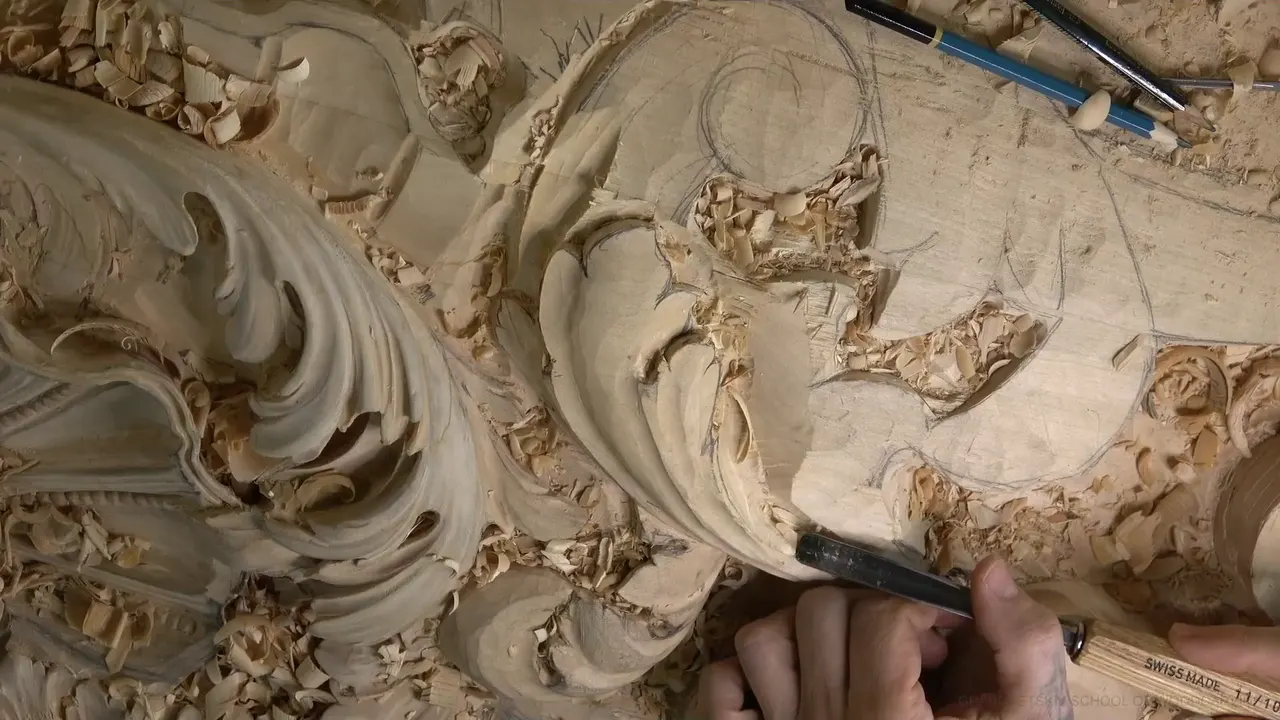

"Who knows" is what I say when a step, a detail or a number is not settled yet. In Venice Room part 26.6 I worked a spot that, as I put it, "is not going to be too much visible from the bottom." Then came the line: "But who knows? Maybe they somehow going to reach it and see it." I say those words in other lessons and other courses too, and they point more than one way.
Ever stopped a gouge short of a line and couldn't say why? Left one spot rough, because you might change your mind? That is where I say it, out loud, so you hear the doubt while it happens. Each passage below names the lesson it comes from.
The phrase in five lines
- In one part I liked a spot that may never be seen, since it matches the leaf's own structure.
- In several lessons the words come as I stop short of a clean-up.
- Now and then they follow a measure I only know roughly, such as half an inch, and I say so out loud.
- Other times a result comes after them that I cannot see until the wood is carved.
- A few times they are about you.
What was I doing when I said it in this part?
An acanthus leaf of the Venice Room panel was under my tool, and the part opens with a plan. "I can excavate a little bit on this side." Probably a number 11, at 10 millimeters (0.39 in). Doing it right away was possible, I said, "pretty much inside like undercutting."

What it gave me, I kind of liked, even though little of it would show from below. After the "who knows" my reason came: "at least it logically works with how the leaf structured in real life. If I have subdivision right there, I got to do subdivision right here, too." Here the words sit beside a spot I liked. They did not stop my hand.
Next I said I was using seven millimeters (0.28 in), "little bigger than a quarter inch" (a quarter inch is 6.35 mm). Again a number 11, used on its side, to get a little cleaner on the inside and a little deeper.
"Let me think," I said. Overall I was happy. I wanted a little more subdivisions, since more would look even nicer, with even more movement. "I'm not sure. Maybe I shouldn't even bother." Leaving it like that for now was the other idea, and later I could see what to do.
What I could do was give it nice rasp work, my new addition to the overall shape, for a really smooth movement. After that I would decide what kind of details to put. All of it was a plan, and I leave it a plan here. The captions skip a long stretch here.

At 5:05 I said, "Here's the other one." This one I wanted a little higher than that one, with the lower one on a lower level. That would look much better, but "not too low, because I still have to maintain overall shape." Outlining it came first, I said, and any tool would do. Mine was a number 11, seven millimeters.

A flatter tool was my plan next, to flatten this out without losing the overall movement. The part closes on a second doubt, and it has no "who knows" in it. I was not sure how deep to go right there. A little deeper was possible, but "I don't want to be too deep." Then, "that is good."

When does "who knows" mean I leave a spot alone?
In several lessons it does. Look at Venice Room workshop 8, part 1. Just before, I had said I needed the same number seven as before, to dig a little deeper and clean the area. I said "Let me get rid of some of that," and that not too much would come off, "because who knows?" Looking from far came next, and maybe adding something. "I don't know yet," I said, and I was happy with at least this area.

Workshop 40 stops the same way, in part 4. I was using a number six to excavate around and get that depth. Right there I would leave the wood alone, I said, and the words came again, followed by "maybe I'm going to do something." I added that I had really good development going on right there.
Workshop 32, part 8, stops after a clean-up. "For now, it looks good," I said, and a mess needed attention. Stopping was needed, and the words came again. Maybe some movement could come from that spot. Just a little, and that's it, not much, "because maybe I'm going to use that space."

Cleaning is what I hold back in workshop 88, part 3. Leaving it for now was the choice, with a clean-up a little later, because I might just change a little bit some stuff. The main movement was there, so next came a plan for another area.

Workshop 72 puts the reason into one sentence. At the end I would go into all those small areas and refine everything. "But now I'm not spending time on detailing. The reason why, because who knows, I might going to change some stuff."

The Floral and Molding for the Panel course, lesson 12, has a version in part 3. I planned to clean up all around one section, and to undercut it on one side. I could start right then. Doing too much was the worry, since maybe I was going to change something.
Why hold back? The Modern Acanthus course, lesson 3, gives the long answer, in part 2. "I'm working on overall project first," I said, because with a fresh eye you might see a change. Spend a lot of time cleaning an area, and you get frustrated when the change comes. In three dimensions you see the piece from all the points of view, and you realize it is better to change a little.
So the first stage is the overall shape. Only then do I look at it from every side. The second stage holds "somewhat bigger details," and clean up is the final stage, I said.
A glue-up brings them out too. The Hazelnuts course, part 3, has Titebond II as the glue I would use, and the blocks should be planed also. Rounding them was not a worry. "Reason why, who knows," came first, and then that maybe we would take advantage of the extra material.
Is "who knows" a way of saying I am not sure of a number?
In part, yes, and I say so. Part 12 of workshop 97 has me with five millimeters (0.2 in) to outline it better. Next came a number three, upside down, at about half an inch. I put that at maybe 12 millimeters, maybe 13, and then asked "who knows? Close enough, right?" A true half inch is 12.7 mm, so my guesses (0.47 in and 0.51 in) sat on both sides of it.

A guess about time works the same way. In Furniture Panel 15, part 8, I called it a good idea to make relief cuts everywhere. You spend the extra minute, but you save "maybe hours." If you make the mistake, you have to fix it. How deep one cut ran, I said, I was not sure, and I doubted it was deep enough. Number nine was the tool I named next.

Can the words point at a result I cannot see yet?
A plan that will only show in the wood is behind the words in workshop 60, part 12. One acanthus piece was set in. It could go a little underneath of another, I said, like a foliage but a little different, "what you normally don't see." Really nice and interesting, I called it, and yes, I know I repeat myself. "But until you see it, who knows what it's going to be?" Next I needed a bigger tool. Some of that stuff had to come out.

Workshop 154, part 2, has a molding I needed to expose and a shell I did not want to lose. I needed to double-check where the shell was going. A mistake was possible, I said, and I added "who knows? We'll see." A moment later the doubt closed: "No, I did not make mistake. Okay? Everything is good."
Compare workshop 156, part 1. Blending and refining a little longer, with long cuts, was my plan, to make it look more beautiful. A rasp instead was the other idea, and the words came. It stayed open, and I moved on: "Let's do another pipe. See, it's already developing."

The doubt in Furniture Panel 38, part 3, is whether I can get something in. The detail mattered, really sharp points, replicating this side. Getting it in looked doubtful to me, I said, and then came "who knows? We'll see."
Grape Onlay course, lesson 4, has a spot that was excellent and I could do it right away. Maybe my tool had to change, since this one was a little too big. "But on the another hand, who knows," I said, "maybe it's gonna be okay."

Edges bring out the same worry. In Plate with Butterflies, lesson 6, I was hitting the edge, I explained, and that was why those butterflies had to wait. The inside came first, since I could not tell what I would create at the edge. I might hit it, and I might damage it.

Who is the "who" in who knows?
Another group of uses is not about the wood in front of me. When I started the Venice Room project I had said I did not expect anybody to follow, since the course is huge. Workshop 6, part 9, returns to it. The course is more for an overall idea. Many details work on a smaller scale or a big scale. Then the words, "But who knows," and after them that maybe some of you will be able to do something like that, for yourself or for a client. "So that would be a good thing."
Plate with Butterflies, lesson 10, goes the other way. There is no end, I said, and you can put even more details on. You do not really need to. Then the two words, and after them: maybe you want to have some fun.
Tools get it too, in Furniture Panel 16. I named a number 23, probably six millimeters (0.24 in), and a mallet. Specialty tools do help, I said, and you might not reach for one every day. The words follow: "who knows? If you're doing reproduction furniture, if you're doing restoration work, or even if you want to do some unique pieces for your house in that style, it makes sense to have those specialty tools."
One use is the plain one. The Greek Acanthus Leaf course, lesson 11, part 1, has me saying that once you have undercut, most people see the carving straight on, so they will not look underneath. "Only one person who knows what is underneath would be just you." Back in 26.6, someone might reach the spot and see it, I said.

Which lesson says what, and why?
| Lesson | What each set of words was about | My own words |
|---|---|---|
| Workshop 26, part 6 | A spot not much visible from below | Maybe they reach it |
| Workshop 8, part 1 | Not removing too much wood before looking from far | I don't know yet |
| Workshop 40, part 4 | Leaving one spot alone after excavating around it | Really good development |
| Workshop 32, part 8 | Stopping near a space I might use | Just a little |
| Workshop 88, part 3 | Cleaning put off because I might change something | A little later |
| Workshop 72, part 5 | Detailing put off until the end of the carving | Refine everything |
| Floral and Molding lesson 12, part 3 | Undercutting one section without doing too much | Maybe change something |
| Hazelnuts lesson 1, part 3 | Blocks for a glue-up I would not round | Extra material |
| Workshop 97, part 12 | A size of maybe 12 or 13 millimeters | Close enough |
| Furniture Panel lesson 15, part 8 | Time saved by relief cuts, as a rough guess | Maybe hours |
| Workshop 154, part 2 | A doubt about where the shell was going | Everything is good |
| Workshop 60, part 12 | One acanthus piece going a little underneath another | Until you see it |
| Greek Acanthus Leaf lesson 11, part 1 | An undercut that only the carver knows about | Just you |
| Butterflies lesson 10, part 1 | More detail than anybody has to add | Some fun |
Each row names the lesson I mean, in the order of the passages above.
How can you try it at your own bench?
Say your doubt out loud, as I did about depth in 26.6. Then do what I planned in 8.1: stop short, and look at the piece from far. My reason in 26.6 was the leaf's structure, seen or not.
Do you have a spot on your board today that you keep wanting to finish? Would a look from across the room tell you more than another pass? Pick one spot and leave it for now.
The Venice Room (Part 3) course runs from workshop 26 to 37, and workshop 26 is where this leaf starts. If you want the whole wood carving behind it, begin there. Shall we carve?
How it's done
- Say what you are unsure of. I voiced my doubt about depth, on camera, near the close of 26.6.
- Stop short and say why. In 8.1 I said I would not remove too much, because I wanted to look from far and maybe add something.
- Keep the work that matches the leaf. A spot I liked near the start of 26.6 logically matches a real leaf's structure.
- Check instead of guessing. In 154-2 I double-checked my shell's path, and everything was good.
- Give a rough number a rough name. In 97-12 I called a size maybe 12 or 13 millimeters, and said close enough.
Frequently asked questions
Am I guessing when I say it?
At times I am, and I say so. In workshop 97 I put a size at maybe 12 millimeters (0.47 in), maybe 13 (0.51 in), and said close enough. In Furniture Panel 15 I said a relief cut saves maybe hours.
Why leave a clean-up for later?
In workshop 88 I said I would clean a little later, since I might change some stuff, and the main movement was there. Modern Acanthus 3 has the long reason: with a fresh eye you might see a change, and cleaning first can frustrate you.
What did I say about the hidden spot in 26.6?
I said I kind of liked what it gave me, even though little of it would show from below, and that maybe someone would reach it and see it. My reason was the structure of a leaf: a subdivision here to match the one there.
What to carve next