
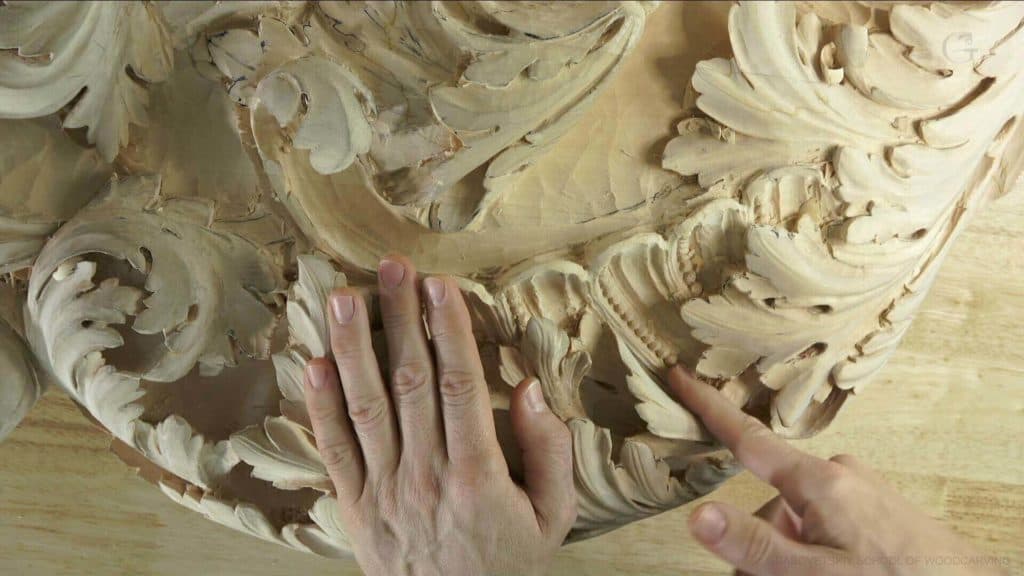
Alexander Grabovetskiy, woodcarver, School of Woodcarving · Published 2020
What does a wood carver mean by "frustrated"?
Quick answer: Part 2 of workshop 58 has me saying that without really sharp tools you get frustrated and think the wood is bad. Elsewhere I used the word for a small tool, a volute, hours of cleaning before a change, and a mistake on a piece I had worked on.
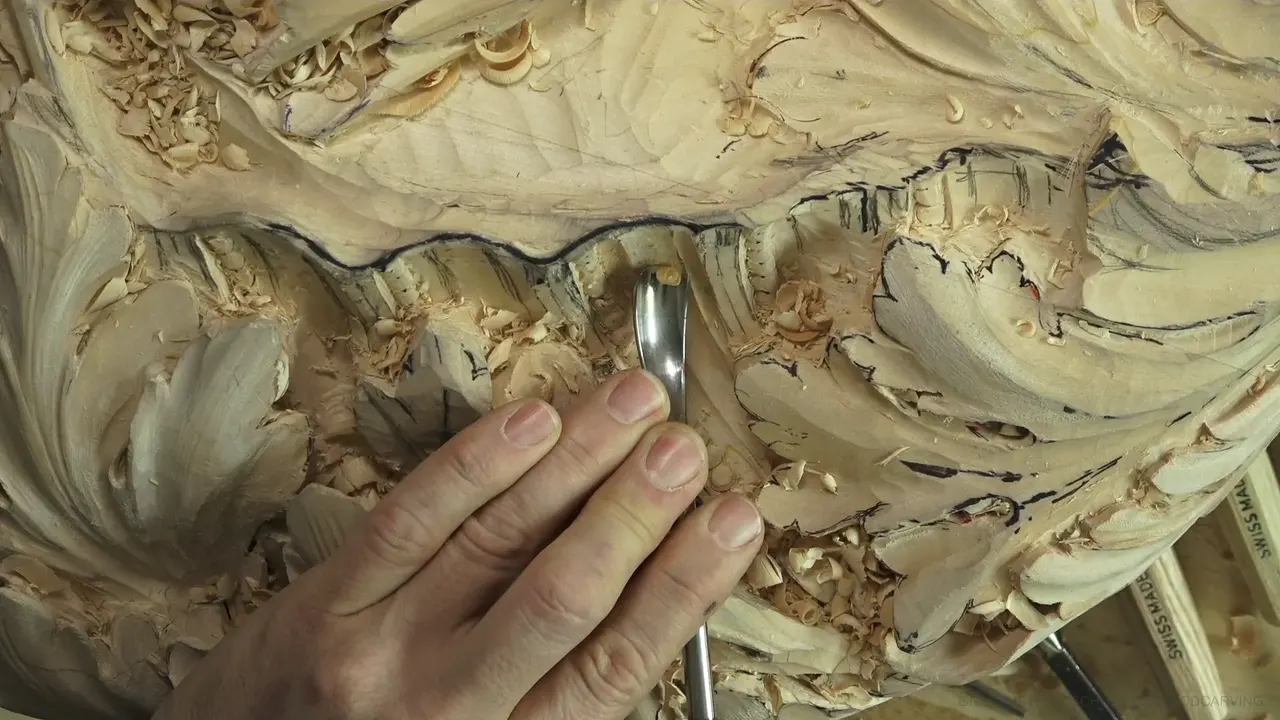

I used the word frustrated in Venice Room 58, part 2, about tools that are not really sharp. Other lessons use the same word, and it reaches past tools.
Have you ever pulled a gouge through a board, watched the grain tear, and decided the wood was bad? My teacher heard that from me, and he had an answer. I use the word in other lessons about a small tool, hours of cleaning, a volute, and a mistake on a piece I had already put time into. The lessons that have a public page are linked below.
What did my teacher tell me about the wood?

The tool is really sharp, I said in part 2, and that's why even the left side is also clean. It's really important to have your tools really sharp, especially for operations like that. If they're not, you'll be really frustrated, and you'll think it's the wood.
Everyone would probably think it's not good wood when they had a challenge like that, and the wood is smushing. It's not coming out as clean as mine, for example. Right now I don't need to do anything, not even sand. It's just perfect, pretty much.
I would complain to my teacher, "My wood is not good." And he would say to me, "There is nothing to do with the wood. It's tools. You have to sharpen your tools."
What was I doing with the tool in part 2 of workshop 58?

Maybe I can use number nine, I said. I cut right in the middle between those two lines. And again, now it's the time to lean a little bit to the right because it's a cleaner side. I'll twist my tool.
Getting too deep or going closer to the edge isn't what I want. In the middle it could be a little deeper, I would say, and it would cast me a really nicer shadow.

To take care of this roughness, I can use just any spoon gouge and undercut. I could use probably smaller, I would say. This one is a little too big. I could use a really small number six, and go in even attacking from that side and in all of those corners and blend that concave to it. I've got to be careful with some spots because the grain is easy to break, so I have to be really patient. I apologize that I'm covering with my hands, but I'm trying to drive my point home.
That is good. You should get an idea. About the shell section, I said I'm done, but it's not completely done. If you look closer, it's somewhat rough yet, and I'll leave it for now like that. A groove will go on the inside, exactly the same everywhere.

Those details make a big difference. Seen at an angle, the line looks almost straight, and that's just the angle of the camera. In real life, it is different. Looking at the overall development, it is not a straight line anymore, and it repeats this curvature.
Which lessons name dull tools?

Carving Furniture Panel 19, part 16, is where I said I've got to undercut it, and your tools must be really sharp. Otherwise you won't get good results, and it'll be all smooshy. Try that type of work with the dull ones and you'll be really frustrated. I know it takes time.

Over in Carving Floral and Molding for the Panel 13, I said we're going to take multiple cuts toward the center with the same tool, and it's really, really important to have sharp tools. A tool that isn't sharp gives you a lot of tear outs. You catch the grain, and you get frustrated. It has to be really, really sharp, almost like a surgeon's knife.

Venice Room 9, part 5, is where I said I think I need to sharpen this one, too. I know I'm saying it sometimes too many times, but sharp tools, it's just a must. Dull tools will give you a lot of frustration, and you'll blame the wood, and the stock you buy, and you'll email me. I've got lots of emails like that, where the wood you get is not the same, it's really bad, it just doesn't cut like it's supposed to be cut.
In my livestream on knives, in April 2020, I said you can have a talent, you're able to design something and even carve, and the biggest frustration I saw is the sharpening. A lot of people buy wood carving tools, carve for a month, and then the tool becomes dull, and they got really frustrated. They blame the wood, or they blame themselves.
The V tool is the most difficult tool in wood carving, I said in my carving tool sharpening course, because it's the hardest to sharpen. One man brought a brand new set to a class, and his V tool needed to be resharpened. He tried that for a couple of hours and ended up really frustrated, because it's really, really hard to sharpen. Many people who try wood carving quit just because of the V tool.
What happens when I clean too early?

Carving Floral and Molding for the Panel 6 has me describing two groups. Some people say you really have to concentrate on the detail you're working on and take it to the finished look. Others say you'll have a chance to clean that later. I probably belong to the second group, because I do a lot of changes on the design later on. That gives me flexibility, and a lot less frustration if I change a movement, because I didn't spend as much time.
In lesson 11 of that course I said I don't want to clean this up right away. That's just my opinion, because sometimes you change your mind, and if you took away too much material and spent a lot of hours on cleaning, it's really frustrating to go back and redo stuff. It's just me, and you don't have to do it that way. Once I establish the overall shape, then I'll just go back and clean it up.

Don't overdo it, I said in Carving Modern Acanthus 3. Overdo it and you'll get frustrated, because we could probably change the design later on. I'm not taking it to the final stage when I work on detail, and I'm working on the overall project first. Who knows, when you look at it with a fresh eye you want to change something, and if you spent so much time on cleaning the area, you get frustrated, because you spent so much and now you want to change.

The Grinling Gibbons class in Maine had two approaches to carving. Work your details per area and clean up completely, and if you decide to change the design, you wasted so much of your time. That gets to you, and it's really frustrating. What I like to do is create the main form and then work the details. And if I need to change something, I did not waste much time.

Part 9 of Venice Room 99 has me asking, see why I'm not doing really final work from the beginning? I'm doing a lot of changes if I don't like something. It would be really frustrating if I'd spent too much time cleaning everything and refining, and then made the decision to change something.
At Venice Room 78, part 8, I said I could completely separate that like I did right here, and you can take it to the extreme if you wish. I don't need it in this case, because I don't want frustration later on. It will be shipped, and it can be broken if I make it too fragile.
How do small tools and hard shapes frustrate people?

My Q and A on big tools and small ones carries one of the biggest mistakes I see all the time. When people start carving, or even carve for years, they take a small tool and dig and dig, spend so much time, and get frustrated. I divide tools into three sizes. The big ones are about 80 millimeters, like three inches and one-eighth, and on a big project I take that big gouge and just knock the whole thing out, really quickly, in one day. Medium tools are about 20 millimeters or so, like three-quarters of an inch. Small tools are a quarter inch (about 6 mm) and less.
We're going to stay away approximately three-sixteenths of an inch, about five millimeters or so, and then go back, I said in lesson 1 of The Tray of Blessing. If you look at me, I let the tool do the work, and I feel the tool. I don't push it at all, and I don't want to get tired. Otherwise you get tired, and you get frustrated.

On volutes, I said in Venice Room 62, part 11, take your time. They can be really frustrating, and they're not as easy as they look, for some of you, if you've never done them. They can be somewhat frustrating, especially when I'm working on a slope, and it doesn't really help. I need to make sure it looks good from all of the points of view.
If it's too complicated, I said in Venice Room 50, part 12, don't get frustrated that you won't be able to carve it. You really don't have to carve this. Just try a detail of it on a smaller level. "This is only six inches overall" (about 15 cm). Part 9 of Venice Room 59 says the same, "please, do not get frustrated if you are not able to carve something like that. Just try a small section, just try." It's up to you if you want to do it or not, or if you just want to watch.

My beginner course says it too. You shouldn't get frustrated if the first try doesn't give you the same result. You just keep trying. The worst thing that can happen is you buy a new piece of wood and keep trying.
What else makes me frustrated?

In Lily Box 11, part 8, I said I apologize if I'm mumbling a little bit, but I want to make sure I'm not making any mistakes. I've already spent too much time doing this piece, and if I make a mistake, it's going to be frustrating, really frustrating. I also said let me use two millimeters (about 5/64 in), number 11, and I'm going to start removing carefully.

I said in the second part of that lesson that the material is 5/8 of an inch (about 16 mm), and it looks like plenty of thickness, but you're running out of the thickness pretty quick if you're trying to do a three-dimensional look. I'm a little frustrated that I lost some of the video footage. Although I didn't do too much, still, I just wish I did not lose it.
One April 2020 stream has me telling about the time I took a chisel in my hands. It was a chisel, not a gouge, and I took it from my grandfather when I was six years old. I stole it, pretty much. I didn't find a piece of wood. I found a white brick, and I used that chisel to make a human face. Another brick served me as a mallet. My grandfather was really frustrated after he saw what I had done with that chisel. I killed it, completely. That was my first experience of wood carving.
In my livestream on making money in wood carving I said I get lots of emails from architects and just normal people, almost daily, asking me to estimate some carving. Sometimes it just gets really frustrating for me when a famous architect or a big architect is trying to get some wood carving detail into his project. I'm turning people away all the time. For me it's even frustrating, and I would rather not do any project at that moment than do it really cheaply. It hurts me.
Not charging by the time is not fair to the client, I said in another livestream. One inch (about 2.5 cm) can take you a day long, and one foot (about 30 cm) can go in one day. When you're trying to polish everything, you can't move too fast, and the client can get frustrated also. So I estimate by piece.
One October 2020 livestream has me telling one of you, "don't get frustrated, okay? Don't let frustration overtake you." In that same stream I said you have to understand what kind of frustration you have to meet, because wood carving is not a common trade anymore. Not too many people are doing it full time. When I came to the United States, one of the biggest frustrations I faced was a man who said, "Nobody needs wood carving in United States." Just because of that advice, I lost many years not carving full time. I built homes, I did some woodworking business, and some construction. I think I wasted a lot of time, but not in the sense of wasted like I really regret. I still like to do the business, but it wasn't my passion.
Where else did I say frustrated, and about what?
| Lesson | Moment | Words |
|---|---|---|
| Workshop 58, part 2 | Tools that are not really sharp, and my teacher's answer | really frustrated |
| Furniture Panel 19.16 | Undercutting with dull tools instead of sharp ones | get really frustrated |
| Floral Panel 6.2 | Cleaning an area before the design changes | a lot less frustration |
| Workshop 62, part 11 | Carving volutes on a slope, where it doesn't help | really frustrating |
| Venice Room 78.8 | Separating a piece that will be shipped | frustration later on |
| Lily Box 11.2 | Losing some of the video footage | a little frustrated |
| Livestream October 2020 | Words to one of you who wrote to me | frustration overtake you |
The full Venice Room 58 lesson and the whole Venice Room Part 5 course are inside the school. Start here to watch the videos.
How it's done
- Sharpen your tools. Make sure your tool is super sharp, I said, and it has to be really, really sharp.
- Feel the tool. In The Tray of Blessing I let it do the work.
- Take your time with volutes. Volutes are not as easy as they look, I said, for some of you.
- Work the main form, then the details. I create the main form and then work the details. Once I establish the overall shape, then I'll clean it.
- Try one small section. In Venice Room 59, I asked you to try, just try.
- Keep trying. The worst that can happen is that you buy new wood and keep trying.
Frequently asked questions
Does a dull tool make wood carving frustrating?
More than one lesson says so. Dull tools give you a lot of frustration, Venice Room 9 says, and the stock you buy takes the blame. Lesson 19 of the Furniture Panel course has the same work with dull ones, and you're really frustrated.
How sharp does a carving tool need to be?
Almost like a surgeon's knife, I said. On the Venice Room panel I said the tool is really sharp, and that's why even the left side is also clean.
Should you clean a carving before the design is settled?
I probably belong to the group that cleans later, because I make changes sometimes later on. That gives me flexibility, and much less frustration when I change a movement. Lesson 11 of that course adds that it's just me.
What to carve next