
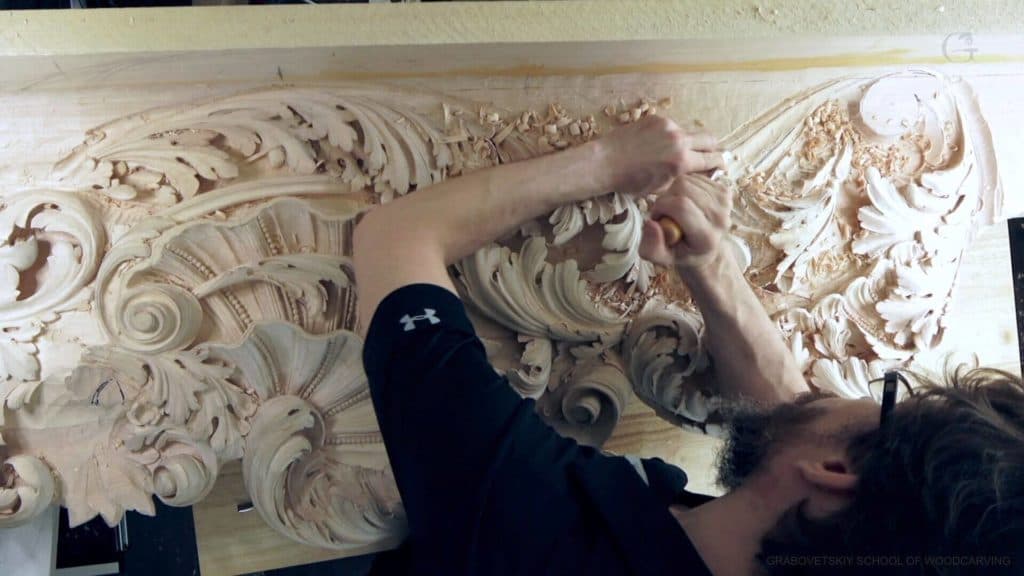
Alexander Grabovetskiy, woodcarver, School of Woodcarving · Published 2020
What does a wood carver mean by "a big mistake"?
Quick answer: During part 8 of workshop 58, I planned to excavate up with a lot less pressure and said that pushing too hard would be a big mistake. In other lessons the same two words follow force, rush, pressure, a tool that is too big and a cut that is too deep.
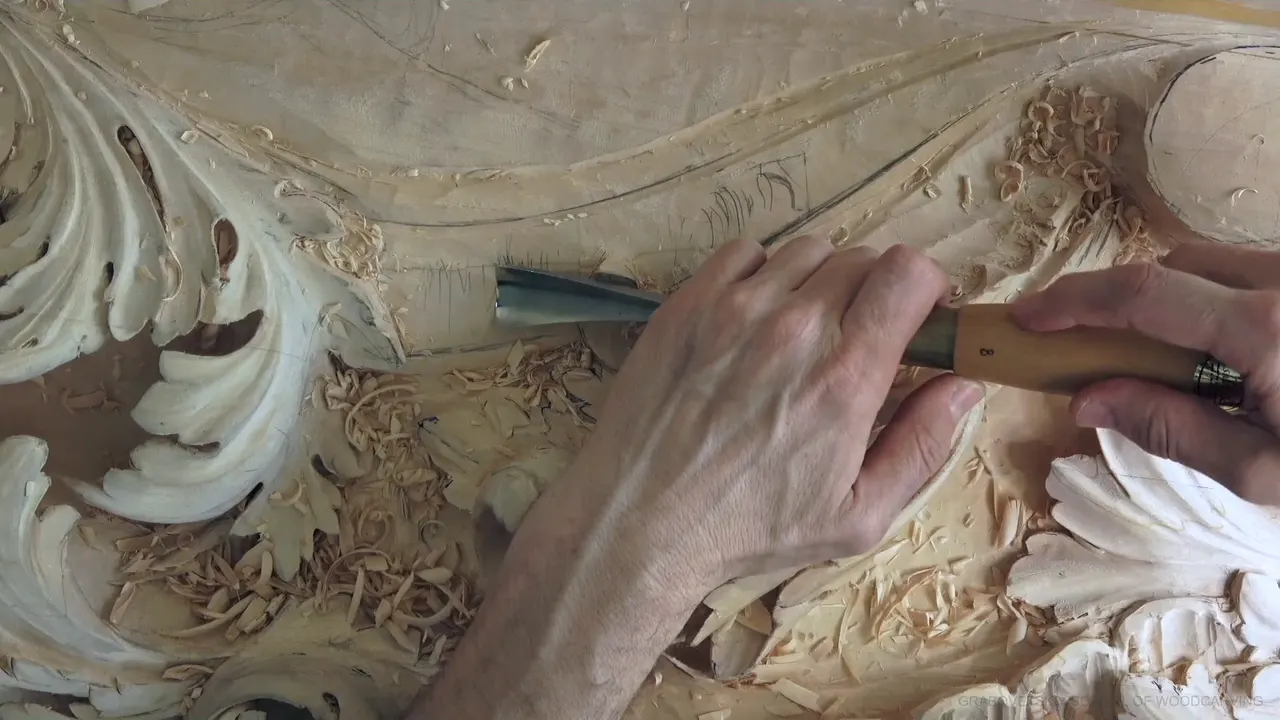

In Venice Room 58, part 8, I said what would happen if I would push too hard. Other lessons of mine carry the same two words about other cuts.
Do you stop before a cut in wood carving because you know it could go wrong? Part 8 has my words for it. The lessons below say them again, and each passage has the two words, so I quote what is said around them.
What was I carving in part 8?

"But I have to be really mindful how I do it. So I have to approach it little by little." In a couple of ways it's possible, I said: "just to take a big gouge and start your excavating," "maybe number eight."
Then: "But the best, in this case, would be start movement across the grain." And: "But I can't use this tool because the ceiling and also those details are going to break it. So I have to use a spoon, and I'll use a number eight spoon and carefully going to start my excavation like that."
How close did I plan to stay to the lines?

"So here's two lines I have to stay between. The ridge I just created with the number 11, three millimeters, and this line." That is 3 mm (0.12 in). I would not stay too close to this line yet: "So I just excavate inside, and then I'll just pass with a clean pass."
"So I'll stay approximately maybe a couple millimeters away, maybe about one and a half millimeters away, like about 16th of an inch from those lines." One and a half millimeters is 0.06 in. For some spots: "Maybe about three millimeters some spots, like eighth of an inch" (3 mm, 0.118 in). And: "carefully, I'm going to take my time. I don't want to rush it."
Which gouges did I try, and did they feel right?
"Although maybe I just switch the tool, and I'll use number seven. I'll use number seven and one inch" (25.4 mm). Then: "That's still not the tool I feel comfortable with," and then: "Let me switch to number six." I said I am just creating concave, with "number six and 25 millimeters, about one inch" (0.98 in).
What shape of concave did I want?

"And for me, concave closer to this groove has to be more pronounced. It's not like a true concave, although it's almost like a true concave." With point A and point B and the groove of three millimeters (0.118 in), I said: "I've got the groove right there, three millimeters, and then I have one of the fillets, and that is going to be a part where the ceiling part goes."
Because "the point of view going to be from this direction," I planned "a concave slightly pronounced right here in this section." It's "still concave, true concave." Of the shadow I said it would be "casting right there."
"And of course, a much darker shadow" on the inside of this groove. "So that is pretty much my goal, what I'm creating."
Which hand cuts clean, and which one steers?

Back with the number six, "number six and one inch, 25 millimeters," I said maybe "a little too big closer to the narrow part I'm coming." My words: "I will have to switch tool." Of those cuts I said: "those cuts are preliminary cuts." So they are not clean. I planned to "probably switch to smaller number six," then "go try to attack that direction."
"Left-hand side is cutting clean and the right-hand side is steering." Closer to left was my plan, and then: "To the left. Or to the ceiling. It all depends how you look at it, I guess. It's how I position my body. So that's why it looks little left from me."

I planned to show a big picture: "So now you should be able to see."
Where did I say it in part 8?

"And I'm going to excavate up just like that, but carefully, so a lot less pressure when I'm going up." It stays "really pronounced," I said. And the plan is "much smaller tools later on."
"But this movement is going to bring me richness, dynamic, if you wish, movement. There is such a thing as actually in design as dynamic movement. Oops. See? I can't do that. So guess I have to switch tools and use much smaller tools. Otherwise, you're going to damage. If I would push too hard, that would be a big mistake. So it's better to be patient and take time."
Where else do I say it?
These lessons come from several courses, and the list of them comes first, before each passage.
| What I carved, and where | My words before it |
|---|---|
| Excavating up, carefully, with the concave still really pronounced (Venice Room 58.8) | you're going to damage |
| Not forcing a cut, taking it little by little with a V tool (Hashemi 3.5) | I can't force it |
| Working with number one on a spot where my hand is in the way (Hashemi 6.5) | How patient am I? |
| A V cut with a slight undercut on the left-hand side (Hashemi 40.1) | From the very first cut |
| End grain, a couple more spots (Hashemi 43.3) | not going too deep |
| Driving a gouge straight down on the line with a mallet (Flower Rosette 1.3) | Don't hit that hard |
| Cutting away from myself and holding it under control (Flower Rosette 4.2) | snap this side |
| Carving toward myself, which I would not encourage you to copy (Venice Room 67.6) | slip and cut yourself |
| A cut where deeper can wait until later (Venice Room 67.12) | do deeper later |
| An undercut made carefully, with a smaller tool as the next thought (Venice Room 72.8) | not forcing too much |
| A section where I was thinking what I can lower down (Venice Room 77.7) | a good idea |
| Moldings to lower by about 1/32 in (0.8 mm), outlined with number 11 at 1 mm (0.04 in) (Furniture Panel 19.1) | really, really deep |
| A side to lower carefully with the knife (Furniture Panel 21.3) | almost no pressure |
| A bigger tool, with care near a head (Venice Room 69.11) | lose the whole head |
| A cut made with a rotation movement, a slicing cut (Modern Acanthus 1.2) | not pushing my tool |
| A spot near the flowers (Venetian Flowers Rosette 4.3) | use a big tool |
| Cuts I always make as slicing cuts (Hashemi 24.3) | not just pushing |
What did I say a big mistake was, and what did I not say?

In Venice Room 69, part 5, I said "Okay, got to be careful," and "See, it's already breaking the grain, which is okay in this case." At a spot closer to the finish line, I said, it would be "huge mistake." Then: "Sometimes those mistakes are unforgivable." Then: "Well, I shouldn't say unforgivable, almost every mistake is forgivable, but consequences you can't change."
Later in that part I said: "No specifics. I'm not going to tell you what I mean by big mistake, because I do understand there's different people watching what I'm doing and different points of view." And: "I can tell you what's right and wrong in the wood carving, in my opinion, of course." Also: "I would never say that is the only way you're supposed to carve or do something."
What do force and rush have to do with it?

Hashemi 3, part 5, is on the course page: I said "Again, I can't force it," and "big mistake" follows.
Slow work shows in Hashemi 6, part 5: "And now it's all about patience," then "How patient am I?" and "Because I can't rush it," followed by "big mistake."

From Venice Room 72, part 8: "I believe it's going to give me a really, really nice movement," then "But carefully, not forcing too much," and "big mistake for me to force it." After that: "I think I should use a smaller tool."
A part of Venice Room 77, part 7, has "For me, probably it's a good idea not to rush it," then "Not to rush it whatsoever" ahead of "big mistake."

Part 3 of Chamomile and Bow Rosette 4 is on the course page: "The main idea, not to force it, not to get a lot of material at once," I said, and "big mistake, okay?" Then: "Just slice it. Just take your time, slice your tool."
Furniture Panel 17, part 3, is on the lesson page, with "than to rush it" before "big mistake."
Take time, I said in Hashemi 20, part 1: "take your time," "even if it takes extra amount of time," and "spend a few minutes more than to force it" leading to "big mistake."
How much pressure is too much?

A V cut in Hashemi 40, part 1, had a plan to undercut it "from the very first cut," with "Definitely, I cannot create too much pressure" and "big mistake" after it.
A knife is in Furniture Panel 21, part 3: "I can probably carefully lower this side also with the knife," then "Almost no pressure." And "big mistake," with "create a lot of pressure right now" after it.

Near a head, in part 11 of that lesson, I said "I have to be careful, it's a bigger tool," and "pushing too much, I can lose the whole head," close to "big mistake."
Modern Acanthus 1 has, in part 2, "See, I'm not pushing my tool," and "big mistake when people push." Then: "It's not carving, there is such a thing as a slicing cut."
Slicing is in Hashemi 24, part 3: "I'm always making my cuts slicing cuts, not just pushing," beside "big mistake."

Flower Rosette 1, part 3, with a mallet: "Just be careful, don't hit that hard because you can make" "big mistake if you're hitting that hard, and you can snap." Also: "It's only three-eighths of an inch thickness, only 10 millimeters thickness, and you can always overdo it." Three-eighths of an inch is 9.5 mm.
Flower Rosette 4, part 2, has "I'm cutting away from myself, that way, I can control that much better." Then: "because if I'm pushing too much, I can snap this side, and that's not going to look good," and "big mistake." Last: "make a couple passes than snap it and make that big mistake."
Rushing shows in Hashemi 26, part 4: "Just don't create too much pressure," "It's tempting," "I'm also trying to rush it," and then "big mistake."
How deep is too deep?

End grain is in Hashemi 43, part 3: "I am not going too deep, like I said," and "big mistake."
Workshop 67, part 12, is on the lesson page: "I can always do deeper later," then "cut too deep right now," and "big mistake for me."

Lowering moldings in Furniture Panel 19, part 1: I was going to lower them "approximately about 1/32 of an inch," which is 0.8 mm. "You could take number 11 again, and 1 millimeter" (0.04 in). Then "and first of all, just kind of outline, but not as deep." After that: "Just try not to go deeper than 1/32 of an inch, okay, don't go really, really deep," and "big, big mistake."
That lesson, part 4, has "five millimeters" (0.2 in) "and this is only 16th of an inch" (1.6 mm), "because if you look at it, it's just continuous on opposite side," next to "big mistake."
Venice Room 64, part 8: "7 millimeters" (0.28 in), "a little bigger than a quarter inch" (6.35 mm). Then: "I've got only about maybe three millimeters right there left" (0.12 in), plus "big mistake" and "huge mistake."
From Venice Room 78, part 6: "Got to check, so I'm pretty close," and "that's probably the most I can get right here," ahead of "big mistake."
Which tool or way of working is not safe?

Another cut, in Venice Room 75, part 6: "10 millimeters right on this triangle" (0.39 in), then "Again, not all the way," with "big mistake" to follow, and "Don't push it all the way."
Furniture Panel 20, part 9, has "see how careful I am approaching this line right here," and "I really don't want to hit that," then "big mistake, okay?" and "hard to fix it."

A spot in part 3 of Venetian Flowers Rosette 4: "I'm getting really too close to the flowers, and I can't use a big tool," with "big mistake" next, and "I'll switch to a smaller tool."
That same lesson, part 6, has "it's not the safest way," then "So what can happen, you can slip and cut yourself," and "big mistake" at the end.
The whole of part 8 and the other parts of workshop 58 are inside the school, and the course page for workshop 58 lists them.
How it's done
- Stay between two lines. I have to stay between the ridge from the number 11 and the line beside it.
- Stay off the line for now. I'd stay a bit away from this line yet. First I excavate inside, then I pass with a clean pass.
- Go with a spoon. A spoon, carefully, to start my excavation.
- Make the concave more pronounced. For me, the concave closer to this groove has to be more pronounced.
- Use less pressure going up. Still really pronounced, I said.
- Take time. Patient, and take time.
Frequently asked questions
What was I careful about in Furniture Panel 20, part 9?
The line right here, I said: see how careful I am approaching it. Big mistake followed.
What do the left-hand and right-hand sides do?
In my case, left-hand side is cutting clean and the right-hand side is steering. I added that it's how I position my body.
Which number six did I name?
One of 25 millimeters (about 1 in). I said maybe a little too big near the narrow part, and I planned to probably switch to a smaller number six.
Which cuts were not clean in part 8?
What to carve next
- Venice Room 58 lesson
- Venice Room Part 5 course
- Venice Room 69
- Venice Room 72
- Venice Room 77
- Venice Room 67
- Venice Room 64
- Carving Hashemi Flowers 3
- Carving Hashemi Flowers 6
- Carving Hashemi Flowers 24
- Carving Hashemi Flowers 40
- Carving Hashemi Flowers 43
- Carving Flower Rosette course
- Carving Flower Rosette 4
- Venetian Flowers Rosette 4
- Carving Furniture Panel 19
- Carving Furniture Panel 21