

Alexander Grabovetskiy, woodcarver, School of Woodcarving · Published 2020
What does a wood carver mean by "clean side"?
Quick answer: Part 3 of Venice Room 66 has me saying a little roughness on one side was okay, and a veiner or a gouge leaves one side clean and the other not too clean. The same words come up in other lessons of mine, where I also talk about grain direction.
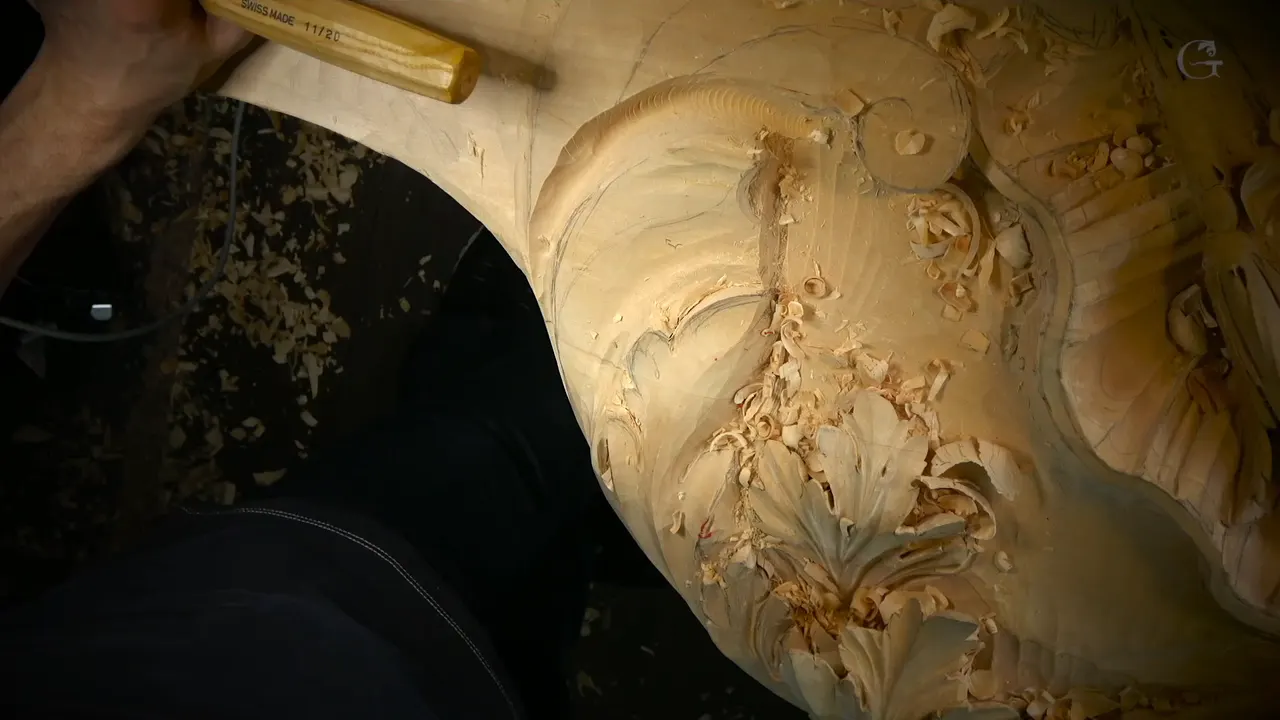

"That is a little rough on this side. That's okay." Those lines are from Venice Room workshop 66, part 3, where I went on to name the two sides of a veiner or a gouge. Other lessons of mine name a clean side along with the direction I attack from.
Have you ever finished a pass in wood with a gouge and found one wall of the cut smooth and the other a little rough? Did that feel like a mistake? Below are my own words from this part and from other courses, each one linked to its lesson.
Where does clean side come up in my lessons?
- Veiner cuts: one side clean, the other not, and a little rough is okay.
- The grain: the side where my cut runs with it.
- A change in grain direction, and the clean side switching to the opposite side.
- Clean on one side and rough on the other, when I wished for the other way.
What does this part say about the clean side of a veiner?
The part opens with a word on depth: "I've got about an inch deep, but maybe that is not even enough to create that deeper shadow. I think I could go even deeper." My measure was "about 25 millimeters down" (about 1 inch). The plan was to go down about 30 millimeters (about 1 3/16 inches) and see.

The curl came next. "Now I can start curling it," I said, and "I can use probably just a skew." Then: "Okay, wonderful. So it curls."

About the depth: "I don't need too much, but I'm going to need to excavate much deeper in this area because I really want to exaggerate that shadow." The first cut: "I need to remove that part." For the tool: "Let me use that 30 millimeters. Number 11, of course. It's a veiner."

"See what my point is with the veiner, I can actually lay it on one of the sides," and it will be "a much shallower cut on this side and much deeper on that side."

The rough side comes up next. "And yes, don't pay attention, that is a little rough on this side. That's okay. It's always like that with veiners and gouges. One side is clean and another side is not too clean." After it: "that's just a gradual movement downhill, so almost from nothing."

Deeper was on my mind. "I want to go deeper, maybe even a couple inches if I'll be able to. I don't know." Doing a couple inches brought up a problem: "then I have a problem with this. I have to blend it, but it's no problem." And "But still, I have to be really mindful."

A smaller tool was a plan: "Maybe I should use a smaller one now, like 20 millimeters, three-quarter of an inch, and go that direction." A little later: "See, it's already giving me some shadow. It's not there yet, but it will be." And then a size, "About maybe five-eighths of an inch, 15 millimeters or so."

About the shape: "I have to make it like it is flipping from opposite side and flips like this, okay? So that's why I'm doing what I'm doing. So I really need to exaggerate this concave." Then I wondered aloud, "maybe flipping, maybe not, because it's possible to do both ways, flipping and not flipping."

"Okay, that is good, but not good enough. So I need to still go deeper." The next plan: "Maybe I'll just chop with the 30 millimeters again, and without fear go even deeper, because I really need that excavation right here."

What do the other parts of workshop 66 add?
Part 2 has this line: "Not much because I do have an upper ridge, and that would be a mistake if I would just go too deep." Part 4 gives "I really need that depth," and "there's going to be some flowers, so that's why I'm not afraid to go deep. But I still have to be mindful how much material I've got left on another side."
Part 4 adds this about a tool: "that is too big of a tool as of now, so I need to switch to smaller one, 20 millimeters." Later: "I'm using number 11 and 20 millimeters." And this line: "I'm using just the side of my tool to clean this up."

The measure comes in part 4 as well. First came "almost three inches down," then "No, it's two and a half," and then "Oh, it's 2 7/8 to be exact" (73 millimeters). Next came "Really deep," and "Now I got to stop because I have some limit."

How does the clean side look in Venice Room workshop 5?
Workshop 5, part 4, says "I'll use the number seven and one inch" (25 millimeters), and a reason: "it's going to be much deeper right here and less deep, more shallow closer to the head of the acanthus." And "number seven gives me that control."
Then, about the two sides, I said "Got to be careful" and "Remember, one side is always clean side." Of this one, "it's this side is clean side," with "opposite side, is not that clean" on the other. A plan followed, "I could attack that from opposite direction with the spoon gouge number seven. I do have a matching one-inch gouge."

"Let me try to make it cleaner cut," I said. Then, on a sharp tool: "see the difference when you cut with a really sharp tool, it leaves beautiful finish. And that is what I'm after."
How did the right side stay clean in workshop 61?
Workshop 61, part 1, gives "What I have to do, I have to just create a concave and concave, right, on both sides." The right side was the clean one, and the tool was number 11, 10 millimeters, three-eighths of an inch.
A caution: "I got to stay away a little bit from our center." Another place to work from, as a plan: "I'm going to attack it from different position, I should say."

The depth was small, "Approximately about three millimeters deep" (about 1/8 inch), and "That's what I'm doing." Then "I need that shadow."
Is a rough side okay before the final look?
Workshop 80, part 1, has a plan for "a number seven and 14 millimeters" (about 9/16 inch), "and little by little, not too deep of cuts."
Then: "Let me clean it. Now I can probably clean this way also. I'm talking about grain direction, okay? So obviously it has to be done from opposite side, but it's okay. I have no problem of seeing somewhat rough side. It's not the final look yet."

Why not show the rough side from below?
Workshop 88, part 9, has "Definitely, I want to see a lot more movement this way. The reason why I don't want to see the rough side when I'm looking from the bottom. So it has to go downhill like this."
How does the grain decide the clean side?
Workshop 104, part 4, gives the grain answer, after a word on distance from a line: "stay away approximately a couple millimeters or so" (about 0.08 inch for 2 millimeters).
Then: "Also, pay attention to grain. So that is the clean side, and see how the grain runs, and I explained that many times. It's just like going downhill. So this is the grain, and that is the clean side, so my cut's supposed to be with this side of the tool with the grain."

About that type of tool: "One running with the grain and the other side runs against the grain." I came back to it, "just like I just explained, so it makes sense to run that direction. So downhill."
What if the clean side lands where I do not want it?
Workshop 162, part 1, shows "I'll take number 11, of course" and "Maybe 7 millimeters" (about 0.28 inch), then "and I'll start my cut carefully."
Then: "my clean side is on the right side and my rough side on the left side. I wish it's the opposite way, but since I readjusted my cameras and readjusted my position, so I going to do it that way." Another line: "I also want to make sure I'm not going to go too low because there's a molding."

Why not do everything in one stroke?
Corinthian Acanthus Leaf 4, part 1, says "If you have temptation to do everything in one stroke, it's a good temptation, but it's not always a good idea because with the gouge cut, you really have only one clean side." The other side, "not so clean as you would expect," I said.
Then: "So it's better to just get few cuts until you reach the main idea." And "in this case, this side is a clean side." And "the grain direction is opposite direction."

Further on, the clean side was on the outside edge: "right now on the outside, on this edge right here. And I will need to turn my gouge and work from the other side," to "make that cut clean, because this cut is a somewhat final cut."
Can the clean side switch on a small design?
Butterflies lesson 2, part 1, brings a cleaning cut: "I'll position my tool like a 45 degrees to the line if you look at that angle, and I'll create my cleaning cut right to the line, but we really careful."
Then "the clean side is gonna be opposite direction. So if previously we attacked from this point and that direction now we have to do it opposite direction."

How do I pick the clean side before the first cut?
Acanthus over Moldings 2, part 2, has "I have to find the right position, right angle how I can attack that." And "One side I'm gonna cut clean and another side gonna cut rough."
On the grain: "the grain of the wood runs that direction, and I really need to keep that side somewhat clean." The tool: "number 17," at "three quarters of an inch or so. It's 20 millimeters to be exact."

After the first cuts, "it would be left hand side cuts really clean," and of the other side, "another side is kind of rough." And: "for me, it's a lot more important to get my left hand side lot cleaner than right hand side, although I mean I could attack from both sides from both directions."
How do I keep control of the clean side?
Roman Acanthus Leaf 11, part 1, has "I don't want to take the material on a single cut because I want to be really accurate, and that way, if I'm just taking little by little, I can control much better what is taken out."
Then "my clean side in this case is on the right-hand side, and this left side is more rough, and I can always attack from the opposite direction," to "make it look really clean cut."

A tool size helped too: "if you would have a bigger number nine, or number eight will work also, it would help tremendously, actually, to make a cut really clean." A size I named: "I can try to use about 5/8 of an inch, and it works just perfectly" (about 16 millimeters). The number: "That's number nine. No, it's number eight."
What do I do when the grain changes sides?
Greek Acanthus Leaf 4, part 2, is about the number 11: "when you do the cut with the veiner gouge, there's only grain direction goes two opposite directions, actually, pretty much." In my words, one side cuts against the grain and the other one with it, and you watch which side cuts cleaner.
The pipe side "is actually clean side." Then: "let me rotate, and I'll do exactly the same cut along my pipe, along my future pipe." Later: "just because the grain direction changed, it's on opposite side."

Which two sides does the Roman lesson ask me to watch?
Roman Acanthus Leaf 5, part 4, shows the same two sides, and the grain direction changes. My words: "That's why sometimes you have to attack from two sides."
Keep an eye on which side is the clean one, I said: "concentrate on that side first, then go back from opposite direction and clean another side." And "don't forget to rotate or sweep while you're carving."
Which lessons name both sides?
Here are the lessons where I named both sides, in one table.
| Lesson | Where the clean side was | What I said about the other side |
|---|---|---|
| Venice Room 5 | This side | The opposite side, not that clean |
| Venice Room 162 | The right side | The left side, and I wished for the opposite |
| Acanthus over Moldings 2 | Left side, which cuts really clean | Kind of rough |
| Roman lesson 11 | The right-hand side in this case | The left side, which is more rough |
| Corinthian Acanthus 4 | Only one clean side on a gouge cut | The opposite side, not so clean as you would expect |
Where can you watch the full videos?
Every lesson above sits inside one of my carving courses, so a full video stands behind each quote. This workshop holds all twelve parts of workshop 66, and workshops 62 to 73 are in Venice Room Part 6. You can go back to workshop 65 or on to workshop 67. To watch the full videos, start here.
How it's done
- Find your clean side first. The Moldings lesson has me saying I needed to find which side would be clean and which would be rough.
- Look at the grain. Workshop 104 has the grain answer: one side of that tool runs with it, and the other side runs against it.
- Take a few cuts. In the Corinthian lesson I said it is better to get a few cuts until you reach the main idea.
- Turn to the other side. When the clean side goes the opposite direction, I said, the next cut goes that way too.
- Leave a rough side for now. Workshop 80 calls a rough side not the final look yet.
Frequently asked questions
What did I say about the rough side here?
I told you not to pay attention to a little roughness on one side, and that it is okay.
How deep did the excavation get in workshop 66?
In part 4 I said it was 2 7/8 inches (73 millimeters) down, after first saying almost three inches, then two and a half. My words were "Really deep," and then I said I had to stop because of some limit.
Where was the clean side for Venice Room 162?
Right, with the rough one on the left. I wished it were the opposite way, but I would do it that way.
Does the clean side stay the same?
What to carve next