

Alexander Grabovetskiy, woodcarver, School of Woodcarving · Published 2020
What does a wood carver mean by "already shaping"?
Quick answer: I said "it is already shaping" in Venice Room 66, part 7, then talked about creating my eyes and pipes. My other courses carry the word shaping beside skews, domes, rough stages and ridges I leave alone, each lesson linked below.
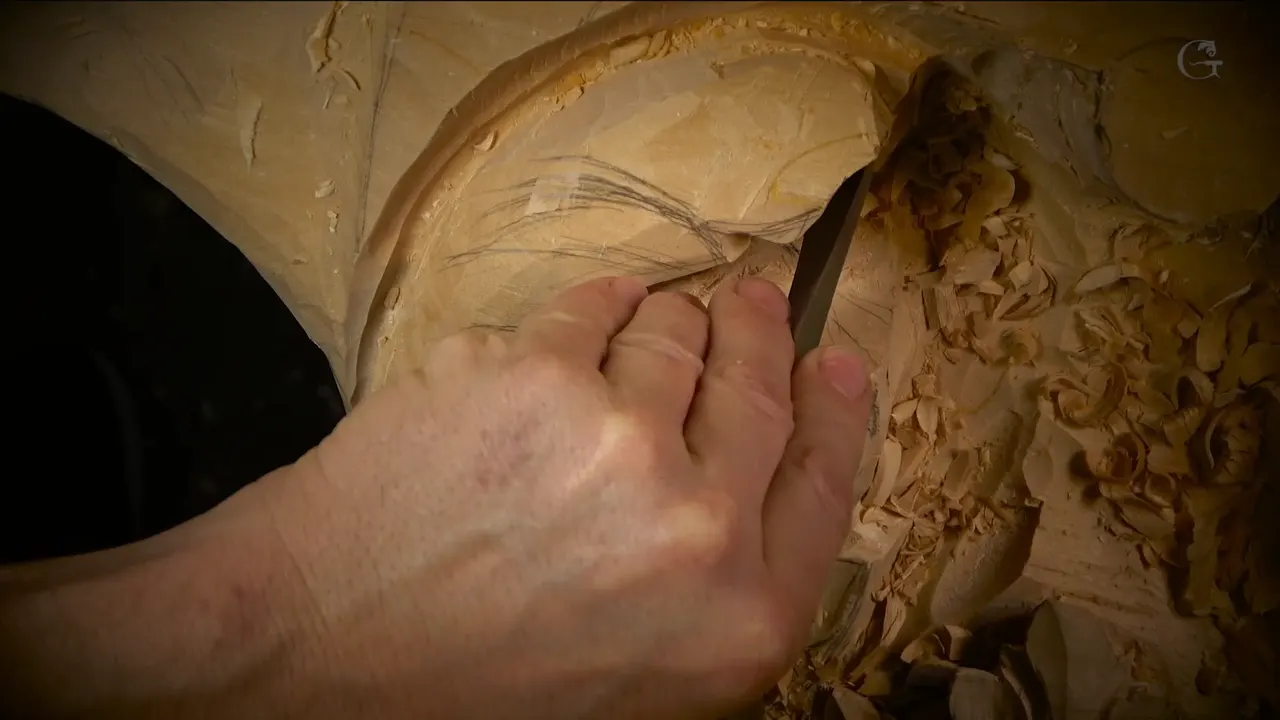

In Venice Room workshop 66, part 7, I said "I need number five maybe, or actually no, maybe number three or four," then "And get this also chopped." After that came "And yes, it is already shaping." Below you get what came after those words, and the places in my other lessons where I say shaping.
Ever looked at a chopped block and wondered whether it looks like anything yet? Did you want to hear what the carver says at that point? Come along into part 7.
What did I say right after "it is already shaping"?
"Get rid of this side," I said. Then: "And later on I'll be able to clean little better on that side. But now what I can do, I can start creating my eyes and pipes."
A big question came with that: "the location of an eye, where I want to get that location." My thought was "I think I would just go all the way down here."

A second question was a decision: "I have to make the decision which one going to overlap." Either this part over that one, or the other way round. I called them "both of those ways actually legit," and added "Maybe more logical for me going to be, in this case, go this one little bit below that."
Which gouge did I name for the movement uphill?
"But I need a bigger number 11 because I want to create a movement uphill a little bit," I said. I went on: "So let me start. I'll take 12 millimeters, about half an inch."

A bigger gouge followed as a maybe: "And maybe even bigger, maybe about 20 millimeters, about three-quarter of an inch, and get even more movement."
From there I turned to the view from below. The view from below mattered: "visible from the bottom," and when it rises "going to be really noticeable." Of the rise I said "a big difference" and then "It will." Right after: "Here you go." The spot would be an eye.

How do I mark the divisions once I have an eye?
"I can actually start creating approximate divisions of this movement," I said. After that: "And that's going to go like that." Another movement would sit "right there." I asked you to look: "Hopefully you can see."
The plan was to "chop a little bit relief," and "And this one, too, right away." Good, I said. "Although, I need to take that eye a little farther right here" came next.

Why did I not undercut right away?
I put it plainly: "I did not undercut that right away really too much because I really need that depth." And: "I can always undercut, but it would be a big mistake."
My next words were "But now I'm creating all those shadows, and because I have extra material, I'm able to create something beautiful and get this eye."

How did I treat an eye I was not happy with?
"Although, I'm not too happy about this eye. Maybe I can just move it slightly this way. Not too late yet." I think it will be better, I said, and moving it would "give me more chunk."
A smaller tool was next in my plan. "I'll take a smaller tool, maybe about three millimeters, and get my eye, not my eye, but eye of Acanthus a little deeper right here and right there. Just couple digs." Three millimeters is about 1/8 in (0.12 in).

"Oops! That's not good enough. Sometimes it happens, but not so much. Just dropped my tool," I said. "And let me get on inside right here," I added.
Why talk about a part you cannot see?
I was not sure you would be able to see that, but "its lip going on like this." A division sits right there too, and "you don't see it from the camera position you're looking at it, but there is a beautiful movement going uphill." Of that I said "Which I'm really happy."
I named an option: "what I can do, I can actually get that thing, little thing from this Acanthus movement, from this separation, go a little higher than this future development. Okay. It's still possible."

Which tool came next for the future pipe?
"Now, so I've got the concave, big concave, but now I need the smaller concave going all the way on the side of the pipe." A small number 11 was next: "Let me use a small three millimeters, number 11." That is 0.12 in.
The spot would become my "future pipe." The part ends on "Yes, I can probably chop out right away whatever I don't need on this side."

Does shaping count when nobody sees it yet?
In Acanthus over Moldings 6, part 2, I said it about a middle part that would be convex: "I can probably start shaping it with my tool." And: "Let me actually start shaping the side."
My verdict: "But it looks good. I mean in my opinion that's already a shaping. I know you don't detect that because of the camera position, but it does go downhill."

What do I call a rough pass?
A shaping stage, in Furniture Panel 29, part 1. "Just preliminary shape if you wish. That was just a shaping stage." Before it came "we're gonna introduce some concaves, some convexes, otherwise it's not gonna look nice."
Right after: "Let me flip my tool and get right underneath. It's not really undercutting, but you know, somewhat undercutting."
In Byzantine Acanthus 2, part 2, one stroke got a name, and it is a slicing cut. "Every cut I do, really important, it's called woodcarver's cut. It's a slicing cut." And: "don't worry if it's going to look rough, because it's just the shaping." Also "if the grain bites, just rotate the piece. Just rotate and just work opposite direction."

Part 1 of Venice Room 159 has a rough pass planned with rasps. "I can probably just use some rasps," I said. I went on with "Make it just that real smooth and nice. Take all of those ridges. Pretty much it's just about the shape in this case, just the shaping." And "it looks really good already."
Where does the shaping begin?
Part 8 of Venice Room 97 comes with a depth: "approximately 10 millimeters deep" (0.39 in). After the depth I said "And that is good," and then "Now I'm ready to do shaping. I'm talking about 3D shaping." Outlining "that leaf also" was my plan, with "5 millimeters, 3/16 of an inch, number 11."

Petals get it in Venice Room 114, part 1. I would indicate approximately where my petals sit, and "how I'm going to shape those petals." Taking out some of it meant it would not be "the same level." My tool: "I need to take number seven, maybe, big one, number seven. Going to chop some of it."

Part 4 of Venice Room 2 has "I can start the shaping." For that I would need my drawing.
Is shaping the whole job?
Workshop 10 of the Beginner course, part 2, says otherwise. "Wood carving is not just about the shaping, okay? It's easy to shape. You can just dig and dig," I said, and "just create lots of different cuts," but "it's not the best way."
And: "Every cut is just like a painter's brush, if you wish, in fine art. It has to leave a right type of mark on the piece of wood."
Furniture Panel 32, part 1, puts shaping before detail. Detail comes second: "then you start digging the details after" the overall shape. Then: "You're pretty much creating shape, you're shaping the wood" and "the most important step 'cause you kind of get the feel."
Leaves that are "not the main idea of the overall, you know movement" get less in Acanthus over Moldings 8, part 3: "we're gonna just do some kind of shaping and some detailing but not as much."
Greek Acanthus 3, part 3, has the order in one line. "We have to actually make sure we do have a straight-down cut, which is called wall cut, like I mentioned before, before we do any shaping."
Does one tool do all my shaping?
A skew shows up in Hazelnuts 2, part 1: "I also like to use bigger tools for the shaping. I like maybe skew. Skew chisel." It is probably better in this case, I said. "Please don't create the final shape. All I need is just a preliminary movement." And "So let me finish shaping this side," with a skew of three-quarters of an inch (19 mm).

About any tool, part 8 of Venice Room 69 says "it could be done with any tool pretty much. It's not the only way. Even like I said before, just skew works perfectly also."
Part 10 of Venice Room 96 says "at least just get the big skew," because "you can do a lot of stuff with just a skew." That skew is one inch (25 mm), and "you can do a lot of cleaning and shaping." A last line: "You can get a really good job with the skew, actually."
My April 2020 stream, in the April 2020 livestream course, shows the same tool: "I'm using skew and I'm just shaping right now." Also "it's already establishing some shadow on this side."
Grape Onlay 5, part 3, has a smaller skew, a quarter inch (about 6 mm): "Even a skew would probably work better, like a small skew, like in this case it's a quarter inch skew, but it's gotta be sharp, obviously." That follows my plan of "shaping the sides a little better."
A back bent comes in Venice Room 33, part 3. "I kind of like overall its development, and now I can probably start shaping." And: "I should use a back bent, I believe." That would be "the best tool right now to knock down and give the movement going that direction on inside."

The dome sits in Furniture Panel 23, part 6, and my plan was "I'm going to start shaping that dome." A different, smaller gouge was the plan next, "with number eight."

The V tool turns up in Hashemi 4, part 1, with "I could use just probably right now the V tool and start shaping it." A knife does it in Acroterion 3, part 2, where I said "I'm actually pretty much shaping the whole" piece, "pretty much with one knife, just taking big chunks of, just really big, you can call it chips or chunks of wood."

A number seven comes with a rule in Lily Box 13, part 2. "I will take number seven and the 14 millimeters" (0.55 in), I said, and "start shaping. Not really shaping, but taking out those ridges. But make sure you are slicing, okay? Really important. And yes, your tool absolutely must be sharp."

Which spots do I leave alone while I shape?
A high point. In workshop 12 of the Beginner course, part 2: "And again, when I'm shaping, this line is my high point. I'm not touching it."

The Acroterion lesson says it with a ridge. "I'm leaving the ridge with my paper because it's my high spot and I don't want to go lower than that. Okay. So carefully shaping it, and I'll take a gouge a little later, and I'll make concave cuts."
A third spot waits in Hazelnuts 2. The plan there was to lower that part even more and "not going to touch yet." I added "I will touch it, but not shaping it, okay?"
Waste comes up in Lily Box 11, part 5. My need was to "chop out" the waste, then "remove that part." Next: "All right, and start shaping."
Can you see the shape while you shape?
Part 11 of Venice Room 50 has the question "Can you see the shape, how it is shaping right now?" "And yes, it has to be gradual movement, beautifully moving in three dimensions," I added.

How do those lessons line up side by side?
| Lesson | What I said | Next |
|---|---|---|
| Eye, Venice 66.7 | Yes, it is already shaping, I said | Clean later |
| Dome, Furniture 23.6 | Start the dome, then a smaller gouge | Number eight |
| Hazelnuts 2.1, skew | I also like bigger tools for shaping | Skew chisel |
| Cleaning, Venice 96.10 | A big skew handles cleaning and shaping | Get one |
| Skew, Venice 69.8 | A lot of shaping with the skew | Any tool |
| Ridges, Lily 13.2 | Not really shaping, but taking out ridges | Number seven |
| Rough, Furniture 29.1 | Just preliminary shape, just a shaping stage | Right underneath |
| Rough, Byzantine 2.2 | It may look rough, it's just shaping | Rotate piece |
| Wall, Greek 3.3 | A wall cut comes before any shaping | Different gouges |
| Knife, Acroterion 3.2 | Pretty much shaping it with one knife | Big chunks |
| Line, Beginner 12.2 | High point line, not touched while shaping | Left alone |
| Petals, Venice 114.1 | I plan to just take out some | Number seven |
Where can you watch every line in full?
This part belongs to workshop 66, and the whole panel sits in the Venice Room Part 6 course. The lessons before and after it are workshop 65 and workshop 67. More of my lines sit in Hazelnuts and in Lily Box, and each course is on this site, with the tuition shown on the start page.
How it's done
- Pick the next gouge. I needed a number 11 for a movement uphill, and I named its size before I began.
- Ask where the eye sits. I asked about the location of an eye, and said where I think I would go.
- Mark approximate divisions. I could start creating approximate divisions of this movement, I said.
- Save the undercut. I did not undercut that right away, because I really needed that depth.
- Move an eye you dislike. One eye bothered me, and I said maybe I could move it slightly.
Frequently asked questions
Which tool did I name for the movement uphill?
A bigger number 11, since I wanted the movement to run uphill a little. My pick was 12 millimeters (about half an inch), with a maybe of about 20 millimeters (about 3/4 in) for even more movement.
Why did I not undercut the eye right away?
The depth mattered to me at that point. I said I can always undercut, but it would be a big mistake. With extra material, I was able to create something beautiful and get the eye, and I was creating all those shadows.
Was it too late to move the eye in part 7?
Not yet, I said. Moving it would give me more chunk. A smaller tool of about three millimeters (about 1/8 in) would take the eye of Acanthus a little deeper, with just a couple of digs.
What to carve next