

Alexander Grabovetskiy, woodcarver, School of Woodcarving · Published 2020
What does a wood carver mean by "please understand"?
Quick answer: I said it in Venice Room 66, part 6, about a dig an inch deep that you don't see, and I went on to name my tools. My Venice Room, Lily Box, Furniture Panel, Floral and Roman Acanthus lessons carry the same two words beside a rough pass, a camera angle or another style.
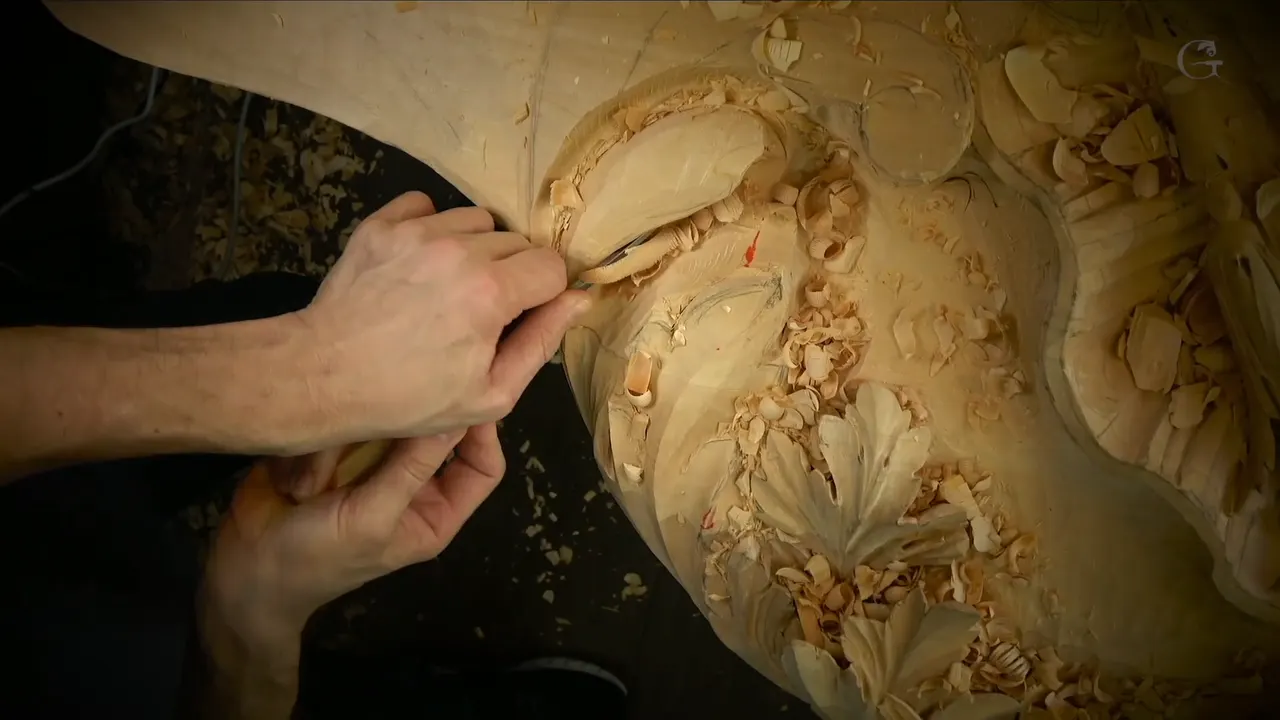

In Venice Room workshop 66, part 6, I said "please understand" about a dig an inch deep that you don't see. I went on to name the order of my tools. The same two words turn up in my other lessons, so below you get some of those places and what came after.
Ever watched a video where a carver dug into a spot you could not see? Did you wonder what was going on in there? Come into part 6. I told you.
What did I tell you about the dig in part 6?
"You don't see it, but I've got deep, deep right there," I said. Then: "About an inch deep on inside" (25 mm). A moment later came the plea itself, "I know you don't see it, and please understand."
I guessed it was possible to "reposition the camera and show you that," but "really you don't need to see it because it's a simple stuff." My process came next. "All I do, just a dig in, and the process I took, it was just use the smaller tools first, and then clean up with the bigger tools."

Before any of that the part opens on "just go all the way beyond that point." My plan for the tool follows: "I can use my tool upside down and attack this way." Then: "Can excavate even deeper."
Further on in the part I said "Right now I'm using 14 millimeters number nine" (0.55 in). Right after: "I need to use some different tool again." Other lines in that part read "Use from opposite direction" and "Use upside down."

A spoon came next. "And right here, I need to use a spoon," I said. My idea was "maybe number nine, 15-millimeter spoon" (0.59 in). "Try," I said, and then "Yes."
That spot was "a high spot," and "I don't want to break it." It was "solid yet," and "I did not undercut anything." Still, "it's one of the tougher spots." Why dig it at all? In my words, "I need the full depths of it, okay? Like I said, I'm after that shadow."

A bigger number nine crossed my mind, "maybe 20 millimeters" (0.79 in), though "not sure if we're going to be able to fit that or not." Nope. "No, I'm not." What I needed was "a medium bend." I guessed at "number nine or number eight." Then "Let me see if number eight will work," and finally "And yes, it does."

Then my plan was "I think now what I can do, I can start creating my divisions." Look at "this piece" and "that piece," I said. Then: "Let me get closer to you." The idea, in my words: "you just imagine you take this leaf, flip it, and make whatever movement like this." It would be "transferred just like that," only "in a more three-dimensional way, I would say."
I wanted my point "really high." A main division would run "all the way that way." "I'm not sure if you're going to catch it or not," I said, and "maybe I can just show that even closer to you." A note about the other side followed: "this part has to repeat on the opposite side."

The part closes on a clean-up: "Let me clean little bit," I said. I named "seven millimeters, number 11" (0.28 in) for it. "Otherwise, it's just a little too messy," I said, and "too messy is not good." Then, "maybe a little more," and "Okay, good. So now I can start my divisions."
Part 5 of the same workshop has the plea again, this time beside a pass against the grain. Breaking the rule was my decision there. "I can go against the grain and break the rule." Next, after "But I need it, okay?" came "Please understand," then "I really need it," and "I need that movement." And "That's why I'm going against all the rules."

What do I say next when you cannot see a spot?
An area I could not show to you comes up in part 4 of Venice Room 18. "I know it's an area that I can't show to you," I said, and "please understand that and forgive me." Next I named "4 millimeters, number 11" (0.16 in), and my idea was to "go up again and a little bit underneath."

Camera angle comes up in Venice Room 19, part 6. My middle point would be "visible from the bottom." Right then: "Please understand, when you look from the camera perspective, it does not look as appealing sometimes because you are looking from this side." Looked at from the bottom and from the front, "it does look good."
A wall showed in Venice Room 24, part 7, because my camera stood a little farther away, looking from that side. I asked you to understand the camera position. "From where I stand, I don't see that at all." The tool there was 7 millimeters (0.28 in), "a little bigger than a quarter inch," and "I really don't need to undercut."

My own hands got in my way in Venice Room 54, part 3. "If I'm covering my view with the hands, please understand why," I said, and then "My apologies, okay." Three millimeters (one-eighth of an inch) was my tool, and "I could create as deep as I wish." You see more than I do there, I told you, "because the position of the camera is little bit away from me."

Part 1 of Venice Room 59 has a concave on the inside. It is "a transition pretty much to the ceiling." "The camera is not going to show exactly how it's supposed to show," I said, and "just please understand." Then: "just in overall picture, you will see that later."
Hands again, in Venice Room 60, part 9. "Sorry that I'm covering with my hands again, but please understand why." Also: "I really need that pipe." My reason followed. "I really want to see a shadow. Right now, those two are too close and I don't really see any shadow."

In lesson 14 of the design course, part 4, I said "I'm sorry if you can't see that," and "sometimes I am covering that with my hand," and then the plea: "please understand what is going on inside."
When is a form still rough?
It sits beside a rough pass in Lily Box 6, part 1. There I could use "smaller gouge, like number three, and clean a little bit." The words there: "please understand that is not the final yet form," and "we are just establishing a rough form of this one."

Mess is the subject in Venice Room 26, part 5. "Get rid of this mess right here." Then "I did not put the final details yet," and the plea followed. Next I said "I can probably do this separation right away too before I forget." My tool for it: "Number three. And this one is one inch" (25 mm).
Next to a chunk, in Venice Room 7, part 8, the words were "please understand" and then "that is just the big chunk." And: "later on, I'm going to develop the final look of this chunk." My wish was to "make it look three-dimensional."
Glue gets the plea too, in Lily Box 11, part 13, where I said "All I need is just that small point to hold that in place. It's not permanent glue, okay?" Right after it came the plea.
Part 4 of design lesson 14 has "That is just the indication." My plea followed. Then: "So let me do some indication of those movements."
Does "please understand" mean my way is the only way?
The lines below say otherwise. In Lily Box 12, part 1, the plea led into "that is not the only way to do those small flowers." Other ways exist, I said, and my plan was "to just scratch a little bit with the gouge."

A wave technique carries it in Venice Room 22, part 7. "It doesn't necessarily apply to all of the styles of acanthus." And "there is absolutely no rule to all because they're all different styles of acanthus." The style I work in is "just in Venetian style."

Another leaf, in Venice Room 60, part 3, has one point and another that are almost equal, "which creates a circle." Next, for the French kind of acanthus: "please understand," and "it's not applicable at all." That kind has a part that is "really long and twisted." Then: "Which is also beautiful, by the way."
A middle part goes convex in Venice Room 84, part 8, and the words were "please understand, it's not always the case." In my words, "it's just particular Venetian style," and "there's also Byzantine style."
The furniture panel carries it too. "There is a lot of different styles of carving for furniture," I said in lesson 21, part 5. Mine was "more North European, more, I would say, French late 18th century style." My aim: "I want to be authentic to what I designed."

Edges got it in Roman Acanthus 16, part 3. Here it came as "please understand, this style is absolutely different from what we did in Greek acanthus or Corinthian acanthus." Still, "you can use that same technique in those also."
How do I give a reason when I ask you to understand?
Right beside it. In Lily Box 5, part 6, "Number 5 and 12 millimeters" (0.47 in) was what I was using. After "please understand," came a line about brands. "If you compare tools from different brands, you will see a big difference in sweep." So: "Don't just go by the sweep. Grab a tool, just to check if it's going to fit, and if it fits nicely, then use it."

A number 11 gets its reason in Venice Room 21, part 5. Mid-sentence sits the plea. "I could use just the one side as just a gouge, like number 3 or number 5, because it's like a U." I can "lay on one of the sides, and I still can get a really smooth transition."
Venice Room 20, part 11, says "number five is perfect right here." After that comes "please understand the logic. So it goes from underneath and goes up and goes like that."
Confusing anybody was not my goal in Venice Room 17, part 11, and the plea sits right before it. I wanted an idea that pleases the eye and is "logically accurate," because "you have to look at that from different points of view."

Why did I ask you to understand how my school works?
The school and I come into it too. Lily Box 11, part 12, has "please understand the format of my school." Then: "It's not really just to give you instructional videos." Instead it is "pretty much just like taking you inside of my shop," where "you're just watching pretty much my daily life and my approaches to all types of wood carving."
Venice Room 41, part 4, has me alone. After the plea, "there is nobody in my shop while I'm working," and the only people hearing me, "it's you, but it's on a camera." Before that I had apologized for talking "a little slower when I'm in development mode."

Tools come into the Floral and Molding course, in lesson 10, part 3. My plea comes first, then "I do carve every day, and yeah, I also get tired of using the same tools over and over and over, and that's always joy to use some other tools."
Roman Acanthus 16, part 5, is about a new system. The plea comes before "I'm still getting used to the new system, and I'm still trying to adjust my angles, trying to adjust my audio."
A design of mine is in it too. After the plea, "I did that design, and when you're doing it even on 3D computer design, it doesn't look the same in real life," I said in Venice Room 85, part 3. "And in real life, I have to make a lot of different choices and decisions."
What do those lessons look like side by side?
| Lesson | What it sat beside | Next |
|---|---|---|
| Hole, Venice 66.6 | Hole an inch deep you cannot see | Smaller tools |
| Underneath, Venice 18.4 | An area that I can't show you | Number eleven |
| Wall, Venice 24.7 | Wall that shows from my camera position | Go inward |
| Hands, Venice 54.3 | Covering my own view with the hands | Three millimeters |
| Pipe, Venice 60.9 | A pipe I really needed to see | A skew |
| Form, Lily 6.1 | Just a rough form of this one | Smaller gouge |
| Chunk, Venice 7.8 | Big chunk with its final look coming | Develop later |
| Flowers, Lily 12.1 | Small flowers with a lot of ways | Light scratch |
| Wave, Venice 22.7 | A wave technique, not for all styles | Venetian style |
| Edge, Roman 16.3 | This style unlike Greek and Corinthian acanthus | Same technique |
| Sweeps, Lily 5.6 | Different brands that mark the same sweep | Check fit |
| Design, Venice 85.3 | Design that looks different in real life | Change it |
Where can you watch each line in full?
This part belongs to workshop 66, and the whole panel sits in the Venice Room Part 6 course. The lessons before and after it are workshop 65 and workshop 67. The Lily Box course, the Furniture Panel design course and the Roman Acanthus course hold the rest of my lines, and each of those courses is on this site, with the tuition shown on the start page.
How it's done
- Name the hidden part. Say plainly that the spot is out of sight. I did, and I called the job simple stuff.
- Order your tools. Small ones dig first. Big ones come after and do the cleaning.
- Turn the tool. Opposite direction, or upside down: two lines I said in part 6.
- Reach for a spoon. A spoon, maybe a number nine of 15 millimeters (0.59 in), got my one word, try.
- Test a medium bend. Number eight was the one I tried, and it worked, I said.
Frequently asked questions
How deep was the spot I could not show you in part 6?
About an inch (25 mm) deep on the inside, I said. I added that repositioning the camera was possible, but you do not need to see work that simple. The plea sat beside that inch.
Which tools came into part 6?
A 14 millimeter number nine (0.55 in), a spoon, a number eight with a medium bend and, for cleaning, a seven millimeter number 11. A bigger number nine, 20 millimeters (0.79 in), would not fit, I said.
Why did I want the full depth of that spot?
The full depths of it, I said, and I am after that shadow. The spot was a high one, still solid, with nothing undercut. I did not want to break it. Part 6 has all this, after a spoon came into it.
What to carve next
- Venice Room workshop 66
- Venice Room Part 6 course
- Venice Room workshop 65
- Venice Room workshop 67
- Venice Room workshop 24
- Venice Room workshop 54
- Venice Room workshop 60
- Furniture Panel design, lesson 14
- Lily Box, lesson 6
- Lily Box, lesson 12
- Venice Room workshop 22
- Roman Acanthus, lesson 16
- Lily Box, lesson 5
- Floral and Molding, lesson 10