

Alexander Grabovetskiy, woodcarver, School of Woodcarving · Published 2020
What does a wood carver mean by "possibility"?
Quick answer: Possibility is a word I use for a path a spot or a movement may take. In that part of Venice Room 66, I used it for a curl that would expose the part below and make a deep shadow. Other lessons of mine use it for another path, and for the danger of taking a spot too deep.
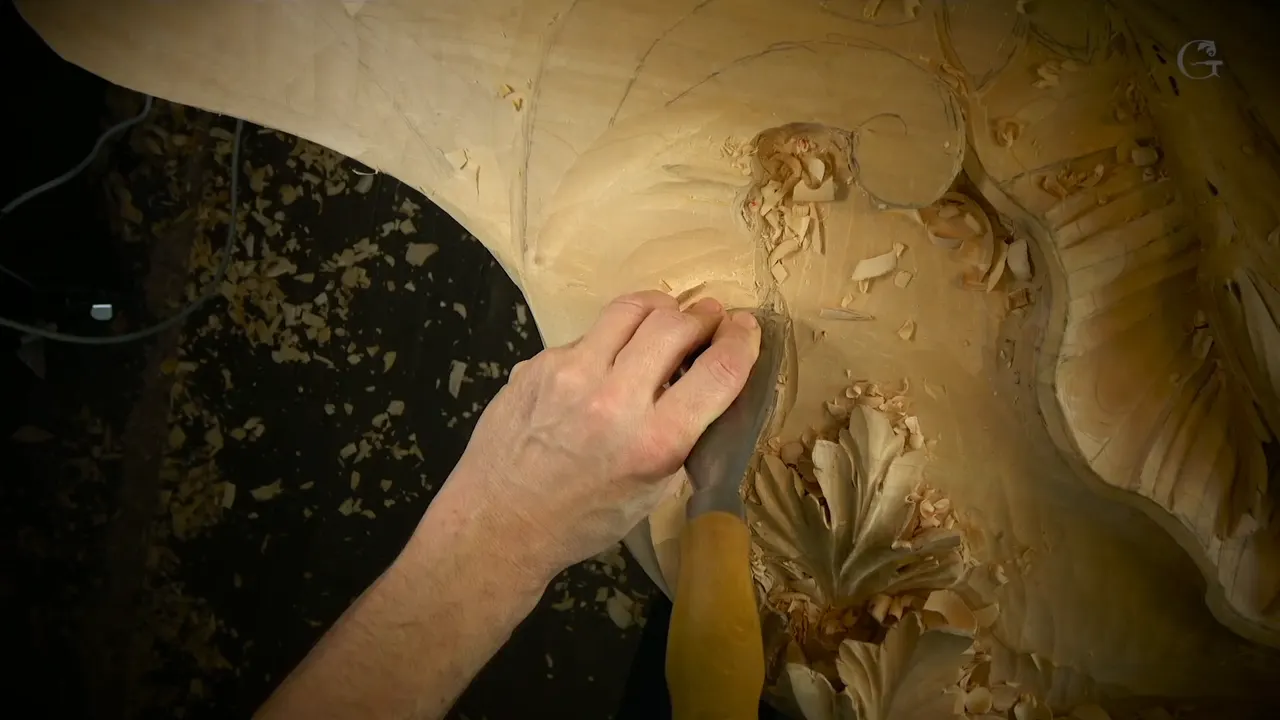

Possibility is a word I use for a way a spot or a movement could go. In Venice Room workshop 66, part 2, a curl from underneath was "one of the possibilities, and I think it's a really good possibility." Other lessons of mine use the same word for another path, and for the risk of going too far.
Have you ever stood over a carving and seen two ways to go? Did you wish you could look at both first? Here are my own words from this part and from other courses, each linked to its lesson.
What possibility means in my lessons
- One more path, said out loud beside the plan I already have.
- One of a couple of paths, with the pick still waiting.
- A step I name and then set aside.
- The chance of going too deep, which I say before a deeper pass.
- More shapes a petal or a design could take.
What was the possibility in this part?
A curl. The part opens with talk of a big gouge, "a little bigger than three inches" (76 mm), and "you can always chop that way also." Of that chop I said "it's going to give me the boundary. Good boundary."

Two options came first, one for each side. "Maybe I can actually do an extra small division in this area," I said, and "exactly the same I could do on this side." I needed the space. "I'll be able to open up a little bit this space because I need it. I need that space for revealing the stuff below."

Then the upper ridge came up. "Not much because I do have an upper ridge, and that would be a mistake if I would just go too deep." Next, "that leaf is going to go underneath," and "That is just establishing that movement, and that's really, really good." Then three divisions, in my words: "Get a little better division right here. Another division right there. And another division."

That area was "probably enough for now," and my next job came with it. "I need to attack that side and establish the main movements and the main idea before I do too much detailing. I really don't need to."
A piece was "sticking out from underneath, and I cannot lose it. I cannot, and I do not want to lose it." Two more lines follow: "I've got that thing from previous design going like that," and "Maybe I just should do that idea. I'm not sure if I should or should not."

Here it is. "I could actually create the motion that this piece is just curling from underneath, okay, and expose the lower part that create the deep shadow, which is one of the possibilities, and I think it's a really good possibility."
The idea came with a challenge. With it, I said, I would be able to bring my point all the way to that height. In my words: "I have a little challenge because I cannot go too low on this side. That could create a little problem."

I needed to think, and I asked it as a question: "Why I'm thinking too much today? I don't know." A different idea came up as well, "Maybe I can just do something else instead," followed by "But I kind of like the idea of wrapping." For that idea I said it would be visible from this side, "so it makes sense to create deep shadow. It does."

"Outline it first," I said. The next words are "Okay, good. So that's preliminary, although I have to go much deeper in this area." Why deeper? "If I want to curl it, so it has to be a lot deeper, so I can safely get with the bigger tool." And "Yes, I know it's looking extreme, but it's okay."

The part ends on a plan. "And even deeper I need. Okay. Even deeper. I'll use 20 millimeters, three-quarter of an inch."

Two more lines from the same workshop use the word. Part 1 has one, with a long leaf in view: "there is going to be another possibility to do, and of course, that is going to go underneath." Part 10 has another, "Deeper, but not too deep. Because there's always possibility to overdo it."

When does a possibility count as one more path to take?
A ridge made me stop in workshop 47, part 4. "I really need that ridge," I said. Next, "I have to think what I have to do with this because as of now, there's a couple ways I could deal with that." One way was "some kind of movement on inside going that way, which is also a possibility. And I think I should." My reason: "That way, it's going to tie together, and all I have to get rid of is just a small section right there."

Venice Room 48 gives another, in part 6. Lowering a middle line was my idea, "maybe I need to actually lower that middle line a little lower." Because of it, I said, I could make "extra separation going that direction and a little separation going that direction." I called that one a possibility too.
A ridge came up again in workshop 50, part 6. "Hit that from two sides," I said, to keep it. Then I thought again. "Maybe it's a good idea to create some of the movement going downhill from this part. That's also a possibility." For that, "I need to lower down this part," and my plan was "a slightly bigger number 11," at 5/8 of an inch (about 16 mm).

The Tray of Blessing course uses the word too. Lesson 5, part 1: "it could go right on top like I said before, or it could be connecting from the below. Also, it's also possibility." Lesson 6, part 3, about an edge: "we can turn that in a beautiful decoration. Or it could be another wine movement. So it's also possibility."

One possibility stayed on the shelf. Lily Box lesson 9, part 1, had "lots of different possibilities what is possible to do" for one detail. Among them, to "make it absolutely separate from upper part and make it like it's growing from underneath and can give a really nice undercut underneath." My answer: "I could do that, but I probably will not. I won't. Not going to make it even more complicated."

What does a list of possibilities sound like?
A short list, said out loud while the pick is still open. Planning an outline for a shell in workshop 36, part 11, I said "a couple possibilities for me to develop that idea," and then "I could actually give a small acanthus movement on that side." Then: "maybe it's a good idea, actually, to do that."

Three ways to end one piece sit in workshop 45, part 7. "There is a few different possibilities of development. Because I have a thick piece." One was to "leave it just like that," another to "give a flip, like a flipping over and get concave," a third to go "around this side." Right after came "But there is always possibility of overthinking, which I do not want to do." My version in workshop 66 was "Why I'm thinking too much today?"
Another list is five long. Over in Furniture Panel 20, part 5, I said "three different, well, actually five different possibilities for those volutes." Among them, a flat top. The others leaned "over that side, opposite side, that side, or that side." Then came "So there's five different directions we can go," and "Let me think."

A chunk's height was the question in workshop 39, part 12. "Maybe I should just knock that down a little bit," I said. I would not take it down too much, because I could "establish this chunk in and just develop something beautiful."
Then there is the bead. In workshop 92, part 2, I said "I could do a bead on inside. I don't know if I'm going to do it or not, but that's a possibility, just to add the beads." It would be "about eighth of an inch probably" (about 3 millimeters). I left it undone: "That's why I'm leaving that one like it is, without finishing."
How does going too deep count as a possibility?
The chance of taking a spot too far, said before a deeper pass. Digging a hollow in workshop 16, part 4, my words were "I'm just checking and checking and checking, okay? Because it is always a possibility to overdo it." Then: "Okay, now I'm using three-quarter of an inch, 20 millimeters, number nine."

A small detail can go the same way. Same trouble in workshop 22, part 8: "I don't want to make this detail weak. Right now it's really strong. I can bump on it and no problem. But it's always possibility to make the detail too weak."
Workshop 63, part 7, has me saying "although you don't see it," and then that there is always a chance of overdoing what you don't have to overdo. My next words were about the side of an eye, "Not much, but little bit of the wall."

Part 6 of workshop 84 says it again. I wanted none of it, and then I said "There you go. Let me now create an eye."

Pressure on the edge comes up in workshop 46, part 4. "I am keeping an eye on what I'm doing to the edge, if I'm creating too much pressure or not, because I don't want to break this edge, which is always a possibility. It is better to take time and excavate little by little than to make the big mistake and press it too hard and all those efforts are gone."

Direction counts too. Careful not to undercut when "attacking from the wrong point or from the wrong position," I said in workshop 85, part 11. And workshop 23, part 10, has me keeping "an eye that I'm not going all the way through." Going through was a possibility, I said, and then "that would be a mistake."
Over in Greek Acanthus Leaf 12, part 3, I said "I need to refine that movement. And that's going to look like it's growing right in the air." I had to be careful, I said, because the chance of overdoing it is always there. Done "the right way," it would be beautiful.

The worry on the furniture panel was a slip. "Don't press too much," I said in lesson 19, part 3, and named the possibility of slipping inside and breaking it. For Lily Box 13, part 1, I said using a scroll saw as much as possible meant "a lot less damage, or possibility of damage, I should say, of this piece."
My teacher used the word in a story I told in workshop 60, part 8. "I still wanted to be super quick, try to be speedy," I said. And he said "if you're going to try to be speedy, imagine what you can do it ahead of time. There's a couple possibilities." A damaged piece was the better case, "which is not the worst one." The worst: "you can cut yourself really badly, because we are working with the sharp tools." Then I said "So it's better, even if you're doing a large sculpture, not to dig too deep."
Do more possibilities mean more shapes to carve?
They can. In Grinling Gibbons class 10, part 2, I said "I also see more possibilities. But you don't really see it." The numbers: "about 10 millimeter" of material (about 0.4 inch), "somewhat angled." With that I could "create a beautiful, beautiful shape" on one petal. And I said "I can excavate this part deeper. I can actually create a really big shadow." That class was on the style of Grinling Gibbons, who has a page on Wikipedia.
Butterflies lesson 9, part 3, has a choice. "I could leave it like that. Or what I could do, I could create the cut right between those cuts." After it: "you don't have to do that if you have only one knife. But I think that gives you some more possibilities."

Part 1 of Butterflies lesson 13 says it about the butterflies design. "There are a lot more possibilities you can do. You can do a fish, you can do birds, you can do lots of different stuff. Or just pure ornamental."
One possibility sat on the board and held back an undercut. Furniture panel 21, part 12: "Clean it. But not undercutting yet, okay? Because like I said, it's still a possibility that I'm going to move it."
Which lessons put a possibility in my words?
Here they are in one table, with the possibility I named and what I said next.
| Lesson | The possibility I named, in a few words | My next words |
|---|---|---|
| Part 2, workshop 66 | One piece curled under the rest, with the lower part showing | I called it a really good one |
| Venice 47, part 4 | Some movement on the inside, to tie two sections together | I think I should, I said |
| Workshop 48, part 6 | An extra separation on each side of a lowered middle line | Another possibility, I said |
| Venice Room 45, part 7 | A flip, a concave, or the end left just like that | Overthinking was the next worry |
| Furniture Panel 20, part 5 | Five directions the volutes could take on one panel | Then, let me think, I said |
| Lily Box 9, part 1 | A part that grows from underneath, with a nice undercut | Probably not, I said, at that spot |
| Butterflies 9, part 3 | Another pass between two passes, or the first ones left alone | More possibilities, I said |
| Gibbons class 10, part 2 | A beautiful shape from about 10 mm of angled material | Deeper at that spot, for a big shadow |
| Lesson 16, part 4 | Overdoing a hollow while digging it with a number nine | I kept checking, I said |
Where can you watch the full videos?
Every lesson above sits inside one of my courses, so a full video stands behind each quote. This workshop holds all twelve parts of workshop 66, and workshops 62 to 73 are in Venice Room Part 6. You can go back to workshop 65 or on to workshop 67. To watch the full videos, start here.
How it's done
- Name the idea. Curling a piece from underneath would expose the lower part and make the deep shadow.
- Say what it costs. One side had a limit on how low I could go, which I called a little problem.
- Stop and think. I asked why I was thinking so much that day, and said I did not know.
- Give the reason. That side would be visible, so a deep shadow made sense.
- Outline it first. The outline came first, then a much deeper pass, so the bigger tool could be used safely.
Frequently asked questions
Which possibility did I name in part 2 of workshop 66?
One curl, tucked under the rest, so the lower part shows and makes a deep shadow. At that point I was not sure if I should, and one side had a limit on how low I could go.
What could I not lose in that part?
The piece sticking out from underneath. I said I cannot lose it, and I said I have to go much deeper in that area. My last words there are a plan to use 20 millimeters (3/4 inch).
What did I say about a detail in Lily Box 9?
Several options were open for one detail, and one was a part growing from underneath with a nice undercut. My answer was probably not, since I was not going to make it more complicated.
What to carve next