

Alexander Grabovetskiy, woodcarver, School of Woodcarving · Published 2020
What does a wood carver mean by "not a good idea"?
Quick answer: In part 1 of my Venice Room course, workshop 72, I called a really deep dig a bad idea, since I could not fit a tool underneath to undercut. Across my lessons I use the words for a cut that risks a break, a dig that goes too deep, or a step that puts the idea at risk.
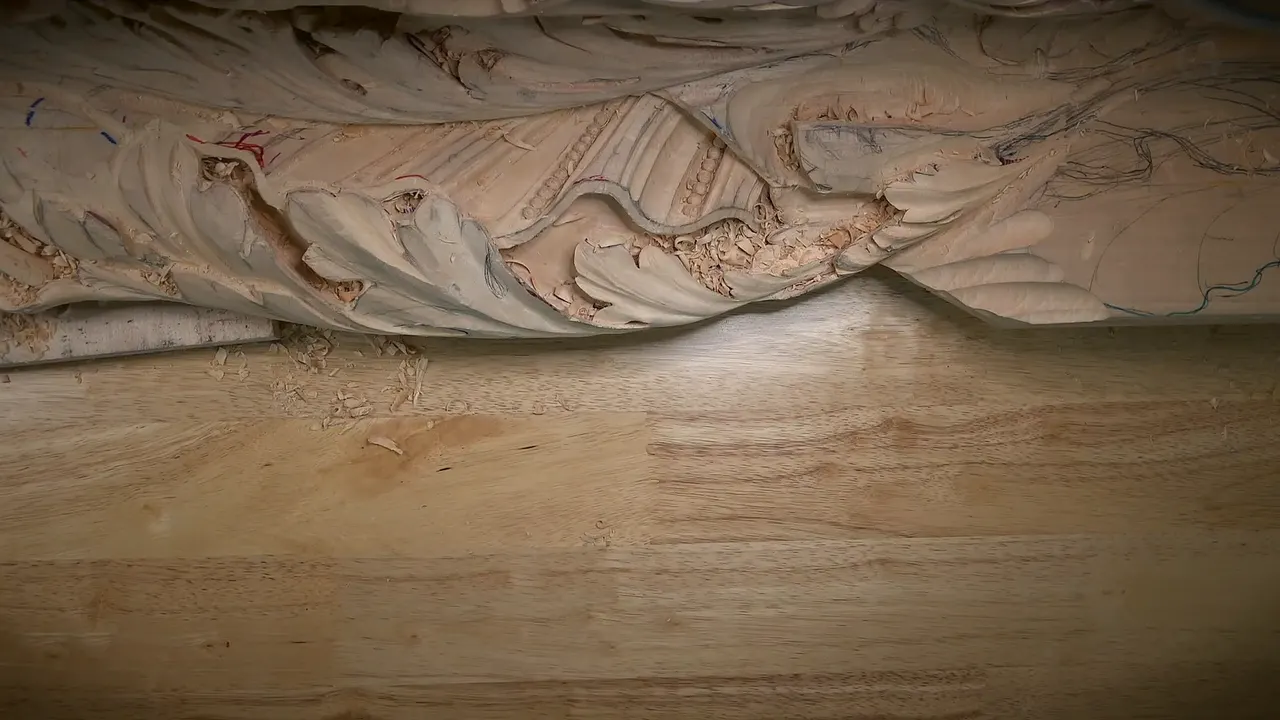

In Venice Room workshop 72, part 1, I called a deep dig "not good idea," because no tool could fit underneath it. In other lessons I use those words for a cut that could break a part, a dig that goes too deep, and a step that costs me the idea. Each line is below, with its lesson.
Ever planned a deep cut and felt your hand slow down? Ever looked at your next pass and seen the one move that would ruin the piece? Then you know this word already. Here is where I said it, and what I did next.
What did part 1 start with?
An explanation. "Actually nothing happened," I said. "The only problem is I just lost again about 40 minutes, well, less than 40, about maybe half an hour of video." Then: "Problem is a problem. What can I do?" For that day I planned to concentrate on one detail, a really important one for me.
That detail sits in a slope area, and I wanted to make sure "it just blends really nicely in the overall movement." My middle line came first. I told you I try to be authentic to the golden ratio: take two points, put an invisible line across, and divide it in 10. Five parts go on one side and five on the other. Then move six parts out of 10 one way, which here was the way the slope goes, "because it makes sense." The exact figure, I said, is "62 parts out of 100."

To open that area for a nicer opening, I said I would use a number 11 at 5 millimeters (about 0.2 in), 3/16 of an inch, and start my separation. An open division, I called it. That leaf would stay out from underneath the line, and it "doesn't have to."

My own words followed: "Oh, look at that. I just left so deep." The marker was brand new, a permanent one. "That was probably a mistake I shouldn't do," I said, "but it's okay. That's going to be open anyway." My marks were there to show you what I was doing, and I feared I would have to excavate much deeper on those sides.

What did I stop myself from doing in part 1?
Digging deep. First I said, "let me do right away some relief cuts" in those triangles. "I need to excavate little deeper with a smaller tool," I said, and the tool was a number 11 of 3 millimeters (about 0.12 in), one eighth of an inch. I put a question to myself: "do I need to do that way?"
Really deep digging could create a problem for myself, I said. "There's no way I'm able to really deeply undercut underneath of here," because of a limitation: "there's no tool I can fit underneath." Maybe I should not do it that way.
The line this page starts from comes next, and it has two halves. "I think that was not really good idea. It wasn't mistake, but it was not good idea." I followed with "let me blend that," and I would bring this part underneath that line. A "little different approach," I called it.
Next up were the concaves. "Same old, same old," I said: "exactly the same what we've done everywhere else." One would go right there. I eyeballed the spot, taking that point and that point, dividing in 10, and moving over, with the same on each side.

"I am not after perfection," I said. I was not going to check with a ruler whether I was really on a golden ratio or not. "That would be too much, I would say." For that concave I would start with the 5 millimeter (about 0.2 in) number 11.

Is a bad idea the same as a mistake?
Part 1 gives me one of each, side by side: a marker mark gone deep, "probably a mistake," and a deep dig that "wasn't mistake," I said. I waved the dig off anyway.
A blue marker shows up in part 3. "That wasn't too smart idea to use blue marker," I said. "For some reason, it just penetrated so deep. Much deeper than I expected." On this piece it was okay, since it will be painted. Elsewhere, I said, the same thing would be "a huge mistake," and I eased it right away: "Not huge, huge. I mean, I'm still able to clean it." The lesson followed: "it is a lesson for me not to use that color."
A marker comes up for a different reason in workshop 33, part 4. I was going to carry a concave along the side of the pipe, and I said "maybe it's not a good idea for me to use a marker, because I can lose the idea."

Furniture Panel lesson 17, part 3, finds me at number 11 again, three millimeters (about 1/8 in). "It's better to take time and remove little by little, than to rush it and make a big mistake." Rushing is a really bad idea, I said.
What breaks when I call it a bad idea?
In workshop 74, part 5, I needed to chop, and then came "Oops." If I kept doing that, I said, "I could break this part," and I called the idea a bad one. After that I could "easily create the line again, recreate the movement."

The mallet question sits in part 4 of workshop 76. "I really can't use any mallet because I already have the main body of a carving." By hand I could try to excavate a little deeper, though the plug cut was out. I thought about hitting a little bit with the mallet, then said "I don't think that's a good idea, by the way." Hooking out whatever I did not need was for the one millimeter spoon (0.04 in).

In workshop 77, part 8, I would glue that part to something else, "probably that's what I'm going to do," or reinforce it on the backside if I wanted the CA glue. Care came first. "So don't have to be too aggressive with my cuts," I said, so aggression was out.

Grape Onlay lesson 7, part 2, has me taking a back bend. It is a number seven, about a quarter inch. "I don't wanna create a lot of pressure downward," I said, to keep from destroying the material underneath. A different back bend was probably better: a number three, a quarter inch, about six millimeters (0.24 in). Then came the short version: "No pressure, all the sharpness of the tool."

By workshop 84, part 7, about five millimeters of thickness were left, about 3/16 of an inch. "Can't do anymore. Don't want to do anymore," I said. Of course I could, but going further was a really bad idea. Next I could start developing concaves and convexes.

The same warning comes from the back in workshop 90, part 9. Too much was "going on underneath," so I needed to remove lots of material from the backside, but not too much. I had to follow the main body, I said, and chopping more out was off the table. Number nine was the tool I named.
When is digging under a part a bad idea?
Floral and Molding, lesson 10, part 1, has a plan to leave only about maybe one-eighth of an inch at that end, about three millimeters (0.12 in). The spot would take three sides, without undercutting. "Like I mentioned multiple times, if I'm going to just dig and go underneath of that part, it would create a big problem later on." A straight down cut was the plan.

Lesson 15 of the Furniture Panel, part 10, makes a plain request: "please don't dig too deep underneath of design." Some parts will be undercut later, I said, but not everywhere. The better way: "It's better to clean with the gouges when you're getting really close." My gouges were really, really close, I said, and then came "a limitation of router plane."

In Hashemi Flowers, lesson 16, part 4, a number seven of about 10 millimeters (0.4 in) was my plan to undercut one way. A spoon, or a short bent V tool like a number 12, was another option. Depth needed an eye, I said, so I would not overdo it. For the clean up and blend I named a number seven of 14 millimeters (0.55 in).

When does a bad idea cost me the idea itself?
In Venice Room workshop 56, part 6, I was really happy with a cut and thought I could probably excavate through and give that little thing a light. "Let me think. Double think." Then: "Although, no, I would lose the idea of rolling." I gave that verdict twice. Drilling through was "going to be a mistake, I think."

Venetian Flowers Rosette, lesson 2, part 3, has two parts on the same level: "if you put some kind of straight edge, they are on the same level." I ruled that out. I still wanted somewhat deeper shadow, so one part would go "much lower."

The Furniture Panel, lesson 31, gives a reason from the furniture side. Some kind of airborne movement was possible, I said, with a cut right underneath so you can see all the way through, but "it would not be practical." "That is the huge difference between carving for furniture versus like ornamental carving." Airborne stuff on furniture is "gonna be low enough and people gonna hit that." That is a bad idea for furniture, I said.
Which bad ideas are about the work, not the cut?
Part 1 of that same lesson has me catching myself mid-sentence: "It's going to give me much better... No, it's not. Sorry." The way I had fastened it was a bad idea, and I should do it a little differently, I said, since I was using that side. My holes were "really, really tight, exactly 20 millimeters" (0.8 in), but the board was MDF.
Someone asked at the October 2020 livestream whether a chipped piece could be fixed with something that hardens, so you do not throw out the whole carving. I called throwing everything out a bad idea: "You worked on that." There is a way to fix it, I said, and I went on to explain.
Lily Box lesson 4, part 1, adds one about the wood. At the beginning stage, I said, you could use just a really big gouge. My plan was a mallet, "but carefully, because I really don't want to break anything here." The grain mattered, too. "If the grain is really curly," a huge gouge was maybe a bad call. I would take number nine next, attacking from different positions.
The Dining Table Apron, workshop 11, has a joke. Sometimes you have to break a rule, I said, "just be really careful when you're breaking it." Breaking the law, I added, is a bad idea. Then I asked what law we are even talking about.
When did I go the other way?
Flip the words and they still work. Part 5 of workshop 46 has me wanting my line gradual all the way, and I said "maybe it's not bad idea at all, just use a rasp just on that edge." Afterward the movement "does look like it's gradual."
A stylized leaf turns up in workshop 97, part 12. "I never saw anything like that," I said, "but like I said, I researched, and that's what they did." It blends nicely with acanthus. "I think it's actually not a bad idea at all." It "doesn't make sense in a sense of nature, but it does make sense in a sense of design and that style."
On the Lily Box, lesson 7, part 11, one high spot sat on the other side. Repeating it here was maybe not a bad idea, I said. This spot would become a high one too, with an overall slope.
Which lessons use the words?
One table below sorts them, each under the course it comes from.
| Lesson | What I called a bad idea | My answer |
|---|---|---|
| Workshop 72.1 | Digging deep where no tool fits underneath | Blend it, a different approach |
| Venice 74.5 | A chop that could break the part | Recreate the movement |
| Workshop 76.4 | A mallet once the main body is carved | A one millimeter spoon |
| Room 77.8 | Cuts that are too aggressive on that part | Glue it or reinforce it |
| Grape 7.2 | Pressing down on the material underneath it | Sharp tool, no pressure |
| Room 84.7 | Taking off any more of that thickness | Start the concaves |
| Floral 10.1 | Digging and going underneath that part | Attack it with a straight down cut |
| Venice 56.6 | Excavating through and losing the idea of rolling | I'm not going to do it |
| Rosette 2.3 | Two parts left on the same level | One part much lower |
| Furniture 31.1 | Airborne cuts in a piece people will hit | Not practical |
Where can you watch the full videos?
Every line above sits inside my own lessons, so a full video stands behind each quote. This workshop holds all twelve parts of workshop 72, and workshops 62 to 73 are in Venice Room Part 6. Go back to workshop 71 or on to workshop 73. To watch the full videos, start here.
How it's done
- Ask the question first. Before the deep dig, I asked myself: do I need to do that way?
- Name what could go wrong. Deep digging left me no way to undercut deeply underneath.
- Pick the safer plan. Blending that part and sliding it under the line was the plan, a little different approach.
- Go back to the concaves. The concaves came next, the same ones we have done everywhere else, placed by eye: take two points, divide in 10, and shift over.
- Skip the perfection. I am not after perfection, so I would not check the golden ratio with a ruler.
Frequently asked questions
Which step was a bad idea in workshop 72, part 1?
Excavating really deep. I had named a number 11 of 3 millimeters, one eighth of an inch, then asked whether I needed to do it that way. That dig could cost me the undercut, with no tool I could fit underneath. Blending the part became the plan I took instead.
How is a bad idea different from a mistake in part 1?
Part 1 puts both words side by side. The marker got the word mistake, with a probably in front of it. The deep excavation "wasn't mistake," I said, yet I still ruled it out. In part 3 I called a blue marker not too smart, and a lesson for me.
Why did I turn down a mallet in workshop 76?
I already had the main body of a carving, so I said I really could not use any mallet. I thought about hitting a little bit with it, then said "I don't think that's a good idea, by the way." By hand, I would go a bit deeper.
What to carve next