

Alexander Grabovetskiy, woodcarver, School of Woodcarving · Published 2020
What does a wood carver mean by "tear"?
Quick answer: Tear is a word I used in Venice Room 72, part 9, for fibers tearing under a back bend, and I said it was not the safest way. In other lessons I tied tear to a dull blade, to sharpness, and to forcing a cut.
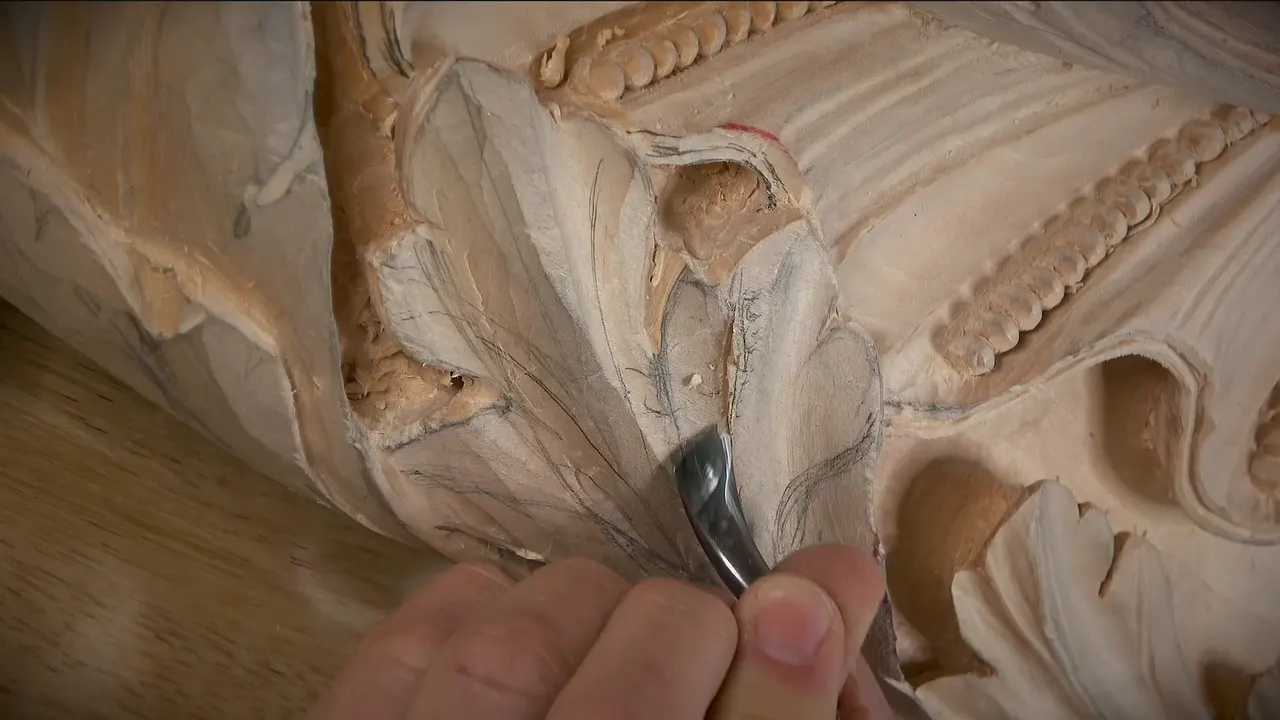

In part 9 of Venice Room workshop 72, I pointed to the tear and said fibers were tearing. Other lessons carry the word beside a dull blade, a forced cut and one side of a gouge cut.
Ever watched a gouge lift fibers instead of slicing them? Did you wonder whether to stop, push on or change tools? Come through part 9 with me, then through the lessons where I said tear, and the ones where I said one side stays rough.
What did I say about tear in part 9 of workshop 72?
The word sat inside a plan. "One of the ways I could do, I could start with my back bend pretty much, and pre-establish whatever the convex part I want to see," I said. Then "It's not the safest way, by the way."
Next came the line itself. "So you can see I have a lot of tear. So fibers are tearing, but it's going to give me approximately the depth." Tear and a depth are the two things I named in one breath.

I kept talking. "But I really, really want to create beautiful movement uphill." Then "Yes, I will be able to make a clean cut, but right now, just to give me preliminary depth, if you wish."
What led up to the tear?
The part opened with "Let me show what I've done off camera." The shell, I said, was "not finished yet, but that shell is coming along."
A leaf was next. "So I think it's not really looking good," I said, and "At least I don't think it looks good." What I meant: "it just doesn't feel three-dimensional. It's just a little too flat for my taste."

My plan, for this movement and this section, was to exaggerate it, partially. A pipe, I said, was "just not dimensional enough for me."
The wood left inside got a check too. "And that is a good thing I did not undercut underneath, and I do have enough thickness on inside," I said. On the concave, "it's not undercut, so I'm safe to do that concave with no problem."
The order I wanted for the shape: "I want to get as convex, and then it would be concave, and then convex again." One more thought before the back bend came out: "But I need to determine what kind of concave I want to do, how deep I want to go."
After the tear, what was my plan?
I named my next tool: number 11 and three-eighths of an inch, 10 millimeters, to "remove whatever I don't need."

"And see, just already giving me much better movement. Much better movement." Going "even more extreme" was an option I named, and "I want to have a really pronounced convex."
A bit later I said "And I can probably actually do even more extreme, I would say." Then "much cleaner cut," twice over.
Which tool did I change, and what did it do?
"And yes, I love back bends and especially this one," I said. And of the tool itself, "It's not sold like that, okay," and you cannot buy it.
"So what I did, I actually modified my tool and made a really long bevel on the back side." The skew was part of it. "But just because it's a skew, it gives me a much better slicing."

The corner of the blade gets a use too: "sometimes I can just use a point of it, just a corner of it." And "even when I'm carving against the grain, it gives me a chance to actually excavate much cleaner, create much cleaner cuts."
Did the same pass return in other parts of this workshop?
The back bend returns in part 11. "Let me use a back bend, same number five. That's what I used before," I said, and "number five and half an inch" (13 mm). "And start establishing my convex."
Next, "That's going to give me approximately the depth I need to go." On its own line I said tear again. Then "Not the safe way, but really quick."

The knife gets a mention. "I could get it done with the knife also, but knife doesn't have that sweep. And this one is a sweep number five, and I kind of like that idea that it has a sweep."
In part 10 I said "doesn't give me a really good cut," and "I'm not able to actually go from this side because it's almost impossible for me."

My fix: "But I can fix it with the skew" and "still create a clean cut."
Further into that part, I planned to "just, with the same back bend, start my convex side and pre-establish that movement." I added "Although I'm working on the back side of my tool, like a heel, if you wish." Then "It doesn't have to be a skew, by the way. I just like the idea of skew."

Part 10 names its tools early. "It's a number five sweep, so the curvature," I said. Then "13 millimeters" (0.51 in), and "10 millimeters, three-eighths of an inch, number 11 veiner, and clean that." On pressure, "I'm not pushing in all. I'm just riding, barely hitting wood."
To clean up, "the 7 millimeters veiner are going to ride right on top of those chips or whatever the fibers are just cut out and clean a little better" (0.28 in).
Where else in the Venice Room did I say tear?
Workshop 57, part 2, has "18 millimeters, number 11" (0.71 in), a veiner that is "going to be bigger." The rule I gave: one side comes out clean, and "the left-hand side, see, it's tearing."
Then I said I would attack from the opposite side. A ceiling stopped that: "Now somehow I have to attack from the opposite side and go this way, but I can't because I have a ceiling." I could use "a little smaller veiner, and it has to be super sharp," I said.

Over in workshop 58, part 1, "gouge is always cutting on one side clean and another side is tearing out the grain." I planned "about half an inch, number seven" (13 mm). The right-hand side was the clean one.
On the angle: "I'm actually creating almost 45-degree right now." Then "That way, it slices much better and creates beautiful and clean cut without too much force."

Later in that workshop, in part 11: "I switch to number seven and 14 millimeters" (0.55 in). Next came "if I'm able to hit, I'll do. But see, it just tears my grain."

From workshop 33, part 10, comes this line: "Carefully just going to excavate that. Probably have to do from both directions because one of the sides is just tearing out." After it came "Maybe I should use a little smaller version." And "the idea is the same," with "concave, convex, concave."

What was the limit of a cut?
Workshop 140, part 3: "Cannot go deeper than that. It's already tearing, and I have to switch again to 2 millimeters to get that much cleaner" (0.08 in).
A back bend was my next plan. "But before that, what I want to do, I want to now take a back bend." Then "And I'm going to just create preliminary convex. But that's only the first step." After it, "Then I'm going to take another tool. Just get rid of edges."
Was tear a problem in the Hashemi flowers?
From Hashemi Flowers 14, part 5: "I'll take a back bend, and that's sweep number eight, and that's six millimeters or a quarter inch." Then "But still keep an eye what the grain does."

"For example, right here, you can see some tear, and I don't want to see that tear." My move was "So I'll just attack it from opposite side."
After that, "And now I'll take a small gouge, and I'll create a concave cut on the left side of my pipe."
Does a dull blade matter for tear?
In Furniture Panel 17, part 10, a router plane was my plan: "I guess I use a router plane right now." Then "I am going to raise it first. I don't want to go to the final depth yet, at least."

Next: "And your blade really has to be sharp, okay? So don't make the mistake and use your tool with a dull blade. It's not good." Tear was the next thing I said, and "So make sure your blade is really sharp."
Floral and Molding 13, part 1, has "multiple cuts toward the center." Right after, "And people, really, really important to have sharp tools." Tools that are not sharp give you "tear outs," I said, and you "catch the grain" and get "frustrated."
Sharp, I said, "just almost like a surgeon's knife, okay? Really sharp."
What about forcing a cut?
In Lily Box 3, part 5, I said I was "not going to force." For the tool: "I could use, always my number 11." Next, "Just hook out all that waste." That way, I said, it would be "real clean."

The other side of it: if you "force it" and "tear it," you "destroy sometimes the edge." In my case, I said, "it would be the edge of the stem."
Venetian Flowers Rosette 6, part 1, opens with a tool plan: "number 11 and 7 millimeters, even if I have only 5 millimeters I have to remove" (0.28 in and 0.2 in). Taking only 5 millimeters would leave "a chance to tear those corners," I said.

Of a bigger tool: "I feel more safer, I'd say, if I were just to use a bigger tool."
What did I call the other side of a cut?
I said rough in some lessons. In workshop 66, part 3, I said "that is a little rough on this side. That's okay. It's always like that with veiners and gouges," and the other side was "not too clean."

Roman Acanthus 15, part 3, shows a number 11 of 5 millimeters (0.2 in). A clean side and a "really rough" one, I said.

Corinthian Acanthus 4, part 2: "gouge cuts one side clean and another one side is going to be rough, so you can always come back and clean your cut." My plan was "10 millimeters one, number nine" (0.39 in).

Another rule from workshop 57, part 5: "that side, this line is a much cleaner cut than on the opposite side." The gouge leaves a rough side "because the nature of the grain," I said.

Greek Acanthus lesson 7, part 2, repeats the rule: a clean side and an unclean one.
Did the grain work against me in other lessons?
In Hashemi Flowers 10, part 11, I said "Later on, I can attack that from the backside and clean that with the grain." It was "just a quarter-inch number nine" (6 mm).
I was wiggling, I said, and it was "not a clean cut because I still have to clean it from the backside."
In workshop 41, part 10: "There was a lot of against the grain cuts, and they don't look clean." Then "And yes, I could take it to the extreme if I wanted to, little by little, shaving more and more and more. But there's always a point when you can't do no more."
Where does each line sit next to the others?
Every lesson here is one row, and the words I said sit beside it.
| Lesson | Moment | Words |
|---|---|---|
| Venice, workshop 72.9 | Back bend, fibers tearing, a rough depth | Fibers tearing |
| Venice 72, part 11, same pass | Half-inch back bend | Not the safe way, but really quick |
| Hashemi 14.5 | Number eight sweep, a back bend | From opposite side |
| Part two of workshop 57, Venice Room | Left side | The left-hand side, see, it's tearing |
| Venice Room 58.1 | Number seven, half-inch (13 mm), a plan | Tearing out |
| Venice Room, workshop 58, part 11 | Number seven, again | It just tears my grain, I said |
| Venice 33.10 | From both directions, one side tearing | Just tearing out |
| Third part of workshop 140 in Venice | Switch tools | It's already tearing, cannot go deeper |
| Furniture Panel 17.10 | Router plane plan, then a blade warning | Sharp blade |
| Floral and Molding 13, part 1 | Cuts toward center | If not sharp, you'll see tear outs |
| Greek 7.2 | Clean on one side, not other | One is not |
| Venetian Flowers Rosette, lesson 6, part 1 | Bigger tool | A chance to tear those corners |
| Lily Box 3.5 | Number eleven, hooking out all the waste | Force, tear |
Where can you watch part 9 and the lessons on this page?
Part 9 sits in Venice Room 72. Workshops 62 to 73 are in Venice Room Part 6. The other lessons on this page have their own pages, linked above, and each is open to you with school access. A workshop number means the Venice Room, and every other lesson carries the name of its own course.
Want to hear me say it in my own voice? Start here.
How it's done
- Decide the shape you want. My words in part 9: a convex, then a concave, then a convex again.
- Set a rough depth with a back bend. One option I gave: start with my back bend, then pre-establish the convex part that I have in mind.
- Remove the rest with a number 11. Number 11, 10 millimeters (0.39 in), to remove whatever I did not need.
- Clean the cut with a skew. My tool got a really long bevel on the back side, and as a skew it does much better slicing.
Frequently asked questions
Where did the word tear show in part 9?
Fibers were tearing, I said, with a back bend to pre-establish the convex I wanted. It would show me roughly the depth.
Which tool was next in part 9?
A number 11, to take out what I did not need. The cut ahead would be much cleaner, I said, and I love back bends.
Does sharpness matter for tear?
The Furniture Panel course has me saying not to use a dull blade, and that tear follows. In Floral lesson 13 I said sharp tools are really, really important, and tear outs follow when they are not.
Which side does a gouge leave rough?
What to carve next