
Alexander Grabovetskiy, woodcarver, School of Woodcarving · Published 2020
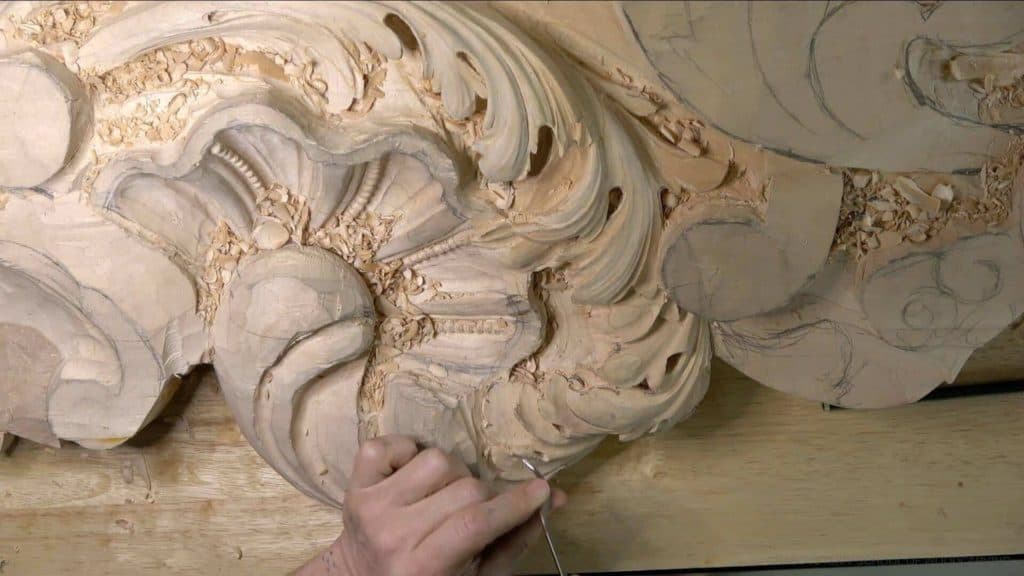
How do you clean the inside of an acanthus eye when the tool is only 1 or 2 mm?
Quick answer: Cleaning inside an acanthus eye is a job for a very small tool. In Venice Room workshop 14, part 7, I said I would use probably 2 millimeters (about 5/64 in), maybe 1 millimeter (0.04 in) in number 11, to clear the junk from inside. About depth I said, "No reason."
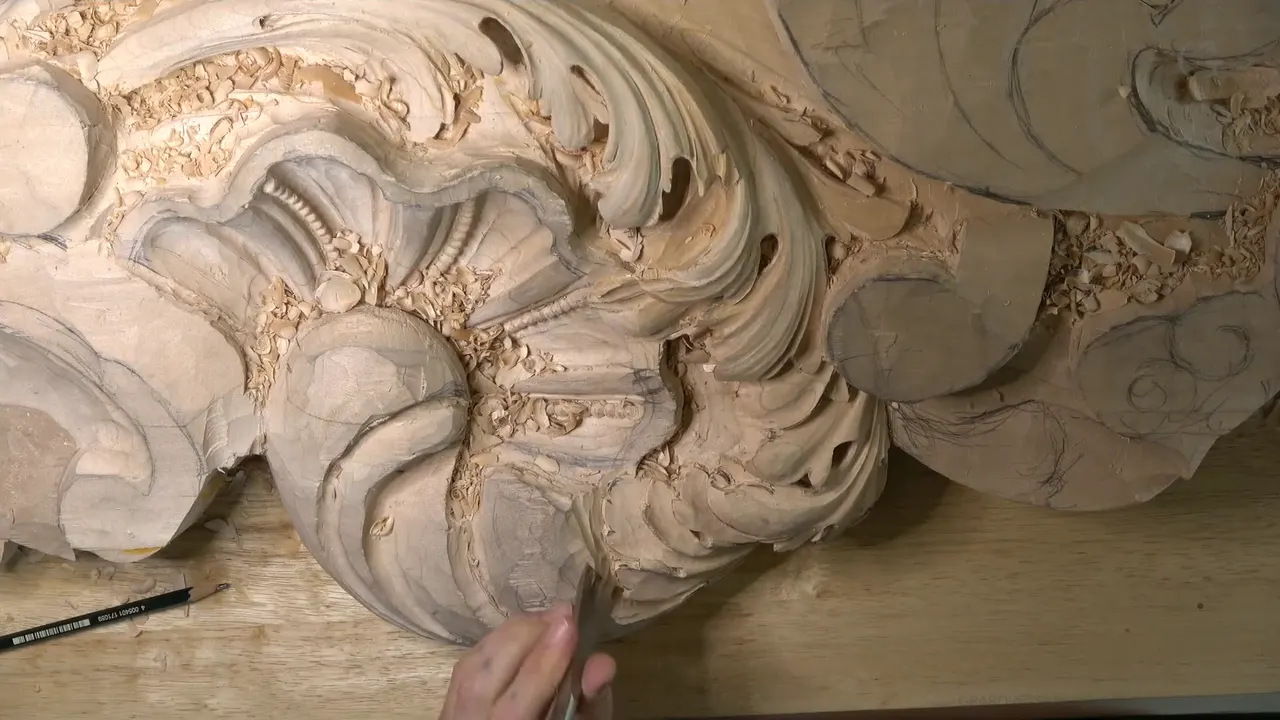
Cleaning the inside of an acanthus eye is a job for a very small tool, and in part 7 of workshop 14 that meant a 2 millimeter (about 0.08 in) or 1 millimeter (about 0.04 in) number 11. I named the job a few seconds after the tool: "Just get inside and remove all that junk."
Ever stood over a small hollow with a tool too big to turn inside it? Did you push in anyway, or pick up something smaller? Here is how I made that call on this leaf, and what my other workshops show when the same trouble came up.

Clean-up of an eye, in six lines
- Small number 11 gouges, 1 and 2 millimeters, got into the eye and cleared the junk.
- A number nine went in as well, for the eye itself.
- About digging deep there I said: "No reason."
- Some cleaning waited, because that side was not developed yet.
- A cleaner cut along the pipe mattered, though the camera could not show it.
- Other workshops use the same small tools.

Which tool did I choose for the eye in this part?
Part 7 opens with a line about a tunnel: "Now I can see the light at the end of a tunnel," I said in the first seconds. By 00:19 I was undercutting slightly in one direction. I held myself back out loud: "I don't want to create too weak spot. But a little bit okay."
The edge looked a little too rough to me (00:41), and I told you I did not want to see a rough edge. Twelve seconds on came the line this page is about: "That is good, except I need to clean up inside."
How would I get in there? "And to get inside, I'm going to use probably just 2 millimeters or even 1-millimeter number 11." In inches, that is just under 1/12 and about 1/25. The words "probably" and "or even" tell you the plan was a range, and the tool was not locked in. The junk is what I picked it for.

Later (01:21) I said I could go underneath if I needed to, "which again, I don't really have to, but if I need to, I can go in and clean." The number 11 had been named not long before, a gouge I could use right at the eye. Wikipedia files the gouge under the chisel family.
Why did I say 1 millimeter, then correct myself on the size?
The choice came back at 06:20. "Let me use a 1-millimeter. Number 11." Thirteen seconds later I stopped myself: "It's actually half a millimeter. I'm sorry. I should use a 1-millimeter."
That slip stayed in the video. I gave the tool's size as 0.5 millimeters (0.02 in), and then said I should use the 1-millimeter (1/25 in). Nothing more came with it, and I invent nothing here.
After the slip I cleaned "a little bit on the inside" (06:52). The last lines of the part, from 07:35, are about tools again: "Maybe number eight, or I should probably use number 11," followed by a small gauge, and "1 millimeter," or 0.039 in. The video ends on that word. Wikipedia has pages on the millimeter and the inch for anyone who wants them, and my inch figures here are conversions at 25.4 millimeters to the inch.

When is it too early to clean inside?
"But again, that's probably a little too early because I still have to develop that side." That was my own verdict on cleaning underneath, at 01:33, and the line I like best follows it: "I really don't need to run ahead of my horses."
Instead of cleaning I turned to the concave, and the line from 01:57 is short: "Let me fix this concave. Go a little bit in. Carefully." After that came the eye (02:15), so the video runs concave first and eye second, and the underneath cleaning waited.

Workshop 31 has a matching moment in the Part 3 course of the Venice Room. At 03:32 of workshop 31, part 3, I told you: "I'm not going to spend time right now for cleaning underneath. I still have to undercut and so on, but let me get this moment more or less like it's supposed to look."
Two workshops, one habit: cleaning sits behind shaping. Neither video says how long the wait lasts, and I would rather leave that gap open than fill it with a guess.
What did the cleaner cut on the pipe side do?
Cleaning goes past the eye. Look at how part 7 moves after the horses line. This eye, I said, would give me "a semi-final look, I would say" (02:20). Then a wall caught my attention: "That is too big of a wall, but on the other hand, what I could do, I could create an even more exaggerated concave on inside. Maybe I should."
I did, and I said it would give "a really nice motion" (03:00). The cut ran on along the side of my pipe (03:21). Next came "Now it's good. Except it needs to be a cleaner cut." Fifteen seconds after that verdict I started over on the cut: "Let me create a little cleaner cut" (03:52).

At 04:07 came the verdict, "Okay, now it's much better." Then a word about the camera. Whatever I turn, I told you, the cut will not show from this camera or any other, but "from the bottom, it will be visible. That is a really nice sweep."

A cleaner cut earned my time even where my own camera showed nothing, and the reason sits in that quote.
Where does the number nine go in the eye?
Next, at 04:25: "Let me get probably a smaller number nine, smaller number nine, like eighth of an inch, and get inside of this eye of acanthus." That size is 3.2 millimeters, so this part runs from a nine of about 3 millimeters down to the 1 millimeter gouge, and every one of them works the inside.
Right after, at 04:54, I made a remark about the leaf: "This acanthus looks more like parsley." It looked close to the original, I said, and maybe they loved parsley so much that they made acanthus look like it: "Italian parsley." Parsley is a real plant. The ornament is the acanthus ornament, which follows the acanthus plant.

Back at the eye: "And now I can clean that side a little" (05:32). Then I wondered about depth, which the next heading covers.
How deep does an eye need to be cleaned?
Two places in part 7 speak to depth, and they agree with each other. One sits at 05:51: "And yes, I will need to go a little deeper right there. Maybe. We'll see. Maybe not, because it's going to be from the bottom. Maybe I don't really need to."
The second comes at 07:00, after I said I would clean a little bit on the inside: "Again, I don't have to excavate really deep right there. No reason. Absolutely no reason. A little bit is going to be always good."

The part gives no depth in millimeters for the eye, and I will not add one. What it gives is a stopping rule. Small is good, and I gave deep digging no case at all. That earlier place ties the rule to the view from below.
Which small tools did I use elsewhere?
Part 7 is one video, and small tools for eyes turn up in many others. Five of them match this one. The Greek acanthus lesson 4 is the place for how an eye gets dug in the first place.
| Where it is | What I said about the job | Tool | What came next |
|---|---|---|---|
| Workshop fourteen, seven | Clean up inside and remove the junk | Number 11 | Later I fixed my own slip |
| Workshop thirty-one, three | Excavate the junk right out of there | Micro tool | Next I wanted a better shape |
| Workshop sixty-three, eight | Need to create some type of eye | Smaller 11 | Next, same thing on another side |
| Roman lesson twelve | To clean inside, a small spoon gouge | Spoon gouge | Many passes first, then cleaning cuts |
| Moldings lesson ten | A small tool would help a lot | Number 11 | Two directions, toward edges and inside |
What do you do when the small tool is still too big?
Workshop 31 has it on the clock. Over in part 3 I reached for a number 11 of 4 millimeters (about 0.16 in) for a division (04:23). "Maybe it's a little too big for this operation," I said, and I tried 3 millimeters (about 0.12 in) next.
The 3 millimeter tool did not last either. At 05:05 I said, "Yep, I need to use 2 millimeters, and maybe even smaller than that" (2 millimeters is 2/25 in). Then "Okay, that is good," and the eye in that spot got its turn: "I could excavate inside of this eye that direction."

A micro tool came up next: "I could use just the micro tool" (05:56). The detail was small, I said, "but it's still noticeable." Then came the line that echoes part 7 of workshop 14: "Let me use one millimeter and excavate all that junk out of there" (06:21), which is 0.039 in.

How small is a small eye in workshop 63?
Workshop 63, in the Part 6 course of the room, has small eyes in two parts. The first of them, in part 8, came when I said I needed to create an eye (00:35), and then: "I need to use a small or smaller number 11. That is exactly what I'm going to do, just to create a small eye with the number 11."
More sizes follow. Another eye, I said, would get number 11 and "a smaller version of it, 1.5 millimeters, like 1/16 of an inch" (02:14). That 1/16 in figure is the one I gave on the video, and it works out to about 1.6 millimeters. For an extra division on the other side I planned to use "a smaller version of number 11, three millimeters" (03:41), or 1/8 in. Near the end I asked again for a smaller number 11.

Part 9 adds two lines. On the sides of the pipes I would create concave cuts, "just a really small number 11." After it comes "Even if the detail is small, it still makes sense for me to create something really nice even on a small detail." Later: "Again, number 11 and 3 millimeters" (0.118 in), then "I created that small eye," and a little later, "But from every eye, I really need the pipe. I need the pipe from every eye."

How do I clean an eye on a piece that will be painted?
Acanthus over Moldings, lesson 10, part 3, gives the reason for how long to clean. I would concentrate on cleaning an eye and on taking facets out without sandpaper (02:44), and this piece was headed for paint: "It is gonna be painted so it's gonna be just a white color. And there's no reason to spend so much time on cleaning stuff."
For the eye: "it would help a lot if you would have a small tool like number 11 in my case. It's half a millimeter number 11" (03:24), about 0.02 in. Then two directions, one toward the edges and one toward the inside, and which comes first does not matter (03:43). The job itself came at 04:14: "pretty much all I have to do just excavate. Right underneath where's the overlap happens." I wanted "a sharp line, which is going underneath of that overlapping part," so I went easy.

What did the Roman acanthus lesson use for the inside?
Roman acanthus lesson 12, part 3, has the plainest wording on this page: "And to clean inside, I could use a small spoon gouge. Let me try to use number nine and two millimeters, which is actually excellent right now, right here. And dig this out" (02:33). That nine is 2 millimeters, or 0.079 in.
The warning came next: "Again, don't force it because, for example, I'm working some areas against the grain. So it's better to make multiple passes and make a deep excavation, and later on, just make cleaning cuts." A deep dig first, cleaning cuts later. Wikipedia has a plain page on wood grain if that word is new to you.

What I would take from part 7
Here is the short version of part 7, using only what I did in it. I undercut a little, because a spot can get weak. I named the rough edge. I went inside with a number 11 gouge and with a number nine, and removed the junk. I left the underneath cleaning until that side was developed. I made the cut on the pipe side cleaner, even though the camera could not show it. I stopped at a little.

The rest of workshop 14 is in the tuition. Workshop 13 comes before it and workshop 15 after it, and the whole room sits in the second Venice Room course. Small tools for eyes come up in my Roman and moldings courses too, linked above, and the Greek acanthus course has eyes of its own.
The room is in the Venetian style. If you want the city, Venice and the Ca' d'Oro have pages of their own, and so do relief carving and wood carving in general.
Next time a hollow has junk in it, pick the small tool, get inside, and stop at a little. Shall we carve?
How it's done
- Undercut a little. I held back on the undercut so that the spot would not turn weak.
- Name the rough edge. Looking along the edge at 00:41, I called it a little rough, and I wanted that look gone.
- Pick the small tool. My plan named a number 11 gouge, 2 millimeters (0.08 in) or one millimeter (under 1/20 in), for the junk inside the eye.
- Put off the cleaning underneath. Cleaning under the edge got delayed, since that side still needed developing.
- Add a number nine. After that I picked a number nine, about 1/8 in (3 mm), for the eye of the acanthus.
- Take only a little. I took a little, and I called a little bit good.
Frequently asked questions
What size gouge cleans inside an acanthus eye?
Part 7 names a number 11, 2 millimeters (about 2/25 in) or even 1 millimeter (about 1/25 in). Later a number nine got its turn, an eighth of an inch (about 3 mm). Every one of those tools cleared junk out of the eye.
How deep should an acanthus eye be cleaned?
On this leaf, shallow. I said I did not have to excavate really deep there, and a little bit was good. Earlier I wondered about going deeper, then added that maybe I did not need to, since the piece will be seen from below.
Should you clean underneath before the other side is developed?
On this leaf I put it off. Going underneath to clean seemed premature to me, since that side still needed work, and I did not need to run ahead of my horses. Soon after, I was fixing a concave, and the eye followed.
What to carve next