
July 27, 2026 · Updated July 29, 2026
By Alexander Grabovetskiy — Master Woodcarver · Founder, School of Wood Carving · 13 min read
Why Tilman Riemenschneider Left His Limewood Unpainted
By Alexander Grabovetskiy, School of Woodcarving · Updated July 29, 2026
Quick answer: Monochrome carving is late Gothic sculpture finished without paint, and Tilman Riemenschneider was one of the first masters to choose it. His limewood figures were never bare wood. They got a thin tinted glaze of egg or glue, plus eyes and lips painted straight onto the wood.
You carved something good. Now you have to finish it, and you do not want to paint over your own cuts.
So you leave the wood naked. Or you flood it with oil and it goes blotchy and dark. Either way the piece looks like it stopped, not like it ended. Sand it smooth to fix that and you delete the one thing telling a sleeve from an arm.
Carvers in Franconia hit this same wall around 1490. One of them solved it so well that a town council later paid Veit Stoss to paint over the solution, and we are still arguing about why.
Let me tell you a story. When I was inside, I carved furniture with a 10mm knife I made myself and a tiny gouge made from a nail. I stained those pieces with a 15th century technique so they looked like marquetry. My pay was one boiled potato a day. One potato. So when I read that Riemenschneider tinted his limewood with egg white and ocher, I was not surprised at all. A finish is not decoration. A finish is what makes separate pieces of wood read as one object.
Below: what wood he used, what was actually on the surface, why he fired the painters, and how he made texture do the job color used to do.
Key takeaways
Riemenschneider carved mostly in limewood, or linden, which is Tilia cordata and Tilia platyphyllos. American basswood is Tilia americana. Same genus.
His unpainted work was not raw. Conservators found a thin tinted glaze of egg white or animal glue, colored with ocher, charcoal, and lead white.
Eyes and lips were painted directly on the bare wood, under the glaze.
He was not allowed to paint his own carvings. Guild law gave that work to painters.
When color goes away, texture has to carry the load. The Creglingen altarpiece shows eight different tool marks.
Museums today cannot always tell a monochrome from a piece that was simply stripped.
What wood did Tilman Riemenschneider carve?
Riemenschneider carved most of his figures in limewood, the European linden, which is the same genus as the American basswood on your bench. Two species did the work: Tilia cordata and Tilia platyphyllos.
Michele Marincola, conservator at the Metropolitan Museum, explains exactly why in the 1999 National Gallery catalogue. Limewood shows no difference between spring growth and summer growth. It behaves the same in every direction. Oak does not, because a hard ray structure runs through oak and fights you the whole way.
Fresh limewood is a pale whitish gray, sometimes almost pink. It darkens with age and with light. Our guide to the best wood for carving walks through the other species.
A Würzburg shop around 1500 stocked wood like this.
Wood | Where it went | Why |
|---|---|---|
Limewood (Tilia cordata, T. platyphyllos) | The figures | Even in all directions, no spring and summer contrast, holds fine detail |
Spruce or pine | The shrine box behind the figures | Cheap, light, big panels, nobody sees it up close |
Pearwood | Small private pieces like the Vienna Adam | Very fine grain, takes tiny detail |
Oak | Mostly avoided for figures | Pronounced ray structure, harder to slice cleanly |
Alabaster, marble, sandstone | Tombs and portals | Outdoors, and for patrons who paid for stone |
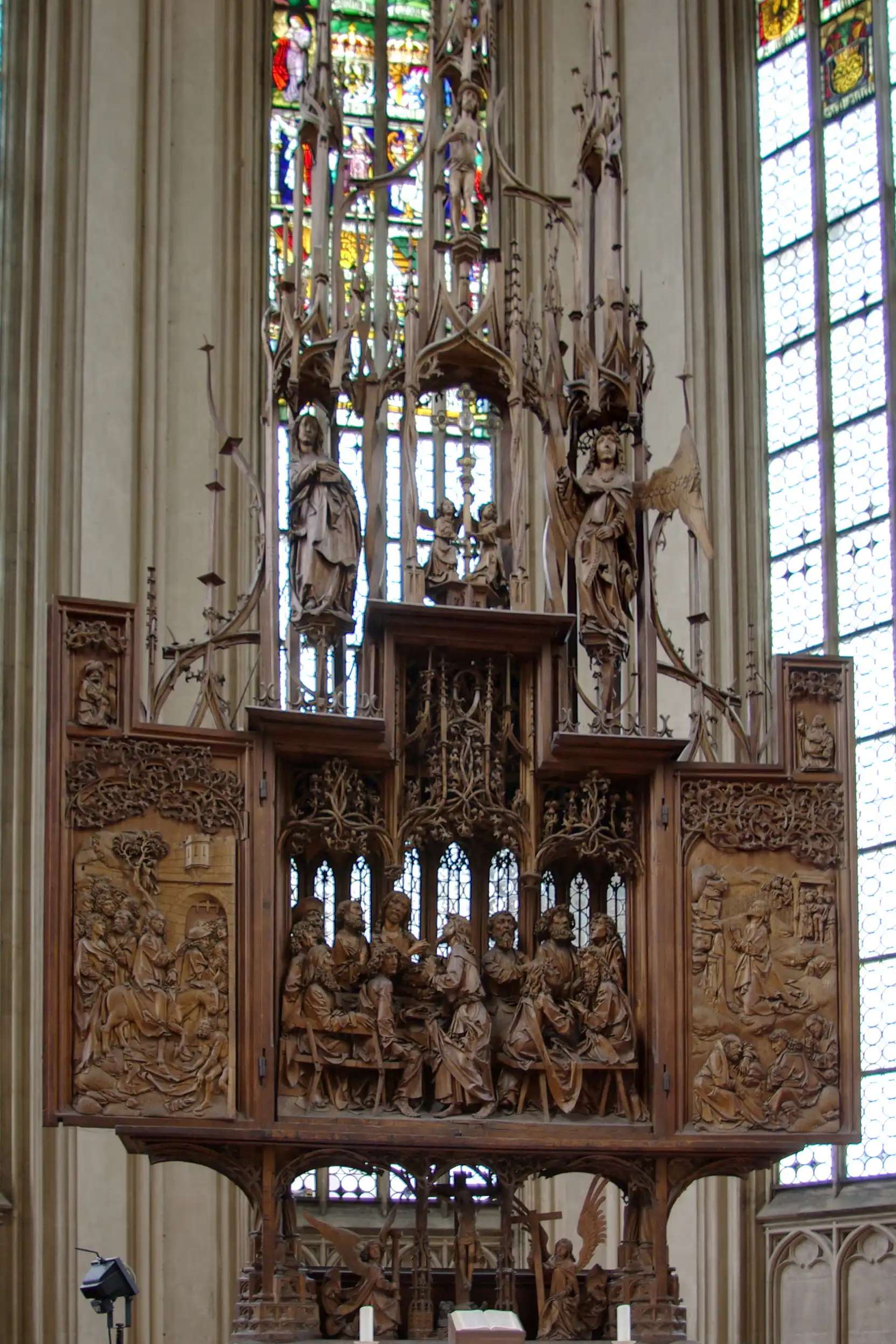
Look at row one against row two. Pale limewood figures standing in a redder spruce box. Hold that thought, because it explains the glaze.
Was his unpainted sculpture really bare wood?
No, and every examination since 1966 has said the same thing: a thin translucent glaze sat on the surface, so the wood shows through but the wood is never naked. Eike Oellermann published that finding first, and it changed the whole question.
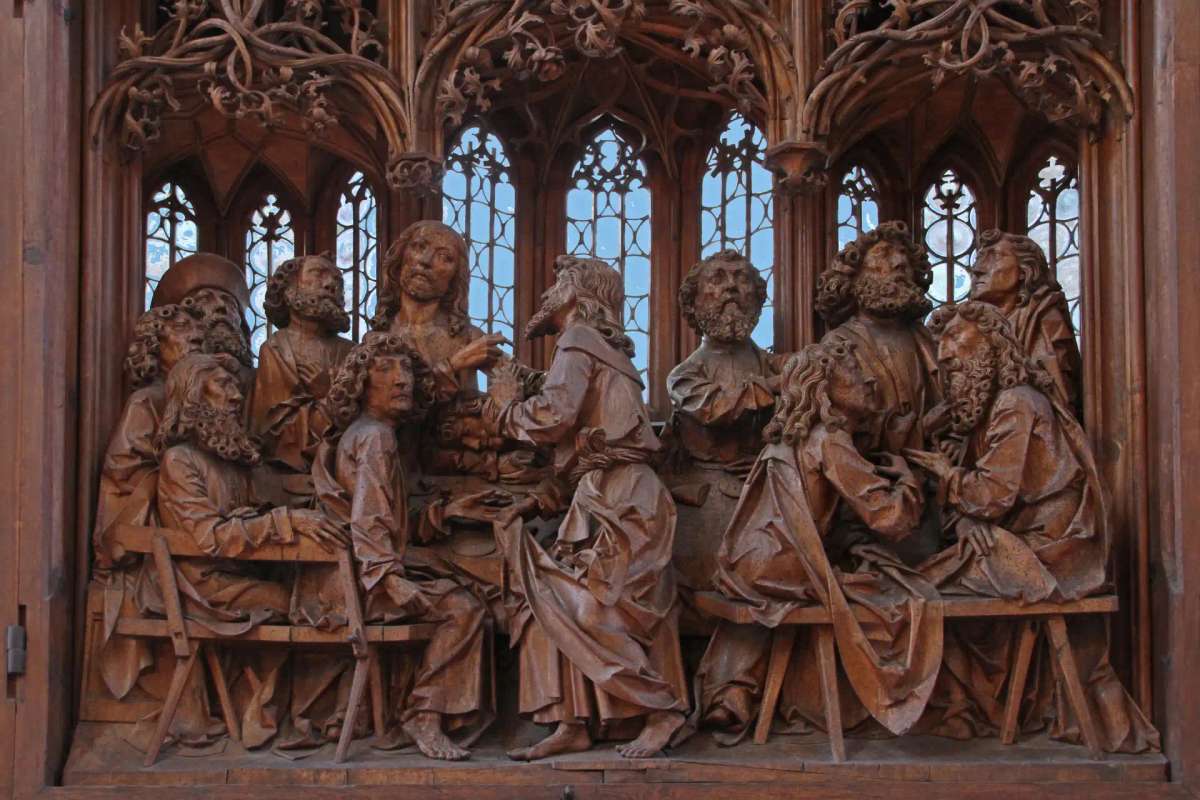
On the Holy Blood altarpiece in the Jakobskirche in Rothenburg, the glaze was egg white and oil, tinted with ocher, charcoal, gypsum, and a little lead white. Both the limewood figures and the spruce shrine got it. In some spots it went on in several layers, which deepens the shadows.
The Münnerstadt figures used something a bit different. Animal glue, a trace of oil, charcoal black, red or yellow oxides, some lead white.
And underneath that glaze, painted straight onto raw wood: irises, pupils, eyelids and eyebrows in black. Mouths in red. Lips on the Holy Blood figures were toned with madder lake. Blood drops in the Christ on the Mount of Olives relief are vermilion and lead-tin yellow.
So the "unpainted" master did paint. He painted four things and left the other ninety percent of the surface as wood under a tinted film.
Now the part that matters on your bench. Marincola gives three plain reasons that glaze makes sense, and none of them are artistic:
The piece reads as finished instead of abandoned.
Pale limewood and redder spruce get pulled into one continuous object.
Sealed pores stop dust from settling into the grain.
Read reason two again. A working carver is fixing a real problem there. No genius statement about it.
Why did he let go of color?
Guild law in medieval Europe gave the right to paint sculpture to painting studios, not to carving shops, so for most of his career Riemenschneider physically was not the one holding the brush. In some cities a journeyman painter had to paint a sculpture as his master exam. That task had its own word, Fassmalerei.
Neither Riemenschneider nor anybody in his shop did that work. He hired it out. A parchment slip found in a cavity in the back of his Steinach Crucifix names the painter: Johann Wagenknecht of Würzburg.
Veit Stoss in Nuremberg could paint his own work, because Nuremberg was a free imperial city where painting and carving counted as free arts and skipped the guild rules.
Scholars still argue about why he would drop color at all. Four positions:
Masters did not want a painter burying their carving under chalk ground and gold.
The patron chose the finish, not the artist. Riemenschneider had limited say in his contracts.
It was a style shift tied to religious unrest before the Reformation.
They are not monochromes at all, just work that never got painted.
That last one is not crazy. Some sculptors clearly did choose it though. Andreas Stoss left written instructions that his father Veit's last altarpiece, now in Bamberg, must stay unpainted.
For Riemenschneider himself, no contemporary document has ever turned up saying "leave it bare." We are reading the objects, not his words.
Other south German masters worked the same way: Hans Leinberger, Niclaus Weckmann, Jörg Syrlin the Younger, Daniel Mauch, Henrik Douvermann.
How does texture replace color?
Take away paint and you lose the easy way to separate skin from cloth, so the carving itself has to do that separating, which means more surface work with fewer tools. Nothing else in the whole story matters more to a carver today.
Ernst Willemsen spotted the trade directly. Color used to tell your eye where flesh stopped and drapery started. On a monochrome, tool marks do it.
Count what the masters left behind:
Work | Different tool marks recorded |
|---|---|
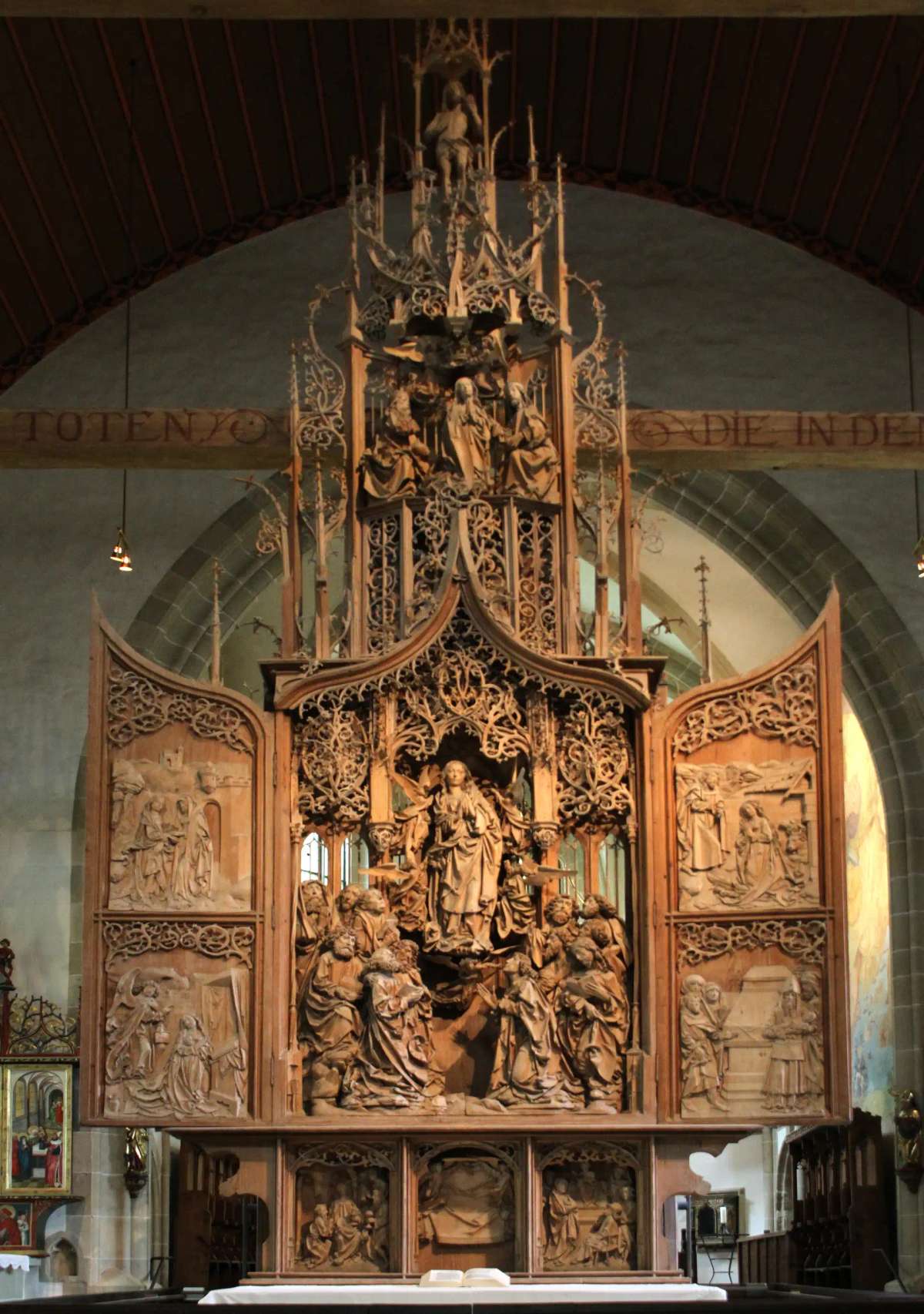
Creglingen Assumption of the Virgin | 8, including a Maltese cross punch and a circle punch |
Münnerstadt altarpiece | 5 patterns |
A female saint, around 1515 to 1520 | 9, including star, flower, and circle punches |
Hans Leinberger, Castulus reliefs | 23 decorative punches |
Riemenschneider's own habits were plainer than that list suggests. A chisel ran a line of half-moon shapes along his drapery edges. Fine stippled dots faked velvet. Into garment borders he cut lines, vines and diamonds with knives and chisels, then struck a shaped punch into them.
He also used a zigzag chatter on backgrounds. Germans call it Tremolierung. On the Noli me Tangere relief from Münnerstadt the ground is busy with it, and the drapery beside it is left quiet. Busy against quiet. The whole trick is right there.
He did all this with a limited number of tools. Not twenty-three punches. A few, used with intent.
How do you use this on your bench?
Work in the order the Würzburg shop worked: carve the texture first, paint only the eyes and lips, then seal the piece with a tinted film instead of a clear one. Below is that logic in modern materials, on basswood, with tools you already own. Nobody is reconstructing a recipe from 1500.
Step 1. Cut for shadow, not for smoothness
Leave your gouge marks where they read as texture. Sand a monochrome flat and you delete the only thing that separates a sleeve from an arm.
Step 2. Carve the background busier than the figure
Chatter, stipple, or a running half-moon on the ground. Keep the flesh and the main drapery calm. Contrast does the work color used to do.
Step 3. Paint only the eyes and the lips
Thinned black for iris, pupil, and lid line. A touch of red for the mouth. Directly on raw wood, before any finish. Exactly the medieval sequence.
Step 4. Tint your film, do not just clear-coat it
A hair of raw umber or yellow ocher in shellac or oil. This is the modern stand-in for the ocher and charcoal glaze. It unifies patchy grain and any wood you glued on.
Step 5. Build in thin layers, heavier in the hollows
Riemenschneider's glaze went on thicker in places to deepen modeling. Do the same. Two or three thin passes, a little extra in deep folds.
Step 6. Stop before it shines
The point is wood you can still see, sealed against dust. Not gloss.
What happened to these finishes over five hundred years?
Most of them were destroyed, and often by people trying to help. The sad half comes now, and you want it before you trust any photograph of a Riemenschneider.
The Münnerstadt altarpiece is the famous case. Riemenschneider delivered it in 1492 as a monochrome. The town council hired Veit Stoss to paint it, gild it, and fully decorate it, and he did, between 1504 and 1505. Twelve years and the master's choice was gone. Nobody recorded why.
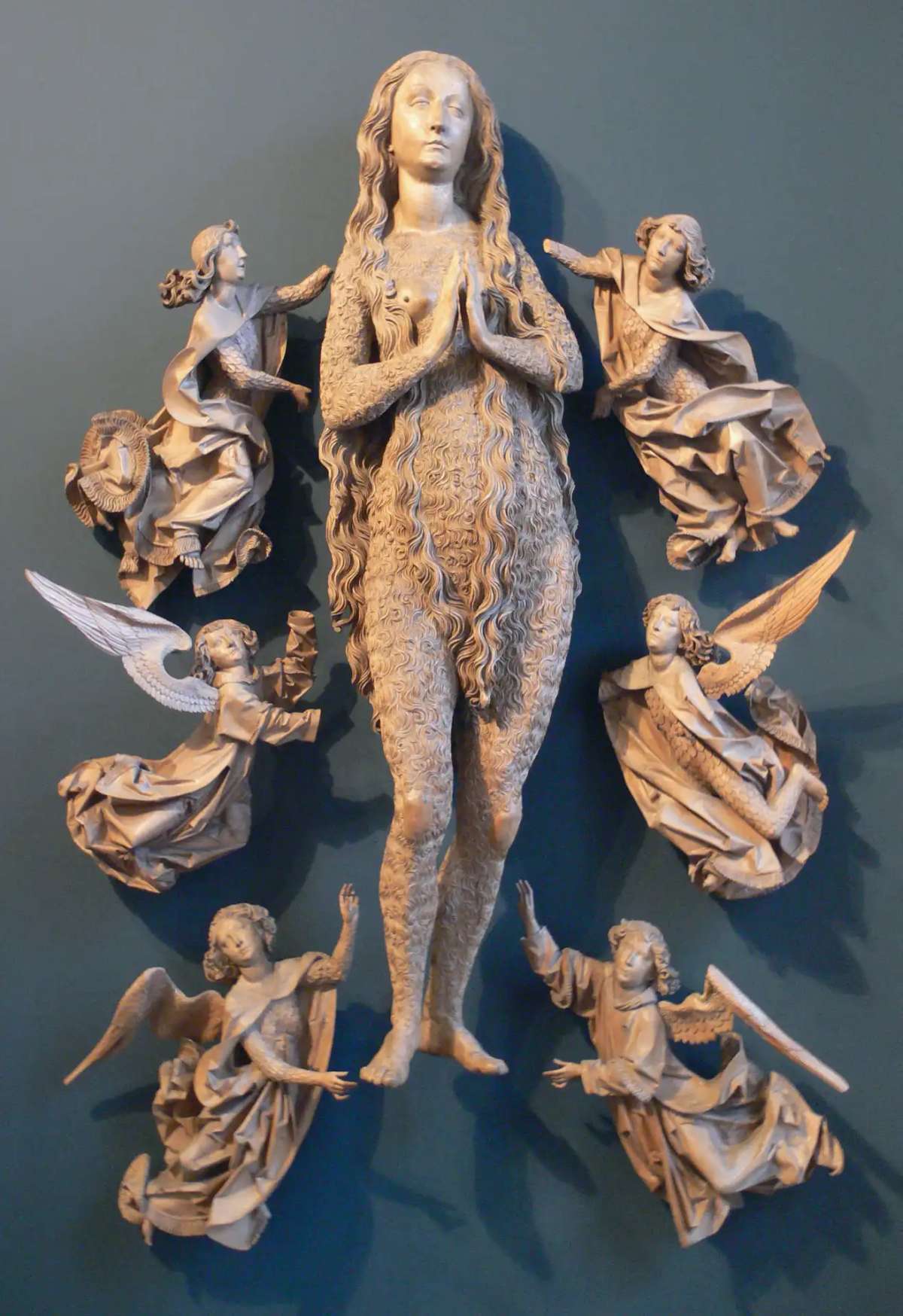
Then the 1800s made it worse in the other direction. Neoclassical taste hated color on sculpture and called bare wood "honesty toward the material." So figures got dunked in lye or pasted with caustic to strip the paint off. Sodium hydroxide eats the wood fiber. It strips the oils that color and lubricate the wood. Leftover alkali dries the surface out until it cracks in fine lines. Then somebody stains and waxes it to bring the color back, and that darkens, and the next generation cleans it again.
In 1896 a man named Franz Pauli from Reichenhall worked on the Detwang Crucifixion, added some neo Gothic bits, and brushed dark linseed oil varnish over the whole altarpiece. It has gone opaque, blackish, crusty, and wrinkled. He pencilled his name and the year on the hollowed back of the mourning women, which is how we know.
So the irony lands hard. A century that worshipped bare wood is the century that stripped the real finishes off it.
How can you tell a monochrome from a stripped carving?
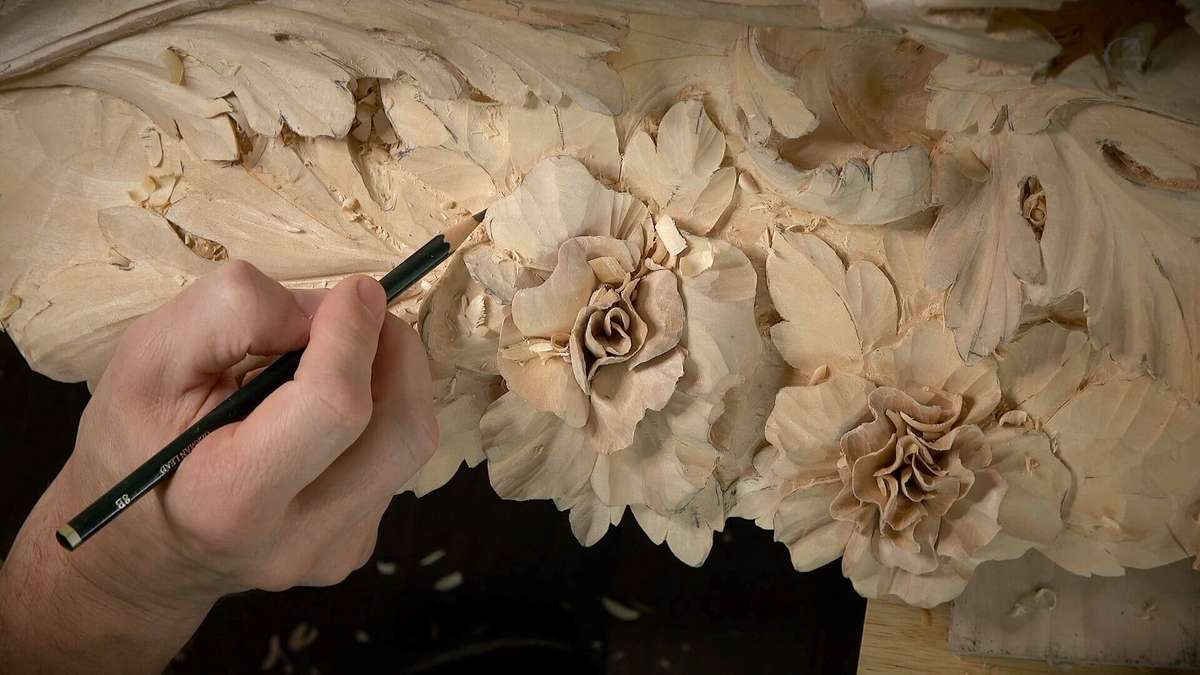
Conservators tell them apart by reading the surface itself, because a stripped figure carries scars that a true monochrome never had. Marincola lists the signals.
Points to originally painted: aged parallel scratches over old repairs, cut to give a cloth patch something to grip under the ground layers. Also open insect channels running parallel to the surface, because the beetles tunnel just below the ground.
Points to monochrome: crisp punch marks, high detail in the surface carving, and pigmented glaze sitting directly on the wood.
Proves nothing either way: painted eyes and lips, or wedges of wood driven into splits that opened while carving. Both kinds have those.
Her closing line is the best sentence in the book. Each sculpture reveals its history in a few millimeters of depth.
Frequently asked questions
Is limewood the same as basswood? Limewood and basswood are the same genus, Tilia, and they carve much the same way. European limewood is Tilia cordata or Tilia platyphyllos. American basswood is Tilia americana. If you buy good basswood you are working the material Riemenschneider worked, close enough that the tools behave the same.
Did Riemenschneider paint his own sculpture? No, and neither did anyone in his shop, because guild law reserved painting sculpture for painting studios. The one thing his shop did paint was the eyes and lips of monochrome figures, done right on the bare wood before the glaze went on.
What was the glaze made of? Analyses point to egg white or animal glue, sometimes with a little oil, tinted with ocher, charcoal, gypsum, and lead white. For the Holy Blood altarpiece the mix was egg based. At Münnerstadt it was closer to a glue size. More than one recipe was in use, so treat it as a family of finishes rather than one formula.
Which of his altarpieces were meant to be unpainted? The Holy Blood altarpiece in Rothenburg, the Assumption of the Virgin in Creglingen, the Crucifixion now in Detwang, the Münnerstadt Magdalen altarpiece, three groups for the Windsheim parish church, and the Crucifix from Eisingen. Rothenburg's has stood as a monochrome for nearly five hundred years.
Can I copy the original finish exactly? You can get close, but honestly you should not try to match it. Those glazes have oxidized and darkened for five centuries, and nobody knows what they looked like new. Copy the logic instead: paint the eyes, tint the film, keep it thin, let the wood show.
Was monochrome cheaper than paint? Probably, since it skipped a painter, a chalk ground and gold leaf, but no contract says so. Painters were a real expense. Shops sometimes used Zwischgold, a gold and silver laminate, to save money on gilding, and contracts often mention it only to forbid it as a substitute for real gold.
Who is telling you this
I am Alexander Grabovetskiy, International Woodcarver of the Year, and I carve architectural ornament for a living. Acanthus, high relief, Baroque, furniture to match Chippendale. My great grandfather worked mahogany in the Chippendale style, so wood is in my blood, and my grandfather put a chisel in my hand at six years old. I took it to a brick and ruined it. The passion was born right there.
I have finished a lot of limewood and a lot of basswood. Most of what people call a natural finish is really an unfinished piece with oil on it. The old masters did not work that way, and now you know it too.
Every fact about Riemenschneider above comes from the exhibition catalogue Tilman Riemenschneider: Master Sculptor of the Late Middle Ages, by Julien Chapuis, published in 1999 by the National Gallery of Art and the Metropolitan Museum of Art with Yale University Press. The technical findings all come from Michele Marincola's essay in it, "The Surfaces of Riemenschneider." Want the plain biography and the list of surviving works? His Wikipedia entry is a fair place to start.
Shall we carve?
Do you want your carvings to look finished instead of just stopped? Ever wonder why a master tinted his glaze rather than painting his figures? Would you rather learn the reason than copy a photograph?
Then come and work with us. The surface carving in this post is the same skill you build in carving the Greek acanthus leaf, where texture has to do the reading. Our Access plans open every lesson we have, and the tuition feeds orphan and widow charities.
Filed under
- altarpiece carving
- basswood carving
- carved figures
- carved figures
- conservation science
- egg tempera glaze
- franconian carving
- gothic sculpture history
- gothic sculpture history
- late gothic sculpture
- limewood
- medieval sculpture
- monochrome carving
- riemenschneider techniques
- riemenschneider techniques
- surface texture
- tilman riemenschneider
- unpainted sculpture
- veit stoss
- woodcarving finish
- wood finish
- wood glaze
- woodworking techniques
- woodworking techniques