
August 12, 2026
By Alexander Grabovetskiy — Master Woodcarver · Founder, School of Wood Carving · 25 min read
Ornamental Wood Carving Design Rules From 1847
Quick answer: Ornamental wood carving is the craft of carving classical ornament, acanthus leaves, scrolls, rosettes and capitals, into wood so it still reads across a room. I work the way a London weekly taught working men in 1847. Beauty here is not taste. Geometry decides it, and geometry can be taught to anybody.
Most people who try to carve an acanthus leaf get a shape that is close. Close, and dead. The lobes are there, the stem is there, the little holes are there. Step back six feet and the whole thing turns into a grey smudge on a board.
I know that smudge. Students send me photographs of it most weeks.
The cause is not what people think. Your hands are almost never the trouble, and neither are your gouges. You were copying a picture instead of building a shape, and a picture carries no rules inside it.
Rules do exist. They were printed for tradesmen in London in 1847, in a cheap weekly called The Decorator's Assistant, and I have a scan of the whole first volume open on my bench. Below I am going to walk you through what it says: why the acanthus and not some other leaf, how to set the leaf out before you cut, where a scroll gets its curl, and what the old writers meant by proportion. Then what happened to this trade once people stopped carving and started casting.
By the end you will know why your leaf went flat, and what to do about it.
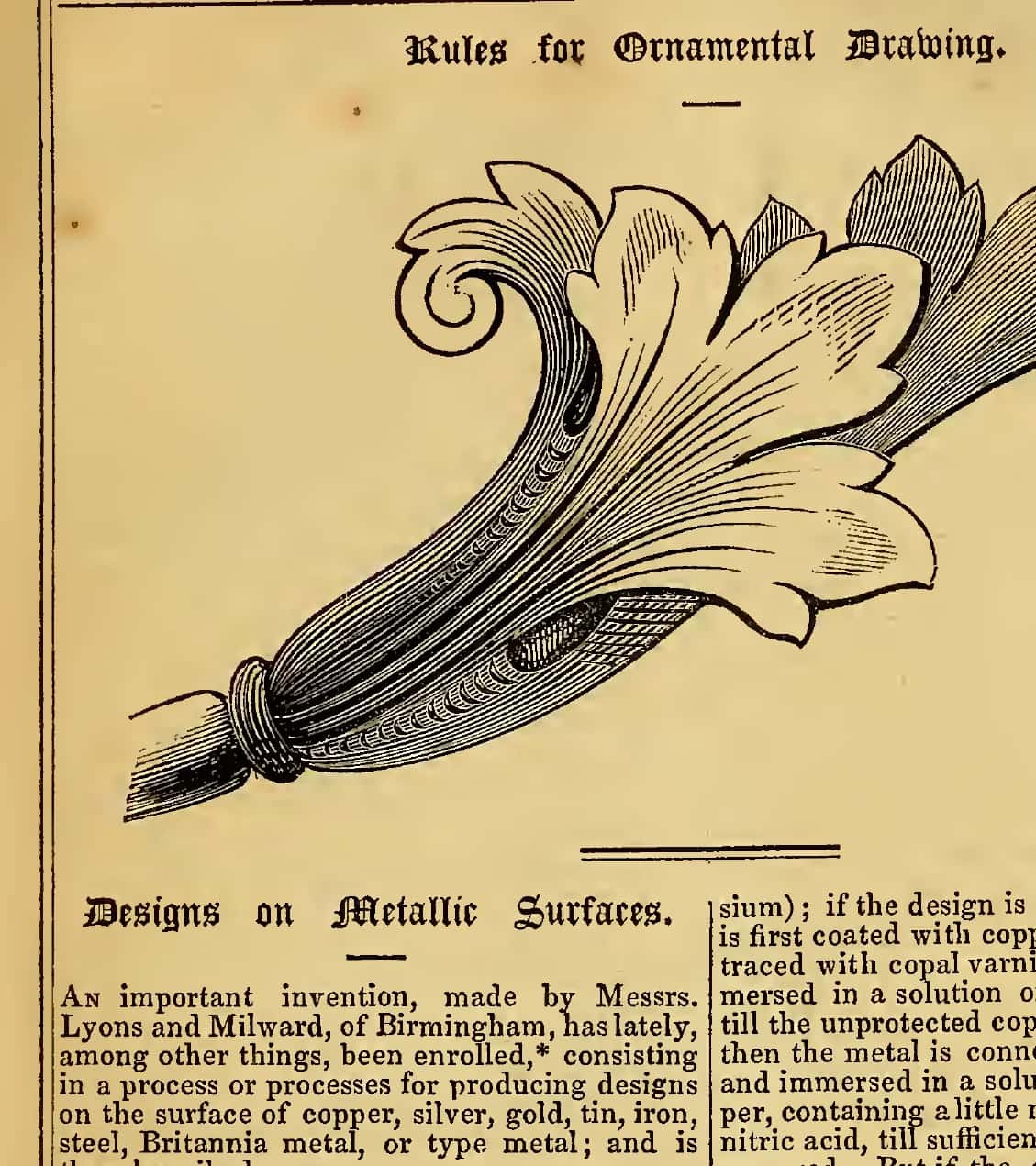
Rules for Ornamental Drawing, page 189.
Key takeaways
Classical ornament runs on a small set of measurable rules, not on personal taste.
The acanthus won because it makes hard shadow, and hard shadow still reads far away.
Draw first. An 1847 leaf starts as a height line and a base half as wide.
A volute grows out of a square cut in seven, and one sloppy center ruins the curl.
Carved ornament and glued-on ornament are different objects. Check the grain.
Learning this takes years, and drawing is where the years go.
What is ornamental wood carving?
Ornamental wood carving is cutting classical ornament into wood as part of a building or a piece of furniture, so the ornament belongs to the object instead of sitting on it. Architectural wood carving means the same craft at building scale: capitals, moldings, brackets, door surrounds, mantels, paneled rooms.
The subjects have been steady for two thousand years. Acanthus leaves. Scrolls and volutes. Rosettes. Shells, ribbons, fruit, wheat, oak, laurel. A short list, worked over and over, in every country, for twenty centuries.
Nobody ran out of imagination. That short list is a filter. Those shapes survived because they work in the one situation that matters, which is a wall in bad light.
There were four kinds of carver in the old shops, and what separated them was never skill. The difference was distance.
Kind of carver | What they actually made in the shop | Viewing distance | What that did to the carving |
|---|---|---|---|
The ship carvers | Figureheads, stern boards and long name boards | Very far | Big forms cut to brutal depth |
The coach carvers | Panels and moldings on private carriage bodies | Very close | Fine tight work and nothing wasted |
The house carvers | Capitals, cornices, mantels and whole paneled rooms | Room distance | Bold shadow and honest visible joints |
The furniture carvers | Aprons, crests, cabriole legs and cabinet doors | Arm's length | Crisp detail on a clean ground |
Look at that table again. A house carver is not a worse furniture carver. He is answering a different question, because nobody will ever stand two feet from his cornice.
I say this because beginners copy furniture carving and then wonder why it disappears on a wall.
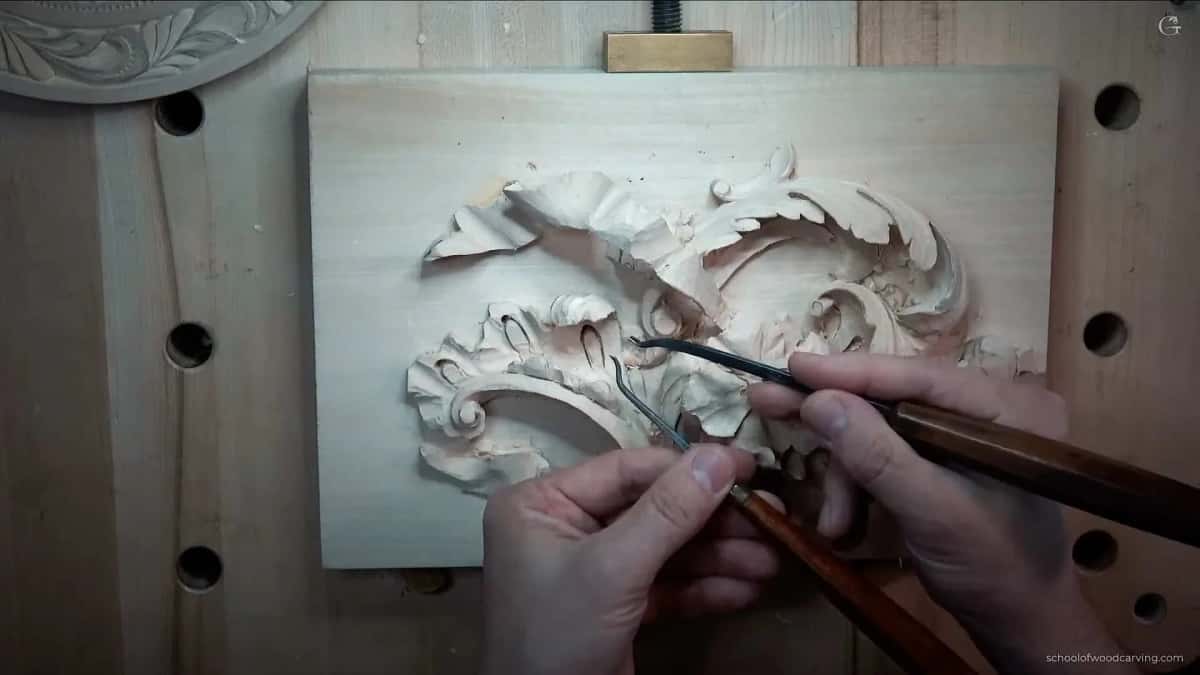
This tool reaches where no straight gouge goes.
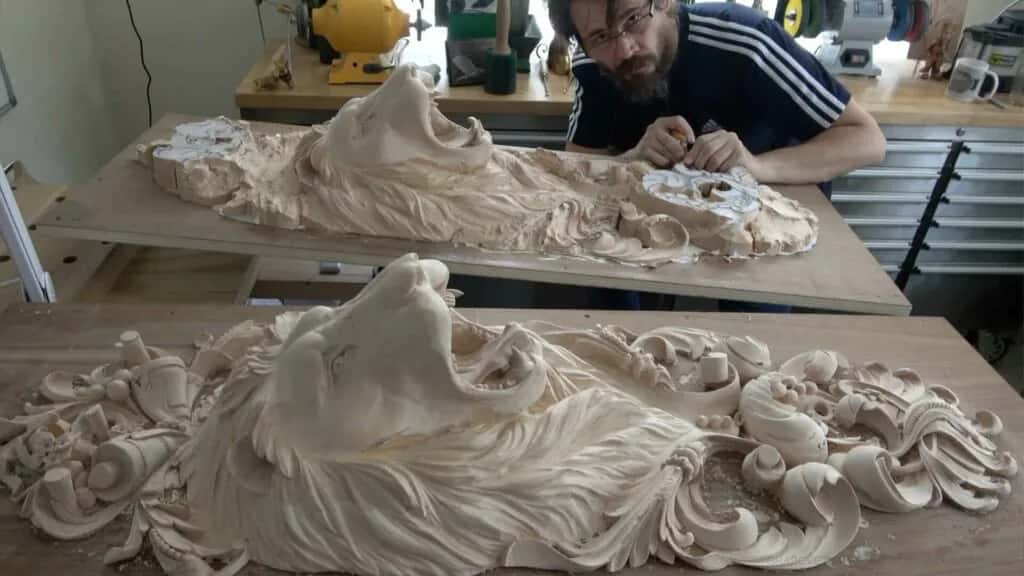
Two lion panels on one bench, and the far one has not been touched past the roughing out yet.
How do ornament and decoration differ?
Ornament is cut into the thing and belongs to it. Decoration is applied onto the thing and can be lifted off. Saw the board through and look at the grain, and the argument settles itself in about one second.
In carved work the wood fibre runs unbroken out of the background, up the stem, and out to the tip of the leaf. Nothing was added. Somebody took wood away, and taking wood away is the entire job.
In applied work a separate piece was carved somewhere else and glued down. The grain stops dead at the glue. Two pieces, two directions, and they pull against each other every winter.
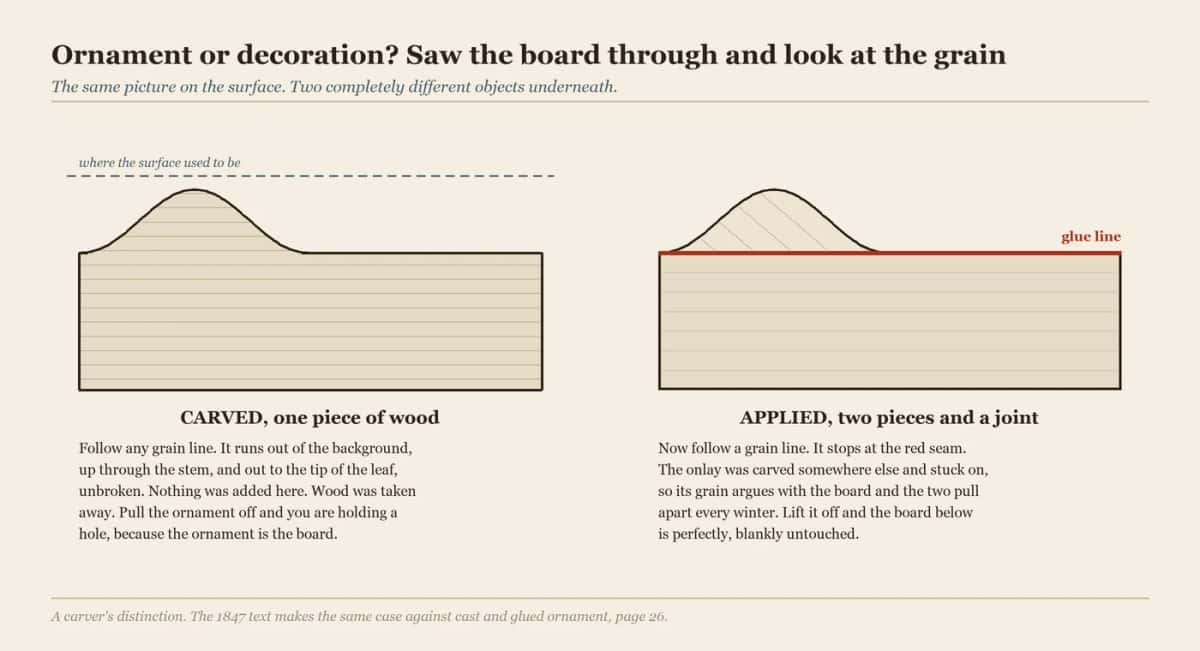
Section through both boards, where the grain settles the argument by itself.
Both have their place. I glue onlays myself when a job calls for it. But they are not the same object, and you should know which one you are making.
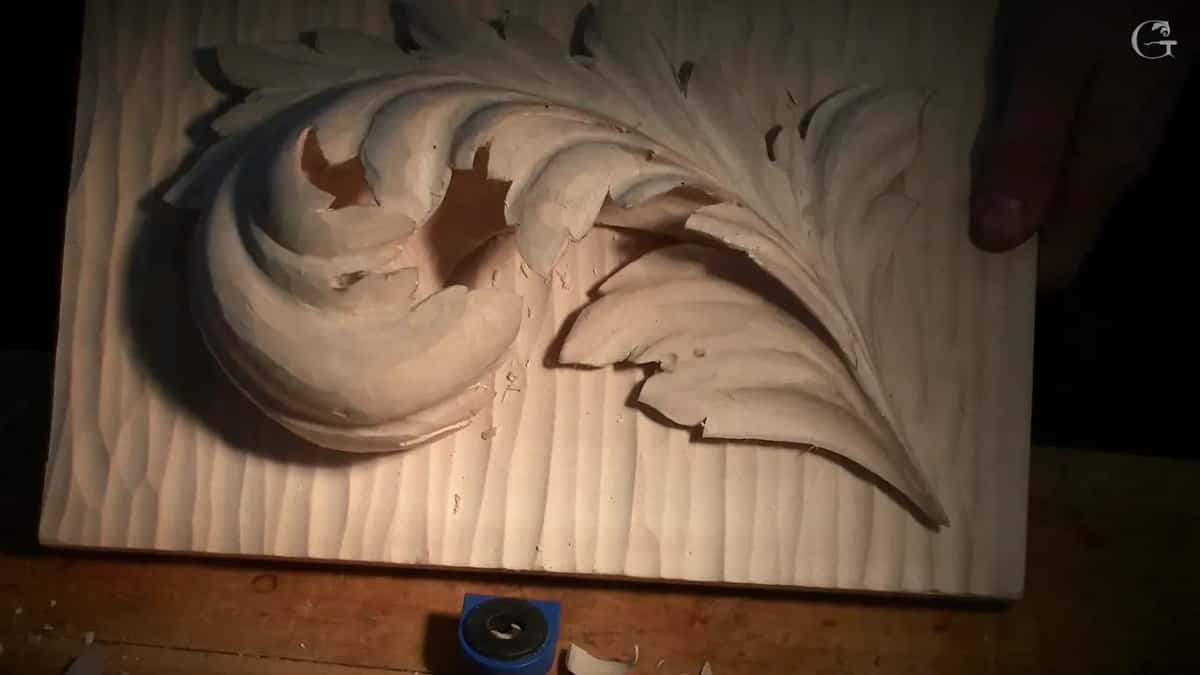
Carved on its own board first, then glued down.
Here is a test you can run on your own house tonight. Find something carved. Ask yourself whether taking the ornament off would leave a hole or leave a flat clean surface. A hole means somebody cut it. If the surface underneath is clean, somebody stuck it on.
Roger Scruton has a line about why ornament exists at all. Quoted in Walker and Tolpin's book By Hand and Eye, he says architectural ornamentation "liberates us from the tyranny of the useful and satisfies our need for harmony."
Why does my carved acanthus leaf look flat?
You rounded it over instead of cutting back underneath it, and a rounded shape has no shadow to give you. Nothing I see goes wrong more often, and it has nothing to do with how sharp your tools are.
Think about what actually reaches your eye from ten feet away. Shape does not travel that far, and texture travels even less. Light and dark, in patches. Your eye receives nothing else at all from that distance.
Carving is always about shadow and light. We are painting with the shadows and the light. It depends how the light hits.
If your leaf has soft shoulders and nothing cut back underneath, the light slides over the top and hands your eye a slow grey gradient. Nice in your hand. Gone at the far wall.
A second version of this mistake is worse, because it looks like patience. People take one small tool and they zig, and zig, and zig, and spend three hours making a surface fuzzy. Then they get frustrated. All that work went into texture, and texture is invisible at distance.
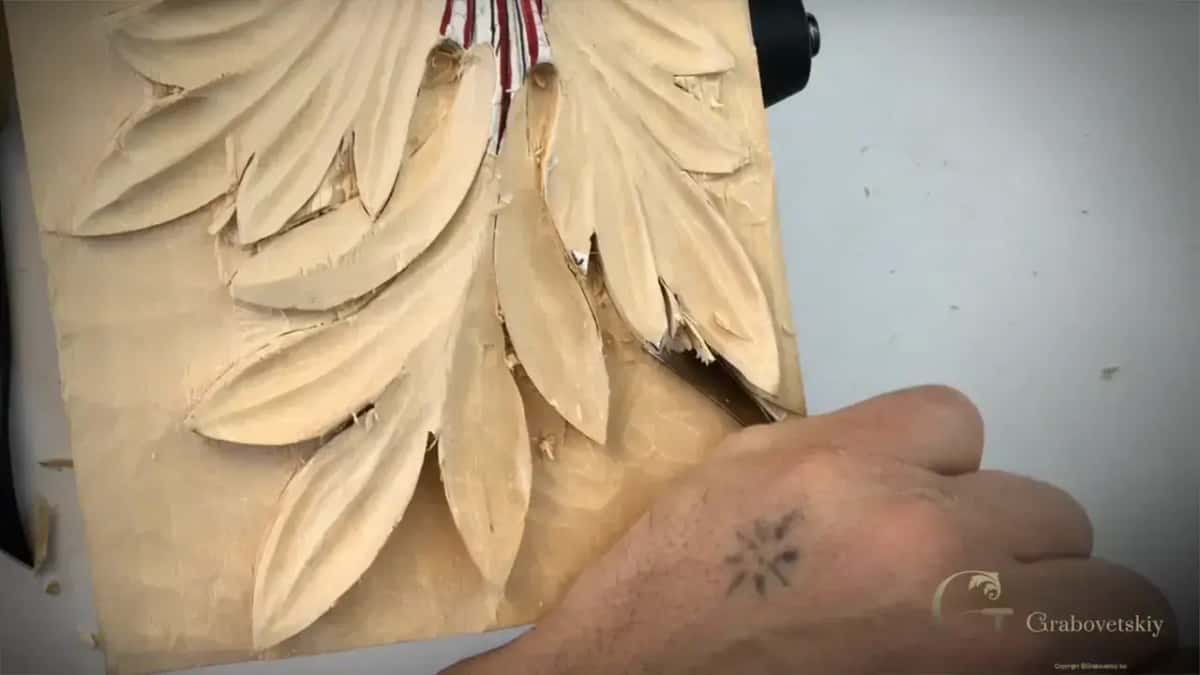
The knife has gone in under the lobe.
Look at that photograph. The black behind the leaf is not paint and it is not stain. Somebody cut that away underneath. A hole stays black in any light, at any hour, forever. When you carve ornament, holes are what you are really carving.
David Esterly carved the replacement for the Gibbons overmantel that burned at Hampton Court in 1986. I knew him before he died. He described our job in one line I have never forgotten: "Carvers are bringers of shadows, stainers of the white radiance of eternity, wreckers of a smooth plank."
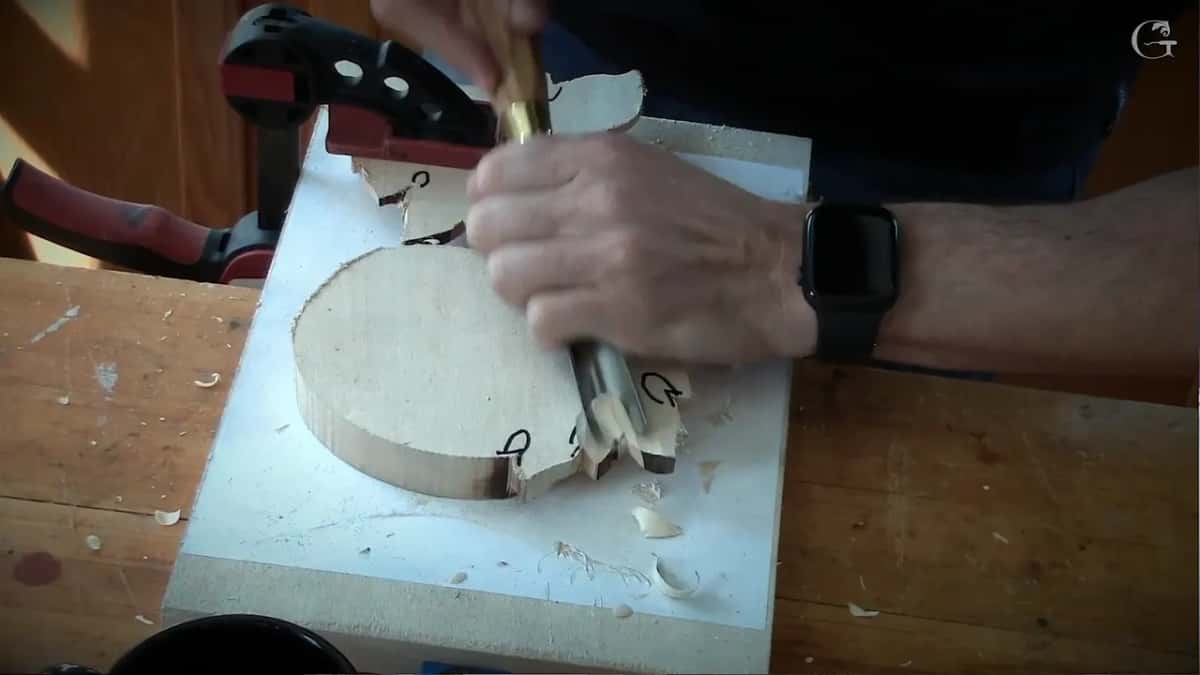
Clamped upside down so the lobes can be carved back underneath, with about a millimeter of wood left standing.
Why the acanthus leaf, and not some other leaf?
The acanthus makes better shadow than anything else that grows, and shadow is what you are really carving. Every article you will read online answers this with a story about a basket on a grave. That story is real and I will tell it to you in a minute. But the story is not the reason.
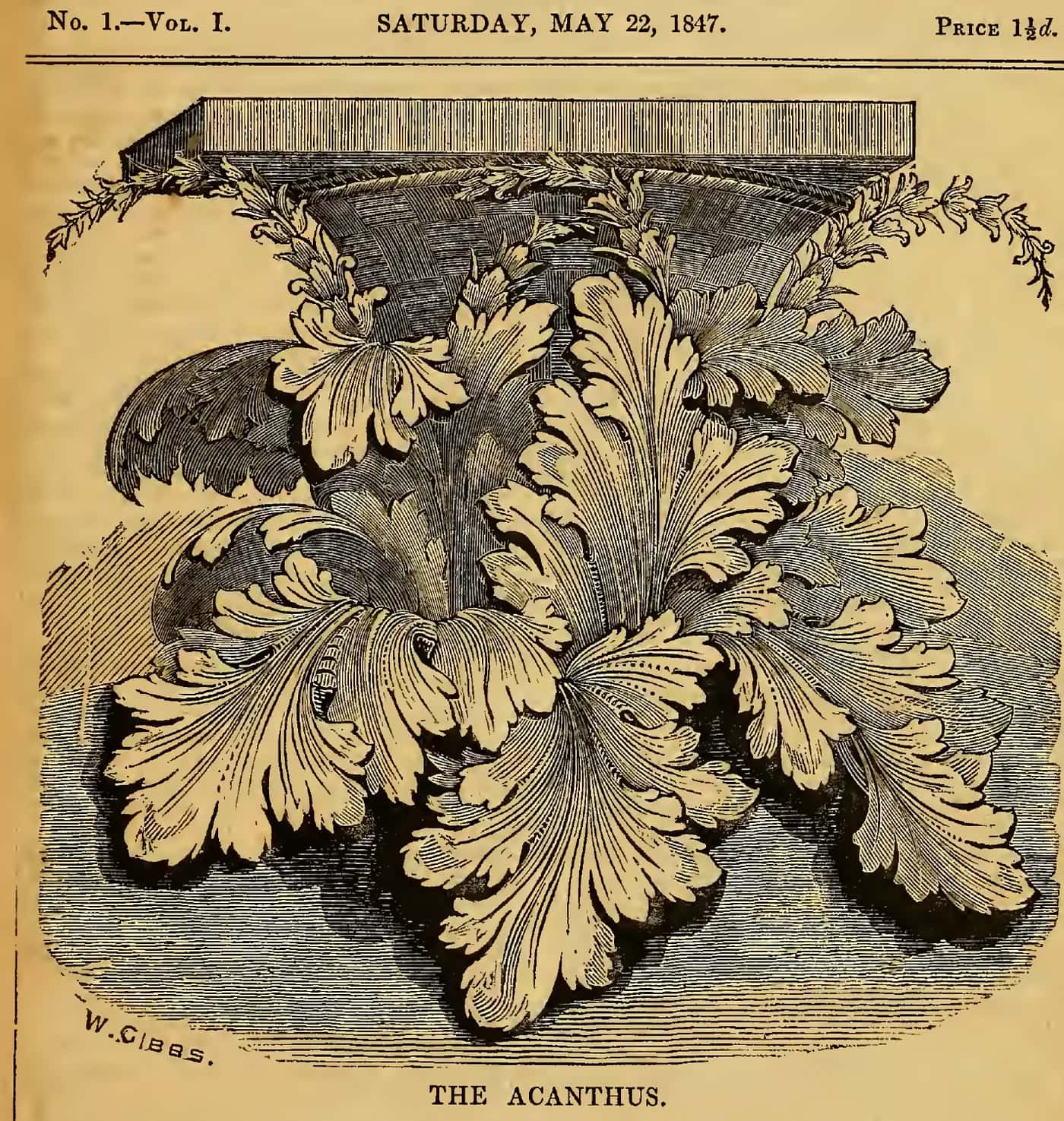
The reason sits in the first sentence of that 1847 weekly, on the front page of issue number one. Its editors say no other natural object is so well fitted to enrich a capital, and they give three grounds: the graceful turns of its outline, the richness of its foliage, and the breadth of its masses of light and shadow.
Read that last one again. Masses of light and shadow. In 1847 a trade paper for working men led with the optics, not the mythology.
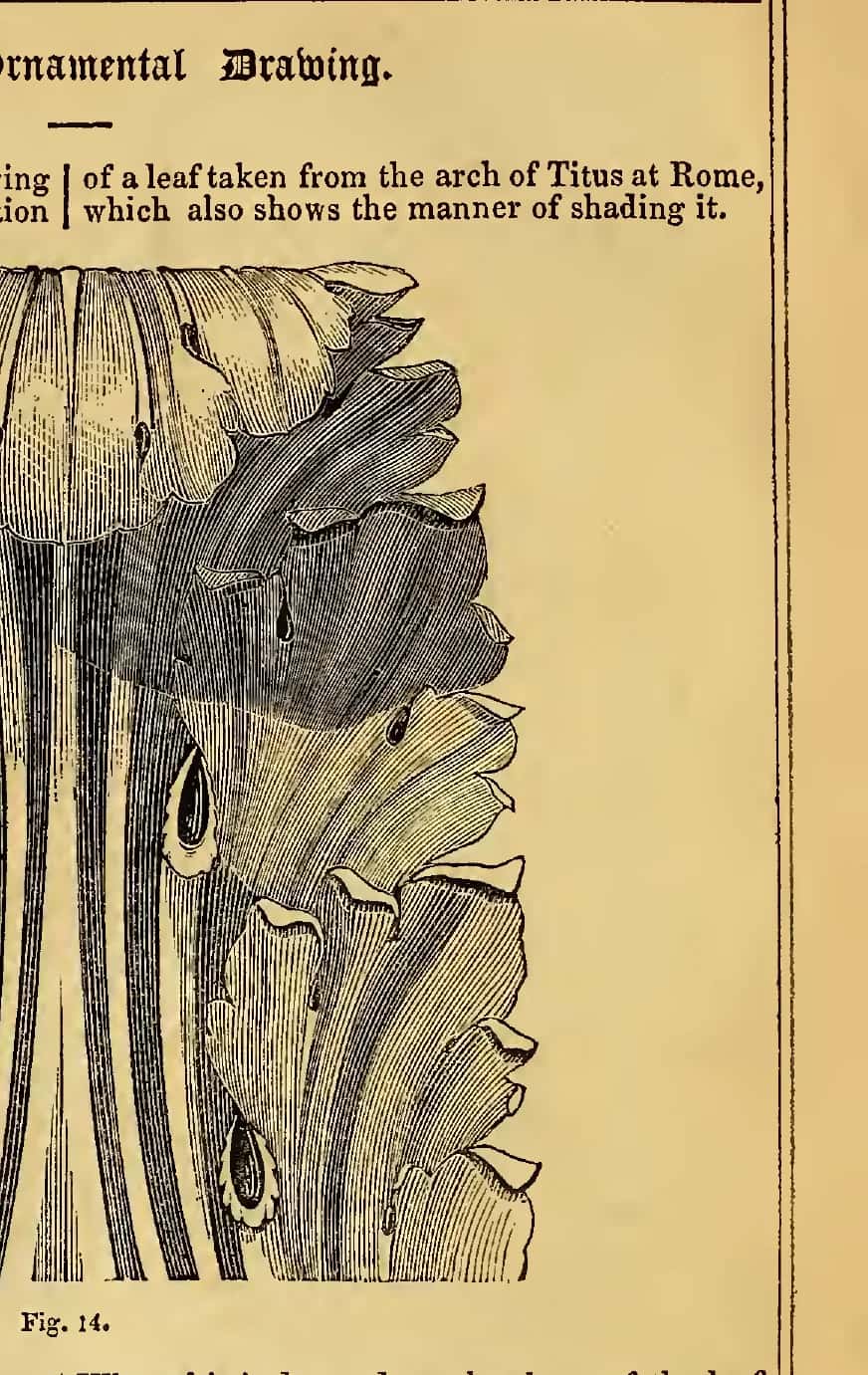
Figure 14, page 109. A leaf measured from the arch of Titus at Rome.
The mechanism is simple enough. An acanthus leaf is deeply divided. Every lobe has a sharp point, and between the lobes the leaf falls away into a deep hollow. Carve that honestly, cut under each lobe, bore the eyes deep, and you get a row of hard black marks with bright ridges between them. Your eye reads a pattern like that instantly.
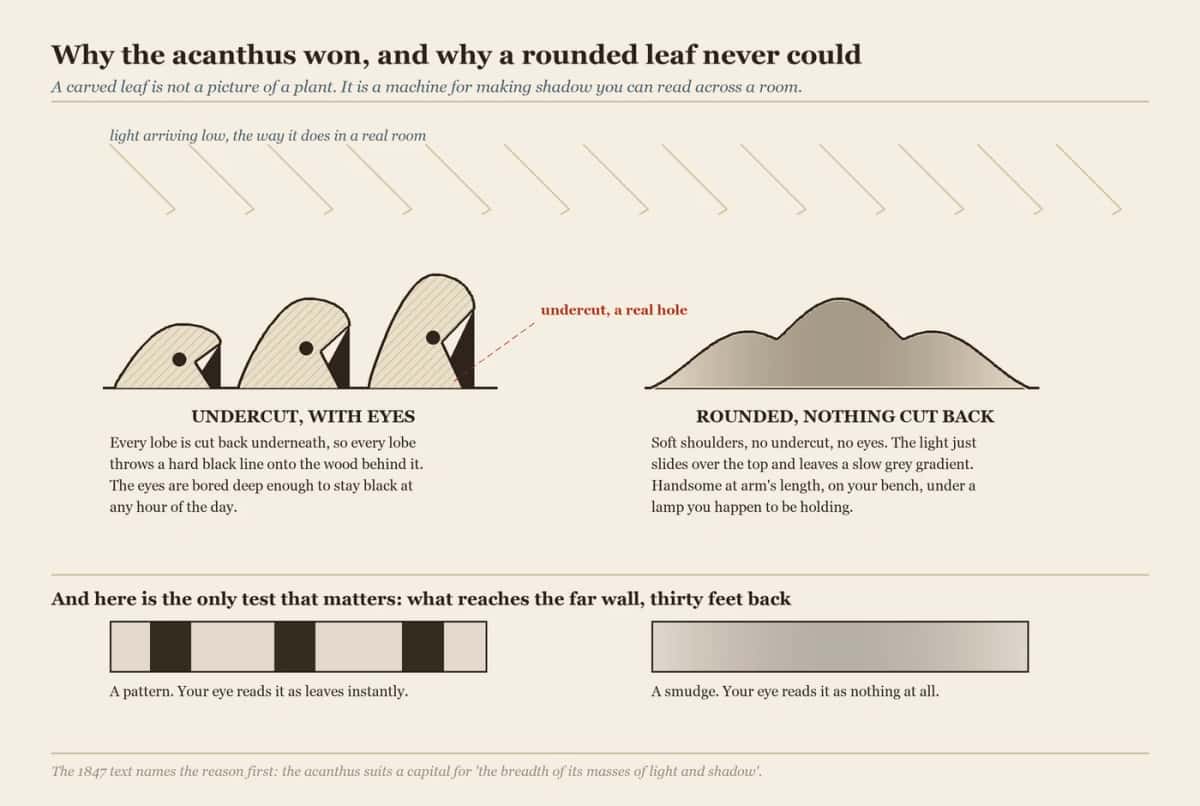
Undercut against rounded, and what each one sends across a room.
A round leaf cannot do this, and neither can ivy. A rose is hopeless at it. They give you soft gradients, and soft gradients turn to mush at ten feet.
So the acanthus was never picked for being pretty. It works as a machine for making readable dark. It beat every other plant on the market for two thousand years because it does that job better.
The basket on the grave
Now the story, because it is charming and because it explains the names.
Vitruvius passed it down. A nurse in Corinth lost a child. She gathered the child's things into a small wicker basket, set it on the grave, and laid a flat roof tile on top so birds could not get in. By chance the basket sat on the root of an acanthus.
Come spring, the plant pushed up. It grew around the basket, and when the leaf tips reached the tile they could not go through, so they had to turn back on themselves and curl.
An Athenian sculptor called Callimachus walked past and saw it. He built a capital out of it.
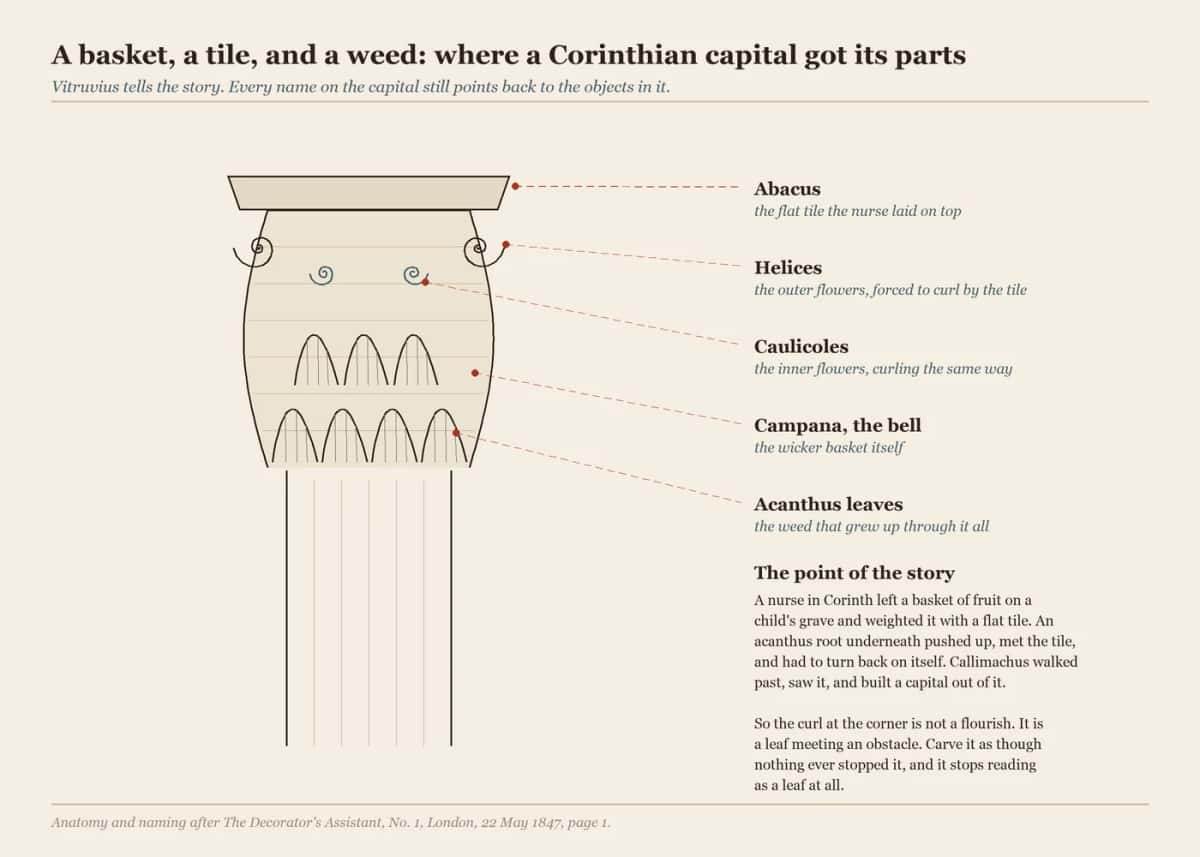
Abacus, bell, helices, caulicoles. All four names come from the story.
Every name on a Corinthian capital still points at an object in that story. The flat slab on top is the abacus, the tile. Underneath it the body is the campana, or bell, standing for the basket. Those big corner curls are the helices, with the smaller inner ones called caulicoles, and both of them are flowers that met the tile and had to bend.
This matters at the bench. The curl at the corner of a capital is not a flourish somebody added for fun. You are carving a leaf that met an obstacle. Carve it as though nothing ever stopped it and it stops reading as a leaf.
The name itself is old and plain. That 1847 volume puts a footnote at the bottom of page two saying acanthus comes from two Greek words meaning pointed and flower. Gardeners in England call the plant bear's breeches. Romans read the plant as a sign of endurance and triumph.
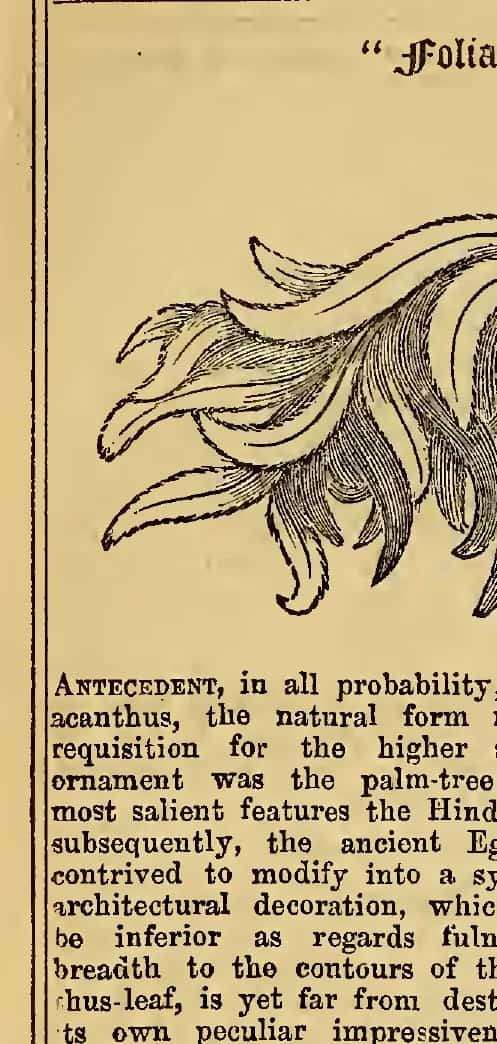
Page 44. The article argues the palm came before the acanthus.
All of those acanthus leaves you see, Greek, Roman, Byzantine, Gothic, French, still represent one leaf, the acanthus plant itself.
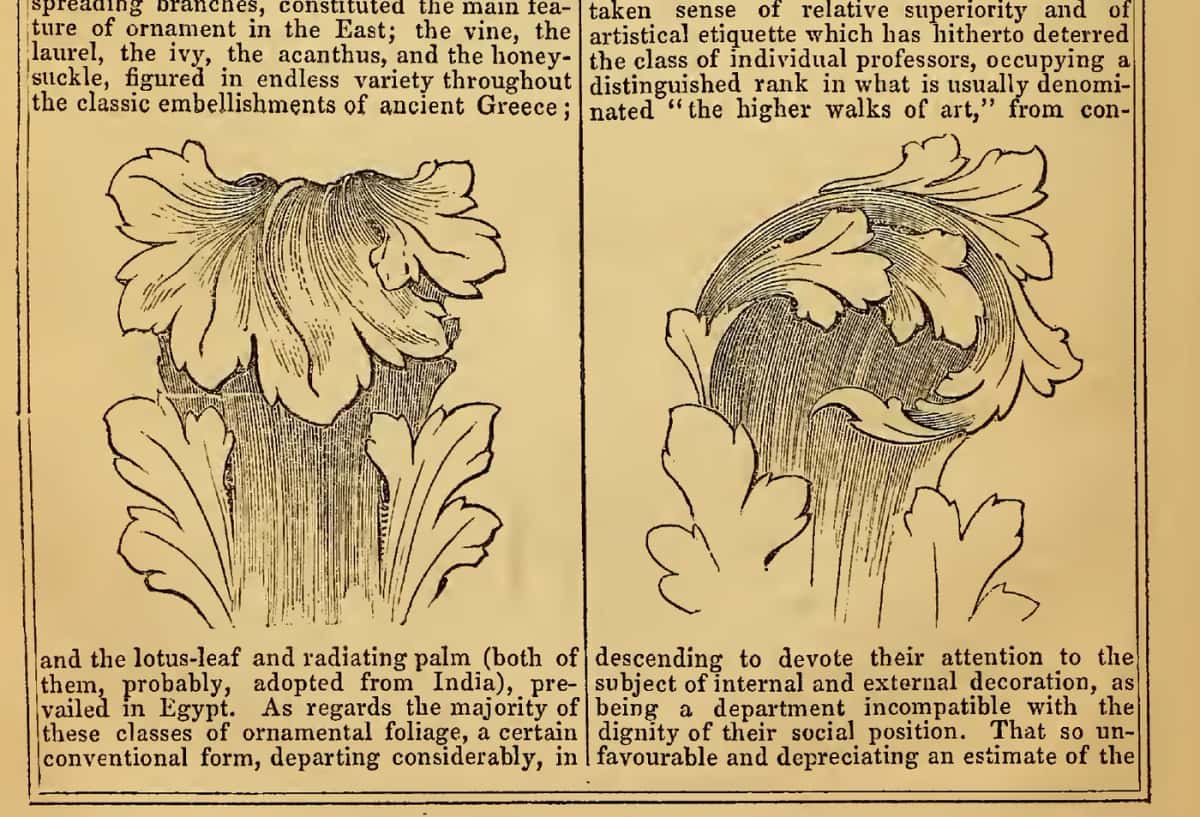
On Foliage as Applied to Ornament, page 20.
How do you draw an acanthus leaf before you carve it?
You build it on a frame: a vertical height line, a base half as wide as the height, and that base divided into six equal parts. The 1847 weekly gives this construction on page 28, under the heading Rules for Ornamental Drawing, and it still works exactly as printed.
Here is the method in plain words.
Decide how tall the leaf is. Draw that as one vertical line, from the apex at the top down to the base.
Lay the base across the bottom of it. The base is about half the height. Never guess that proportion, because everything after it depends on the number you pick.
Cut the base into six equal parts.
Measure one of those parts out from the center, left and right. Those two points start the main lines.
Run a line from each of those points up to the apex.
Now step up that line, using the distance between your two points as the step. Draw a horizontal through each step.
Where those horizontals cross the rising lines, an eye of the leaf sits.
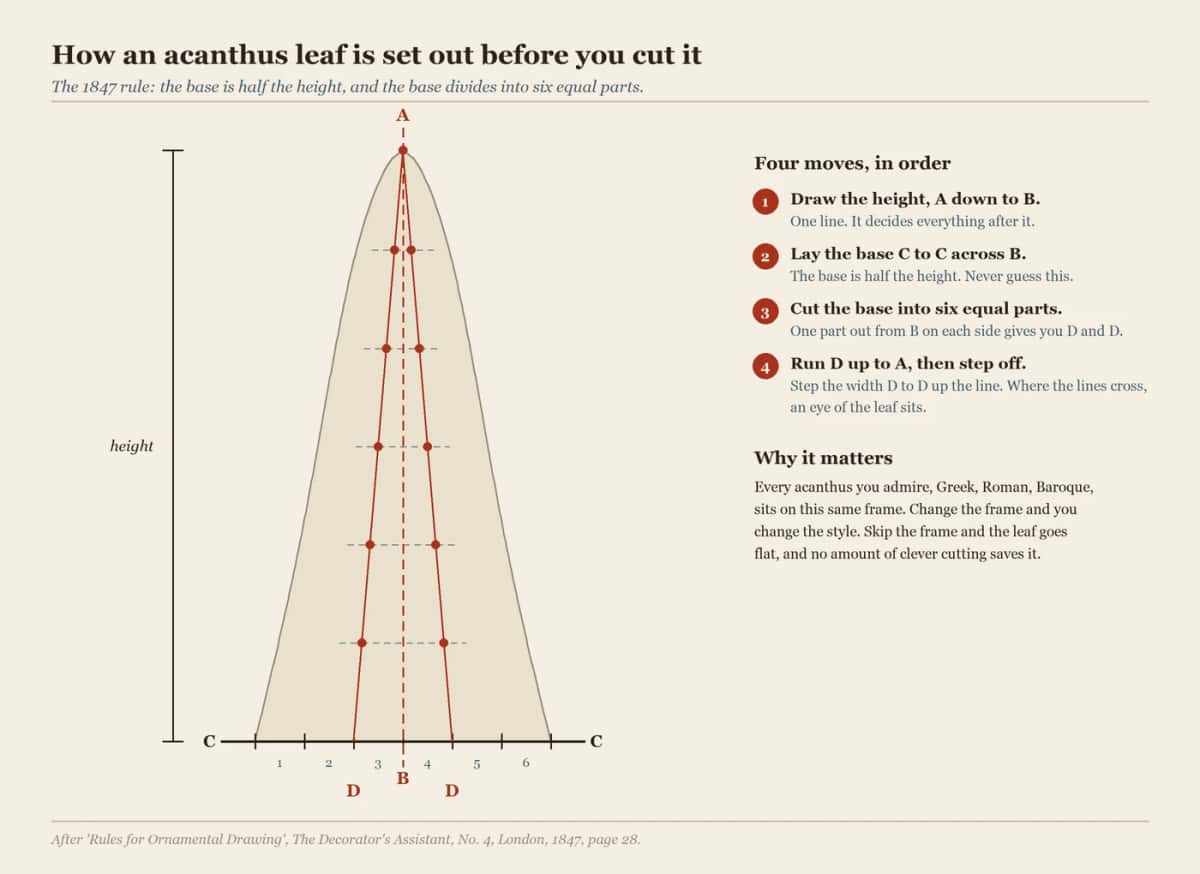
Four moves.
The spacing shrinks as you climb, all by itself, because the lines are converging. You did not have to judge it. The frame did the judging.
Old draughtsmen were not born with a magic eye. They had a scaffold, and the scaffold did the tapering for them.
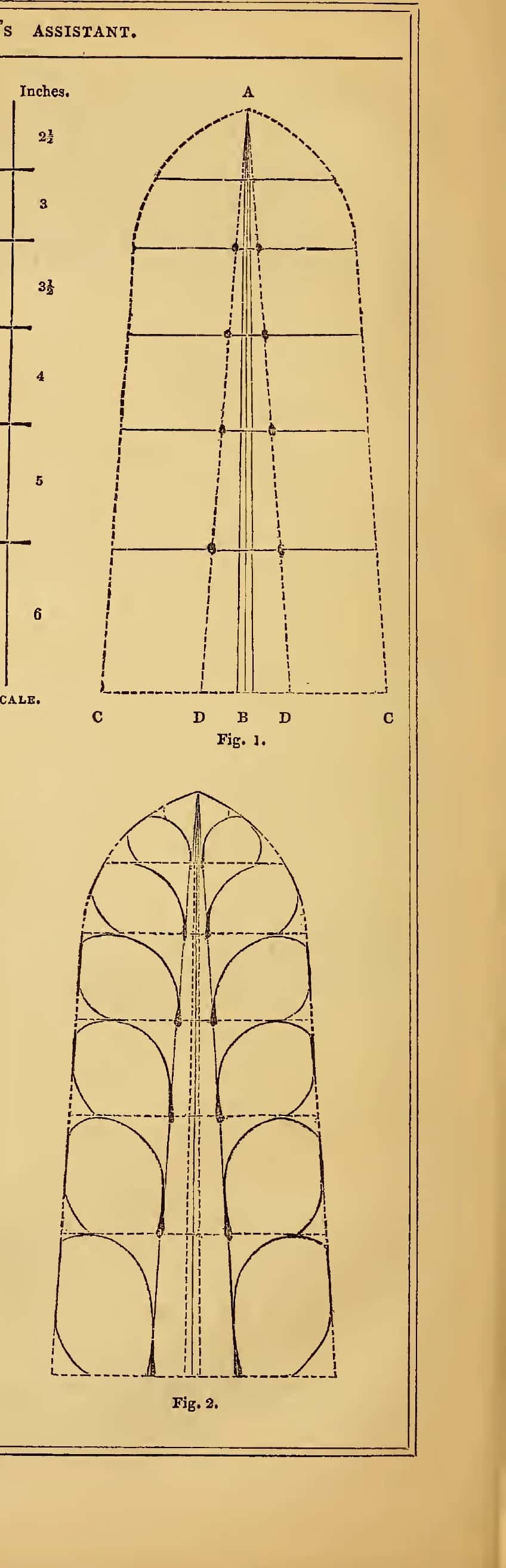
Figures 1 and 2, page 28.
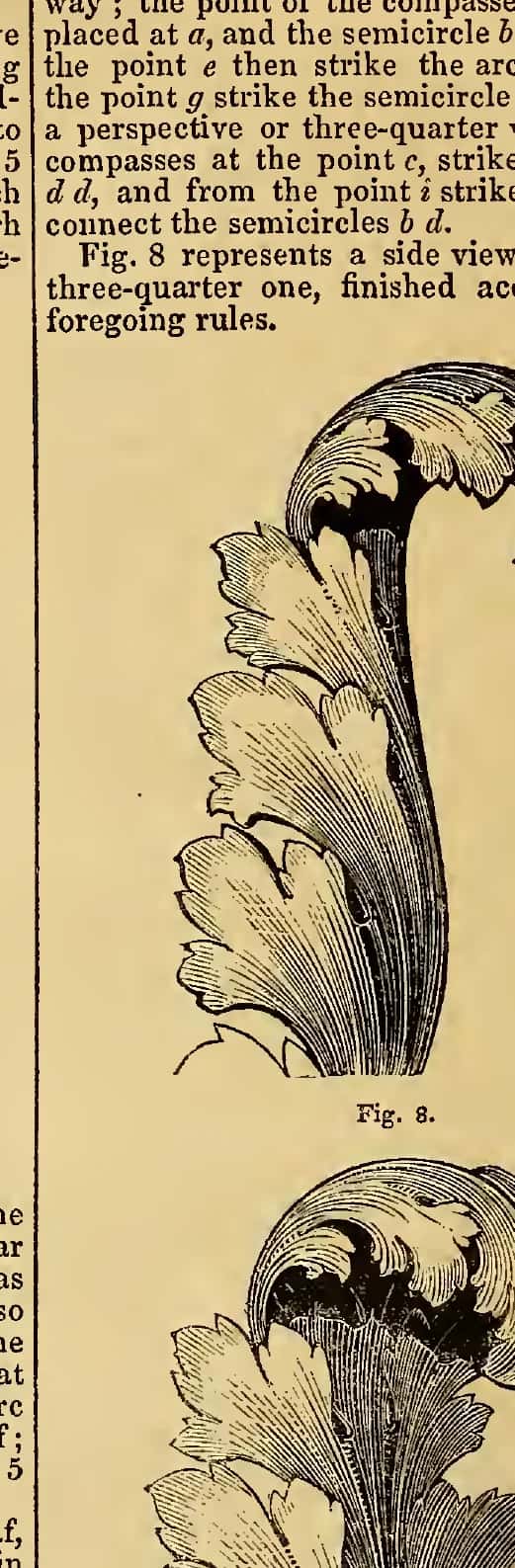
Figures 8 and 9, page 92, the bendings and foldings of the leaf.
Some numbers hold across the whole family. Count the divisions on a good acanthus and you get three or five, never four and never six, because that is how the plant itself counts.
Where the styles part company is where those divisions sit. Push them toward the center and the leaf gets tense and French. Spread them out and it relaxes and turns Italian. Same frame, different pressure. I put the two ends of that range side by side in Greek versus Roman acanthus.
Let me confess something. I have a problem with this leaf. Whenever somebody hands me a foam cup I start drawing acanthus on the side of it with my fingernail. My wife has watched me do it in airports for thirty years.
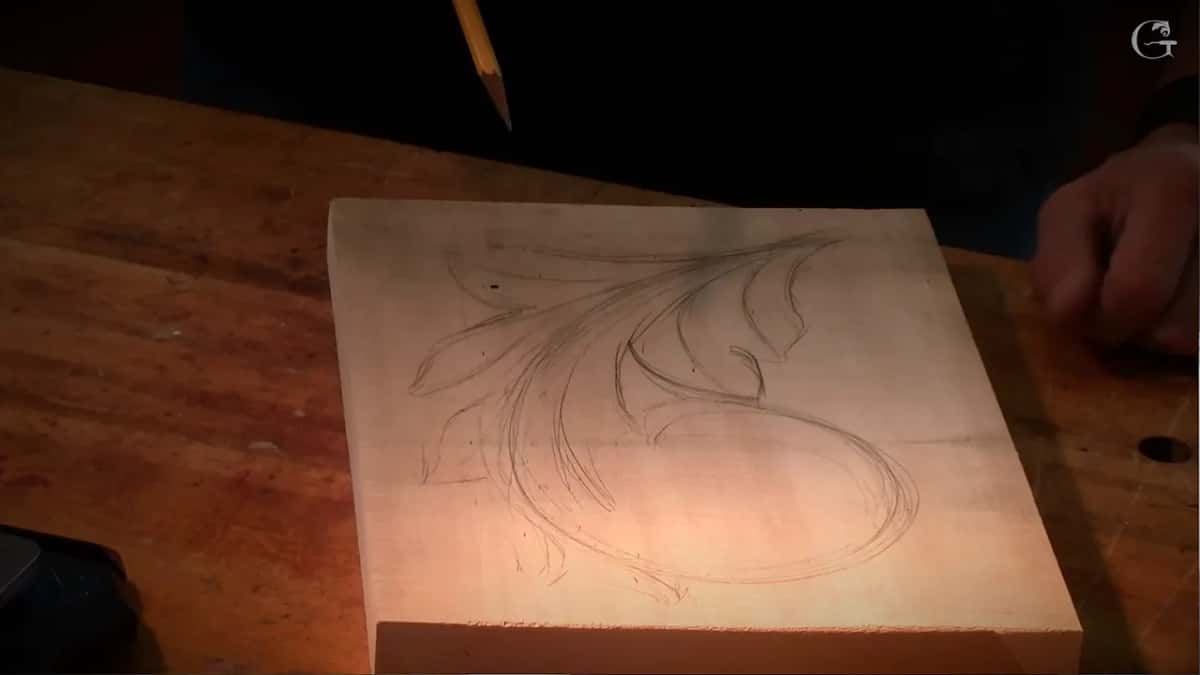
The whole layout goes on the blank before any tool touches it.
How is a volute or scroll set out?
A volute is drawn inside a square divided into seven parts, with a small lozenge at the center that fixes every arc. The 1847 text calls it the ram's horn turn of a running scroll.
The steps are on page 100:
Draw a square and divide it into seven parts each way.
From the third mark on the base, draw straight up.
Halfway up the side, at three and a half, run a second line across.
Where those two lines cross is the eye of the volute.
Half of one division gives you a small circle around that eye. Inside the circle, draw a lozenge.
Split the lozenge diagonals into six parts, and mark each one. Those points are your compass centers.
Swing a quarter of the curl from each center in turn, working inward.
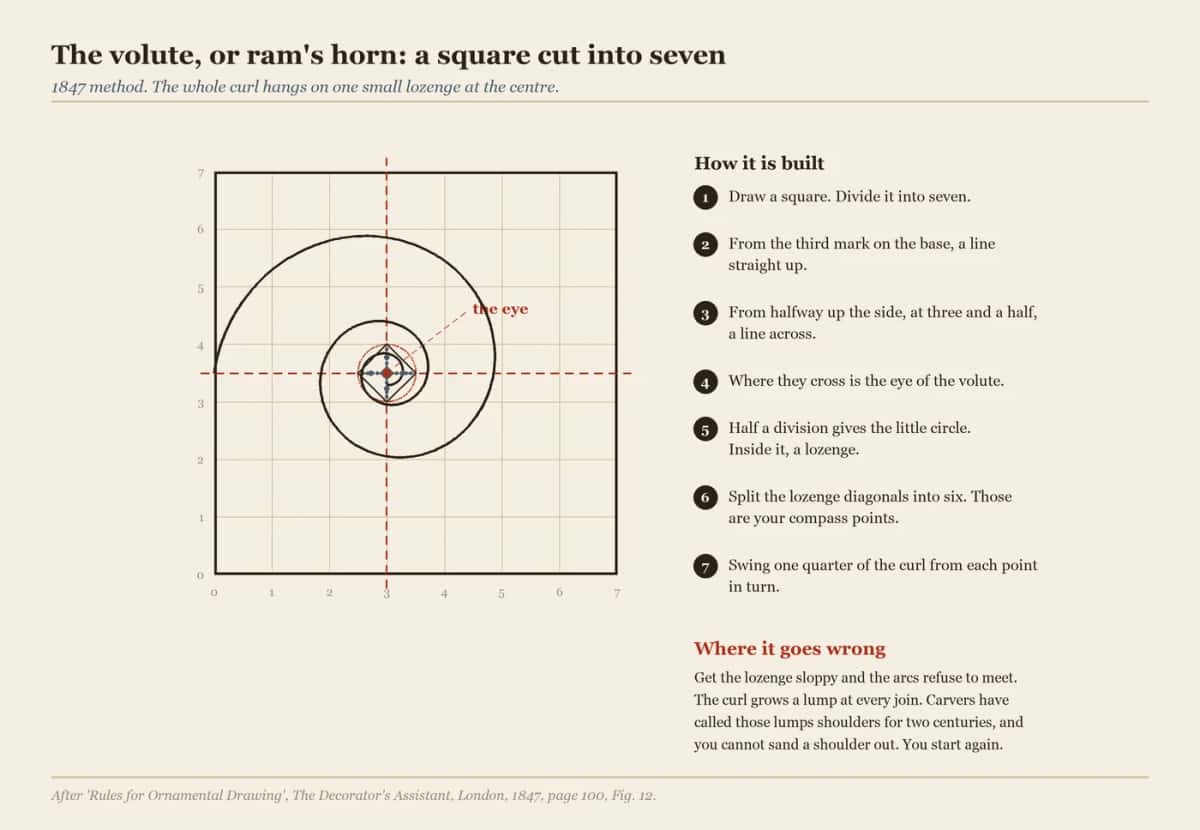
Seven divisions.
Now the warning, and I wish somebody had read it to me at sixteen. The accuracy of the volute depends on that little lozenge in the middle. Get it sloppy and the arcs will not meet. The curl grows a lump at every join, and carvers have called those lumps shoulders for two hundred years.
You cannot sand out a shoulder. The board goes in the stove and you start again.
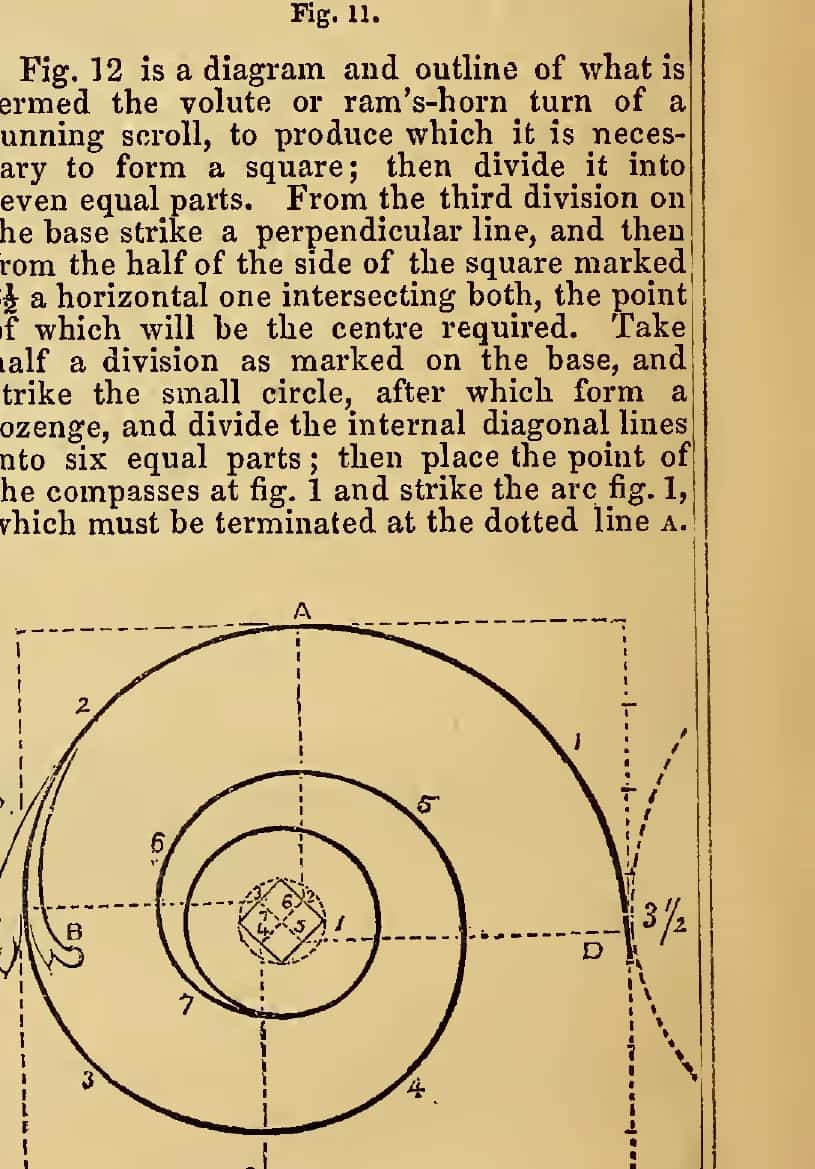
Figure 12, page 100.
I still draw them this way, in a ruled square, before I touch wood.
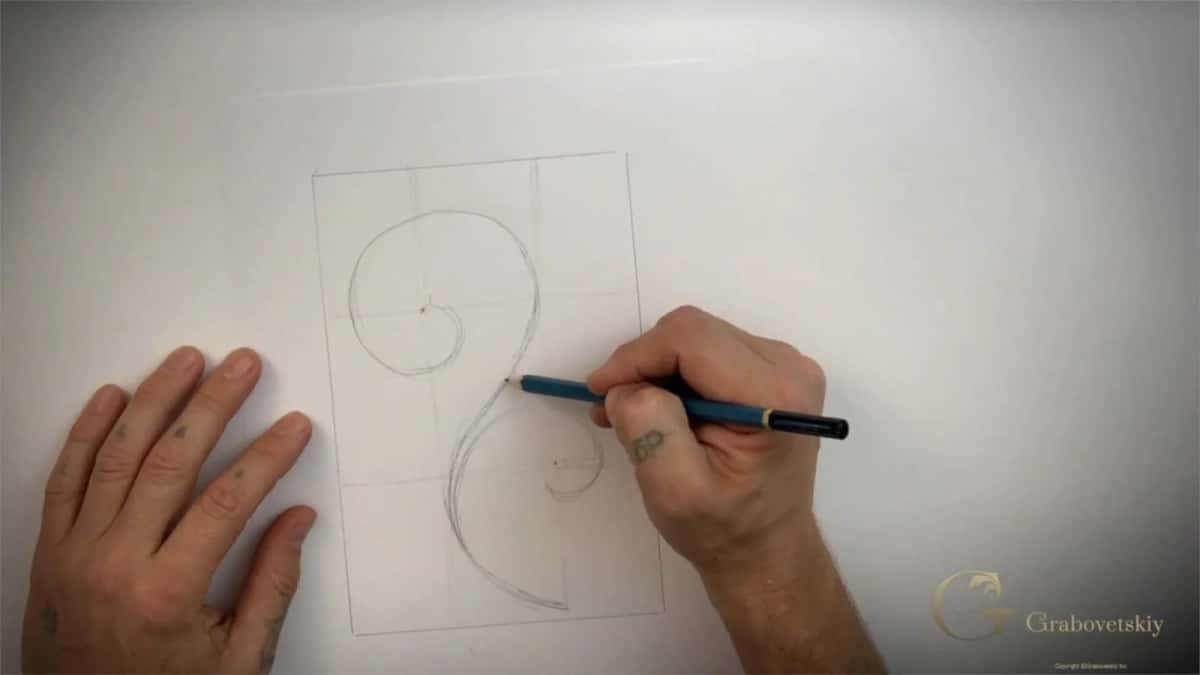
Drawing the first line of a volute inside a ruled square.
A related shape, the ogee curve, comes from two squares and two arcs meeting at a point. Between the volute and the ogee you have most of the moving lines in classical ornament. Learn those two and the rest is variation.
What are the laws that make ornament look alive?
Movement, rhythm, opposition and space, and each of them is a rule you can check with a pencil. My master taught me these as laws, not as opinions, and I teach them the same way in Principles of Design in Wood Carving.
Even in complicated work I always start with the movement. Always. Everything else hangs off it.
Nothing in nature is straight. There is no such thing as a straight line in nature, and your ornament should not have one either. Everything is supposed to connect to everything else.
Then rhythm. Rhythm is repetition of a detail, but the detail is not supposed to be the same size each time. It repeats the way music repeats. Pum pum pum, pum pum pum. The player changes the volume to say which beat matters. Press harder here, barely touch there.
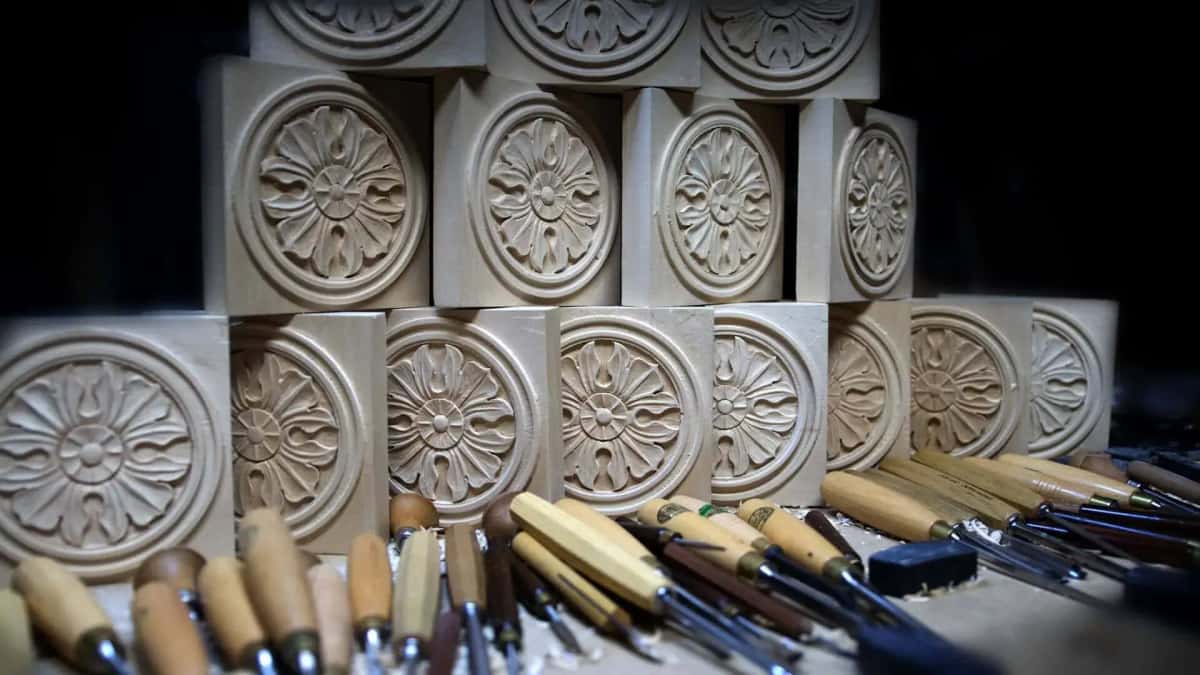
Fifteen rosettes, and no two of them measure the same.
Then opposition, which is the one people leave out. When you look at flowers in a good panel there is more going on than beauty. A war of ideas is going on, even in a simple design.
Take the fight out and the life goes too.
One shape has to be the main one. Only one main guy in a design, with something pushing against him. Give two shapes equal weight and the eye has nowhere to go, so it leaves.
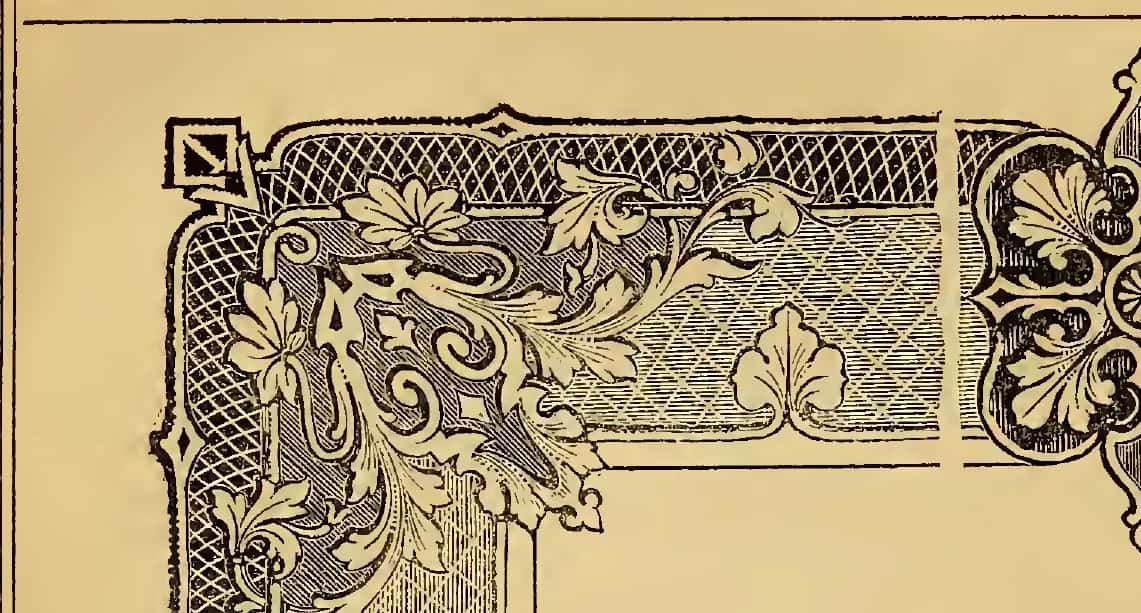
Design for a Corner and Centre-piece, page 116.
And space. Empty space holds the form up. What surrounds a shape matters as much as the shape.
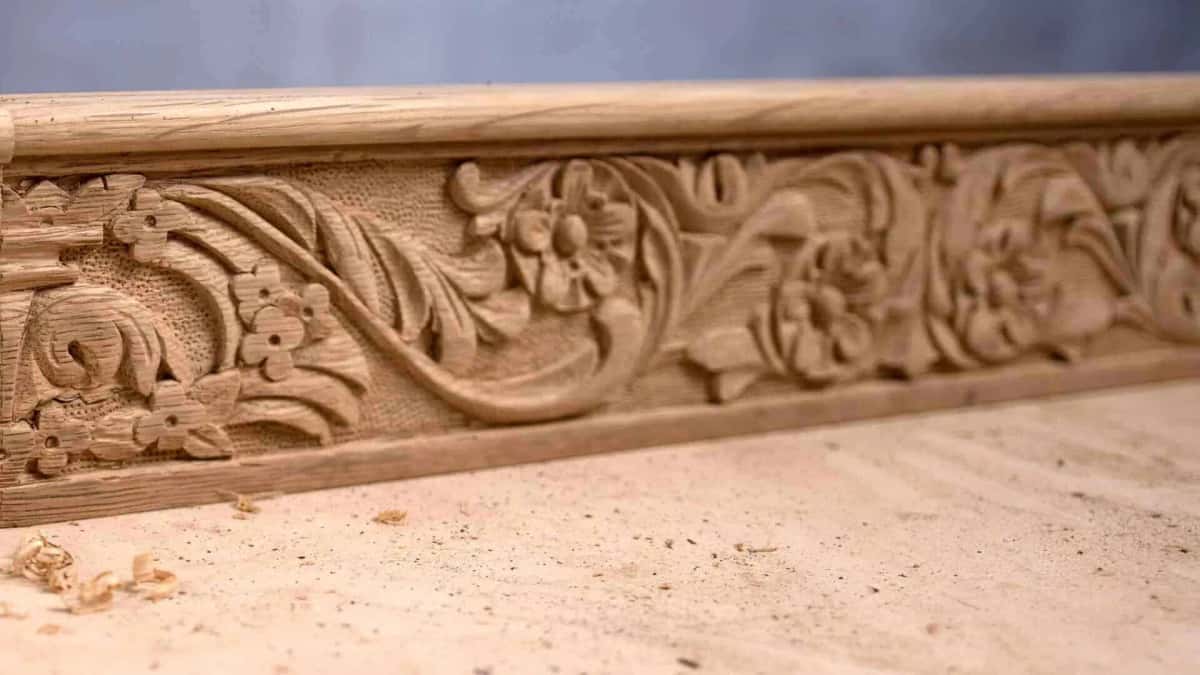
Punching the ground kills the reflections that would otherwise compete with the carving.
I have a plain word for it. Boring. And boring means one thing only, which is that the movement is not enough.
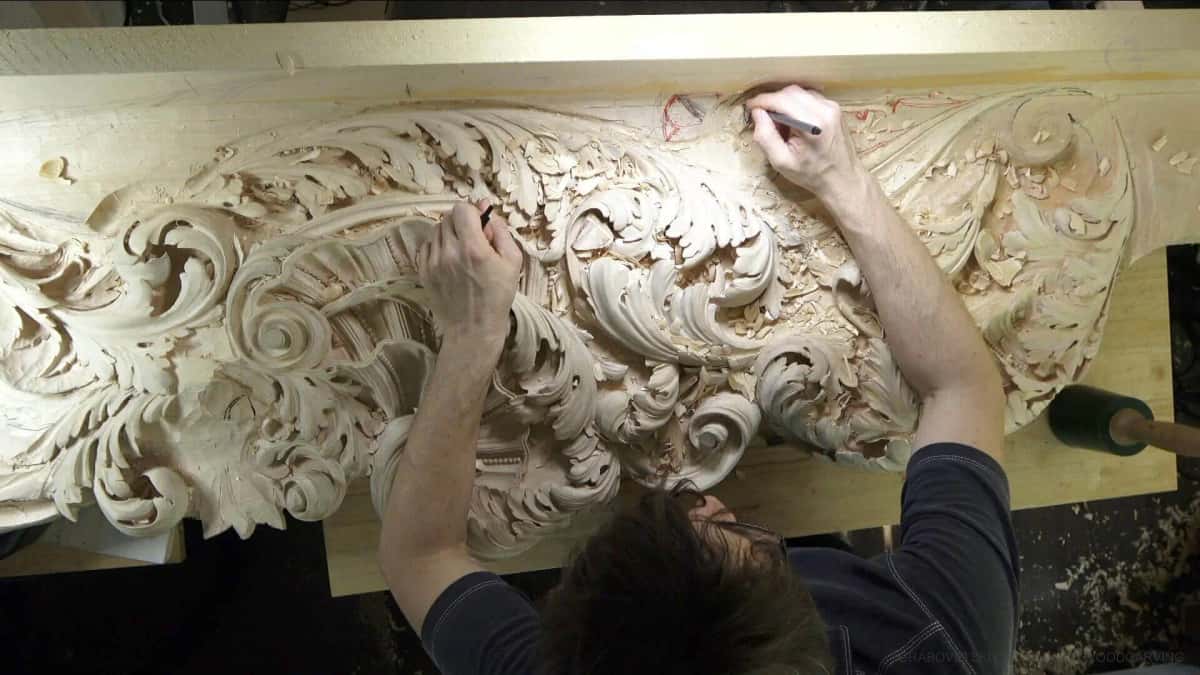
Baroque acanthus for a large room, so the cuts go deep.
Proportion sits underneath all four. That 1847 volume defines it on page 180: "By proportion, we mean, generally speaking, the size and dimensions of one part compared with another, or with the whole of that to which it appertains. Greatness is only, of course, a comparative term. Nothing can be either great or small, except in reference to some other thing."
Nothing is great or small except next to something else. That is the whole of it. When I lay out a panel I want the parts to land on a Fibonacci step, and I want the center never to be the center. Even when you are not going to see it, it is going to bug me if it is not right.
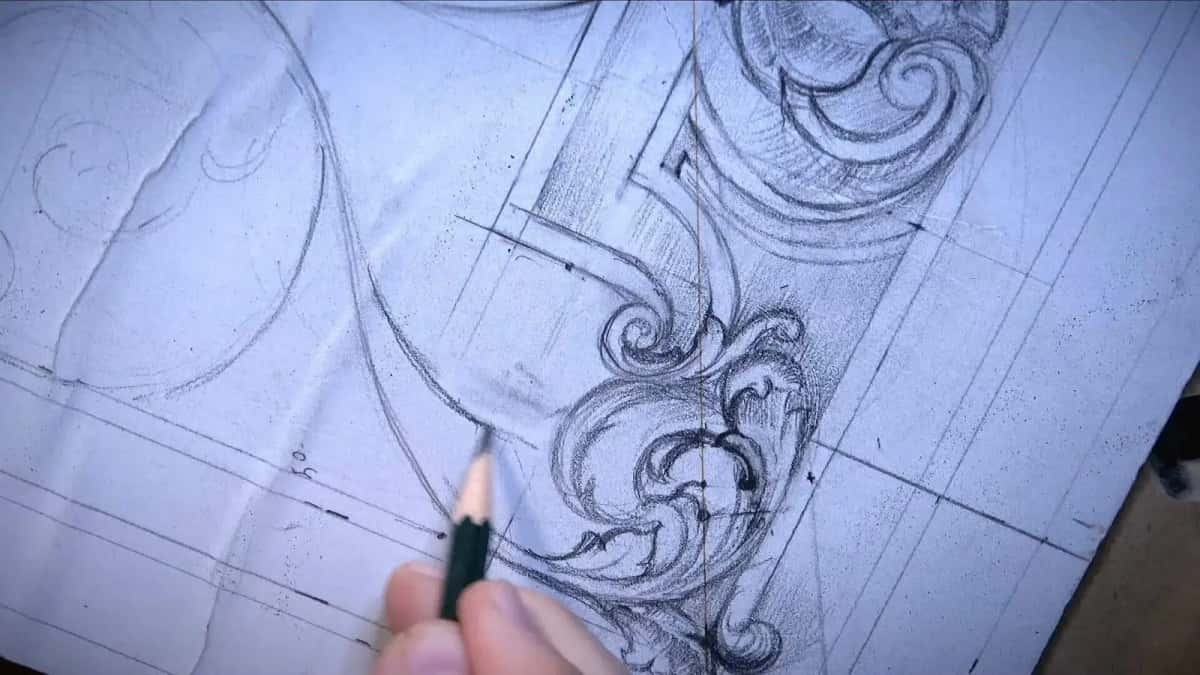
The grid and the pencil come before the gouge.
How much of classical ornament is just personal taste?
Almost none of it, and a Scottish decorator proved that to a room full of scientists in March 1847. This is the part of the book that changed how I talk about my own trade.
David Ramsay Hay read a paper to the Royal Scottish Society of Arts on 22 March that year. The weekly reported it on page six. Hay argued that there is a demonstrable truth in ornamental design which makes it beautiful, and that this truth holds regardless of the taste of whoever is looking, and regardless of style.
Then comes the thing that matters. That truth is mathematical, and so it is teachable. Taught well enough that a decorator can produce symmetry of form and harmony of color in almost endless variety, without copying anybody else's work.
And then he draws the line:
the beauty thus produced differed from picturesque beauty, in so far as the former is teachable, while the latter is exclusively the province of genius.
One kind of beauty needs genius. The other kind somebody can teach you at a bench.
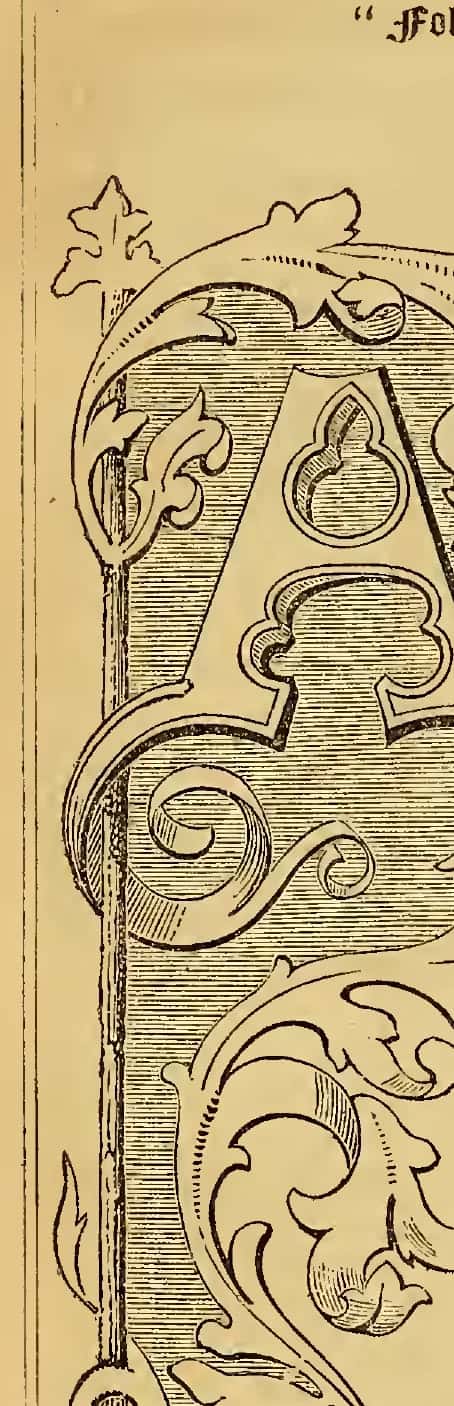
An ornamented initial, page 36.
Since the nineteen fifties and sixties this got turned upside down. True art was reduced to a kind of soul therapy, something that makes you feel good. This work is real math and real geometry.
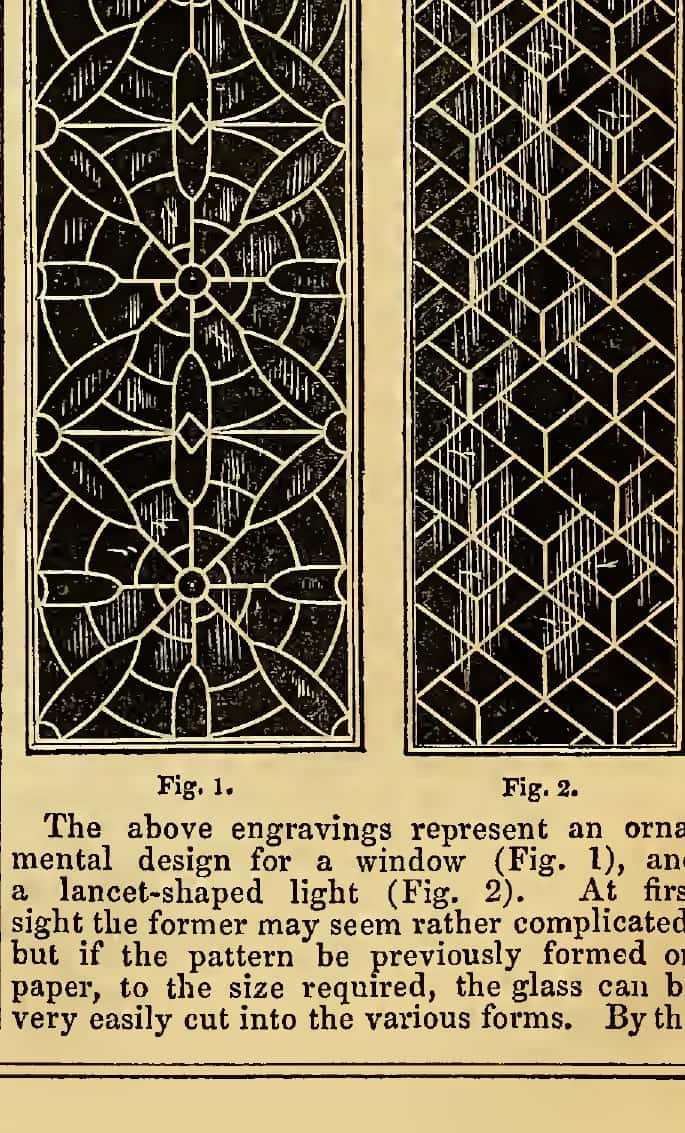
Ornamental Leading of Windows, figures 1 and 2, page 125.
The same page quotes Sir Joshua Reynolds. Beauty of form must be taken from nature, he says, but finding it takes long practice. Then comes the line itself. "We must not content ourselves with merely admiring and relishing; we must enter into the principles on which the work is wrought; these do not swim on the superficies, and, consequently, are not open to superficial observation."
They do not swim on the surface. Photographs of finished carvings will not hand them over, and photographs are what most people are studying, which is exactly why their leaves come out flat.
If you like this kind of primary source, I pulled apart a later one in Wornum's Analysis of Ornament.
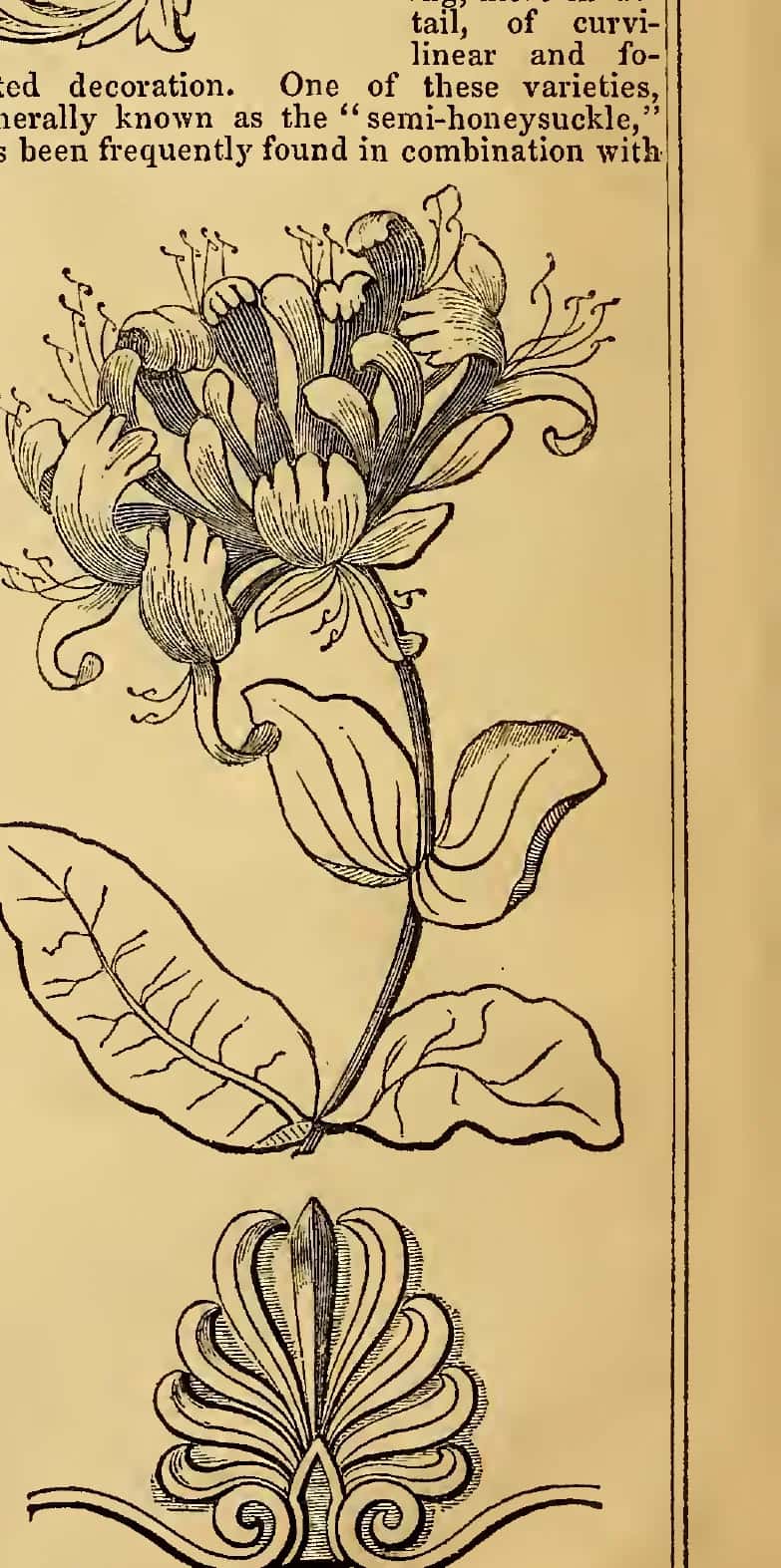
Page 60. The honeysuckle, drawn from life and then conventionalized.
Should you copy old work, or invent your own?
Copy, and copy carefully, until you understand why the old carver did what he did. Then start deciding for yourself. Anybody who tells you copying is beneath you has skipped the only reliable way in.
I encourage students to start by copying, because you understand much better what they did. Until you understand the wisdom behind it, the logic behind why they did it that way, you cannot really develop your own.
And here is the comfort. Nobody can replicate your tool marks, or copy the way your own hand lands. That mark is going to be only yours, so the work stays original whether you like it or not.
Esterly said what the work is for. Carving, he wrote in The Lost Carving, does not reproduce nature but translates it. Then he compressed the whole lesson into six words: "Don't imitate Homer, imitate the Iliad."
He is right, and the old writers agreed. There is an old book I love, and I wish I could give you the title. Two men in it are talking about carvers in stone and wood, and one asks whether the carver is trying to match nature. The master says no. We are pushing nature further, trying to be more than nature, because in nature not everything connects on one line.
So the work is an exaggeration of nature. Conventionalizing a plant means exactly that, and the 1847 foliage serial puts it the same way in its own century's language: the old carvers took a certain conventional form, departing a long way from strict imitation.
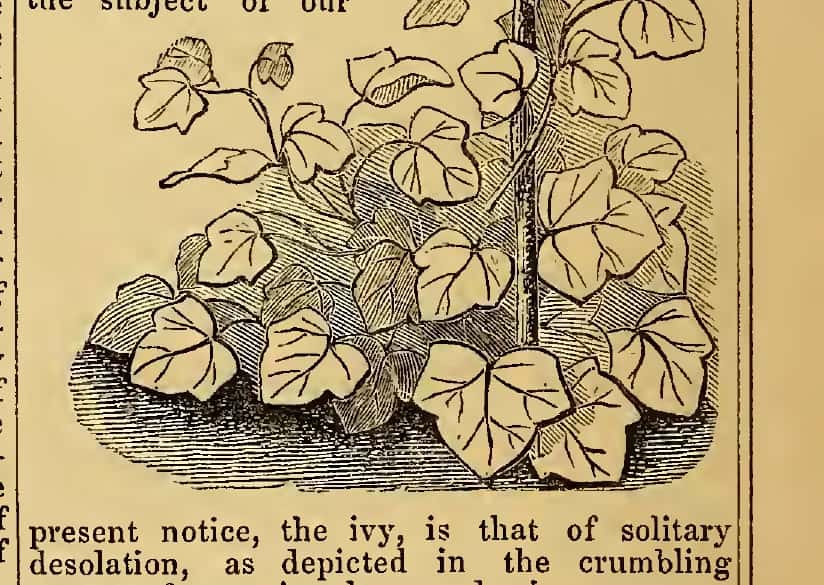
Ivy over a ruin, page 52, drawn as a source for carvers.
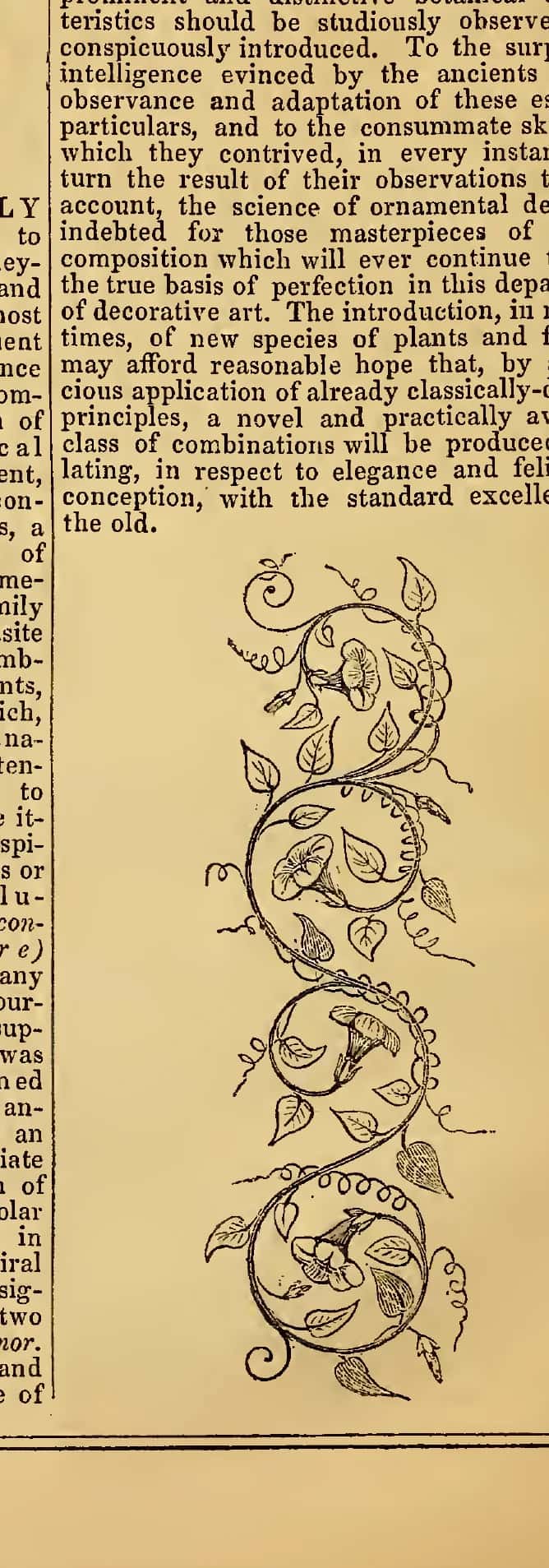
Page 108. The convolvulus winds in spiral rings.
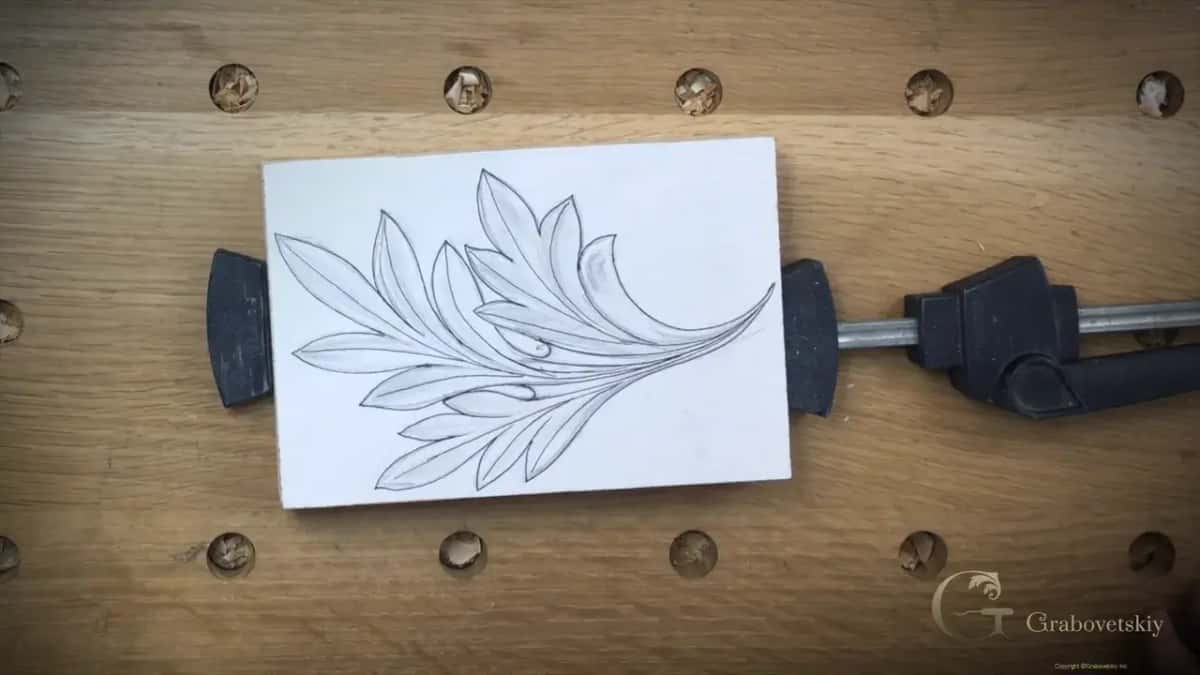
Somebody else's drawing, copied carefully, which is how you learn what they knew.
What happened to architectural wood carving?
Casting happened. And the 1847 writers watched it happen, and they were furious about it, which is why page 26 is my favorite page in the book.
Before cheap casting, enrichments were modelled by hand in wet stucco, on site, fast, before the material went off. That took a man who could design while he worked. So there were few of them and they were paid well. The book says these men turned up to work wearing swords, with lace ruffles on their wrists.
I like those guys.
Then somebody worked out how to cast ornament in plaster and papier mache instead. Cheaper. Faster. And here is what it cost, in the book's own words:
All the deep undercuttings and bold shadows which marked the style of design in the age of Queen Anne, became impracticable when ornaments were to be cast. A meagre, tame, petite manner ensued, almost of necessity, until by the end of the last century the art of designing architectural ornament had fallen into a deplorable state of imbecility.
A deplorable state of imbecility. Nobody writes like that any more, and it is a loss.
Notice the mechanism, because this is not snobbery. A mould cannot release deep undercutting, so the undercutting went. The shadow went with it. And once the shadow was gone the design had nothing left to work with, so it collapsed into something flat and timid.
The tool decided the style. It always does.
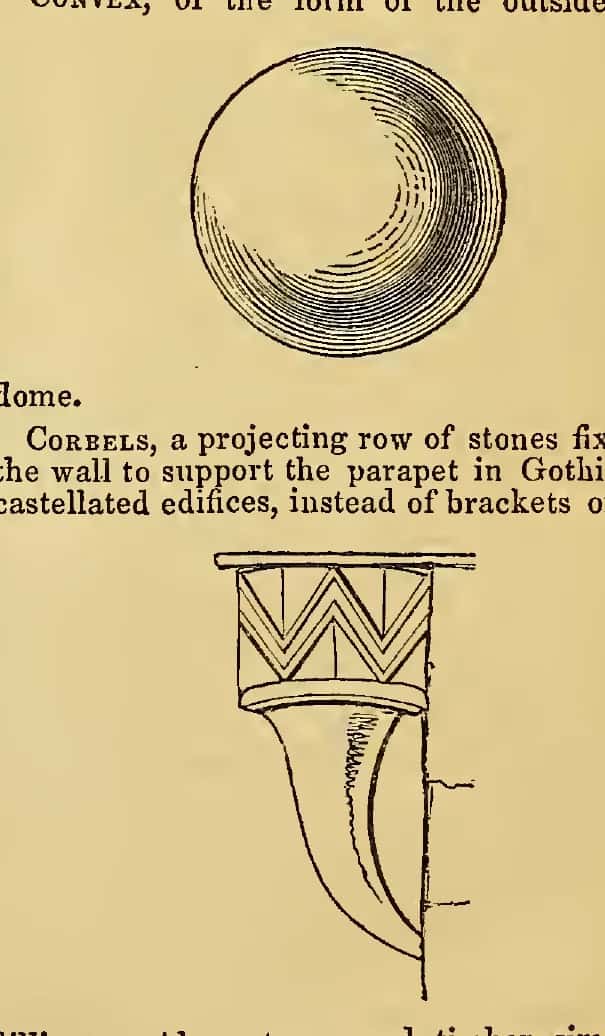
From the Illustrated Glossary of Technical Terms, page 177, where the trade words are defined.
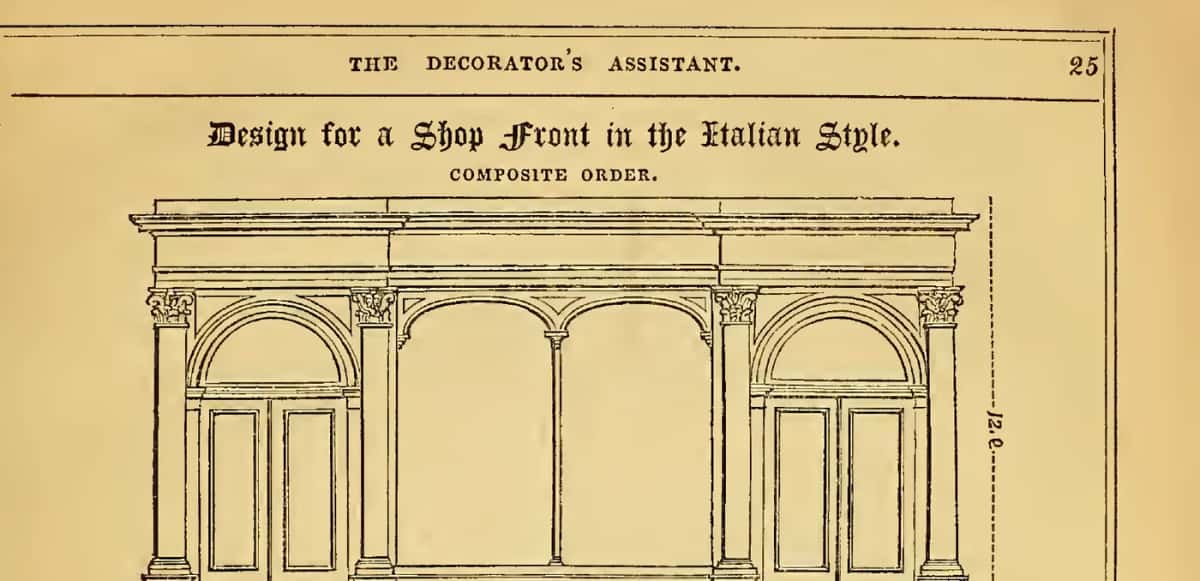
Page 25, Composite order. Carpenter and joiner 30 pounds, carved enrichments 7, and 63 pounds for the whole front.
The page before it tells you what the trade cost. Page 25 costs out a whole shop front, with the price broken down by trade: 30 pounds to the carpenter and joiner, 7 pounds for the carved enrichments, 4 to the plasterer, 19 to the glazier, 8 to the painter. 63 pounds for a whole shop front in 1847.
Read the argument about casting again and then think about a router table. I am not against machines. There are machines in my own shop. But if you shape ornament with something that cannot cut back underneath a leaf, you will get exactly the flat, tame result the 1847 writer complained about, and for exactly the same reason.
The trade is still here, though, and the news is good. Rich houses never went modern. In the really expensive houses you always find columns and a Corinthian capital somewhere, because richness and harmony have always been classical. I carve consoles and capitals for those rooms now, the same way, with the same tools.
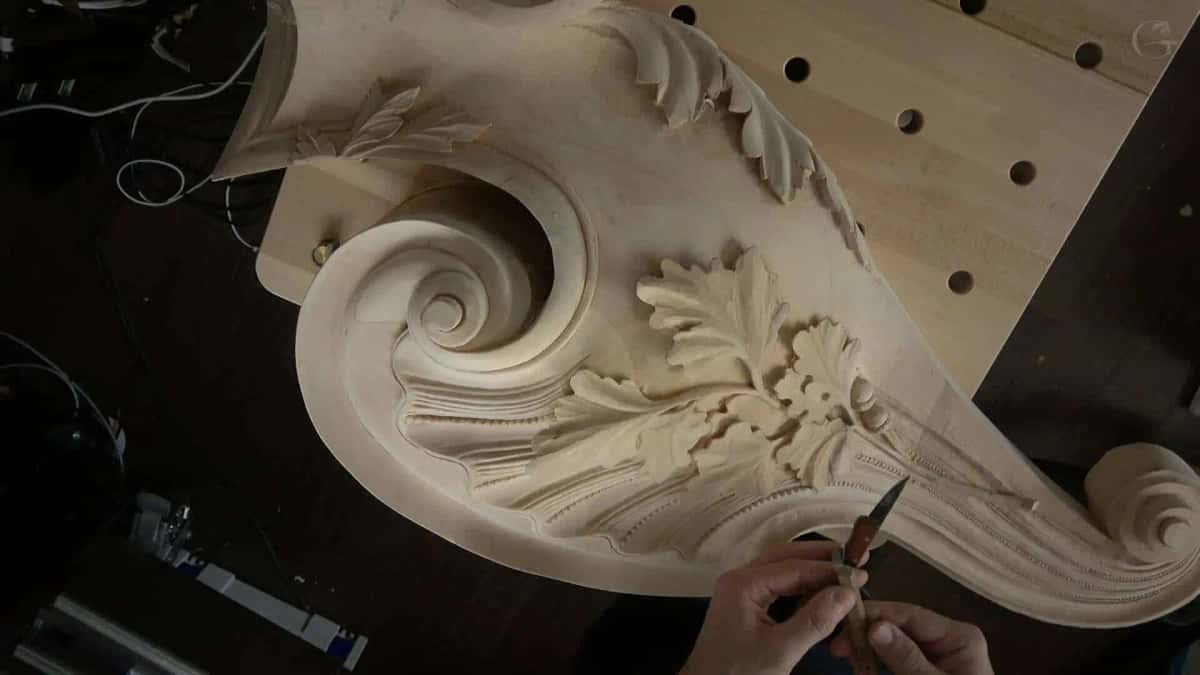
A console for a period room, carved loose and fitted afterwards.
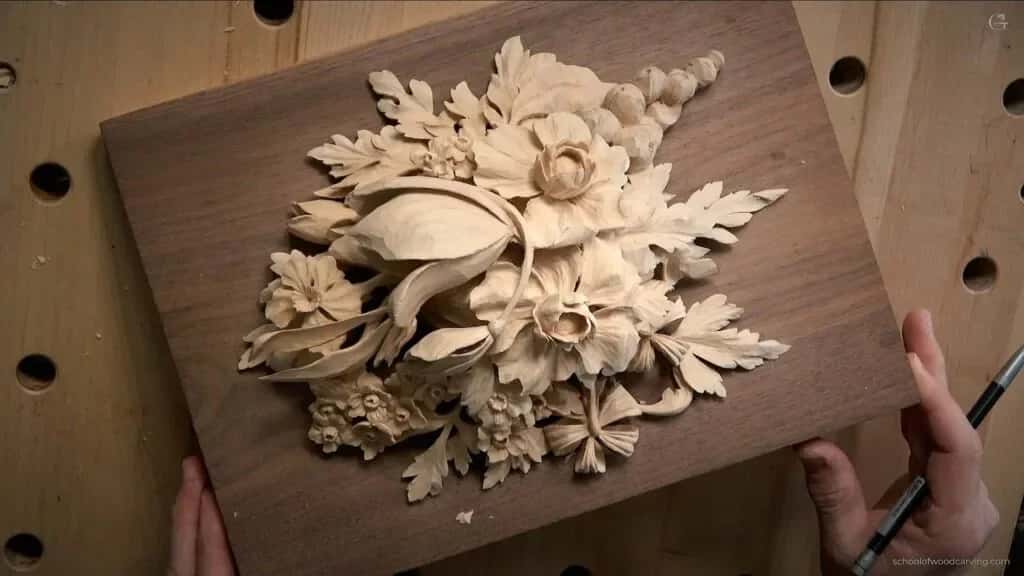
Gibbons style work in basswood, pierced and layered until the whole spray lifts clear off the board.
How long does it take to learn ornamental wood carving?
Cutting wood cleanly takes a few weeks. Learning to design ornament takes years, and that is where almost everybody stops. I would rather tell you that plainly than sell you a weekend.
The physical part is not the hard part. Anybody can learn how to dig with a chisel without much trouble. A week, maybe two weeks, and your cuts stop tearing.
Design is the mountain. One of my students studied acanthus leaves for over ten years and still did not have it, and he only started to get it when he sat down and carved one with me in person. Books look easy. The trouble is that the thing is three dimensional and the book is not.
The work has an order, and it is not the order most people choose.
When I became an apprentice, my master handed me a piece of paper and told me to draw. I spent the whole day on it. In my own opinion it looked good. He came over, looked at the paper, and said: think. Think how you will carve it. A piece of paper is not a piece of wood. What tools are you going to use, and how many do you even have?
Then he gave me a knife. One knife. He would not give me a gouge until I had mastered the knife.
That order is still right. Draw, then sharpen, then cut. And sharpening is the one people skip, which is strange, because there is no such thing as bad wood. There are dull tools, and dull tools are the only problem. If the wood is fighting you, sharpen something.
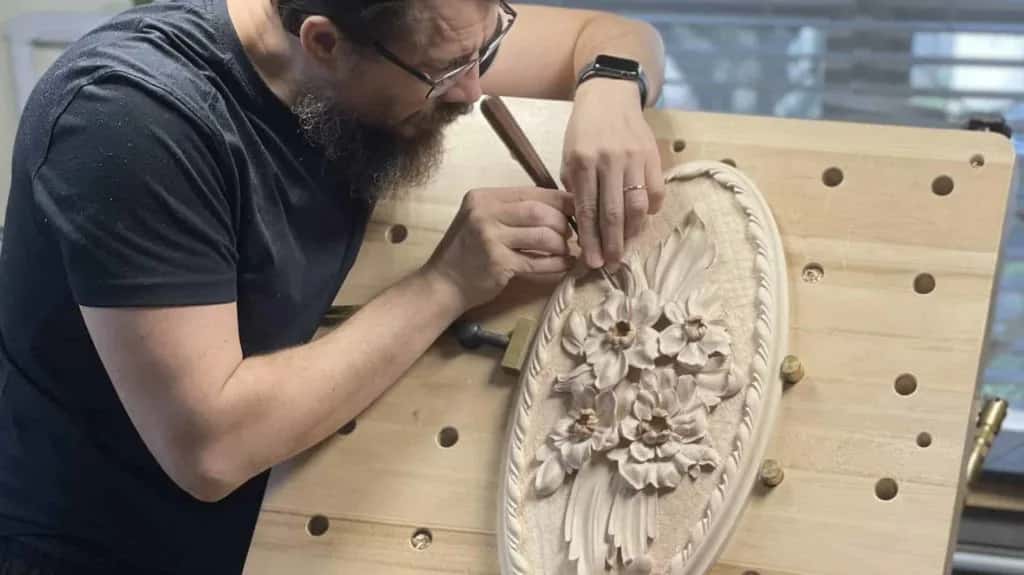
Both hands on the tool during an in person class.
So here is an honest timetable, and you will not like all of it. A few weeks to stop making a mess. Then a year of steady drawing before your own layouts look like they belong to the tradition. Several years before you can look at a wall and know what the ornament on it should be. The Corinthian acanthus is a good place to start, because it holds a leaf, a turnover and a volute all in one piece.
More you carve, more you see. Deeper you go, deeper you see.
And this is worth saying plainly, because I have watched it happen. The richest place on the planet is a cemetery, because of all the talented people lying in it who never used what they were given. If you have this in you, do something with it.
Do you look at a plain board and see what it could hold? Would you rather draw than trace? Are you tired of carving leaves that die the moment you step back from the bench?
So let's go and set one out properly.
Frequently asked questions
How does architectural carving differ from ornamental carving?
Scale and setting, mostly. Architectural work is fixed to a building, so capitals, cornices, mantels and panelling get cut bolder and deeper because nobody views them up close. The same motifs on a cabinet door get cut much finer, because a hand will be six inches away from them.
Do I need to be able to draw to carve classical ornament?
Yes, and there is precedent for saying so bluntly. Old English shops would not take an apprentice who could not draw, since a carver unable to draw cannot plan a cut. You do not need portrait skill. What you need is to lay out a shape accurately with a pencil, a straightedge and a pair of dividers.
Which wood suits ornamental carving best?
Basswood, which botanists call Tilia and Europeans sell as lime or linden. Its fibre cuts predictably in every direction and holds a fine edge on a turnover. Gibbons used the European form, and so did Tilman Riemenschneider. Keep away from construction softwood.
What tools do I need before I start carving?
Fewer than the catalogues suggest. A knife, a number seven gouge, a V tool and something flat will carry you a long way. A Victorian carver named Thomas Wallis recorded owning 228 tools while reaching regularly for about 55. Buy the next one when a shape defeats what you own.
Is the acanthus based on a real plant?
Yes. Two species turn up in the ornament, Acanthus mollis and Acanthus spinosus, and both grow around the Mediterranean. Carvers never copy them literally, though. A carved version deepens the divisions and the hollows so the leaf throws shadow, which a living plant has no reason to do.
Where can I read The Decorator's Assistant myself?
Free scans of the whole first volume sit at the Internet Archive. Issues ran weekly through 1847 at a penny halfpenny each, and the ornamental drawing series is spread across pages 28, 92, 100, 109, 116, 125, 177 and 189.