
Online and in person wood carving classes for Palm Coast, FL
Learn to carve from the first cut to a finished acanthus, without leaving Palm Coast, FL.
Many people around Palm Coast, FL want to carve wood and never start. No one put a gouge in their hand the right way. That is the whole problem, and good Wood Carving Tutorials should fix it.
Ever look at a blank panel and see the shape hiding in it? Want to draw your own ornament instead of tracing somebody else's pattern forever? Tired of a tool that tears the grain instead of parting it clean?
Then you are in the right place. I am Alexander Grabovetskiy. I carve for a living, I have carved since I was six years old, and I teach in the order it was handed down: design first, then carving, then sharpening.

Wood Carving Tutorials at home in Palm Coast, FL
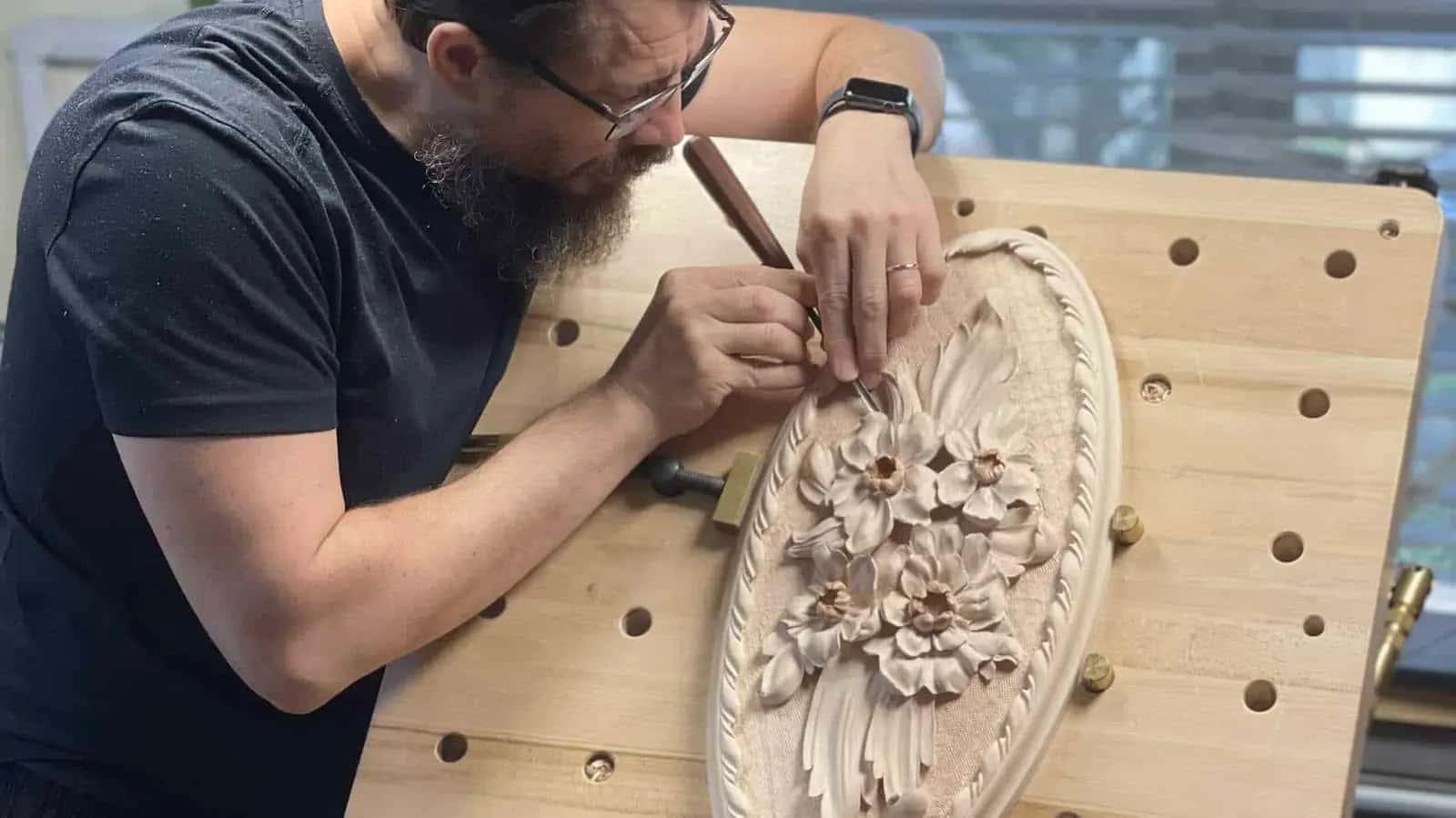
You do not have to live near a carving shop to learn this properly. The camera sits where my eye sits, so you watch the cut from the carver's side of the bench. A room full of students in the back row never gets that.
I have 46 courses up there, 618 lessons, cut into 3,036 parts. You watch a part, you go to your bench, you cut. You come back and watch it again because you forgot where the gouge was pointed. Nobody is standing there sighing at you.
And you keep your place. Stop in the middle of a lesson on Tuesday night, open it Saturday morning, and it starts where you left it.
The closest carving school to Palm Coast, FL might be half a day away. That used to end the conversation. It does not end it now.

Design first, then carving, then sharpening
Almost everybody begins in the wrong order and pays for it for years. They buy a chisel, they copy a pattern, and they never learn to draw. Then every piece they make is somebody else's piece.

Design is the geometry, the hidden laws of how a leaf turns, how a scroll runs out, how a volute closes. Learn that and you can draw an acanthus that belongs on the panel instead of sitting on it. This is the part almost nobody teaches, and it is the part that separates a carver from a copier. It has its own course here, Principles of Design in Wood Carving, and I would start there before you start cutting.

Carving is the middle. High relief, low relief, the way you cut the ground away before you shape anything. Baroque, Rococo, Venetian, the shapes that hold up furniture worth passing down. The leaf underneath all of it is the acanthus, and there is a whole course on the Greek one alone: Carving Greek Acanthus Leaf.

Sharpening is last and it is the hardest. Years, not weeks. A dull gouge tears the grain and then you blame your hands, and it was never your hands. It was the edge. Which is why Carving Tool Sharpening is its own course here and not a footnote inside somebody else's.

It makes no difference whether your bench stands in Palm Coast, FL or in a shop in Europe. The geometry of a leaf does not change with the address. Good Wood Carving Tutorials will teach you the drawing before the cutting, and the ones that skip it leave you copying somebody else's patterns for the rest of your life.
Now, shall we carve?
The wood and the tools you need for Wood Carving Tutorials
I will not pretend this part is free. Good wood is not cheap and good tools are not cheap. That is the way of it.
Carve professional wood. Limewood, lindenwood, American basswood. It cuts clean and it holds a fine edge in the detail. Take a construction two by four off the rack in Palm Coast, FL and you will get so frustrated you will quit, and you will wreck your tools doing it. There is nothing in it to learn from. It is just a bad afternoon and a ruined edge.

You do not need forty tools. You need three or four good ones, sharp. A 10mm gouge, a V-tool, something flat. Which ones, and why, and what to do when the edge stops slicing: all of that is in the courses.
If the lumber yards near Palm Coast, FL only stock framing pine, order basswood online and have it shipped. The wait is worth it. Honest Wood Carving Tutorials will always tell you this part, because the wood decides half of how the carving comes out and no amount of skill saves a bad board.

I also teach carving in person
The lessons carry you far, but nobody can film the feel of a cut. So I teach in person too, in workshops, a few times a year.
Read that carefully, because I will not blur it: the school is online. There is no building in Palm Coast, FL with my name on it. The in-person work happens at my own workshops, wherever they are held that year, and people fly in for them. If somebody tells you there is a carving studio waiting for you around the corner, that is not true.
What that means for you in Palm Coast, FL is simple. Every lesson is there tonight. A workshop is a thing you plan for.

What you pay for Wood Carving Tutorials
Tuition is $25 each month, automatically renewed every month until you stop. You cancel it yourself from your account page, in about ten seconds, and nobody calls you about it.
The school is a 501(c)(3) non-profit. Your tuition does not go into somebody's boat. It keeps the lessons being made, and part of it goes to orphans and widows. None of that is there to move you. You should simply know where your money lands.
Now, here is the part I want you to hear. God gave you a pull toward the three dimensional world for a reason, and it was not to spend your evenings scrolling. If that pull is in you, it is a gift with a job attached to it. Work on it.

Who comes here for Wood Carving Tutorials
Students here run from fourteen years old to past ninety. Some have carved for thirty years and came here for the design lessons. Others have never held a gouge in their life.
Carving works on much more than your hands. It grows the part of your brain that holds shapes in space, and it keeps that part together when you are old. I have seen it more than once. A man who cannot remember a phone number can hold a whole acanthus scroll in his head and cut it clean.
They carve in kitchens, in garages, in spare rooms, near Palm Coast, FL and a long way from it. Comparison is somebody else's idea of teaching. The wood tells you how you did, and it is a fair judge.
Frequently asked questions
Do I need my own tools before I start?
No. Watch the first lessons first, then buy. The lessons tell you which few tools to get and which ones to skip, and that will save you more than the tuition costs.
I have never carved anything. Is this too advanced?
No. Start with the beginners course, a Bird of Paradise cutting board, which begins at the first cut. There are also courses on Baroque and Venetian work for people who have carved for years, so you pick where you start.
What wood should I buy first?
American basswood, also sold as limewood or lindenwood. Do not start on construction lumber from a hardware store. It tears, it frustrates you, and it wrecks your edges.
How long before I carve something worth keeping?
Working a few evenings a week, most students finish a small relief in the first month or two. It will not be perfect. You will keep it anyway.
Are these classes held in Florida?
Everything here is online, so you study from home in Palm Coast, FL or anywhere else. Alexander also teaches in person at his own workshops a few times a year, and students travel to those.
What makes these different from free videos online?
Order and depth. Free videos show you one cut. Here you get Wood Carving Tutorials built as courses that run design, then carving, then sharpening, in that order, with the reasons behind each step.
Can I stop paying whenever I want?
Yes. Tuition renews automatically every month, and you cancel it yourself from your account page at any time. You keep access until the month you already paid for runs out.