

Alexander Grabovetskiy, woodcarver, School of Woodcarving · Published 2021
What does a wood carver mean by "let's say"?
Quick answer: Workshop 111, part 2, has me saying "let's say" just before 2 mm (0.079 in) on a number 11, after 7 mm and 4 mm. Other lessons carry the same words in front of a gouge size, a depth in millimeters, a tool you could swap in or a sample wood.
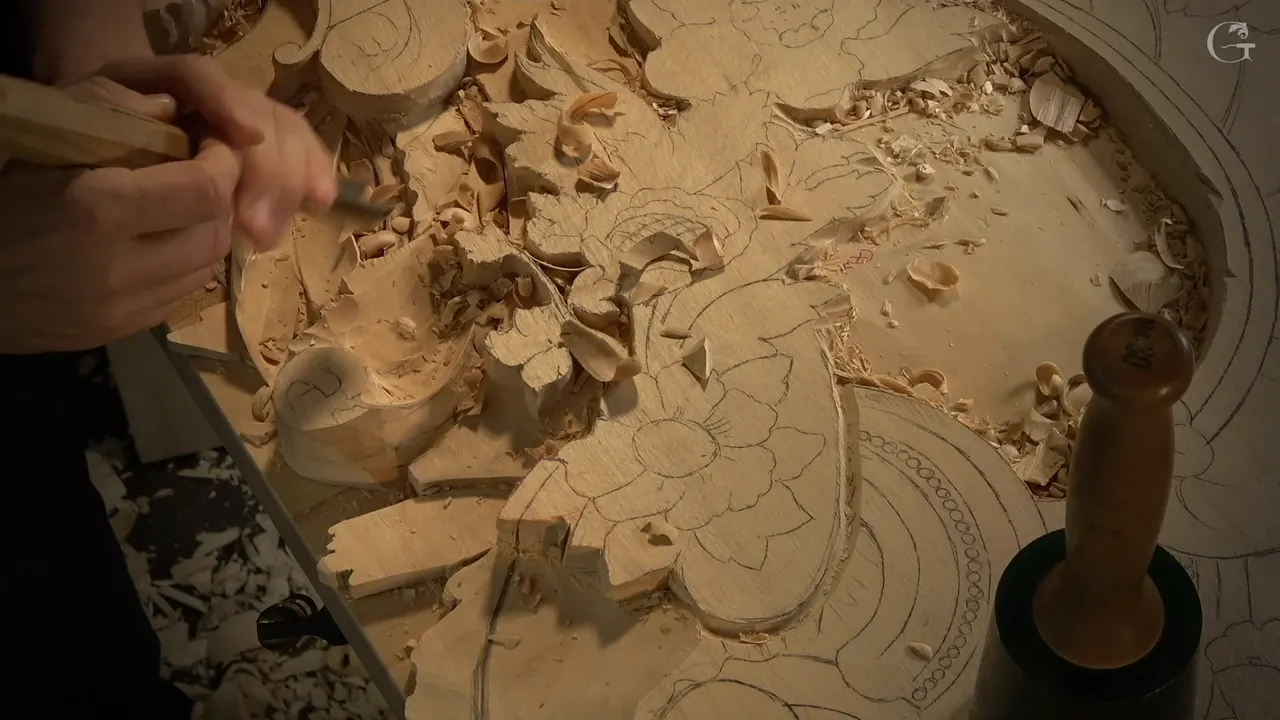

I said "let's say" in workshop 111, part 2, right before 2 millimeters (about 5/64 in) on a number 11. In my other lessons the same two words come before a gouge size, a depth, a stand-in tool or a sample wood.
Ever stood at your bench, gouge in hand, trying to say its size out loud? Did the number come out a little round, with a "maybe" or a "let's say" in front of it? Part 2 of workshop 111 is a short video, and the words sit in it. Lines from my other lessons follow, each one named and linked, so you can go and watch the hands. Every size is in millimeters and inches, my figure first.
What did I say in part 2 of workshop 111?
The video opens on a clean-up. "I like it so far," I said, and then "Let me get rid of some of the mess I created with the 20 millimeters number 11" (0.79 in). Next came "Now it's easier for me to undercut" and "much easier to get that shadow much deeper."

The head of the leaf was next: "make that head round" and "There's many different ways. I'll just use a big number seven." It "also has to go underneath" and "I don't want to damage my bench." My plan was to stop "approximately about quarter inch," which is 6.35 mm, and "I'm leaving some of the mess for me later on to clean."

For the number 11 I had another plan: "I'll lay it flat on the bench and remove some of that mess this way. That way, I'm going to keep my bench safe."
How did the sizes step down for the shadow spot?
"Also, right here, I've got another line," I said, "and I want to create some kind of shadow spot, and that's going to give me a really beautiful movement." My first pick was "probably number 11 and seven millimeters, little bigger than a quarter of an inch" (0.28 in). Then came "Maybe it's a little too big."

Four millimeters (0.16 in) came next: "Let me jump on four millimeters." I gave it two fractions: "millimeter less than 3/16 and millimeter more than one-eighth of an inch." A true 3/16 in is 4.8 mm and a true 1/8 in is 3.2 mm, so each gap is closer to 0.8 mm. "I think that is good, at least as a starting point."
The words came after that. "And I think I can jump on smaller one. Let's say two millimeters. Number 11, of course." That is about 5/64 in, and the size came with a reason: "you can already see how beautiful the shadow is."

Next on my list was the number three: "Let me blend it little better with the number three." I would "ride right on top of that movement so you can see it's kind of rough" and with it, "I can take care of that roughness and make it look beautiful." Then came "That's enough. That's good."
The part ends on a plan. "I kept that part which I don't want to touch, and that part is this part." The final words are "I want to excavate some kind of empty spot right here and make my movement going from underneath."

What did the other two videos of workshop 111 say about size?
Neither of them uses the two words. Part 1 still has "approximately" and "maybe" beside its sizes: I said "Let me create approximately 10 millimeters away from this wall line, about 10 millimeters or so" (0.39 in). Next was "a bigger number 11, maybe 20 millimeters" (0.79 in), and "I could use actually even bigger if I wanted to."
In the same video I said of that number 11: "You can use just the side of the tool as a number three flatter tool."

The plug cut sits in part 3: "10 millimeters, three-eighths of an inch, number nine." I added "I could go probably even bigger." Once I was really deep, "I can take smaller now, like a quarter-inch number nine, and in this case, it would be six millimeters." Those two sizes are 0.39 in and 0.24 in.
One more size from part 3 comes with a range. I named 4 millimeters, and then: "A little bigger than eighth of an inch. You could use 3 millimeters, 5 millimeters. It still would create the same idea." In inches, that runs 0.16 in, 0.12 in and 0.2 in.
Where else do I say it before a gouge?

More of these lines sit on the Venice Room panel, and the gouge changes with each video while the two words stay. Over in workshop 92, part 7, I said "I can take number 11 now, number 11, let's say 10 millimeters" (0.394 in).
A figure that moves sits in workshop 95, part 1, where I took "number three in about 18 mm, let's say 18, 19 mm three-quarters of an inch." My "about 18 mm" (0.71 in) became 19 mm (0.75 in) in the same line, and I went on with "I'm not really happy with that movement yet."

Two of them sit in part 1 of workshop 116. "I'm going to do the same, 7 millimeters," I said (0.28 in), and then "It could be number 11 in, let's say, 2 millimeters" (0.08 in). Between those lines came "Don't pay attention to this mess yet" and "I still have to take care of it, but little later." Later in that video: "probably take a smaller number 11. I would say, let's say 5 millimeters" (0.2 in).

A run of 5, 4 and 2 sits in workshop 127, part 3: "we're going to use 5 millimeters" next "I can use 4 millimeters" and last "I can use now, let's say, 2 millimeters." In inches, that is 0.197 in, 0.157 in and 0.08 in. My reason: "I think it makes sense just to create a lighter look, I would say."
Plans carry the words in workshop 131, part 2: "What I could do, and I probably should do, I could take number 11, let's say 30 millimeters, and rotate that to one of the sides and try to create a cut like this." Thirty millimeters is 1.18 in. It would be "almost undercutting, but it's really, really slight undercutting."
A size and a doubt share a line in workshop 143, part 1: "I could excavate with a smaller one in this section, with maybe, let's say, 12 millimeters or so" (0.47 in). Then: "Let me think if I should do that or not."

Does a depth follow the phrase too?
The wall in lily box 7, part 6, brings a depth: "I want to remove as much as possible this wall," I said, and some stays, "because I still have to develop the details." Then: "let's say approximately if I can be lower, let's say approximately four millimeters down, like 3/32 of an inch, I should be safe."

My two figures do not match there. A 4 mm size is 0.157 in, and 3/32 in is about 2.4 mm. After it I said "I should use smaller tools for that" and my pick was "number nine and quarter inch, six millimeters" (0.24 in).
Another depth turns up in part 7 of that lesson, in the same tone: "I'll go almost all the way, and leave approximately about five millimeters, let's say 3/16 of an inch for now. And that can also be gone." Five millimeters is 0.197 in, and a true 3/16 in is 4.8 mm.
Depth comes up again in lily box 2, part 5: "three millimeters deep. And I usually don't like to go deeper than that." Then: "In cases like that, if you have to blend from the edge in, so if you're going to go deeper, let's say 5 millimeters or 3/16 of an inch, or 6 millimeters, like a quarter-inch, it's not going to be looking good." The 3 mm is 0.12 in, the 5 mm 0.1969 in and the 6 mm 0.236 in.
In workshop 128 I talked about taking material down: "I can actually go almost as low as this side, about 30 millimeters almost." Then, "maybe about 25 millimeters, let's say," which runs from 1.18 in down to 0.98 in.
The surface in workshop 148, part 2, gets numbers too: "So that is going to be about, let's say 10 millimeters" (0.394 in). Then: "it's actually rising up, and it becomes six millimeters at this point, and it becomes only three millimeters right here." Those are 0.236 in and 0.1181 in.
Does a stand-in tool follow it too?
Furniture panel 21, part 5, gives a bigger tool: "You can always use a bigger tool, let's say like number 7, if you have. And in my case, I could probably try to use 20 millimeters, number 7" (0.787 in). Then: "It should give me clean cut, I should say."

A plan and an offer sit in furniture panel 18, part 7: "Let me clean that again with number nine." The offer: "Or you could use actually a little flatter gouge, to clean that area, let's say like a bigger number four or so." My router plane was still coming, "but just to prove a point so it's possible."
In part 11 of furniture panel 19, a pair of sizes sits in one line: "let's say half a millimeter or just the one millimeter, whatever is best for you, and just go ahead and just clean all around." Those are 0.02 in and 0.04 in.
Furniture panel 15, part 2, shows "Let me use number nine, let's say. Ten millimeters, number nine. Exactly the same idea" (0.3937 in).
The knife comes first in furniture panel 22, part 10: "After cutting with the knife, I could go in with the number 11 and let's say one millimeter and go in even deeper if I want to" (0.04 in).
Roman acanthus 16 has the words over chips: "You could use a knife to remove those chips, just like that, until they fly out. Or you could use a gouge, let's say a number five. And I'm using just a quarter inch." A quarter inch is about 6.4 mm.

Over in lily box 4, part 9, I said "Number seven, let's say. Whatever fits to that profile." Then "This is a number seven, and approximately maybe 12 millimeters, I'd say. Little less than half an inch" (0.472 in).
Greek acanthus 2, part 2, offers "I could use, let's say number seven, or 14 millimeters, and I can just make my preliminary cuts just like that" (0.55 in). And then: "I'm not afraid of hitting the wall."
Greek acanthus 4, part 1, offers a start: "One of the easiest would be just to take small gouge, let's say I can use probably even number 11, three millimeters. You could use number nine" (0.1181 in). Then: "That probably would be the safest way to do."
A smaller back bend appears in Greek acanthus 9, part 3: "I can just bring another back bend, a smaller one, let's say I can use still number 25, but only six millimeters, and continue my undercutting this way" (0.2362 in).
Hashemi flowers 11, part 5, goes the smallest: "let's say, half a millimeter gouge, like a micro tool." Then: "It's actually even better. Then I can make a separation cut really deep." The half millimeter is 0.02 in.

Does it name a sample, not a size?
Other lines carry no tool at all, only a wood or the size of a project. Lily box 1, part 1, has "If it would be a softer wood, let's say lime wood, or I call it basswood, it's okay. I could glue it right on top. But this is olive wood, and it's a harder wood."
Workshop 104, part 1, uses it for a big project: "Let's say you've got 36 inches by 120 inches, so I'm talking about 3 feet by 10 feet long." In metric, that is 914 mm by 3,048 mm. My answer on big tools versus small has two. "The medium size tool, let's say three-quarters of an inch tool, is just like a driving" (about 19 mm), and next "let's say if you're going to take a small tool, you're still going to get there, but it's going to take you about forever."
Lesson by lesson, the sizes at a glance
| Lesson | What follows the words |
|---|---|
| Two millimeters | A number 11 after a four, workshop 111 |
| Ten millimeters | A gouge on small movements, workshop 92 |
| Eighteen, nineteen millimeters | Three-quarters inch, number three, workshop 95 |
| Five millimeters, then two | Two number 11s in workshop 116, part 1 |
| Five, four, two millimeters | Run of three in workshop 127, part 3 |
| Thirty millimeters | Slight undercut plan, workshop 131, part 2 |
| Down four millimeters | Mismatched fraction in the lily box seven lesson |
| Five or six millimeters | Deeper than three, lily box 2, part 5 |
| A bigger number seven | Probably twenty millimeters, in furniture panel 21, part 5 |
| A small number 11 | Three millimeters to start, Greek acanthus 4 |
| A micro tool | Half-millimeter gouge, deep separation, Hashemi flowers 11 |
| Lime wood | Softer sample against olive, lily box 1 |


Is there a gouge on your own bench whose size you only know by feel? Every lesson named on this page opens with full access to the school. The Part 10 course page lists workshops 110 to 121, and workshop 111 has its own lesson page, next to more wood carving.
How it's done
- Clear the mess. Getting rid of some mess with the 20 mm (0.787 in) number 11 came first, and then I said "Now it's easier for me to undercut."
- Spare the bench. Damage to my bench was the worry, so I planned to stop short and leave mess for later.
- Name the first size. Seven millimeters (0.276 in) on a number 11 was my pick, and I called it maybe too big.
- Step down. Four millimeters (0.1575 in) came next, and "let's say two millimeters" (0.079 in).
- Blend the roughness. The number three could make that roughness look beautiful.
Frequently asked questions
Which gouge sizes came up in 111-2?
Part 2 names a 20 mm (0.7874 in) number 11 for the mess and a big number seven with no size. Next came 7 mm (0.276 in), 4 mm (0.1575 in) and 2 mm (0.0787 in), with "Number 11, of course" at the last one. The number three is for the roughness.
How did I plan to keep my bench safe in 111-2?
I did not want to damage it, so I meant to stop approximately a quarter inch (6.35 mm) short, leave some mess for later, and lay the number 11 flat on the bench to remove some of it.
What came after 7 mm in 111-2?
Seven millimeters (0.2756 in) was my first pick, and then I called that size maybe a little too big. Next, 4 mm (about 4/25 in) came in, and I said it was good as a starting point.
What to carve next