

Alexander Grabovetskiy, woodcarver, School of Woodcarving · Published 2021
What does a wood carver do right after saying "let's start"?
Quick answer: Workshop 111, part 1 shows it. After "Let's start" the next line named a wall line and "about 10 millimeters or so." My plan then named 20 millimeters (just under 0.8 inches). In other lessons the words sit beside a 7 millimeter (0.28 in) gouge, a V tool, or a spoon.
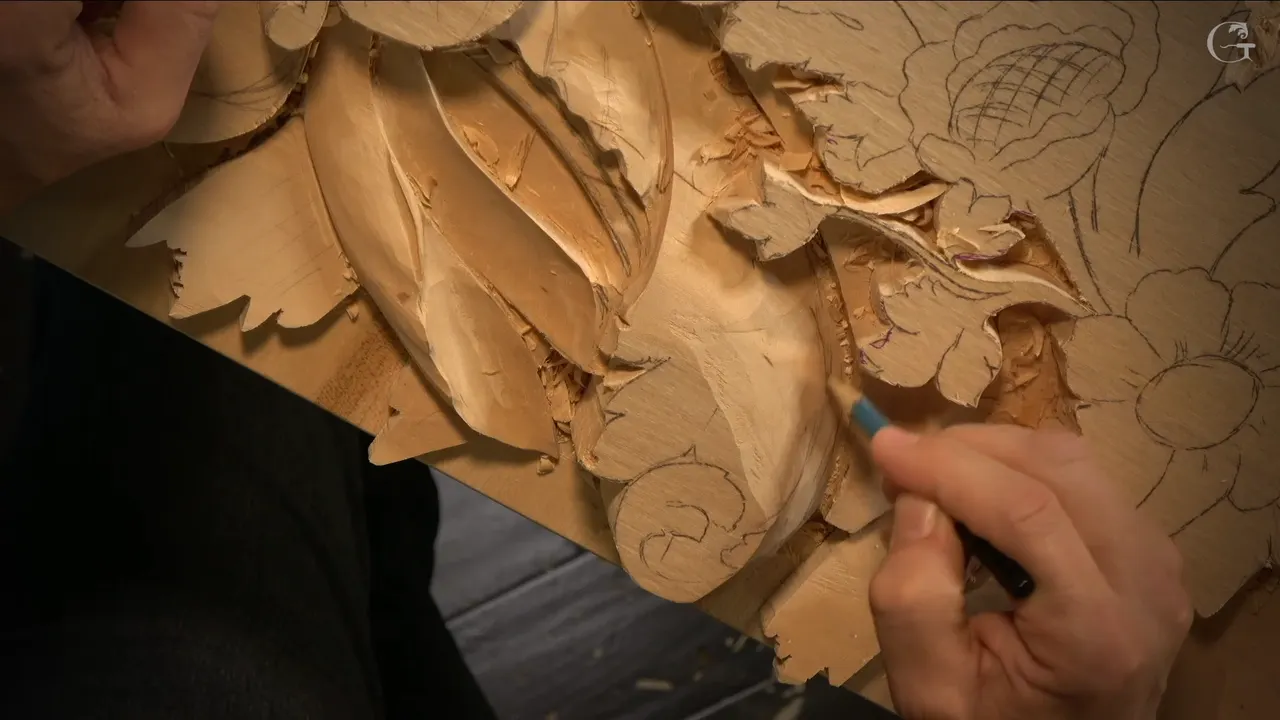

In the first video of Venice Room workshop 111 I said "Let's start" and the next line was "Let me create approximately 10 millimeters away from this wall line." In my other lessons the same words sit beside 7 millimeters (0.28 in) on a number 11, a V tool, a spoon, or a number nine and 20 millimeters (0.8 inches).
Ever stood over a board with the tool in your hand and no idea where the first cut goes? This page follows two words, "let's start," through one short video and then through wood carving lessons from my other courses, with the lines around each one so you see what came before the cut and what came after. Every size is in millimeters and inches, my figure first.
What did I say before "let's start" in workshop 111?
The video opens on a plan, and I wanted to jump on "this area on this guy." "Some acanthus development" was coming, I said. Its purpose was "just a frame around those flowers," yet "I'm still going to spend some time."
One movement was "going from almost nothing right here." "Flipping this way" came next, and another part would "go underneath" with the area "excavated" and, I said, "concave."
A last plan sat in front of the start, "some kind of line work and so on" and "those two" would "grow from something like that." Then came the line this page is built on. "So it's going to flip this way. Okay? Let's start."
What came right after it in the same video?
The next line named "this wall line" and "about 10 millimeters or so," which is 0.4 in. It would be "part of that acanthus movement" and my plan named "a bigger number 11, maybe 20 millimeters," close to 0.8 in. I could use "even bigger if I wanted to."
Next, "that anyway has to be a concave" and "just excavate this thing then" with my pressure planned "only on the left side of the tool."

A number 11 is a U shape, I said, and "You can use just the side of the tool as a number three flatter tool." About the concave: "I like that concave right here what I created." Then "not the final yet." I planned "a little deeper concave" and wanted "that shadow much sharper and nicer."

What came after the concave?
I said "let me outline this guy first" and then, "not outline, but lower that down." My reason was "I need to round the head of acanthus." And "I don't really need that high." Next: "Let's move this direction" and a verdict, "Maybe it's a little too high." Later: "That is good, but this part could be little lower."
It "has to go downhill like that," I said, "so that's why I'm creating movement this way." Then: "let me actually use a different tool." I named my skew chisel, "big one, one inch," which is 25.4 millimeters. "One of my favorite tools," I said, and "I'll attack that." It would help me "to blend nicely."


Then: "Let me try a different angle for you to see what is going on." Near its end the video turns to the acanthus head: "I am happy with the result" and "Let me outline this guy, this acanthus head."

How did workshop 111 go on after the first video?
Video two opens, "I like it so far" and continues with "Let me get rid of some of the mess I created with the 20 millimeters number 11," a size of 0.79 in. It has "a big number seven" and a planned stop at "approximately about quarter inch," which is 6.35 millimeters. Later come "it's easier for me to undercut" and "much easier to get that shadow much deeper." The third video says the section would be "cut all the way through" and names "10 millimeters, three-eighths of an inch, number nine" for the plug, though three eighths is 9.525 millimeters. All three sit on the workshop 111 page.
What does "let's start" sound like in my other Venice Room lessons?
Here are Venice Room lines, each with what came before and after. The plan in Venice Room 62 was "I need to lower down the middle section." I named "number 11 and seven millimeters," a little over a quarter of an inch, and the line ended "let's start." Next: "That's kind of wrong way of doing it. This is going to be the right way." And I was "not afraid" of my middle line going "a little lower."

Over in Venice Room 70 the words come with a twist: for me it was "let's continue" and "for you, let's start." After that: "Should I work on this one right now and then jump on development of those shells and the details, or I should continue to work on this side?" Another video of that lesson has "10 millimeters, like, 3/8 of an inch or so," which is 9.5 millimeters on the fraction, with "And let's start rotation." Next: "I remove that plug. Beautiful."

The second video of Venice Room 148 opens on it. I planned to start "probably from that shape" and go "all the way that direction" with "just one side" and the flower "off camera." Then: "But let's start. There's going to be a small acanthus sticking out."

Before the start in Venice Room 114, a flower, I said "let's develop some movements." After it came "It is simple flower, but still I want to make it look really nice" and "let me think from which one I want to start" then "let's start from this one."
Take Venice Room 128, where "let me undercut" comes first, with "again number 11" then "7 millimeters" (0.276 in). Then: "I need to attack that from opposite side." And "I'm not going to undercut yet." The part has "Final, final undercut" and, after it, "That's enough for now."

Venice Room 49 has "But let's start. So let me start." I use "a lot of veiners," I said, and in that lesson I planned "seven millimeters, little bigger than a quarter inch."
An eye comes first in Venice Room 47: "Maybe I can get actually bigger eye. And this one a little smaller." Next, "Let's start with this one" and a straight number 11 was "not going to fly because I have stuff on my way." For the tool I planned "spoon" at "two millimeters in this case" (0.079 in).

An outline comes in Venice Room 87. "So I have to be really careful, and I cannot use too big of tools." Then "just number nine at three-quarter of an inch" and "let's start outlining." Three quarters of an inch comes to 19.05 millimeters.
Then there is Venice Room 135, with a new kind of cut. "Although we don't have yet any concaves and convexes, so let's start on those concaves and convexes." The tool in my plan was "number 11, I would say, maybe about five millimeters," (0.197 in). Next, "let me start with the extreme one."
In Venice Room 27 the words land on an idea, "let's start developing the idea" and I needed "to actually just excavate around first" before I could "make feel like it's flipping from that side."
Look at Venice Room 104. "But anyway, so let's start, and I'm going to start working on it. I hope you're going to like that process." And: "that type of carving, what I'm doing on the walls, could be applied to any type of framing."
Does "let's start" come with a V tool?
Look at Hashemi flowers 45, where "Now I have to decide which one is going to flip over which" comes first. A V tool follows: "Take a V tool, and carefully let's start my cut." And last, "Let me blend that a little bit nicer."
A V tool shows up in Hashemi flowers 37 too. After "Let's work on details" I said "let's see how much down I can go." The V-tool was my first pick, with "I'll just undercut" and "I'm just laying on one side."
What else do the Hashemi lessons say?
Over in Hashemi flowers 28, the video opens on a layer: "let's start on this second layer now" with "I hope everybody does understand what I do have in mind."
Hashemi flowers 44 sets the words beside a form: "let's start, for example, with this one" then "First of all, definitely I need to establish more form" and "I can use just a knife as a preliminary cut."

Does a measurement come first, before "let's start"?
Furniture Panel 39 does, and you can see it in that lesson. "Going to get my calipers and let me check what I've got." The reading was "little less than a quarter of an inch" and a quarter inch is 6.35 millimeters. Next came "let's start" then "a number 11" as the first tool, in "two and a half" millimeters, about a tenth of an inch. The size "does not have to be" that, I said, "but it just happens."

Roman acanthus 2 opens with "let's start working on it" and a block: "one inch and 7/8. Well, 47 and a half millimeters to be exact." One and 7/8 inches works out to 47.6 millimeters. The background was "about one-quarter inch," or a bit over 6 millimeters, and to mark it, "we're going to use woodworker's marking gauge."

The second video of Hazelnuts lesson 1 opens on the wood, "a basswood or a limewood if you're in Europe, a linden wood." It is basswood, and I said, "American basswood in my case." The words "let's start" lead into "attack from the side" with "number nine and the 20 millimeters" (0.787 in). "The bigger tool you can use, it's always better at this stage." The whole course sits on the Hazelnuts course page.
The plan came first in Grape Onlay 11: "I can actually do the main part, which is gonna go above, but section of it can go right underneath." Next came "let's start" followed by "I'm gonna use, uh, as always my favorite number 11," while the size was "five millimeters at three 16th of an inch, uh, for outlining." Five millimeters is 0.2 in, and three sixteenths of an inch is 4.76 millimeters.

Vase with grape leaves 3 ties them to clock positions. "We're going to start straight down." And: "Let's start movement facing 2:00 now."
The beginner course, workshop 2 has them over angles, "either right-hand angle or left angle" with "let's start from the upper one" after it.
What comes ahead of "let's start" when I design?
In Furniture Panel 3 I said "I made a mistake" and "My line should be right here." Then "So let me get rid of this one" and "let's start the movement."
Roman acanthus 1 takes them to the design itself, "the process of the actual design," followed by "just establishing my eyes, okay, and the main points."
On the Floral and Molding lesson 3 page, "let's start" comes before "developing of this section," a section with a molding and a volute. Then: "That section has multiple details."
Chamomile and Bow Rosette 1 has them before the second piece: "let's start," followed by "I've done one side already, and you can see" and "work on the second piece."
Do I say "let's start" at the grinder too?
In Sharpening back bent gouge I said, "I think it's probably a really good position for me, and let's start grinding. Okay. Let's check how it's going to work." In Sharpening V-tool: "let's start. Again, it's a 80-grit sandpaper, and it's sticked right on the top of the glass wheel." The straight gouge lesson has "let's start" with "from this end and move in" right after it.
Lesson by lesson, the words next to "let's start"
| Venice Room workshop, or other lesson | Next to "let's start" |
|---|---|
| 111 | Ten millimeters (0.39 in) from the wall line, then a bigger number 11 |
| 62 | 7 mm, a little past a quarter inch, number 11 |
| 70 | "But for you, let's start" then a plug at 3/8 in (9.5 mm) |
| 148 | One side, flower off camera |
| 114 | Some movements, then which flower to start from |
| 128 | Again 7 mm (just over 1/4 in), to undercut |
| 47 | A spoon at 2 mm (0.079 in), after a straight number 11 would not fly |
| 87 | Three-quarter inch (19.05 mm) |
| 135 | Number 11 at about five millimeters (0.197 in), starting with the extreme one |
| 49 | 7 mm (1/4 in plus a bit) again |
| Hashemi 45 | Taken carefully, a V tool, and a plan to blend it |
| Furniture 39 | Number 11 at 2.5 mm (0.1 in) |
| Roman 2 | A block of 1 7/8 in (47.6 mm), with a marking gauge planned for the background |
| Grape Onlay 11 | 5 mm (0.2 in), 3/16 in as I said it |
| Hazelnuts 1 | Number nine, with the cut from the side, at 20 mm (0.787 in) |
Is there a first cut on your own board that you keep putting off? The Part 10 course page holds workshops 110 to 121 of the Venice Room, and everything named on this page opens inside one tuition plan. Good wood carving starts with one cut.
How it's done
- Say where the next cut goes. In workshop 111 I gave a distance from the wall line, 10 millimeters (0.4 in).
- Name the tool and its size. A 20 mm number 11 (about 0.8 in) sat in my plan, and I could use "even bigger if I wanted to."
- Check the shadow. After the concave I said "not the final yet." A sharper, nicer shadow was still ahead of me.
- Check the height. "Maybe it's a little too high," I said, and later "this part could be little lower."
- Change tools when the job changes. Then came my skew chisel, "big one, one inch" (25.4 mm), after "let me actually use a different tool."
Frequently asked questions
Which size came right after the start in workshop 111?
The line began "Let me create approximately 10 millimeters," a distance of 0.39 in. A number 11 of "maybe 20 millimeters" followed in my plan, which is 0.79 in.
Which tool sizes sit beside "let's start"?
A 7 millimeter number 11 (0.276 in) in Venice Room 62, 49 and 128. A spoon at two millimeters (just under 0.08 in) in Venice Room 47. Furniture Panel 39 has 2.5 millimeters (about 0.1 in) on a number 11; Hazelnuts has a number nine at 20 millimeters (almost four fifths of an inch).
What did the start sound like in Venice Room 70?
"Let's continue" for me. "For you, let's start." After that came "Let me work a little bit" and "Let me think."
What to carve next