

Alexander Grabovetskiy, woodcarver, School of Woodcarving · Published 2021
What does a wood carver mean by "why don't I"?
Quick answer: In Venice Room 111, part 3, I said this gap was not the best idea and that I needed some kind of stability, and then I asked myself whether to take "this part a little bit underneath of this acanthus part." Other lessons carry it before a tool, a plug cut or a fix.
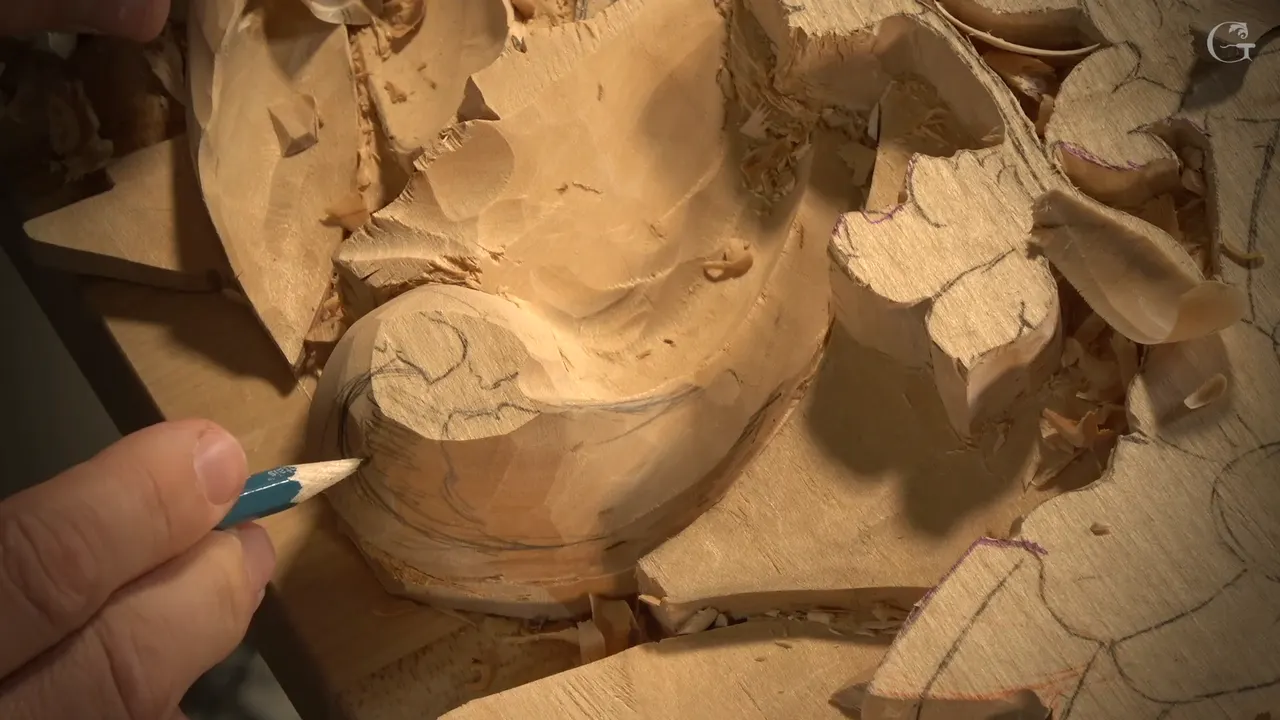

In Venice Room 111-3 I stop on a gap and put one move to myself as a question. Other lessons of mine carry that question before a tool, a plug cut, a shape or a fix.
Ever stood at your bench halfway through a piece of wood carving, a gouge in your hand, and spotted a different move for the next cut? Did you say it out loud, or just do it? This short video is one plug cut, and my question sits near the end. Lines from my other lessons follow, each one named and linked, to send you to the hands. Every size comes in millimeters and inches, my figure first and the other system after it.
What does workshop 111 show in part 3?
The video opens on a worry. "But I don't want to make a mistake," I said, and then "I know I'm not going to make mistake, but it is easy to make mistake." The plan followed: "This section is going to be cut all the way through. That's what I want to do." Right after: "a lighter look, almost really airy, like air, really light and nice."
I called the result "really light and almost fragile." Next came "I'll make it not as fragile. It's still fragile, okay? So you still can break it if you want to."

The first tool I wanted was a "number nine" at "10 millimeters" (0.39 in). Next came "10 millimeters, three-eighths of an inch, number nine" then "I'm going to create the plug cut." Three eighths of an inch is 9.5 mm. My verdict on the size: "I think it would be a sufficient tool. I could go probably even bigger."
The tool work started with "I'm actually pointing inward direction" and "let me crank it." After "Here we go" came "That's why I call it plug." The mallet was part of it: "of course, mallet will help also." My instructions were "Just rotate, attack that from different positions, and crank it, remove it." Last in that stretch: "I can expand that actually."


Deeper in: "Okay, let me get deeper." About the sound: "Yeah, that sound is kind of scary. Always be careful not to break my tools." A smaller gouge came up: "I am really deep, but I can take smaller now, like a quarter-inch number nine, and in this case, it would be six millimeters." A quarter inch is 6.35 mm, and 6 mm comes to 0.24 in. I named a French brand for it.

The angle changed too. "Now I need to twist a little bit to the left, because I need to hit the spot right here." "That would be my opening," I said, "and that's going to create that airy look." I pointed, saying "you don't see that, probably" then "Now you see it, okay" and last "So that is my target."
The bigger hole helped: "just because I created a bigger hole, it gives me a lot more ability to rotate in the right direction." Something was in the way, so "Let me remove it." Then came "I can always attack also from this side. Exactly the same idea. Plug cut." Later came "I'm all the way through" then "Get rid of this junk" and "That is what I'm after."

How did the question come up?
A tool for later came first: "Now, I can use a long bent if I wanted to." I called it "the small one like this," pretty much a "number 11" and said it could "create a beautiful excavation," a job for "a little later."
A gap was next: "Now, originally, I do have a gap right here, but I think this gap is not the best idea." The reason followed: "I need some kind of stability. Yes, it needs to be really light-looking, but I need to add some stability to this piece." Then the question: "So why don't I take this part a little bit underneath of this acanthus part? Okay? This movement."

My answer was a plan, not a finished cut: "That's what I probably going to do." It would give me a "more stable element." For the tool I said "I'm going to just use 4 millimeters, number 11. A little bigger than eighth of an inch." Four millimeters comes to 0.16 in, and an eighth is 3.2 mm.
I left the size open: "You could use 3 millimeters, 5 millimeters. It still would create the same idea." Those two sizes are 0.12 in and 0.2 in on a ruler. My limit was "I'm not going to do it too deep. We really don't need to." After that, "round this a little bit."

What do the other two videos of workshop 111 hold?
The question is not in them. Part 1 opens on "some acanthus development" and "just a frame around those flowers." After "Let's start" came "Let me create approximately 10 millimeters away from this wall line" (0.39 in). For a bigger number 11 the plan was "maybe 20 millimeters" (0.79 in). Part 2 opens with "I like it so far" and holds "a big number seven."

Which tool follows it?
Over in workshop 116, part 2, I said "Not gone, but it's going to be much, much lower, so I'm not afraid of lower that down right away." The question follows, with a number seven in it, and then "get rid of some of the junk I don't really need." A warning to myself came along: "Be careful when you working with the grain, so you can just make big mistake."
Take workshop 69, where a size and a change of mind sit side by side. "I'm using 20 millimeters" (0.79 in), "but I could use actually 30 millimeters easily, I would say" (1.18 in). Once I had asked, it was "30 millimeters" and the plan was to do it. A moment later: "20 millimeters is fine also" and then "That's too big right now."
Furniture panel 17, part 8, has "I could probably find the matching profile sweep and do that way." I asked, and went on with "Try number 7" to see whether it matched. "Yep. It looks it does." The number 7 was "approximately, I would say, 10 millimeters" (0.394 in), "three-eighths of an inch" (9.5 mm), and "I need to get something smaller." Later in the part "Maybe it's not" fit, the question came up again, and the line was "just use a knife." Then the figure was "1/16 of an inch" (1.6 mm).

Panel lesson 26 brings in a router plane. "I am safe," I said, and "I can always do it." Next, "let me think what blade I should use" and "Quarter inch, six millimeters" (about 6.4 mm and 0.236 in). Then: "It takes only a couple seconds actually now to set up. Why not?"

Hashemi flowers 5 has "I probably could use even number eight." Once I had asked, "just take also one-inch number eight gouge" (25.4 mm). My reason: "just to make sure you also understand there's more than one way to do exactly the same task."
What about plug cuts and openings?
The plug cut in workshop 82 has "I need to create the plug cut in this section, and create a really nice shadow." Right behind it: "with the number nine and maybe quarter inch again" (6.35 millimeters). Then "I'm not sure if the quarter inch will be sufficient or not. Yes, it will be."

Before the question in workshop 64 I said "maybe, for me, it's a good idea to create a really deep shadow in this area, which I probably should do." Next: "Quarter inch, number nine" (about 6.4 mm). I hoped to fit: "And yes, I'm able to fit there. Start and create my plug cut."

Next, workshop 106 has "it's somewhat fragile, so I can just switch probably to a smaller tool, smaller number nine." That gouge was 10 mm (0.394 in). After "Okay, I think it's enough" came the question about "this section right away." The plug was "just a perfect plug." It "jumped out about eighth of an inch, about three millimeters" (3.175 mm), (0.12 in). I said "For me, it's better than drilling, okay?" The drill stayed an option: "I could use probably a drill."

Grape onlay 11 has "I left approximately half an inch" (12.7 mm), "from the high spot right here." Then "make it like airborne right away." Next to the question: "And move those plugs, drill right underneath." Then "one eight of an inch" (about 3.18 mm) and "Three millimeters I can probably take" (0.1181 in).

A warning sits in Grinling Gibbons Maine class 14. "I can take it to the extreme and just pretty much create the opening," I said. I asked, and then "If you don't feel comfortable of doing it, then don't do it, okay. Guess it's gonna give you really weak spot." Then "I'm not planning to use it as a piece of furniture. It's gonna be on the wall."

Where does it lead to a new shape?
Back in workshop 89 the setup was "what I also could do in this case" and the move "just a flip backward." My verdict: "I think it's also going to look really good." Then, with the question out, "just flip it, just like that" and "letter S curvature going this direction."
The move I explained in workshop 109 sounds like the one in 111-3. "guess this part could go underneath of that. Maybe I should. Let me think." I took it back: "Let me change what I just explained to you." The old idea, I said, "is not right." My plan was a "number 11" at "seven millimeters" (0.28 in).
The other way round is in workshop 44, part 12: "I could go the same idea, get this one below that one. Or, on another hand, because it's above and it's much higher" and then the question about doing the opposite. "Get this underneath of that one." Next: "it's going to make sense, but I need to get the bigger No. 11."
Workshop 136 has "I could probably go somewhat low right here, too, since I do have approximately half an inch on the opposite side" (about 12.7 mm). Next the question, and "Maybe about 12 millimeters or so" (0.47 in).
Can it come before a quick fix?
In floral and molding 10 I said "make sure you leave some material, okay?" The reason was "that leaf going to curl downhill a little bit about to that point" and the line ended on "create that movement right away before I make mistake?"
The clamp comes into workshop 125: "I don't know why it's jumping so much. Maybe I should clamp it." Between the two lines sits the question, then "Going to get the clamp and maybe clamp that somewhere right here." Then "a little more stable" and "I hope," I added.
Who asks it, me or someone else?
The moment before it is described in workshop 47. "It just comes a time when it's just like a light bulb," I said, and "you think, Wow, that's going to look good right here." Next was the question, then "I knew I want to do something right there, but I didn't know what exactly."
One question with no answer sits in workshop 66. "Although, like I said, some of the stuff, it's really not necessary, but I love it," I said, and "sometimes I'm asking myself" the question. My own answer was "Yeah, there is no answer" and then "So I still would do it."
Other people ask it of me. In the in-person sharpening class I said "you would probably ask me" the question about using a tool all the time. My answer: "The answer is easy." Then "you can pull it and then you're going to change your bevel, okay?"
Then workshop 90: "if you would ask me" about a 90 degrees V-tool, "Oh, absolutely you could" then "Absolutely, no problem" and last "You could do that, I just like that tool, okay?" In the curly cutting board lesson, "one person asked me" about sandpaper. "That is a really good question," I said, and "I don't like when you sand, you're actually pressing fibers together."
Lesson by lesson, what came after the question
| What came after | Lesson |
|---|---|
| Junk to remove, and a warning | Venice Room 116, part 2 |
| A bigger gouge, then a change of mind that ends at the first size | Workshop 69 |
| A matching sweep, then a knife | The furniture panel, lesson 17, part 8 |
| A router plane | The furniture panel, lesson 26, part 3 |
| A one-inch number eight | Hashemi flowers 5 |
| A plug cut with a quarter inch | Venice Room 82, part 3 |
| A plug that jumped out, which I liked better than drilling | Lesson 106 (Venice Room) |
| Plugs | Grape onlay 11 |
| A flip backward ending in a letter S curve | Workshop 89, part 7 |
| A part going underneath, with a number 11 | Lesson 109 (Venice Room) |
| The opposite way | Number 44, part 12 in the Venice Room |
| Asked of me: the bevel changes | Sharpening in-person class |
| Asked of myself: no answer | Number 66, part 11 in the Venice Room |
Is there a move you keep to yourself at your own bench, because you never said it out loud? Every lesson named on this page opens with full access to the school. The Part 10 course page lists workshops 110 to 121, and workshop 111 has its own lesson page, next to more wood carving.
How it's done
- Name the gap. I said "I do have a gap right here."
- Say what it needs. The piece had to stay light, and I also wanted to add stability.
- Ask yourself. I put the move to myself as a question and called it what I would probably do.
- Pick the tool. I planned four millimeters (0.16 in), number 11, and said you could use 3 mm (0.1181 in) or 5 mm (0.2 in).
- Keep it shallow. My limit was to stay shallow.
Frequently asked questions
What did I plan for the gap in 111-3?
I wanted the piece to stay really light-looking and still gain stability, so my plan was to tuck one part under the acanthus. A "more stable element," I called it.
Which gouge sizes came up in 111-3?
I named a number nine of 10 mm (0.3937 in) for the first plug. For when I was deep I named a quarter-inch nine of 6 mm (0.24 in). For the underneath part I named a number 11 at four millimeters (0.157 in), and I said 3 mm (0.118 in) or 5 mm (0.197 in) would work too.
How deep did I plan to go with the number 11?
Shallow. Too deep was off the table, and I planned to round it off.
What to carve next