

Alexander Grabovetskiy, woodcarver, School of Woodcarving · Published 2021
What does a wood carver mean by "my question"?
Quick answer: The line comes from part 2 of workshop 113, where I wondered about an undercut that deep and then offered a lowered, exaggerated concave. Other lessons use the same words at a fork, in Venice Room, Hashemi and Greek acanthus.
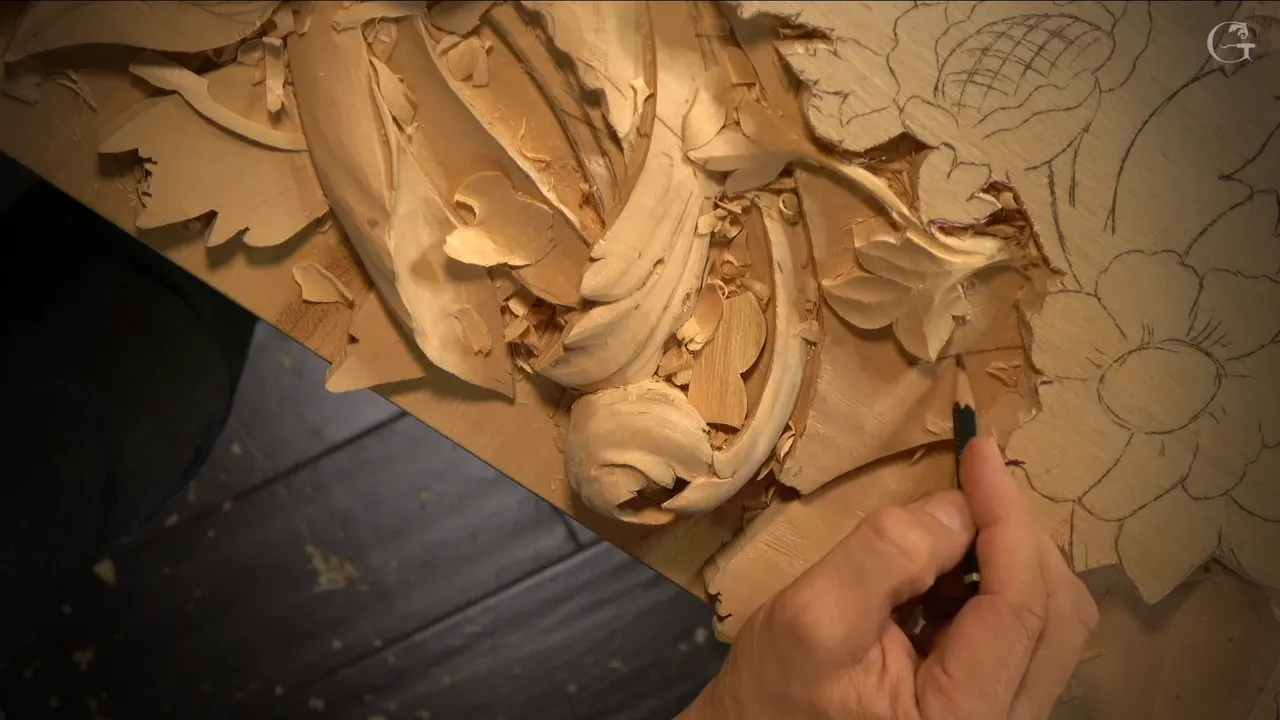

My question is a line I said in workshop 113, part 2, just before I offered another idea, lowering a section and exaggerating its concave. Other lessons of mine put the same words in front of a decision between two ways.
Ever stood over a carving with a gouge in your hand and two ways to go? Does one pass look like extra work, the other like a risk? This page starts with one short video of mine, then follows the question through other lessons. Each is named and linked. Sizes come in millimeters and inches, my figure first.
What was my question in workshop 113, part 2?
It came in the middle of the part, over an inside section. Just before: "Yes, I do need the shadow." Then: "do I really need to do a super deep undercut?" The whole part follows.
Part 2 opens on a choice between two jobs. "I can probably start outlining flowers. Or maybe no. Maybe I'll just establish whatever's going on inside right here. Let me do that." Inside, I said, would be "like a frame" and it would "go underneath."

One part, I said, would be "a little lower. Not much, but a little lower." For the moment, "I can probably just indicate that." A depth followed, about one-eighth of an inch, about 3 millimeters deep, which would give "that feel that's really architectural," I said. Next: "So I think it's enough."
A number 3 spoon gouge of about 12 millimeters (0.47 in) came first. For the next one I said I would need "probably a smaller one," still number 3, at 5 millimeters, "three-sixteenths of an inch." Then "even smaller," still number 3, at 3 millimeters (about 0.12 in), "and scratch inside."

Afterward I said, "Obviously, there's no undercut yet, and it looks somewhat messy, but I can take care of it really easy." A doubt followed: "Although I don't know if I want to do a deep undercut."

What did I set next to the deep undercut?
Another way to get shadow. Right after the question I said, "By the way, I could actually lower down a little bit this section." The idea was to "exaggerate concave almost all the way to the background" and I told you that would add extra shadow, adding "I think it's a good idea."
I planned the same "right here in this section." "I'm going to exaggerate that concave." Then "a little bit right here" and "That's not too bad. That is not too bad." The next words were "Now I can probably just work on undercutting."

The cleanup was another matter. "I can probably take care of all the cleanup off-camera. You don't need to watch me how I'm dealing with that." On the camera I could "lower down at least this section" and "really soon, we're going to start those flowers."

How far apart did the two levels end up?
By my own words, roughly 16 millimeters (5/8 in) of distance. Before that I had named the big tool. "We take a huge gouge. Not a gouge, but veiner, number 11, 20 millimeters" (0.79 in). Then, with a "you know what" came "I can take even bigger, 30 millimeters" (about 1 3/16 in).

After the big tool, "I think it is enough." "It gave me approximately maybe about 16 millimeters distance in this section between the upper part and down." That distance would allow "beautiful movement downhill with my petals of the flowers."
A little of one corner I planned to keep. A smaller gouge would outline "the rest of leaves," or "leafage, I should say. Whatever that part is."

Which part goes underneath, and which part overlaps?
Several lessons put the same words over a part and what sits under it. In Venice Room 76 I had made another shadow, and "now easily I can create that separation which is going to go kind of underneath." There I asked how to do it. "Should I take this part underneath and get the main body overlapping? Or I should do opposite direction."
A separation cut came to mind first, with a number 11 spoon gouge, "or spoon veiner, I should say" at 2 millimeters (0.08 in). My first cut was coming, and "I think it more logical to take this part."
Venice Room 71 came with another eye. The tool would be "probably number 11 in the 5 millimeters" (0.2 in). What should overlap? This one over that one, or the reverse. The two ways both looked fine, I said: "actually both ways going to look good." My pick: "But logically, I think I should overlap."

Proportions came first in Venice Room 73, and I called them "really pleasing to the eye." A different matter followed, what I really wanted to do. A part could go underneath a line, or the opposite, with that piece overlapping.
A lower part would go "underneath of this line" and "I think it's more logical," I said, "but on another hand, yeah, it should be good." About that choice I added one thing more: "if I don't like it, then it's a problem. I have to live with that if there is a problem."

Another fork sat in Venice Room 69, over the middle line. There were "a couple ways" and "I need to make the decision" on "the most logical way." Also, "I do have a big chunk on this side which you don't see." The line could end somewhere about an inch (25.4 mm) below and wrap, "just establish a head movement," or go down and return another way.
Where you would see it mattered. You would see it "from the bottom," I said, "mostly." A line was the fork in Venice Room 57. Tie that to this section, or to the lower one, and which is the most logical? What I did not like about moving that direction was "this triangle," which "creates the 'off' look from this line."

Where does a movement or an eye go?
A pipe was in play in Venice Room 75, and "the next decision" was eyes. "Logically I should create some kind of eyes," I said. The choice was that position or bringing them in "and create a lot more attractive look." Leaning toward "somewhere right here," I mentioned the "60/40 rule, golden ratio" and added that I was "just eyeballing it."
A lot nicer look, I said, with a doubt next over developing that eye: "That's the question."

The middle line was the question in Venice Room 67. It had to be "readable by other side," not equal, but about the same point as on the other side. Measuring came next. "I'll just measure with the calipers and reference" and then, "it looks like I actually got that right."
Another lesson is Venice Room 74. I was "really happy with that movement" and wondered about the opposite side. "I really don't want to extend any movement this way. Really don't." Then I could "probably start some of the divisions" of the movement.

Two questions sit in Venice Room 59. One came as I got ready to develop a little more: "should I attack this part" or "concentrate on this volute?" Both areas were important, "but I think I probably should attack this section." And I could see "a movement going upward right here."
Later in that video the idea was a boat, "like a fisher boat front" and I asked "how developed I want to see this?" Then: "If that is my middle line, what I really want to see in this area right here?"

Do I go deeper, or leave it?
Depth is another fork, and Venice Room 42 shows it. It looked "nice and clean" and I could "take it more if I wish." After that, "should I or should not? The answer is, I doubt I should." The reason I gave: "I can take one millimeter later on and excavate even deeper right here."
Workshop 37 had a spot where I could "get as deep as I want," yet did not want to get too deep. It came down to "should I or not?" Next on my list was a different number 11, "a short bend," of maybe about 7 millimeters (0.28 in). Digging under that shelf could wait. For now it was "good."

An undercut I might skip is the subject of Venice Room 23. I wanted an edge "almost perfect" and I could "undercut this way," I said, but asked "should I, because it's going to be visible only from the down position, and I think it would be just unnecessary." Next came "Maybe a little bit" and then "not much."

Workshop 72 went the other way. I needed to excavate a little deeper with a smaller tool, number 11, 3 millimeters, one eighth of an inch. I put it as "do I need to do that way?" And I named a cost: "if I'm going to excavate really deep, I going to create a problem for myself." That problem was "no tool I can fit underneath."
In that video I went on, "So maybe I should not do that way" and "it wasn't mistake, but it was not good idea. But let me blend that." A separation in Venice Room 78 was "already through" and I could "get as crazy as I want to with this." Did I want it to? "I think I don't want it to."

I needed to keep it "somewhat strong yet," I said, and a little later: "it becomes really, really, really fragile." I wanted to keep an edge in Venice Room 34, and the part would be "underneath anyway." Did I need the eye at all? "Maybe not," I said, "but I still have to make it readable."

What comes right after the question?
A tool or a plan follows. Slope came up in Venice Room 88, over whether to slope more. "Maybe yes, maybe I should." My next words were "let me take a flatter gouge," a number 3, to "replicate the slope that I have right here."
Taking a part down is the subject of Venice Room 29, and I said "I think yes," adding "Think it's going to look better." Then: "let me use number 11 and preliminary." After a ridge where two surfaces meet in Venice Room 94, the question was "do I like that idea or not?" My plan was to flip it, "try both ways" and "see if I can like it."
A harder moment comes in Venice Room 25. "It doesn't look too good," I said, and "I think I made a mistake I should not do." Then I corrected myself: "it's not a mistake, okay? Don't get me wrong. It's not really a mistake." I had made the decision to do that type of movement, and "should I do that or not" was the question. "Maybe it's not that bad yet. So let me do this subdivision, and we'll see."
You are watching me work in real life, I told you, and I have to think at every step, "what's the next move going to be."

Who else do I put the question to?
It can go to you, as it did in Venice Room 66. The question: "should I create a deeper cut, a deeper shadow in this area, or should I bring this separation all the way?" Then, to you: "what would you do." My own reading came next. From that position, I said, you cannot "catch a longer cut" and you cannot see from this side, because a corbel would sit on the side. Then: "So I think there's no reason. There is no reason. But I'll do it anyway."
The people who watch got it in Venice Room 83. It's "kind of hard to film and talk all the time," I said, and not all of you will "repeat exactly what I'm doing." Then: "if it's okay, sometimes I'll just be quiet and keep carving." Speeding it up was possible, but some of you wrote me an email asking for "a real life more." "Speed up is okay, but it's better to just watch real life."
The Hashemi Flowers course has a quieter one. With my gouge in hand, I would start undercutting first. Then: "Or even I should. Should I, is my question." Doing "something crazy with this one," or not, was the choice. And: "Let me think. What I could do, I could create a slight curl. Not big, but slight curl right here."
Other wood carvers come into it in the Greek acanthus course. "Like I said before, I am on more extreme side of undercutting" and some of the wood carvers would not approve. They say I'm making my carving "too weak and easy to break, and that's true. Absolutely true. You can break it easily. My question is why would you break it?" You can break pretty much anything, I added, and it "depends who's going to touch it."
A sharpening lesson has the words over a rounded edge. Rounding creates resistance when you dig inside the fibers, I said, even if the edge is really sharp. I asked "should I really worry about that rounding?" Next: "if there is any way I can eliminate that rounding? And the answer is yes, absolutely." What you do with a strop comes next in that lesson.
All the questions from these lessons, in one small table
| Lesson | What the question was about |
|---|---|
| 113-2 | A super deep undercut, and a lowered concave |
| 76 | Which part goes under |
| 71 | What overlaps, with both ways looking good |
| 73 | A part under a line, or the opposite one |
| 69 | Where the middle line ends |
| 57 | Tying a movement to one section or another |
| 75 | Eyes on the pipe |
| 67 | A middle line that has to read from the other side |
| 59 | How developed to leave it |
| 42 | Going deeper, or leaving it for a millimeter later |
| 72 | An excavation that makes a problem |
| 66 | A deeper cut for a deeper shadow, and what you would do |
| 83 | Quiet carving |
| 11 | Why would you break it |
Is there a spot on your board where two ways look good and you have to pick one? Everything in these lessons sits inside one tuition plan. The Part 10 course page holds workshops 110 to 121, and lesson 113 has all three videos of this workshop. More wood carving and relief waits there.
How it's done
- Pick the inside first. Outlining flowers was one option, then "Or maybe no," I said. Maybe I would establish what was going on inside.
- Indicate the depth. Probably just indicate it, I said, at about one-eighth of an inch, about 3 millimeters deep.
- Step the gouge down. Spoon gouge number 3 came first, then smaller ones, to scratch inside.
- Ask about the deep undercut. Yes to the shadow, I said, and then the question: did I really need to go that deep?
- Lower the concave. A section could go lower, with the concave exaggerated nearly down to the background, for extra shadow.
- Name the big veiner. The veiner, a number 11, came up, with a bigger one offered, until I said I think it is enough.
Frequently asked questions
How did I put the undercut question in part 2 of that workshop?
I wondered if I really needed an undercut that deep. Another idea came with it: lower a section a little and exaggerate the concave nearly down to the background.
Which tools came up in that part?
First a number 3 spoon gouge of about 12 millimeters (0.47 in), then 5 millimeters (0.2 in) and 3 millimeters (about 0.12 in). Later a number 11 veiner of 20 millimeters (0.79 in), with 30 millimeters (about 1 3/16 in) offered as a bigger one.
How much room did the lowered section give?
Approximately maybe about 16 millimeters (5/8 in) between the upper part and the lower one, by my own words. That would let me create beautiful movement downhill with the petals.
What to carve next