
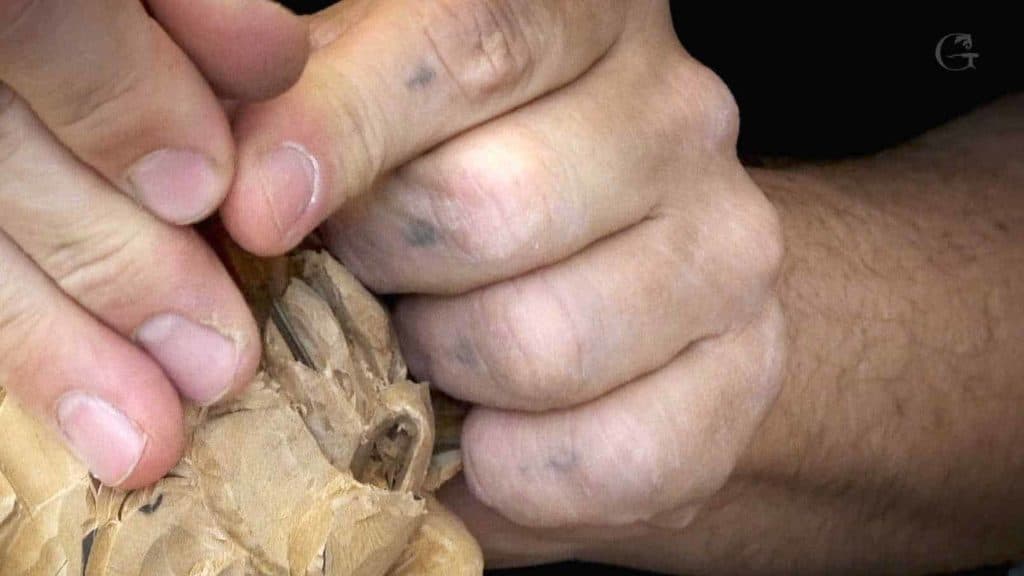
Alexander Grabovetskiy, woodcarver, School of Woodcarving · Published 2019
Does the wood tell you which way a carved petal should curl?
Quick answer: Letting the wood decide a petal's curl is normal practice on a flower like this. The blank arrives with a tendency already in it, left by an earlier pass or by the grain running under it, and fighting that costs work and risks the edge. Look from several angles, then take what the shape offers.
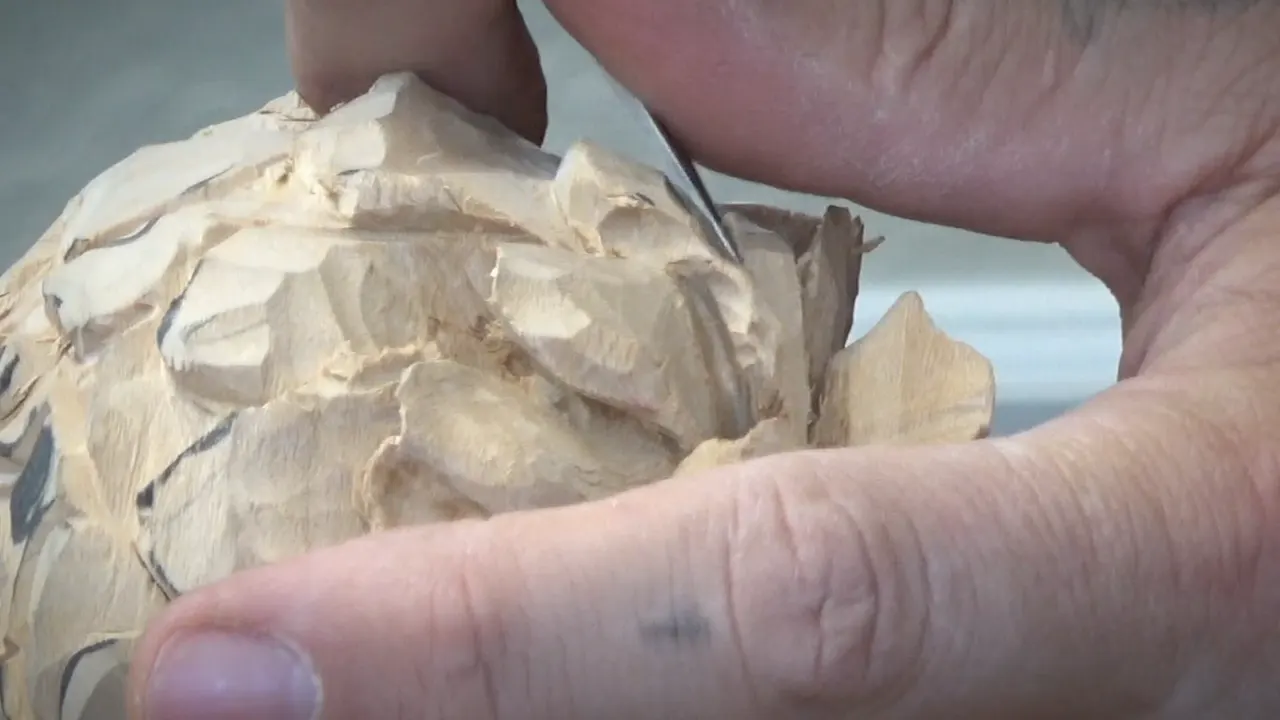
Often, and I let it. A blank comes to this stage carrying a suggestion already, put there when you roughed it or by the grain running under it. Reading that beats imposing something of your own.
Ever fought a piece of wood for twenty minutes and ended up with what it wanted anyway?
Lesson 46 of the Hashemi flowers panel is mostly me looking. Turning the peony over, staring at one petal, asking whether it should curl outward or inward, and several times deciding that the grain had already decided for me.

What this hour is really about
- A blank arrives with a suggestion in it, and read it before you impose anything of your own.
- Deeper excavation means a more fragile petal, and one of them may break on you.
- Not every petal should curl hard, because identical curls all round read as a pattern.
- A crack gets blended and left, rather than chased.
- Every cut still runs to the drilled bore, whatever the petal is doing.
- Extreme undercutting is where the small tools go.
Does the wood decide which way a petal curls?
More often than not, it does. My own words on camera are plain enough: it looks like it has a tendency to do that, and I have to just follow it.
Two things put that suggestion there. One is the grain, which makes a curl in one direction easy and the same curl the other way a fight. The other is the roughing you already did, because every earlier pass left a shape and that shape leans somewhere. Ignore both and you spend an afternoon forcing wood to do what it did not want, and the edge is the thing that pays. Adding a leaf the drawing never asked for is the same instinct applied to the design rather than to one petal.

What does a suggestion look like on a blank?
A small unevenness that is already halfway to being a shape.
On one petal here I notice a section that wants to lift along its rim, so I take a concave out beside it with a knife and it becomes a lip. Nothing about that was in the drawing. I just saw the wood offering it. A petal further round already curled slightly from the roughing, so I took that further rather than flattening it and starting again. Further round the same petal offers it again, and again I take it. The word I use is tendency, and half the decisions in this lesson come out of hunting for one rather than inventing anything. Usually it is there if you turn the piece far enough.

Why not simply carve the shape you drew?
The drawing was made on a ball, and the ball is long gone.
Every division I marked back at the layout stage sat on a surface that has since been hollowed, undercut and rounded three times over. Those lines told me where petals begin and end, and they were never going to tell me how one of them raises its edge. What does tell you is the piece in your hand, looked at from four sides. Where this peony started shows the layout that got us here.
Should every petal curl the same amount?
They should not, and I say so out loud while deciding to stop on one.
Halfway through one petal I look at what I have and leave it alone, because not every petal is supposed to curl that crazily. Twist every one the same distance and the thing stops looking grown and starts looking stamped. Real peonies have a couple of petals doing something dramatic and a dozen doing very little, which is why restraint on nine of them is what makes the tenth land. Whether a carved flower has to look realistic takes that argument further.

What happens when you find a crack?
Blend it and leave it. There is one in this petal and it bugs me, which I also say out loud.
My first instinct was to carve it away. Then I looked at how deep it ran and refused to risk that much wood for a mark most people will never notice. So the pass next to it got softened until the eye reads a shadow instead of a fault, and the petal kept its thickness. Wood that has been dry for years does this, and a carver who treats every check as an emergency will ruin more pieces than the checks ever would. Lime and basswood are stable, and they still do it.

Reading a petal before you touch it at all
| Sign | Tool | What you do with it |
|---|---|---|
| An edge lifting on one side | Knife | Cut a concave beside it and let it become a lip |
| Curl left over from the roughing | Number four | Carry that same curl further than it went |
| A ridge down the face | Number one, with a bevel ground on both sides of it | Blend the whole face flat |
| A crack | A single softened pass alongside the crack itself | Shadow |
| Bulk at the top of the petal | Eighth inch gouge | Make room for a movement |
How far can undercutting go before something breaks?
Further than feels wise, and I warn you about the price in the first minute of this lesson.
More excavation means a more fragile petal. You have to expect that you could break something, and it is unfortunate, but sometimes it happens. Saying that on camera is not me being gloomy. It is the honest arithmetic of the thing: the shadow you want lives behind the petal, so the only way to get it is to remove wood from a place that was holding the petal up. Breaking a carving tool deals with the other casualty of working that deep.

Which tools get in under a curl?
Small ones, and I apologise on camera for not naming half of them.
Start with a number eight at an eighth of an inch, then number three, then number four for cleaning an edge. For the tightest curl, a sixteenth inch gouge. Then a number eleven at one millimetre and again at half of that, with a three sixteenths at five millimetres when there is bulk to shift. They are the same tools as the lessons before, which is why I stop announcing them. Pfeil, Ashley Iles and Henry Taylor all number their sweeps the same way.

Does a favourite tool exist?
One does, and it happens to be a knife.
Partway through this lesson I catch myself saying number twelve when I mean number eleven, twice, and I work out why on camera: the number twelve knife is my favourite knife at the moment, so the number sits in my mouth ready to come out. Small thing. It tells you something about how much of this work goes through a blade rather than a sweep. Whether carvers have a favourite gouge answers the wider version of that question.

Why does every cut still run to the same bore?
The flower grows from one point, so the carving has to agree with it.
Whatever a petal decides to do at its rim, the far end of it disappears toward the centre of the flower, and the drilled bore is where it happens. I have another hole on this side, which means all of these have to run down into it. The rule survives every bit of improvisation at the edges, and it is what keeps a wild flower from looking random. The vanishing point cut explains how those bores got there.

What is a twist?
My word for a petal that changes direction on itself, once outward and then back in.
Late in the lesson I excavate one and call it a twist, which is not a term anyone taught me. A curl goes one way. A twist goes one way, thinks better of it, and comes back, and the ridge where those two surfaces meet catches light along its whole length. It is the single most effective thing you can do to a petal that would otherwise be dull, and it costs almost no extra wood. Concaves and convexes covers the two surfaces that make one, and the undercut that has to go in beneath a twist is what stops it looking painted on.

Does grain direction matter at this depth?
Less than you would think, and I hit it repeatedly here without stopping.
Near the end of the lesson I notice out loud that I am going against the grain, and I keep going. These cuts are tiny and the tool is sharp, so fibres get severed rather than lifted. Care is the only thing that changes. No forcing, no levering, and a pass taken in two goes. A blunt edge on that same stroke would tear a hole in the petal.

How do you know a petal is done?
When you like it and stop touching it. Soft as that sounds, on this kind of work no better test exists.
Nobody has ever measured a movement. I say I am happy with it four or five times in this lesson, and each time that is the decision being made. What stops me going further is knowing that another pass to improve the curl is also another pass that can snap the curl off, and I have had that happen. Holding a carving too fragile for a vise is what comes next when petals get this thin.

Does this only apply to flowers?
A peony has no monopoly on it, though this flower punishes you fastest for getting it wrong.
Movement works the same way in any relief carving. An acanthus leaf lifts where the wood lets it. Leave a ribbon leaning and it twists that way for you every time, where the roughing left it leaning. Go and look at the foliage in the V and A sculpture rooms and you can see the carvers taking what the blank offered, over and over, in work that predates every tool I own.

What if you cannot see a suggestion at all?
Turn it over. The whole technique is that, and it is what I do between every petal here.
From above, a petal is an outline. Turn it, and the side view hands you a section instead. Underneath is where you find out what the undercut has done. Most of the movements in this hour came out of moving it about rather than out of any plan, and when nothing suggests itself I leave the petal quiet and go to the next one. A quiet petal is not a failure. Keeping a carving clean as you work matters here too, because chips hide the very thing you are trying to see.

Why so much of this work goes unsaid on camera
Work stops being explainable at a certain size. I apologise for that twice.
Half the cuts here are a millimetre long, made under a petal, in a spot the lens cannot reach. I keep saying that I hope you can catch what I am doing and admitting that it is almost impossible to see. What you can follow is the reasoning: which petal, which direction, why this one and not that one. The hand skill comes from repeating it on your own blank until the tool tells you what the camera could not. Carving has always been taught that way, long before anyone pointed a lens at a bench.

How much of the hour is actually removal?
Nearly all of it. A lot of undercutting with the flowers, as I put it in the middle of the lesson.
Adding is not an option in this craft, so every improvement to a petal is wood leaving the piece. That reframes the whole job: you are not building a curl, you are removing everything that is not the curl, and the material you take can never come back. It also explains why I keep stopping to look. Looking is free, and the alternative is not. Sculpture in every material works this way, and wood is simply less forgiving than clay about it.
What this lesson leaves you with
A peony with two or three petals doing something worth looking at, several doing very little on purpose, and one crack that got blended instead of chased.
What a wall is on a carved petal deals with the edges left behind by all this, and what to do when you make a mistake carving is worth reading before you undercut anything this far.

How it's done
- Turn the piece before carving anything. From above it is an outline, from the side a section, from below an undercut. Most movements in this lesson came out of moving it about.
- Take the lift the wood already offers. A rim starting to raise becomes a lip with one concave beside it. Nothing about that was drawn beforehand.
- Deepen a curl that began in the roughing. A number four carries it further in the direction it already leans, rather than flattening and starting again.
- Leave most petals quiet. A flower where every petal twists the same distance reads as a pattern. Restraint on nine is what makes the tenth land.
- Blend a crack rather than chasing it. Soften the cut beside it until the eye reads shadow. Chasing a deep check costs wood the petal cannot spare.
- Run every cut down to the bore. Whatever the edge does, the far end of the petal disappears toward the centre of the flower.
- Stop when you like it. Another pass to improve a curl is another pass that can snap it off. There is no measurement for a movement.
Frequently asked questions
Should a carved petal follow the grain or the drawing?
The grain, once shaping begins. Layout lines were drawn on a ball that no longer exists, and they were never going to say how a rim lifts.
What is a natural tendency in wood carving?
A shape the blank is already halfway to making, put there by grain direction or left behind when you roughed it. Carving it further is cheaper than imposing something else.
Do all petals on a carved flower need movement?
The opposite, in fact. Two or three doing something dramatic, against a dozen doing almost nothing, is what a real peony looks like.
What to carve next
- Carving Hashemi Flowers
- What a wall is on a carved petal
- The vanishing point cut
- Breaking a carving tool
- Where this peony started
- Concaves and convexes
- Does a carved flower have to look realistic
- Do carvers have a favourite gouge
- Adding a leaf the drawing never asked for
- Holding a carving too fragile for a vise
- Keeping a carving clean as you work
- What to do when you make a mistake carving