
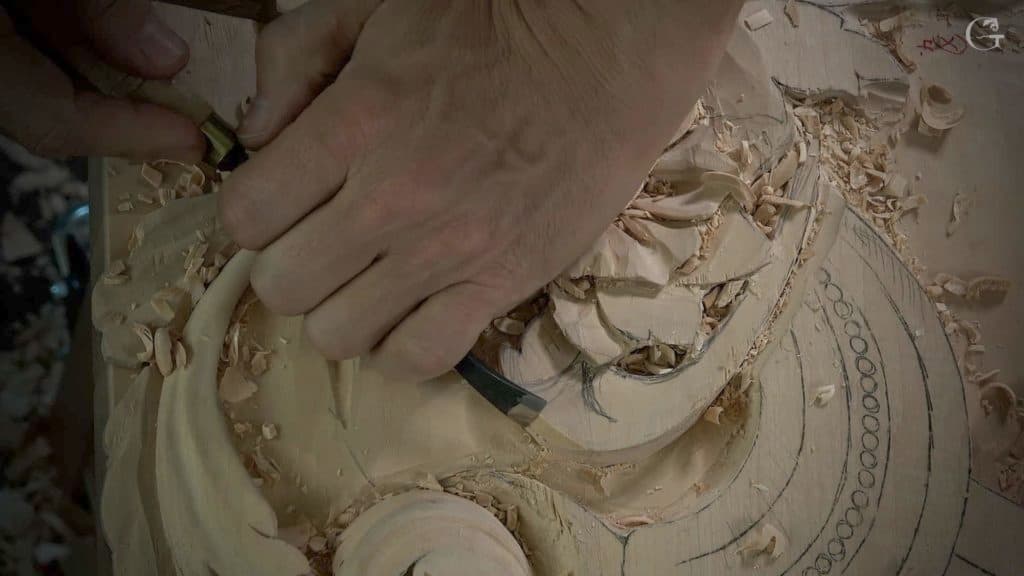
Alexander Grabovetskiy, woodcarver, School of Woodcarving · Published 2021
What does a wood carver mean by "the only thing"?
Quick answer: In workshop 121 of the Venice Room, part 1, I placed a number five on a line and said the only thing to worry about was an undercut. My cut had to go 90 degrees down. In other lessons I used those two words for a dislike, a limit and a must.
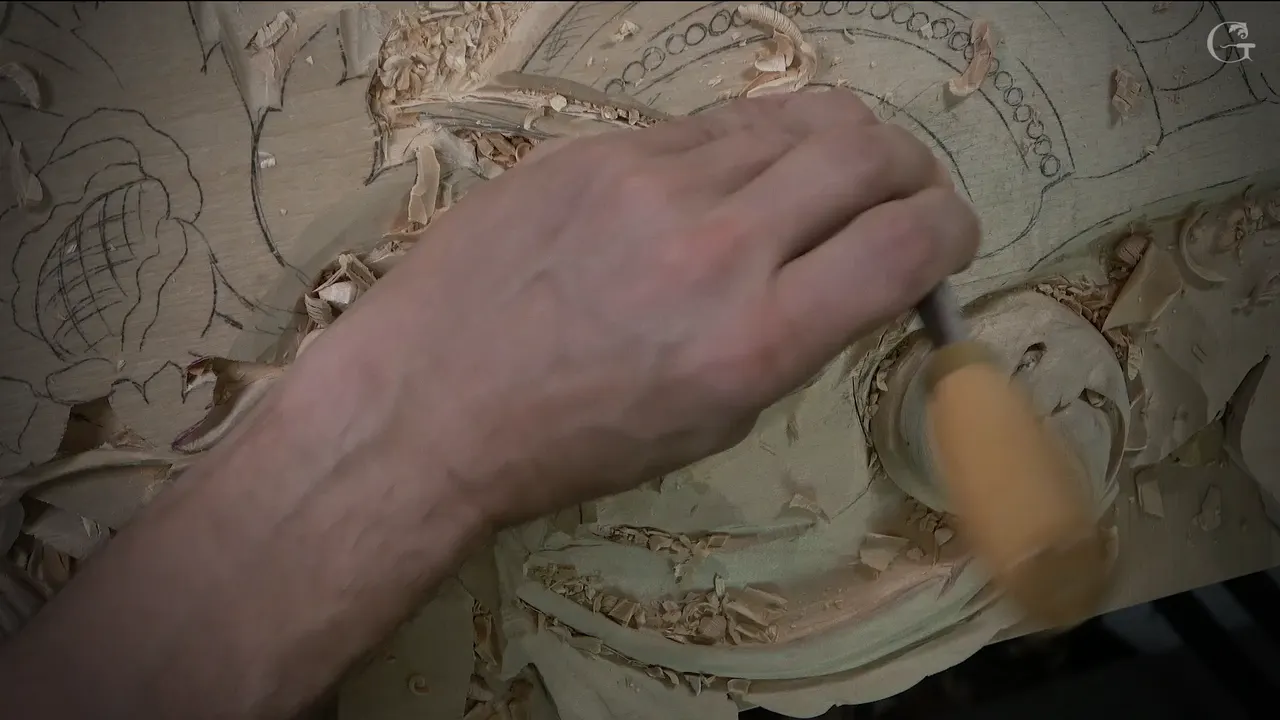

In Venice Room 121, part 1, I said it with a number five on a line: "The only thing I have to worry about, not to undercut." This page starts at that bench. Other lessons follow, where I used the same two words for a limit, a dislike or a rule, and each one says where it comes from.
Have you ever set a gouge on a drawn line and wondered which way the edge would lean? Did you look at it from the side before you tapped it? Then you already know the worry behind my words, because you have stood in that spot.
In workshop 121, what was the only thing to worry about?
An undercut. My first tool talk is a switch: "Now I need to switch to number five, I would say." "I think this one will work," I said. The next words were "Straight down cut."
For that cut I was "just placing right on the line" when I named my worry. I had to position my tools the right way, I said. Then came the angle. "So my cut must be 90 degrees down. Okay? So not that way, not that way, just but 90 degrees straight down."

Why worry here and not on another piece? I gave the reason. "I wouldn't worry about that if I would just work on one piece, but I have to do opposite side." One side was in front of me. "So that is only one of the sides." The second side would be "equal, just flipped" and then I said what was important. "And that's really important, not to lose the position of the lines. For me, it's important not to lose positions of the lines."
Which tools came after the first cut?
Number 11 came next, for what I called preliminary cleanup. "Again, just preliminary, like I said." My reason followed. "There is no reason to create final, final cleanup yet, because we have to establish some details on inside."

A triangle was next, "a little triangle I have to take care of." I added, "See? This part is going to be lower than those details."
Number three came next. "Okay, now I'm going to take, again, number three." The aim was to create "that really, really, really 90 degrees" and I gave the reason. "For the sake of keeping line, that's the only reason." Then: "Otherwise, I wouldn't even worry about that, wherever it falls." Here it "would be big mistake." And, "really, I don't want to make that mistake."

Next I was "using just a spoon, number 11. Veiner." Then came "Let me also outline right here a little bit" and "maybe just clean it little better." Then a short aside. "Or just in case if it bugs you. Sometimes it bugs me also, but that's okay."
Extra depth came next. "But now I do have extra depth, in this case, and even other angle, like right here. So you can see it does cast really, really good shadow." Next came a plan for the light: "Let me turn one of the lights off and see if it's going to show you what I'm talking about." My own question came right after: "See how deep shadow it creates?" And a verdict: "I think it's beautiful."

The spoon was the wrong tool for the spot, I said. "I shouldn't use spoon in this case," I said, and "I need just a straight tool." Number three was what I was using, and "I need to attack from opposite direction."
"Maybe that was little too big, but it's okay." A part of the leaf was "going to just flip on top of it," I said, and "that's going to give extra dimension to it." The last lines of the video looked ahead. Rolling it "this way a little bit" was the plan, but "not much, because we still have to do some concaves and convexes."

What else did I name to keep in view?
A worry of the same kind sits in workshop 102, part 7. I called the cut "a simple cut, pretty much" and then led with "the only thing," going on, "I have to keep an eye, it has to be perpendicular." The line was "supposed to be like 90 degrees."
My help was on the piece already: "I do have my glue line, and I can use that glue line as a reference." Then "I can put any type of ruler, whatever you have, right on the line, and that's going to give me a really good idea of the movement." I could "just eyeball it," I said, but "I don't trust sometimes just the eye" and "sometimes it could be really deceiving."

Force was the thing to watch in workshop 85, part 5. "So the only thing you have to keep an eye, how much force you're applying because if you're going to do much more force, you can get a much deeper cut." You also have to be "really careful how you approach it," I added. The wood came off in steps of about 6 millimeters (about 1/4 inch), "three-sixteenths sometimes, about five millimeters." I called that "a really sweet spot."

The direction of my grain was the next thing to watch in that video. Straight down could "split," I said, and a tool placed another way could "make a mess." So "I'll just go across the grain" and "I have to just angle it about 45 degrees or so." Later, an area was "supposed to be a really nice 90 degrees area," so I had to be "really careful." I said, "I never place the tool on the inside, so it's better to just be a little off" and then, "that way I'll know I'm not messed up, and of course, I can measure."
The Tray of Blessing, Cabernet Sauvignon, lesson 2, part 3, holds one more. I was "still keeping this line somewhat high" and said I could probably spoon, "almost like a, you carving a spoon." Then: "But the only thing is please don't raise too high." My reason: "This part, if you're going to raise too high, it's gonna be really hard to," I said, "escape from that cut. Okay? So that's not gonna look good."

Which dislike does the only thing point to in my lessons?
A clean result comes first in workshop 69, part 2. Describing a pass, I said it was "just barely hitting the upper part of the fibers" and then: "Okay, and that's really clean. I don't need to sand anything or anything." Here came the catch. "The only thing I don't like in this case is that center line is a little off."
I wanted the ridge "in proper position," so I planned "probably around 10 millimeters tool" (about 0.4 inch) "or even bigger, maybe 15 millimeters tool" (about 0.6 inch). And "I don't need deep cut, but still want to make sure the light hits and creates the right motion, right movement."

A question comes before the dislike in workshop 57, part 4. Should I "tie that to this section, or should I just tie that to the lower section?" My next words opened with "the only thing" then closed on one spot: "I don't like about moving that direction is this triangle." It "creates the 'off' look from this line."
Another way of moving "would look a lot more organic," I thought. A second dislike followed. It was "the space between this point and that point," "almost equal everywhere" and "it should not be that." The plan was to "slightly move it to the right."

A knife turns up in Beginner in Woodcarving workshop 15, the Curly Kitchen Cutting Board, part 2. "I'm using number 12 knife, but there is actually smaller knives you can use." Of the small one I said "the only thing," followed by "I don't like about this one, the metal of it, you can see the thickness of it." That meant it was "not as flexible." Even so, "for some areas, like small, tiny spots, a smaller knife would be nice."

A live stream on April 8, 2020, brought me a question about butternut. "It's beautiful wood. It's just hard to get in United States nowadays." "I love butternut," I said, and the drawback I named was "the grain."
Context followed. "Depends on the job, what you do." For really big movements, "if you just see too many stripes, and the butternut does have a pronounced grain, so that would not be too nice." But with a lot of details, I said, "butternut is a really great wood."
What is the only thing a big tool must have?
Sharpness. In Grape Onlay lesson 9, part 2, I said it plainly, in a line about big tools. "The only thing with the big tools, they must be super sharp." A line about all tools came next. "All the tools, they must be sharp, but with the big ones, even more important." After that came "Let me switch to smaller one 10 millimeters" (about 0.4 inch).

My teacher said something close. In Roman Acanthus lesson 10, part 3, I began with my own line about sharp tools, "absolutely must" and then told what he said when I complained that a wood did not carve nicely. "There is no such a thing as a bad wood. Only dull, not sharp tools. That's the only thing is the problem."
A limit followed. "Of course, there is some species of wood almost impossible to carve." But for carvable species, I said, such as walnut, cherry, basswood and lime wood, "the problem is not the wood, the problem is the tool."

What other jobs did the only thing name?
Over in workshop 150, I said I could "just outline the whole thing right now." Next I turned: "the only thing" and I went right on, "I want to say, I want to change something. I kind of don't like that part." My plan was to take a detail and expand it, "like growing from underneath of the molding" and to "just remove" another section. I planned "the same number 9 and 20 millimeters, about three-quarters of an inch."

I said I would work on a tulip first, in class 6 of the Grinling Gibbons class in Maine, part 3. "The Tulip itself is not that complicated thing." My next sentence began "the only thing" and ended, "with the Tulip you really have to see it's just like a barrel goes around." I also said "we do have limitation" and then, "Think about we excavated from the back side." For the drill: "make sure you gonna point that slightly uphill."
The last job was small, in the Chamomile and Bow Rosette course, lesson 4, part 3. The first words of that line were "So now the only thing," while the last were "just remove that rest of the paper." There are "multiple ways," I said. One is to "use sandpaper" and I said, "I'll use just the 100 grit." "It takes just seconds to remove it," I said.

Does the undercut come back later in lesson 121, or does it stay a worry?
It does, in the third video. "I want to create the undercut underneath of here." I could "go opposite direction," I said, "but I think it's going to look much better if we're going to do a shadow cast from this side." I planned to take "number 11 and maybe 5 millimeters" (about 0.2 inch). "It doesn't have to be really deep cut. And I can start carefully."

Part 1 gave me a pass that must not undercut, and the third video had an undercut I wanted on purpose. The side was a question of where the shadow would be cast. The lesson 121 page has all three videos.
Every lesson that gave me the only thing
The table names each lesson and the one thing I named in it.
| Lesson | What the only thing was |
|---|---|
| Venice Room 121 | Not to undercut on a straight cut |
| Workshop 102 | A cut that stays perpendicular |
| Venice 85 | Force put on the tool |
| Tray 2 | Raising one part too high |
| Workshop 69 | My center line, a little off |
| Venice Room 57 | One triangle that gave an off look |
| Cutting board 15 | The metal thickness of a small knife |
| April 2020 stream | The grain on butternut, a wood I love |
| Grape Onlay 9 | Big tools must be super sharp |
| Roman 10 | Dull tools, said my teacher |
| Venice 150 | One part I did not like |
| Maine 6 | A tulip goes round like a barrel |
| Rosette 4 | Removing the last of the paper |
What is the one thing you watch before your next pass? The full set of workshops for this panel sits inside full access to every workshop. The Part 10 course page holds workshops 110 to 121, and the April 2020 live streams are there too. More wood carving waits on those pages, and so does a chisel or two.
How it's done
- Pick a tool and set it on the line. I switched to number five, said I thought it would work, and placed it on the line for the straight down cut.
- Hold the cut at 90 degrees. My worry was an undercut, so I said I had to position my tools the right way and keep it straight down.
- Keep the second side in mind. The second side would be equal, just flipped, and I called it important to keep the lines.
- Clean up only a little. With number 11 I did preliminary cleanup, and I said final cleanup had to wait until some details inside were set.
- Change the tool when it is the wrong one. The spoon was the wrong tool, I said. I needed a straight tool, number three, and I needed to attack from the opposite direction.
Frequently asked questions
Which tools did I use in workshop 121?
A number five came first, and I said I thought it would work. Later a number three took a pass I wanted at 90 degrees, "for the sake of keeping line." A spoon number 11 veiner followed, and I called that spoon the wrong tool for the spot.
Why would I not worry on one piece?
On one piece, I said, I would not worry about it. The carving I had in front of me needed an opposite side too, equal to the first and just flipped. Keeping the lines in place was really important to me.
What do I say about force on a tool?
Workshop 85 put it this way: watch how much force you apply, because with much more force you can get a much deeper cut. A warning followed about how to approach it, and I took off about 6 mm (about 1/4 in) at a time.
What to carve next