
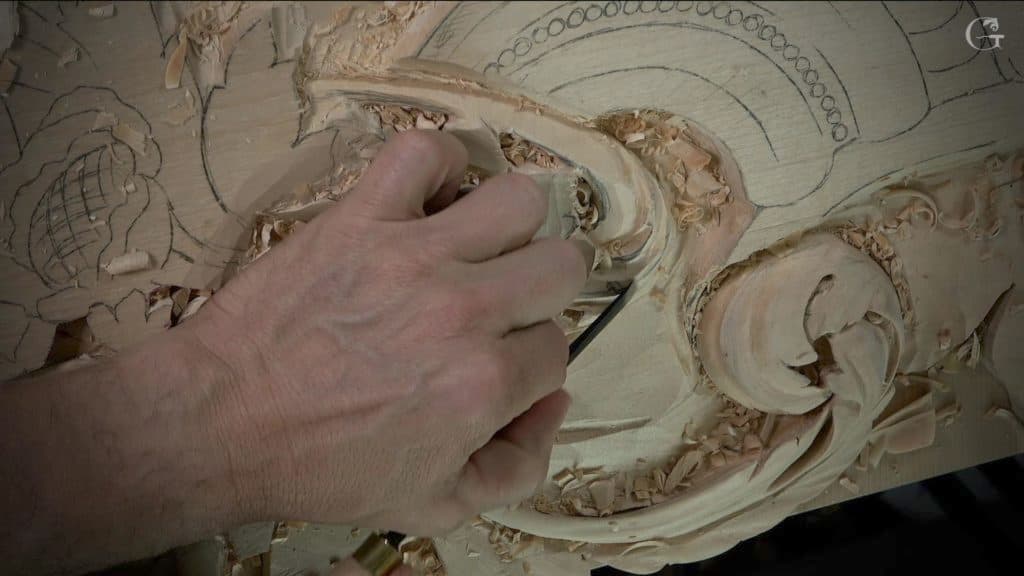
Alexander Grabovetskiy, woodcarver, School of Woodcarving · Published 2021
What does a wood carver mean by "a much better job"?
Quick answer: Video 2 of Venice Room 121 has me naming a Henry Taylor number 11 for the first concave, then planning a Pfeil one and saying what Pfeil does with 11s. Other lessons use the same two words for smaller gouges, veiners, bent tools, a flip and a rasp.
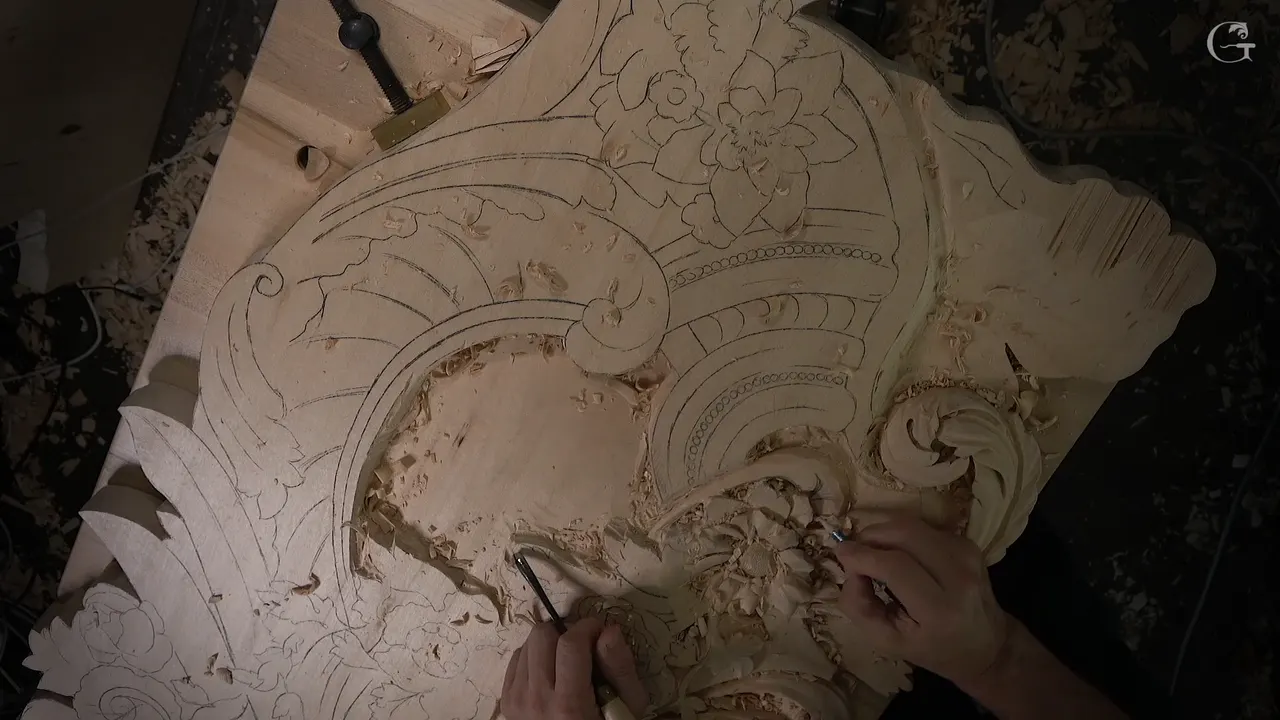

Venice Room 121, video 2, has me saying I would grab a different number 11, and then one line about that maker. The page starts at that bench. From there it follows two plain words, better job, through my other lessons, and it names the lesson behind every line.
Ever held two gouge shapes that looked close enough and wondered why a carver bothered to swap? Did the swap change the cut at all? Then you know my spot.
What happened with the number 11 in workshop 121?
The video opens with "convexes and concaves" and a plan for each. The center line would sit "somewhere right here" and one movement would go "all the way this way." My aim was that "it looks like it's rolling from underneath."
A snag showed up, a "possibility of an eye." That meant moving the movement "a little closer to this line," so the distance from one point to the next had to shrink, and then shrink again. "So it has to taper this way."

One concave would go each way, both "all the way down." The opening concave got a number 11: "Same as always, number 11, but in this case, I got by Henry Taylor."
"Still the same. Doesn't have to be Henry Taylor." Seven millimeters (0.28 in) was the normal one, a number 11 by Pfeil. And here is the line that names this page: "Pfeil does much better job with 11s."
The eye called for a smaller number 11, about three millimeters (0.12 in), to "create that eye" and get "this piece rolling underneath." Not "my eye," I said, "but the eye of Acanthus."
Then a number three of about 10 millimeters (0.39 in), for blending. I wanted that because it is "not how it's supposed to look" and I did not want to see "that really sharp ridge." One part would be a pipe, so I planned "some kind of concave" there, taking five millimeters (0.2 in), "carefully."

I also said, "I know it doesn't look too appealing yet, but it will." After it I planned to blend, because "I really don't need those ridges."
A flatter tool, "like number three," was meant for the ridge, and I planned to "just blend everything." Then: "I have really good idea how my movement going to look." Cleaning might happen "off camera," maybe with a rasp again, which I expected to use because it "saves me some time and give that thing little better shape." Overall, "that's what I want to see."

Next I planned to show the piece from above. More details were coming, I said, and I asked myself, "Why don't I establish them?" That way, "I'll know how deep I have to go that direction." My iPad came next.
Which other videos of lesson 121 add something to this story?
Video 1 opens with a switch to a number five. A straight down cut was the job, placed "right on the line" and the one thing to watch was "not to undercut." My cut had to go "90 degrees down" and I said this was "only one of the sides." The second side would be "equal, just flipped."
Next I held a spoon number 11 veiner, and I stopped: "I shouldn't use spoon in this case. I don't need it. I need just a straight tool." Number three took over, and the plan was to come at it from the opposite direction.

Video 3 begins with some kind of shell inside, which I could probably recreate "from my head." A thought followed about movement inside: "I don't know. Should I or shouldn't?" A test came with the big 30 millimeters (1.18 in), to "see if it's too big." After the first cuts came a verdict: "It looks like 30 millimeters is actually a great tool. Works really good."
Grain mattered here. Working along it, I had to be really careful not to break the wood. I would not force it. "All that can be taken care of with a smaller tool." For the future convex I had a back bent, number seven, in mind, and "that blends beautifully."
Two ways to undercut came up. "I could undercut this way, but I think it's going to look much better if we're going to do a shadow cast from this side." For that I would take a number 11 of maybe 5 millimeters (0.2 in), and not a really deep cut.

Where did a smaller gouge win?
Hashemi Flowers 43, video 2, opens with a tip. I held a 3/4 inch (19 mm) gouge. Too much resistance, I said, is a reason to try a smaller one. "Sometimes smaller tools are less resistance, and actually, you can do a better job." We used about 5/8 of an inch (16 mm).
A mallet could be used, I said, but "with the mallet, you create too much shakiness" and the two screws "can become even more loose." That is why I worked with "just hand" and took my time.
Furniture Panel 36, video 2, has me saying "let me actually grab a smaller one." One tool was "little too big." Two millimeters (0.08 in) in a number 11 followed, with three (0.12 in) as the other thought. Two, I felt, would work much better. "I don't wanna overdo it because my background is pretty close."

Furniture Panel 28, video 2, lists a few shapes: a one millimeter (0.04 in) tool, "same number eight," or number 11, or number nine. In the end I leaned toward number 11, because "it's only half a millimeter" (0.02 in). My excavation would start "almost from nothing."
After a deep cut, Venice Room 83, video 3, has me switching to 7 millimeters (0.28 in) or even 10 (about 0.4 in), a number 11. Maybe 10 would do the work better here, I said, to carry the cut along. A blend with the 7 was next.

Lily Box 2, video 5, makes the point about the number itself. The tool selection "is not really the biggest thing in operation." Seven, five or four would all work. I was using number five. "I think even number seven would do an even probably better job."

How did a different shape do?
Roman Acanthus 16, video 5, has a slip that took a little off the side of my design. "That is no good." Cleaning it called for a number 11 veiner of 1 millimeter (0.04 in). A V tool could do it, and I really like number 16, yet the veiner here, I felt, would do much better.

Greek Acanthus 10, video 1, finds me with a straight gouge, number five, and a thought about a bend: "it would be better if I would use a bent, like a short bent, let's say number five, but 8 millimeters" (0.31 in). I said I could do far better work right there, and left the cut "like that for now."

Does it ever point at my own work?
It does, and the point is a later pass. In Venice Room 49, video 9, I said I was "not going to carve too deep" yet, not undercutting yet either. Later, I said, "I will go much deeper" with a result a lot better. Cleaning meant number seven at 25 millimeters (about 1 in), "about one inch."
A scratching pass sits in Venice Room 57, video 7. A sweep is a curvature, I explained, and six "is a 6 millimeters" (a quarter inch). My tool could go right inside the groove to "kind of scratch it." Then, a correction, in my own voice: "I should do a better job than that."
Butterflies 7, video 1, has me describing lost footage. "Actually what I did I outlined well, I should do a little better job." Flowers were excavated "really really deep," about 1/8 in (3 mm), where each was "supposed to be connected to the stem."
A middle line drives Venice Room 94, video 1. It went "right at the ridge" and I asked, "Do I like that idea or not?" Then, "let me try to flip that." I thought I could find my middle line "this way" and create "a much nicer movement" and I planned to try both ways to see "if I can like it."

What about a rasp?
In Venice Room 91, video 9, I said I would create multiple cuts "off-camera." For now it was "just not convenient to get with the camera," I said, and the final result would be "a lot better job." Rasps were the plan, probably "somewhat aggressive" ones, for "nicer, smoother transitions."
Another view comes from Venice Room 137, video 3. A rasp might join the cleaning, and it would "probably expedite my work." A caution came with it: "It's not always the case, though. Sometimes it creates a lot more problem." Mine were bought "about a year ago" and "I am able to just do with my normal tools, sometimes better job than rasp."

Did I ever keep the first tool?
Greek Acroterion 2, video 3, shows it. A cut was good, but I thought I might check number six, in case it would do better. "No, it's not. I guess I'll just keep the same gouge."

Number seven, one inch (25 mm), made the cut "really clean and uniform." I would keep the gouge because "I like how it works."
And a plain good job?
The same words came with a simple good. Antique Rosette 4 has these lines: "Now I have to find the right sweep for this section." "I think my number eight, 10 millimeters" (about 0.4 in) "will do a good job right here. And it does, it fits perfectly."

Dining Table Apron 8 is relaxed about fit, and I said different sweeps and gouges can still work. "It doesn't have to be just a perfect fit." Use "just the edge of it" and follow along the profile, "just little by little" and a number five would handle it well, I said.
For Venice Room 109, video 3, I planned a number 11 of 10 millimeters (0.39 in). It "will do a really good job." The grain asked for a new position. "Sometimes it just doesn't work because the grain against me."

A back bent comes to mind first in Venice Room 141, video 3: it "would help much better." Straight tools could still serve, I said, if I would "change the position and attack that from opposite side."

A smaller kit comes up in Venice Room 96, video 10. If you lack a big number two, "at least just get the skew." Mine was one inch (25 mm). For the cuts, I said, "just get really gradual movements and so on."
My verdict after a pass came in Venice Room 36, video 5: "I did a really good job with just the skew." The rasp took out "not much."
Lily Box 5, video 4, carries a warning. My tool went "on inside" with a rotation "to the left" and "almost no pressure," I said. If it is really hard, make "a couple relief cuts first."
Last, Venice Room 139, video 3, points the words at a texture that "just blends those designs together." I decided "to blend all three" and gave my verdict: "I think it just does a great job."
What do these lines add up to?
In lesson 121 it was a maker and a number 11. Elsewhere it meant size and shape. A flip got the words, and so did a rasp. Once I checked a tool and kept the same gouge. My own pass got the words too. Each lesson and its line sits in one table.
The whole run, row by row
| Lesson | The tool and the line |
|---|---|
| Venice 121 | A Pfeil number 11 after a Henry Taylor one |
| Hashemi 43 | Smaller gouge, for less resistance |
| Panel 36 | Two millimeters over three, in number 11 |
| Panel 28 | Number 11, with number nine as another choice |
| Venice 83 | Number 11 at maybe ten millimeters |
| Lily 2 | A seven, though I used number five |
| Roman 16 | A veiner beside a V tool |
| Greek 10 | A short bent over a straight gouge |
| Lesson 49 | A deeper pass later, with seven first |
| Lesson 94 | A flip, to find the middle line |
| Room 137 | My normal tools, sometimes, over a rasp |
| Acroterion 2 | Checked number six, kept the same gouge |
| Rosette 4 | Ten millimeters, in a number eight, a fit |
| Apron 8 | Plain number five, and the edge of a gouge |
| Workshop 109 | A new position, number 11, ten millimeters |
| Room 141 | Back bent first, then straight tools from the other side |
| Workshop 96 | A big skew of one inch, as a fallback |
Which of your gouges could use a swap right now? The full set of videos for this panel sits inside one tuition plan. The Part 10 course page holds workshops 110 to 121, and lesson 121 has all three videos of this acanthus workshop. More wood carving and relief waits there.
How it's done
- Start with the shapes. Video 2 began with convexes and concaves, and a center line to work from.
- Name the first tool. A Henry Taylor number 11 opened the first concave, and I said the maker did not matter.
- Plan the swap. Next came the standard number 11, a Pfeil, and then I said what I think of Pfeil with elevens.
- Go smaller for the eye. Smaller number 11 for the eye, I said.
- Plan the blend. Next, a number three to blend away a sharp ridge I did not like.
Frequently asked questions
Which tool did I swap in workshop 121, video 2?
A number 11. Opening the first concave, a Henry Taylor one went in, and I said the maker did not matter. After that came the normal one, and I told you what I think of Pfeil with elevens.
Why try a smaller gouge in Hashemi Flowers 43?
Too much resistance with a 3/4 inch (19 mm) gouge. Smaller tools are less resistance, I said, so we used about 5/8 of an inch (16 mm), working by hand and not with a mallet.
Do I say it about my own work?
Yes. A plan to go much deeper later sits in Venice Room 49, a scratching pass I wanted to improve in Venice Room 57, and a little better job in Butterflies 7.
What to carve next