
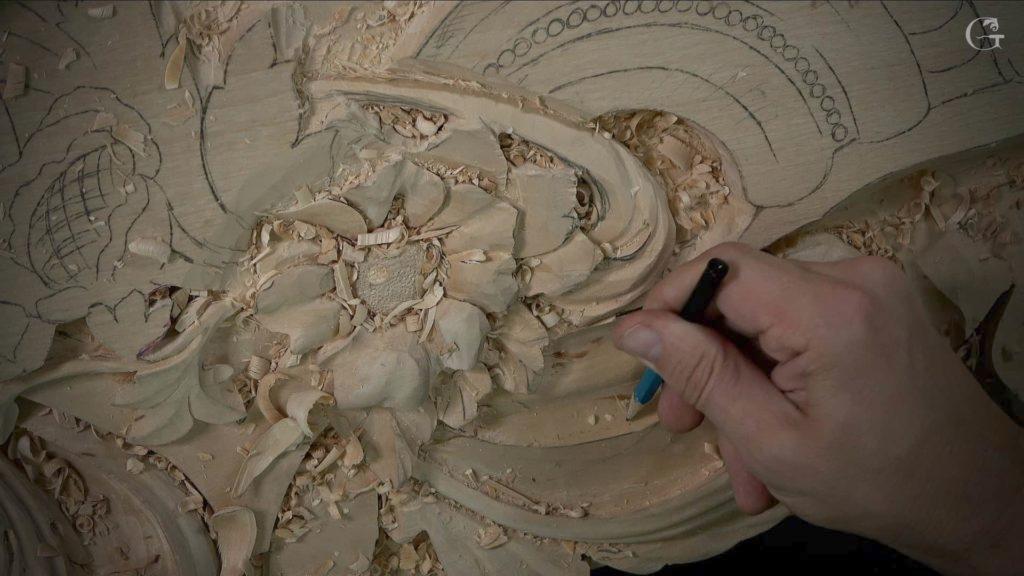
Alexander Grabovetskiy, woodcarver, School of Woodcarving · Published 2021
What does a wood carver mean by "I don't think so"?
Quick answer: In part 3 of workshop 121, I checked an approximate distance and gave my answer: no. Next I said where each part was meant to go. In other lessons the same answer came after a question I put to myself, with my next step after it.
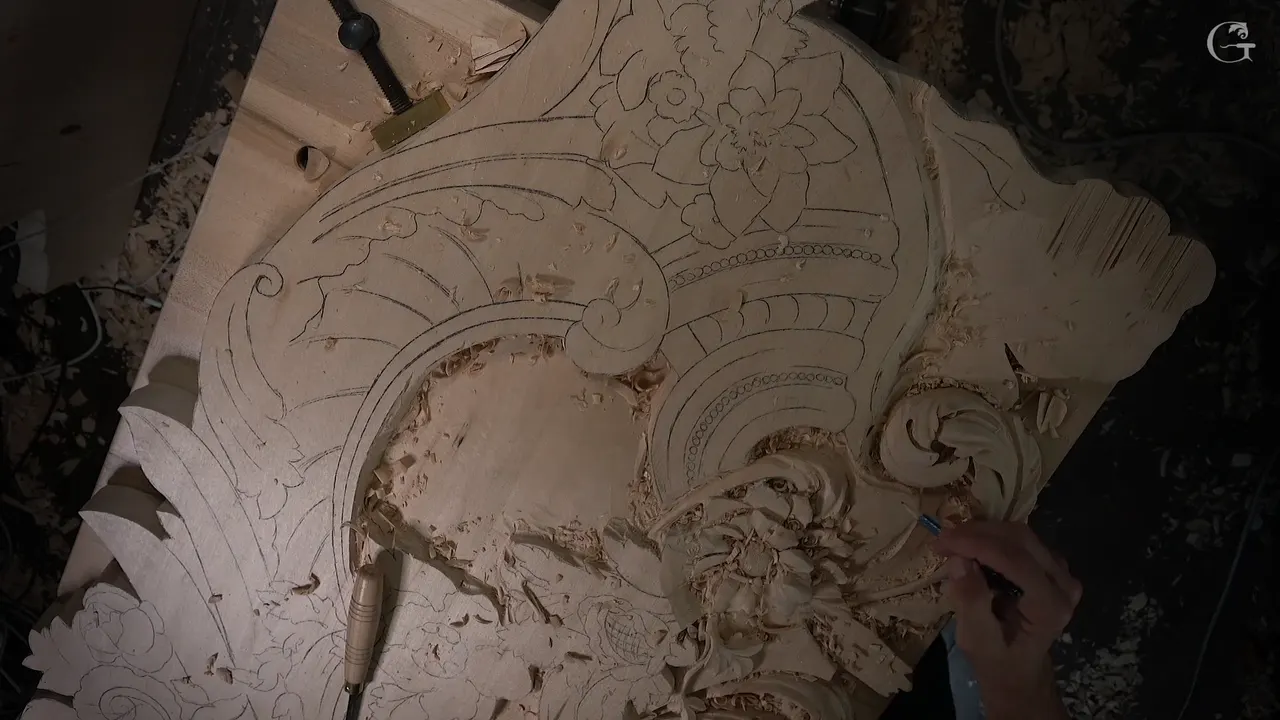

In part 3 of workshop 121, I said "Let me see if I've got the right approximate distance" and the next words were "I don't think so." A line about direction followed: "this is supposed to go that direction, and that's supposed to be a little more that way."
Ever held a pencil over a drawing and asked yourself if one line sat in the wrong place? Did you answer out loud, even with nobody in the room? This page starts in that short video of the Venice Room. From there I follow the same kind of answer, and its yes, "I think so," through other lessons of mine: the Venice Room panel, the Maine class, a Greek acroterion and a lily box.
What short answers do my lessons give?
- The no in workshop 121, part 3, came right after a check of an approximate distance.
- Other lessons put it behind a question I asked myself.
- Work went on after a no, and I told you what came next.
- A hedged yes stayed hedged.
- Part 3 also has a 30 mm (1.18 in) number 11 that I called a great tool, and a number 11 of maybe 5 mm (0.197 in) planned for an undercut.
What was I checking in part 3 before I answered?
The part opens with a shell. "So I have some kind of shell going on inside," I said, and the shell was "not a problem." I thought I could "probably just recreate from my head." A sentence about a canvas began, "So if that is a part of a canvas--", and stopped there.
A new thought came next. "By the way, maybe it's a good idea for me to establish some kind of movement on inside." Next came a question: "I don't know. Should I or shouldn't?" The distance check followed those lines. My no came, and the directions followed in the same stretch.

Inside, "something going on also," came next. The shapes got names: "concave, concave" for that part, "also concave" for the rest, and then a convex. A single word was my verdict: "Easy."
How deep did I plan to go, and with which tool?
Depth was next on my mind: "So let me think how deep I want to go" and I thought I could go "actually deep for just the sake of shadows." Then a tool: "Let me think which tool I should use." The plan was a number 11, starting with "the big 30 millimeters" (about 1.2 in) "or maybe 20" (about 0.8 in). "Let me start with 30, and I'll see if it's too big."

Then the verdict on the big one: "It looks like 30 millimeters is actually a great tool," I said, and also "Works really good." Next came a limit: "I cannot go too deep because I'm really, really close to my workbench. That would be a big mistake." Then, "Let me see the second cut."

The grain set a limit of its own as well. "I can only start with the 30 millimeters," I said. "See, I'm working along the grain and really have to be careful not to break." Force was out: "And I'm not going to force it." A smaller tool, I said, could take care of the rest of it.

I would attack from one side, then "again from this side." Later: "Here you go. That is my convex."

What came after the big concaves in part 3?
A back bend was on my mind. "And that convex, I can take a backbend," I said. "In this case, I'll just take number seven backbend," followed by "And right on top of it." After that: "And that blends beautifully."

A mess was left on the inside. "All right, so now I need to take care of mess on inside," I said. That would wait "a little later." I would "just clean up that off camera." One more line: "But you should get an idea what I'm doing."

Last, I planned an undercut: "I want to create the undercut underneath of here. So going in that direction." The opposite direction was open too, I said, but I thought it would look much better to "do a shadow cast from this side." The tool I planned was "number 11 and maybe 5 millimeters" (about 0.2 in). The pass "doesn't have to be really deep," I said, and then "I can start carefully."

What else did I ask in workshop 121?
Elsewhere in lesson 121, a spoon was in my hand, and I said, "Of course, that's the wrong tool." Then: "I shouldn't use spoon in this case. I don't need it. I need just a straight tool." Another question with a plan behind it sits in part 2. Some details came with the question "Why don't I establish them" and the reason was "That way I'll know how deep I have to go that direction." Pulling my iPad was the plan.
Where else do I say "I think so"?
Workshop 75 of the Venice Room, part 9, starts with a dislike. "I kind of don't like the motion of it," I said, and wondered whether to bring the division "a little this way." My answer was "I think so." Triangles came after, with a reason: "I really want to move it toward like that, overall movement."
In workshop 159, part 3, I said "And let me double-check" then "Maybe I should use a little bigger." Then came "I think so." Right after, I could "probably just check which number 11 is going to be the best." After "a really close profile," I said I was going to use "just the 12 millimeters, number 11" (about 0.47 in).

Another one sits in the Part 4 course, workshop 40, part 7. There I asked, "Maybe I should give a separation down here like this." The reply was "I think so, because I'm not too happy that this doesn't have repetition on the other side." For it I said I would need "five millimeters, number 11" (about 0.20 in) again.

The doubt in workshop 29, part 2, came as a line and then a question. First: "Maybe yes, maybe no, we'll see." Then a question to myself, "should I take this down like that?" And an answer: "And I think yes." "Yes, I think so." It would look better, I said, and the plan was "let me use number 11 and preliminary."

A section needed lowering on both sides in workshop 61, part 10, but I did not want to lose "overall feel to it." That is why I had doubts, I said, with "Should I do that or not? But looks like yes, I really think so." Then the plan: "let me chop out some of the material."
On the Furniture Panel, in lesson 21, part 12, I planned to establish a curvature, and "Let me try number five, maybe about 20 millimeters" (0.79 in). It "would be maybe appropriate to use it right here" and then "I think so" came. A mallet would help me. In lily box lesson 10, the slab had a crack on one side, and I said it was "going to be safer if I'm going to put some glue on this side." Same words again: "I think so." Then, "let me establish some concaves first."
Some yeses stayed hedged. The next one is in workshop 53, part 11: I said an undercut would cast "even more shadow to this small detail" and called it "absolutely beautiful and gorgeous." Then: "At least I think so." In the grape leaves vase course, lesson 3, part 4, an inward pass was "not really necessary," I said, but it gave "an extra dimension" and "extra shadow." And again: "At least I think so."
The grape onlay has a yes aimed at the camera. In lesson 11, part 2, I said, "You probably don't see it, but uh, there is a hole." And I added, "But again, gotta be really careful. Uh, I'm not sure." Then came a question aimed at you: "Can you detect that at this camera?" My own answer was "Yeah, I think so." Right after, I said "my flute is upside down to approximately six o'clock relative to the detail."
When does the same answer come out as a no?
Extra movement came up in workshop 70, part 7. A pass "a little deeper in this area" was possible, and then I wondered: "maybe should I do extra movement this way or not?" I said no, and my plan was to make the part "little wider": "That's what I'm going to do."

The doubt in workshop 22, part 6, ended in a no, and I gave a reason for it. I could "curl it absolutely backward," I said, and "It's still possible." Next: "do I want to do that or not?" After "Maybe yes, maybe no," came the no, "because this is a little too high if you look from the bottom. So you're really not going to see too much." My verdict: "I think it is good."

I asked about one part in workshop 19, part 6: "maybe I could actually get this one bigger. But do I have to?" My reply was no. Soon after, I said, "Let me actually get this one bigger" with the side "equal to that." My comment: "So that would make more sense."

A deeper pass was in view in workshop 90, part 10. "I wanted to do a deeper cut right there, but do I really want to do it or not?" Here too I said no. My plan changed to "a concave cut," "not as deep as I wanted to before."

The Maine class, lesson 11, part 1, had a plan for a number nine, "six millimeters about quarter inch" (0.24 in), and a rotation motion. "And I'm not doing that full rotation," I said, and "Yeah, I mean I could but." Then, "Do I have to" and a no. Later I said, "I even don't know how deep that spot is. But I think it's gonna be good area."
Over in Chamomile and Bow Rosette lesson 4, part 1, I planned to "go around with the knife and create my cuts right on those lines, just to outline the whole thing." Then: "in this case, I don't need to relieve it" and I gave the same no.
In the first lesson of the Venice Room, part 4, a no sat beside a scare. "I have to make the right decision. I think I'm making a mistake," I said, then "I might have to move it slightly down." My reply was no, and "So we are on the right track." But "I get scared for just one second," because I had to make sure "it's gradual going to the ceiling."
Does a no only answer my own question?
In Greek Acroterion lesson 1, part 2, I said I would not go deeper than "about 1/16 of an inch" (about 1.6 millimeters) in a section. The easiest way, I said, "would be just to take a shoulder plane." Then: "Somebody would call that cheating" and I said no to that. My reason: "It's still a hand plane." And: "It's still hand tools, and they used hand planes in ancient times."
A curl comes up in workshop 110, part 3. "I think it's going to give me some more interesting look," I said. "Is it important" was my question, and my words were "I don't really think so." It was "not really important" and "I could just leave it like it is, but every little detail helps." The big idea, I said, was "here" and "those flowers are big," so "I need to frame it somehow" with "a lot lesser details than on the flowers."
And in lily box lesson 2, part 1, the talk was about a second layer that would be glued. I asked whether there was "any other trouble." The answer was no, "except maybe in this area." Touching beyond two points was what I wanted to avoid, because that layer would be glued and I needed that surface.
Where I said it, in a small table
| Kind of answer | Where in my lessons I said it | Next step |
|---|---|---|
| A plain yes | Three Venice Room parts, 75-9, 40-7 and 29-2, each after a question I put to myself | Triangles, a point, number 11 |
| A yes with a tool | Workshop 159 of the Venice Room, 12 mm (about 0.47 in), and Furniture Panel 21-12, 20 mm (about 0.79 in) | Number 11 in one, number five in the other |
| An unsure yes | Lily box 10-7 plus Venice Room 53-11 and the vase course 3-4 | Glue, an undercut, an inward pass |
| Reasoned no | Greek Acroterion 1-2 beside Venice Room 22-6 and 110-3 | The hand plane, a high spot seen from below, a frame for big flowers |
| No, then a change | In workshops 70 and 90, and Maine class 11-1 | A wider part, a shallower concave, no full rotation |
| No, with a catch | Venice workshop 19, Chamomile 4-1 and lily box 2-1 | A bigger side, knife lines, one area to watch |
| A check | Venice Room 121-3 | Directions for the parts, then a 30 mm (about 1 3/16 in) number 11 |
Is there a spot on your piece where you could ask a plain question and answer it out loud? Everything in these lessons sits inside one tuition plan. The Part 10 course page holds workshops 110 to 121, and lesson 121 has all three videos of this workshop. For more wood carving and relief work with a gouge or a chisel, take a look at the Furniture Panel course.
How it's done
- Check the distance. A check of whether I had the right approximate distance.
- Give your answer. My answer was no, and directions for the parts came right after.
- Think about depth. I thought about going deep, just for shadows.
- Try the big tool. Number 11, 30 mm (1.18 in), to see if it was too big.
- Watch the bench. A limit set by my workbench, which was really close.
- Plan the undercut. A shadow on one side, with a number 11 of maybe 5 mm (0.197 in).
Frequently asked questions
What did I check right before my answer in part 3?
An approximate distance. The aim was to know whether it was the right one, and I said no. After that I said where each part was meant to go, one this way and one a little more that way.
Which tool took the big concaves?
The big number 11, 30 millimeters (about 1.2 in). The plan was to test whether it was too big. Next, I called it a great tool that works really good, and a smaller tool could handle the rest.
What held back my depth at one spot?
I could not go too deep, I said, because I was really, really close to my workbench. Earlier I had said a deep pass was possible for the shadows.
What to carve next