
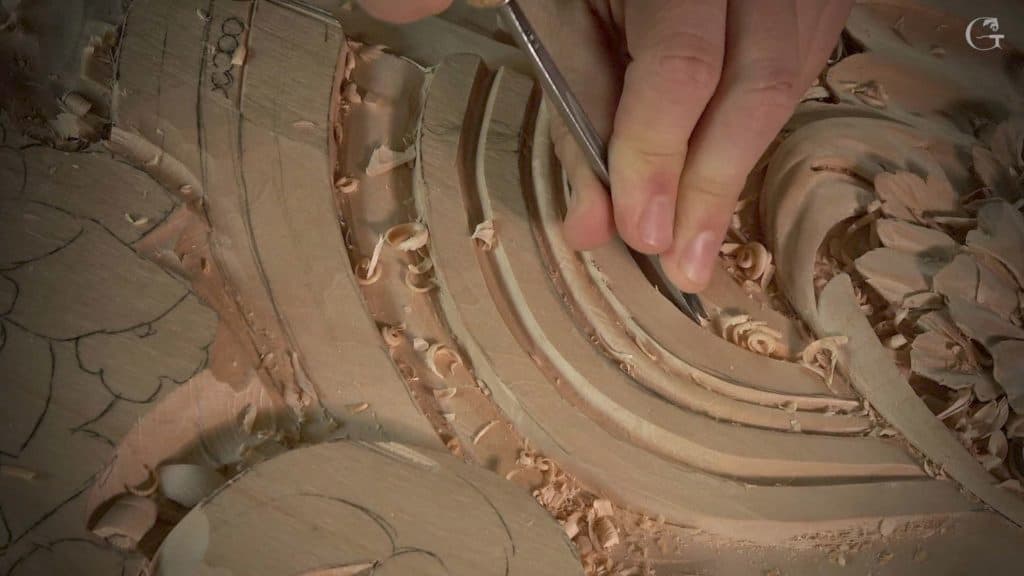
Alexander Grabovetskiy, woodcarver, School of Woodcarving · Published 2021
What does a wood carver mean by "double convex"?
Quick answer: These two words open the second video of lesson 141, right before a 4 millimeter number 11 starts the groove and the sizes step down toward 1 millimeter. Other lessons of mine name one convex beside another on spines, eyes, petals and moldings.
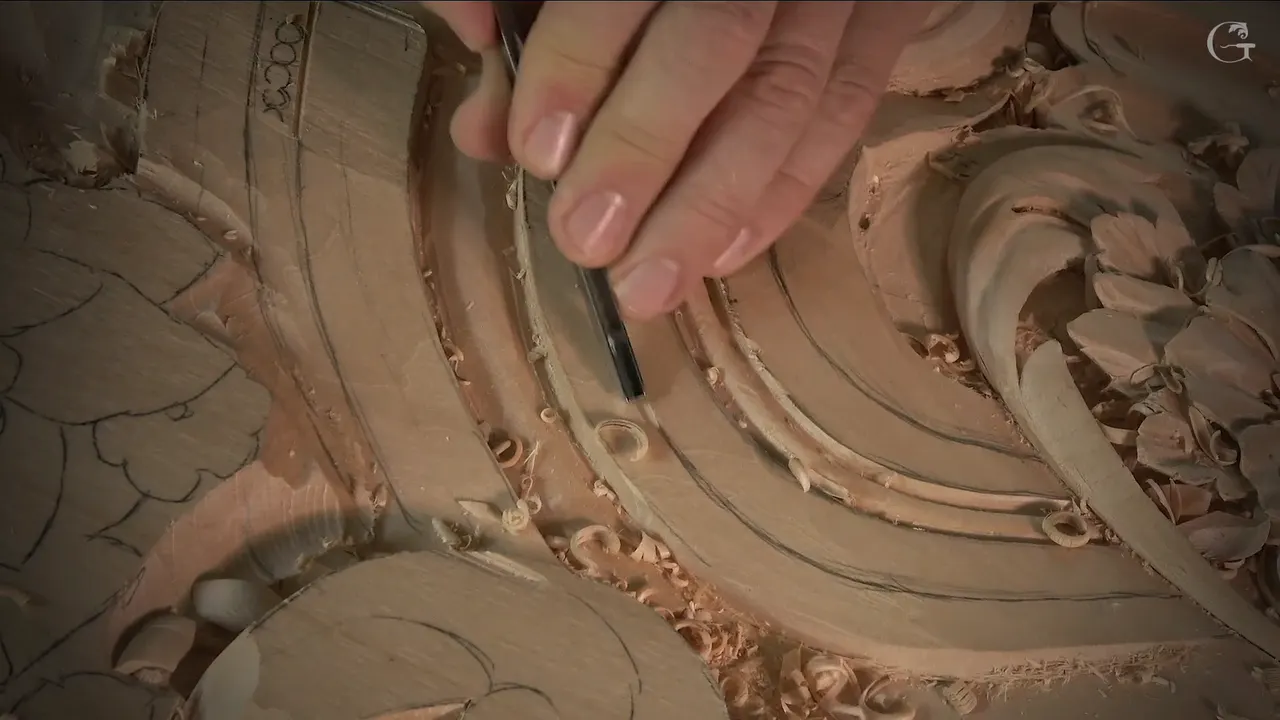

In Venice Room 141, video 2, I open on the words "Double convex" and start the groove with a 4 millimeter number 11. Other lessons of mine name one convex and then another, on spines, eyes, petals and moldings. My own lesson comes first below, and the other lessons follow in groups, each with the lesson it came from.
Ever looked at a band of wood and tried to tell where one raised part stops and the next begins? Did you wonder how a groove beside it gets deep enough to hold a shadow? That is the spot I talk about here, and below is what I said each time it came up.
Which shape did I plan for the beads?
The plan comes from video 1. There were "a couple ways I could develop it," I said. One was concave-convex, "and the same idea, convex-concave, and exaggerate my beads." The other was "double convex, which is also pretty common, actually, in the end of 15th and the beginning of 16th century." My pick was a plan: "That's what I'm going to do, probably."
Video 2 starts on the same two words. "Double convex. Okay?" Then the size: "I'm going to start with the 4 millimeters." It was a number 11, of course, and "just a little bigger than one-eighth of an inch" (about 5/32 in). Create the cut "right on the line," I said. The next words I have are "And this side, the same idea."

How did the sizes go in the groove?
The 4 millimeter was the first size. A bigger tool came up next: "I could actually use an even bigger tool in this case. Maybe even 7 millimeters. Get that much deeper." In inches, seven millimeters comes to about 9/32. The words after that were "And get that much deeper" then "And this side, the same thing."

"And another pass," I said. The list of sizes followed: "Now I can just go with 5 millimeters, and then 4 millimeters, 3 millimeters, and so on. Okay? And just make it deeper." The five had its own figure, "3/16th of an inch" and yes, it was number 11 (about 0.2 in).
Then came a line about shadow, fixed right away. I said it was "going to give me a beautiful shadow." Then, fixing it: "I should say, I hope it's going to give me a beautiful shadow."

Next, the four: "Obviously, that would be number 11, and get inside even deeper." "Yes, that will be number 11," I said of the three. In inches, 3 millimeters is about 1/8.

Two sizes were left, the 2 and the 1, and I talked my way through both. "Well, I don't know if I should do 2 millimeters." Then: "Yeah, I probably should." And: "I could take it all the way to 1 millimeter." A plan for the in-between came next, and the doubt came with it: "Let me do one and a half," I said, and then "I'm not sure, maybe just 1 millimeter right away" and then the question, "I don't know, should I, or should not?" The answer was short: "No, let me do that." Those sizes run about 0.08 in, 0.06 in and 0.04 in.

Next came the question: "And why 1 millimeter? I really want to see a separation between..." The sentence stops there. Then: "It actually doesn't make a big difference as far as I see right now. Doesn't make a big difference."

After 1 millimeter, what came next?
The last words I have in this part are a plan, and I called it obvious: "Okay, so now, obviously, I need to convex it." Then: "Let me use number seven upside down, 14 millimeters." Those 14 millimeters (about 0.55 in) come to a little over half an inch.

Here "convex it" is a verb, and the number seven turned over is the tool I named. A later section has more on turning a seven over for a convex. The gouge is the same in both.

Which convexes came in the Venice Room lessons?
Video 2 of Venice Room 62 has my spine, or middle line. My words on it: "I really need convex at least on one side" and "I'll try to establish also convex on another side. Not sure if I'll be able to."
The result came a moment later: "And yes, I was able to. It's a convex and convex. Okay? Little bit of convex but still convex. Not the biggest convex, but it's still convex, and that's what I'm after." A number seven was in my hands, "just cleaning," "transitioning to concave." After that the seven looked "slightly too big," or "more than slightly," so I planned a smaller tool, a number six, to get rid of some of the tool marks.

Next, Venice Room 75, video 6, ranks the pair. A separation number one and a separation number two meant "my convex, the main convex, is going to go this way, and this one is going to be the secondary convex going that way." Then the words: "Convex and convex. Again, I have to check."
It looked like almost a rectangle, I said, "which is no good." I wanted more of a tapered look and a little skew. "So now it's better." Then a rule, for every convex: "I have to create concaves."
Concaves would get "just a blue pencil," not a marker right now. "Number one convex and number two convex going to go all the way like this." On the other side I said it again and caught myself: "I'm sorry, concave. The blue would be concave." Then, "let me write that down": blue would be concave, "and red will be convex."

How many convexes does a Venetian leaf have?
Five, I said in Venice Room 74, video 9, and I gave the reason. Three main divisions, and "we also divide by three" inside each. With three divisions "it should be two eyes" and "if you have an eye, you always have a convex."
So: "two eyes, two main convexes." The rest of the count: "If it's Venetian style, you will have also convex, convex, and a convex." Then "Five total." And last: "Two main ones out of the eyes and three secondary and inside of each division."

I showed an updated version later: "Two big pipes, really thick and pronounced pipes." A side convex is "a lot less pronounced." And the words for the pair: "That's the two convexes, the main convexes."
A count of three came in Venice Room 69, video 10, where the convexes ran to three. The final shape would wait for later. My next question was why not use a different tool, "maybe number three or so," to "just knock down those ridges," one side and then the other.

Then Venice Room 101, video 6, counted along with the concaves: "That would be convex number one" then "convex number two, convex number three" and in the end "So we've got four concaves and three convexes."

In Venice Room 97, video 4, I said I would probably follow "the logic of those people who used to live in the beginning of 16th century, end of 15th century." Their idea, I said, was "the main convex right in the middle of those three main divisions."

My width came from Venice Room 5, video 6. The middle convex would start "approximately half an inch wide" (13 or 14 mm, I said), then "narrow to approximately a quarter inch, six millimeters." I planned to eyeball it.

What did Furniture Panel say about it?
Over in Furniture Panel 19, video 6, a line sounds close to lesson 141. I would divide a section in 10, and the middle line would move "slightly to this side and about 6 out of 10 parts." Video 1 of lesson 141 had "about six parts out of 10." A similar line follows here: "there's a couple ways I could attack this middle part."
One way was to "create that part as a raised part and then lowering down on both sides." The other was a veiner cut on the inside, "and this part is going to be convex, convex, okay, going downhill just like that." That was probably what I would do. For the first pass I would take a number 11 again.

The tool after that was still a plan: "upside down number three" to "shave it like that." Then a caution: "your cut, this cut should not be lower than the background. Should be slightly higher."
Furniture Panel 29, video 2, takes the idea to a petal. The petals are supposed to have "the middle part raised up," I said: two convexes in the middle, "and two concaves on the side." Next I had to find "my most important convex" with "two concave cuts right there."

In Furniture Panel 37, video 3, an eye is the topic: "That is the eye when those two parts intersect each other." Then: "So you gotta have a convex and a convex." Then: "To create that convex, I need to create the concave on both sides." The tool would be "just the number eight," "about four millimeters or so" (about 0.16 in), with that concave "right on the side of the future convex."

Where did the Lily Box, plate and acanthus come in?
Lily Box 4, video 5, has me saying I needed to fillet two parts, "some radius right there." I called the two parts convex and named a tool to try: "let me use number five and see how it's going to work." A little digging did not worry me in "this section," since I could "always clean with the number 11 again."
In Carving Plate with Butterflies 1, video 3, I described the overall shape. It would be "a bulging," I said, and "obviously all around it's gonna be a convex." Then, of two convexes together: "Those are gonna be raised up."

Modern Acanthus 4, video 3, has a line about cuts: "I just do the two convex cuts on the sides." With a number seven, "even if I'm not able to flip that upside down to create that convex, I still gonna use my number seven the normal way" at "45 degrees," for "blending cuts," "really tiny small cuts."

Chamomile and Bow Rosette 2, video 3, says what a convex needs. "To make that convex, obviously, you have to do concave and concave on the sides, middle line, middle groove, and then blend that." Just before it I had said "the main convex everywhere."
Which colors stood for a convex?
Floral and Molding for the Panel 9, video 3, used two colors "just to understand the concept." My convex would be red and my concave blue, and I asked you to think of the red as sunshine and the blue as the ocean. The same pairing showed up in Venice Room 75, blue for concave and red for convex.
Floral and Molding for the Panel 8, video 1, gave a molding a count of its own: "It has a convex, convex, convex." The middle part is a convex, I said there.
One row for each lesson I named
The table keeps each lesson in its own row, with the words I used about the convex and any tool or count I named.
| Where I said it | What I said about the convex | Tool or count |
|---|---|---|
| Workshop 141, video 2 | Opened on those words, then named the first size | Number 11, 4 mm (5/32 in) |
| Venice Room 5, video 6 | Laid out a run of convexes, wider at one end | 6 mm (1/4 in), narrow end |
| Venice 62, video 2 | Reached a small convex on the other side of the spine | Number seven, six next |
| Venice 69, video 10 | Named three convexes, then asked about a different tool | Maybe a number three |
| Workshop 74, Venice, video 9 | Counted five convexes on one Venetian leaf, two main and three secondary | Five in all |
| Workshop 75, Venice, video 6 | Called one convex the main and one the secondary | Blue pencil for concaves |
| Video 4 of Venice 97 | Put the main convex in the middle of three divisions | No tool named |
| Video 6 of Venice 101 | Counted convex number one, two and three beside four concaves | Four concaves, three convexes |
| Furniture Panel 19, video 6 | Planned a middle part that is convex, going downhill | Upside down number three |
| Panel 29 of Furniture, video 2 | Described a petal raised in the middle between two concaves | Two concave cuts |
| Furniture 37, video 3 | Said an eye is where two convex parts meet | Number eight, 4 mm (0.16 in) |
| Lily Box 4, video 5 | Said two parts need a fillet, and called them convex | Number five |
| Modern Acanthus 4, video 3 | Described two convex cuts at the sides, then planned blending cuts | Seven at 45 degrees |
| Chamomile 2, video 3 | Said a main convex needs a concave on each side | Nothing named |
| Floral 9, video 3 | Planned convex in red and concave in blue | Red and blue colors |
Which band on your own bench would you carve a second convex on? Every lesson named here opens with access to the school, paid monthly or yearly and renewed automatically until you stop it. Lesson 141 sits on the Part 12 course page, with lesson 140 before it and lesson 142 after. Each one is wood carving, and the Venetian leaf with five convexes sits in lesson 74. In video 1 of lesson 141 I found my calipers too big to fit, so I had to "just eyeball" the golden ratio split.
How it's done
- Pick the shape. Concave-convex, convex-concave or double convex, I said, and double convex was my plan, probably.
- Start with the 4 millimeter. Take the 11 at 4 millimeters, a bit over 1/8 in, and work along the line.
- Try a bigger tool. I said I could use an even bigger one, maybe 7 millimeters (about 9/32 in), to go deeper.
- Go down the sizes. Five, four and three millimeters (3/16 down to an eighth of an inch), I said, and so on, to make it deeper. I named number 11 for each.
- Ask about the last size. Before the last size I wondered whether to do it, and afterward I said it changed little.
- Convex it. After the groove I would turn a seven over, at 14 millimeters (0.55 in).
Frequently asked questions
Which shapes did I weigh before picking double convex?
Two others, concave-convex and convex-concave, with the beads exaggerated. Double convex was also pretty common at the end of the 15th and the start of the 16th century, I said, and it was probably the one I would use.
Which gouge started the groove in video 2?
The number 11 of 4 millimeters, which I called just a little bigger than one-eighth of an inch. The plan was to start with it and make the cut on the line. Later sizes were number 11 too, I said of the 5, 4 and 3 millimeter ones, which run from about 3/16 down to 1/8 in.
How many convexes did I count on a Venetian leaf?
Five, in Venice Room 74. Two main ones come out of the eyes, and three secondary ones sit inside each division. The count began with three divisions and three more inside each, and I said that should give two eyes.
What to carve next