

Alexander Grabovetskiy, woodcarver, School of Woodcarving · Published 2020
What does it mean when a wood carver says a part goes underneath?
Quick answer: Underneath is my word for a part that tucks below its neighbor. In part 1 of workshop 33 I was not sure if one movement should sit above another, then said it would probably be wiser, and more logical, to send it underneath. My other videos tie the word to hiding a shell, a flip, or a shadow.
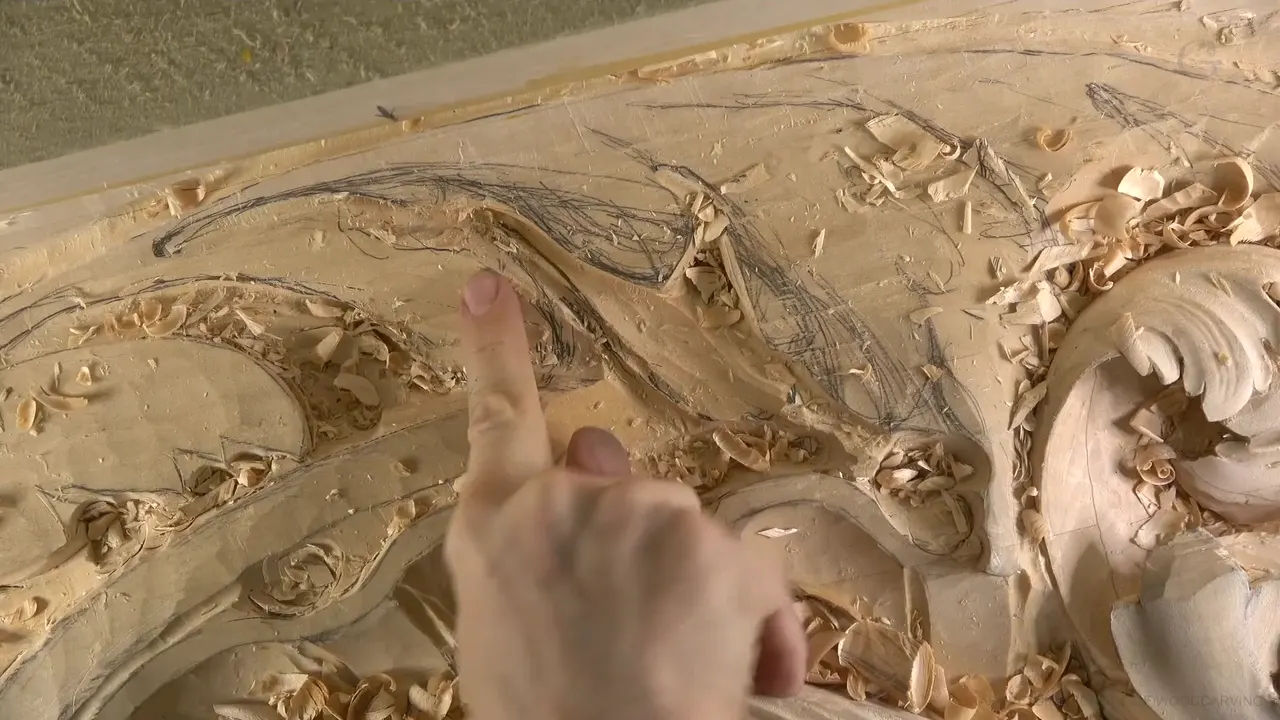

Underneath is the word I use when one part of a carving tucks below the part beside it. This page starts with part 1 of the 33rd workshop, where I decide out loud which of two movements goes under the other, and I tell you why. The word turns up all over my other courses too. This page sets those passages beside this one.
Two shapes meet on a board, and nothing tells you which one belongs on top. I stood in that spot on camera, and the doubt stayed in. Here is what I said about it, and what I said about the same word in other videos.
What did I mean by underneath in part 1?
The part opens with a plan for the wood. "But now I need to make this part a little lower, even more." Some of that stuff can come out also, "because it's going to go more underneath just like that." Next: all those chunks, with the number 11.

I can see this movement, but I want to make sure it looks really organic and nice in the overall picture. Another part could go a little closer to a part right here, and that will be "the main center point, center lines." The same number 11 comes back for a first dig. "This is not the final excavation, but at least where I can see and read much better the final movement."

A chip follows. Probably I could chip this side right away, "otherwise it just disappears and I can't see what I'm doing." One chunk I probably still keep, to cover up a section, and I give it a little shape. The chunk will be "sticking from underneath." And that is probably good, I would say.

Then the doubt arrives. "I'm still not sure if I should just get that one above that one." Probably wiser, then, to give this movement go underneath of that movement, and "I think it's going to be more logical." My reason is the division. That gets me "that division which you're supposed to have right on the side."

The commitment lands in the same breath. "So this one, I'm going to go underneath of this one." After that I could probably chip a little more "to give better idea for myself." Another movement will move a little more like that, but not much. It is hard to see, I admit, "but it should look good at the end." A next one goes also, the same way.

A bent one would probably be the wiser tool, I say. One more part gets a shape moving downhill. Hope you are able to see it, I say. One more worry: I want those movements to run "all the way on the backside." One must run this way, and the next one in that way.

Boiled down, part 1 has four steps: more wood off, a doubt about which one sits on top, an answer I called more logical, and a set of movements I want on the backside too. Now see what else I have said about the same word.
How do I choose which part goes under?
I do not always know right away. In Furniture Panel 21, part 11, I just want to see which one is supposed to go above which one, and I think it is what I originally drew. A line I like follows. "It doesn't really matter. This one can go above of that one or opposite direction. Doesn't really matter. But let me do that way." Right after, the cue has this part going underneath.
Hashemi Flowers 30, part 2, finds me thinking in front of you. One will grow under another, though "it's okay, but it doesn't look too good." So I say, "let's think." Which way is better? Another definitely goes under it, and then, "let me preliminary undercut." A little later, "let me think about how I want to do that." Maybe that one goes under this one. The tool is a V tool. "Any V tool will work, but I really like this number 16."

The choice in Hashemi Flowers 26, part 2, sits inside a plan. That's probably a good idea to do everywhere, "where I'll know exactly which one goes where." So one part should go underneath. A line comes after that. I add that I didn't have to do that. It still would look nice, but what I want is "even better than just nice."
Venice Room 85, part 3, has the same worry: "I hope I'm doing the right thing. I think it should go underneath." Earlier in that part I say I have to excavate much deeper in these sections, so I'm safe, and at least I know exactly how it will look. Then I take a skew, for a little cleaning, and I ask you to understand one thing. I did that design, and even in 3D computer design it does not look the same in real life. "And in real life, I have to make a lot of different choices and decisions."

A check comes in Venice Room 77, part 4. Recheck how it fits: "Double check, double check how it fits inside." If it fits right there, "this definitely" goes underneath, though "that piece can go up maybe, just raising up a little bit." The edge of this one needs to go up, I think, and I will curl it up.
Its own turn comes in part 2 of workshop 33. I need to think again. One element must be wider, and it goes under this one. So a narrow cut comes next, a mirror cut. Maybe this way is better because, as I said, one of the sides is clean and one is not. I need the right side cleaner, and I know that is the right position for my tool.
Why put one part underneath another?
One reason is to hide something. Workshop 72 gives a first reason, in part 5. How do I want to end this movement? "Maybe I should actually end up right underneath of that movement. That would give me ability to actually hide that shell." The decision comes on the spot. A main movement goes under, "so which means I have to create extra divisions."
A smaller case sits in Hashemi Flowers 6, part 3. I'll take a V tool again to make a better outline of a detail, and by the way, this part will be completely hidden underneath of the flower, "but still." My own workshop has an eye to hide, in part 3. Sometimes that is even a good idea: "I really don't need that eye underneath, but we'll see. Maybe I'm going to do it, maybe not."

Flips are another reason. Next comes Hashemi Flowers 15, part 3. That is my main idea, and I take a number nine. "This has to go underneath. So I have to make it look like it flips." The size is six millimeters (0.24 in). I am working against the grain, so I should probably rotate and attack that from the opposite side. That will be better.
The goal is plain in part 2 of workshop 33: it should look like it's "growing from underneath." To get that effect I need to round up the edges later on, and I will do that a little later. At that point I am really happy. The right position for the eyes and the pipes is still to give.
Small swirls in that same lesson are the other extreme. They have to go almost to the background, "no more than 16th of an inch above, 1.5 millimeters above my background." Those swirls grow from underneath the main acanthus movement.
Width is the point in my Chamomile and Bow Rosette course, where it is time to develop the petals. I probably just go around and create better separations, and one petal can tuck under that one, and that one under the first, "to make it slightly wider look." Relief cuts come first, with a small number 11. That is the plan.

Even a flower's last petal tucks under. Part 7 of Hashemi Flowers 49 has "Here's my center." The closer to the center I get, the more petals I get, until the last petal tucks under another one, "just like that." After it comes "now it's all about cleaning and finalizing all the forms." And then comes the line I like best here: "it does look like a flower."
What comes after the choice?
Shadow, most of the time. In workshop 64, part 8, the part goes right under this leaf, "or division, I should say." Maybe a bit of cleaning will create deeper shadow. "It casts shadow now. Beautiful shadow."
Two sizes show up in part 9 of workshop 33. A much smaller number 11 is three millimeters, one-eighth of an inch. "I'll go all the way underneath." I would like that excavation to get really deep, because I really want to see a really good shadow right there. Next I say maybe I have to turn to a smaller number 11, maybe two millimeters (0.08 in) right now, and continue the excavation deeper, "because like I said, it's all about the shadows."

Furniture Panel 23, part 5, adds one more size. A deeper undercut underneath here is the need, "really carefully." One millimeter (0.04 in) is the size, and "probably wiser would be to use a half a millimeter" (0.02 in). That would give a much deeper cut and a much more three-dimensional feel, "and deeper shadow casting."
Sometimes the whole job is to keep the idea. In part 8 a preliminary notch, or separation, comes first, along with a better outline of that direction. I will excavate that leaf underneath later, yes. "But for now, all I need is just to establish a really nice overall movement of this part of a leaf." Later is a plan there, not a pass.

Lines between parts come next. One leaf goes under the leaf still to be created, in part 6 of workshop 83. The middle line and the boundary get named, and a separation is coming. I say let me outline this leaf, and "that all has to be gone." Workshop 66, part 1, starts a division, and it will be multiple, because it is a long leaf. Another possibility is on the way, and of course, it goes under. An eye goes right there, with repetition on this side. Whether to do that big, or do one big division like that, stays open.
Small things get lost. Furniture Panel 17, part 9, has me catch myself. I almost lost a detail, "which I can't." That one goes underneath, and I will go around it, because "I really don't want to lose those details."
The plan in workshop 75, part 7, is a number 11, maybe seven millimeters (0.28 in) at first, then a bigger one. One cut runs right under the shell. After that, the whole run is just a bunch of concaves.

Where did I say it, and what came next?
The table puts the passages side by side, one line each, with my words in the middle column and what I did or planned in the last.
| Where it came up | What went underneath, in my words | What came next |
|---|---|---|
| Petal ring, Hashemi 49.7 | The last petal, once the petals crowd the center | Cleaning and finalizing all the forms |
| Hashemi lesson 15 | Something that, I say, must look like it flips | A number nine, at six millimeters (0.24 in) |
| Hashemi, lesson 30 | Another one that, I say, definitely can go underneath | A preliminary undercut, planned |
| Panel lesson 21 | Small swirls under the main acanthus movement | No more than 16th of an inch, 1.5 millimeters, above the background |
| Workshop 72, part 5 | A main movement, to hide a shell | Extra divisions I have to create |
| Workshop 85 | The spot I hope I am placing right | A skew, to clean a little bit |
| In workshop 64 | A leaf, or a division | Maybe a little cleaning, for a deeper shadow |
| Workshop 83, part 6 | A leaf below the one still to be created | Middle line, boundary and separation named |
| Panel lesson 17 | A small detail I almost lost | Going around this detail, so it is not lost |
| This part, 33.1 | A pair, one beneath the other | A little more chipping, to give a better idea for myself |
Look at your own wood carving. Is there a place where two parts meet and you cannot tell which belongs on top? Workshop 33, part 1, shows one answer, and the videos above show a few more. Whichever goes under, my next step was the same kind of step: clean, find the shadow, or keep the movement. For the whole run of my videos, start here.
How it's done
- Look at the movements. Let's take out all those chunks with the number 11, I said. I could see this movement and wanted it really organic in the overall picture.
- Ask which one goes above. Unsure which sits above. Sending the other underneath was probably wiser, I said.
- Check the division. My reason was the division you are supposed to have right on the side. More logical, I said.
- Make the choice. This one goes underneath of this one, I said, and a little more chipping would probably give a better idea.
- Take it to the backside. The movements reach the backside too, one running this way and the other in that way.
Frequently asked questions
Did I know right away which part went underneath?
Not at first. Part 1 holds the doubt. A plan follows: probably wiser to send the movement underneath.
Can it matter less than you think which part goes under?
Panel 21 says it can go either way: one part above another, or the opposite direction. Then: let me do that way.
Can a part go underneath to hide something?
A shell, for one. Ending a movement right underneath another would give me ability to hide that shell, I said in workshop 72. A detail in Hashemi Flowers 6 would be completely hidden underneath the flower.
What to carve next